

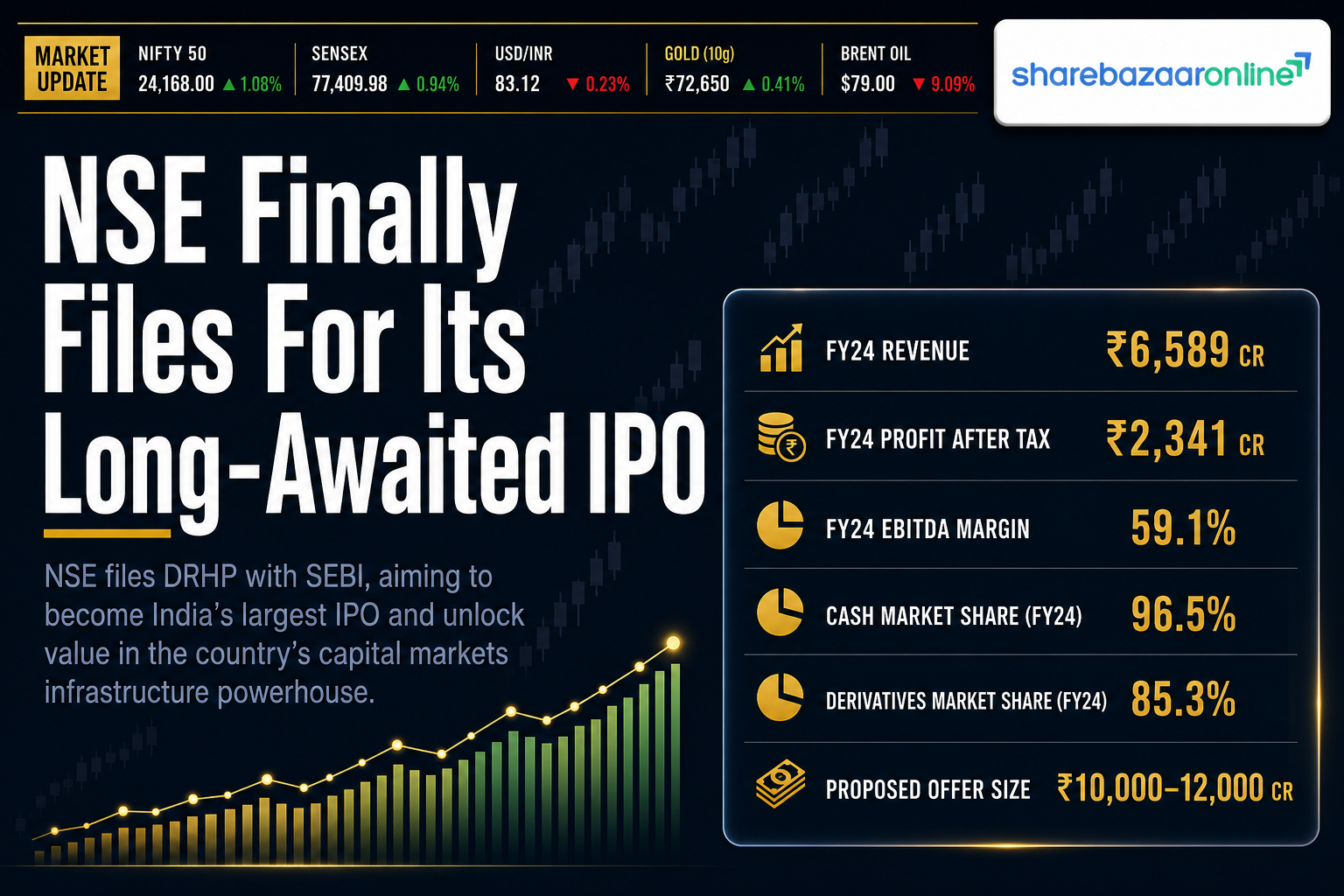
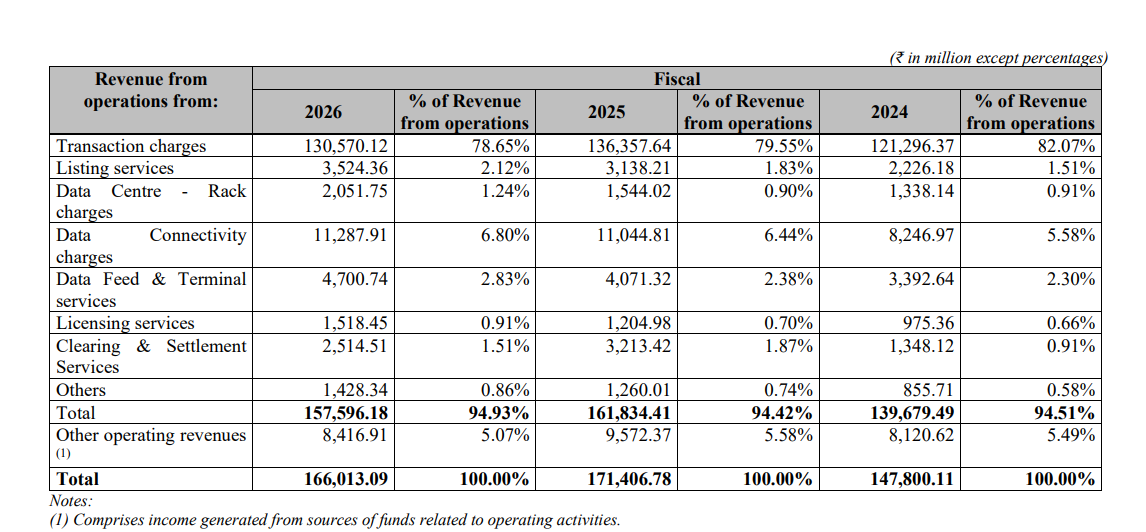
After years of regulatory delay, the National Stock Exchange has finally filed its Draft Red Herring Prospectus. For an institution that sits at the centre of India's capital markets — and earns money almost every time someone in the country places a trade — that single filing carries more weight than most IPO paperwork usually does. NSE earned over ₹16,600 crore from operations in FY26, of which roughly ₹13,057 crore came purely from transaction charges. That's the business retail investors are about to get a shot at owning.
Why This Matters
Stock exchanges don't list every day, and an exchange this dominant lists even less often. NSE isn't selling a product — it's running the marketplace itself. Every trade routed through Zerodha or Groww eventually lands on either NSE or BSE, and in most segments, NSE wins that race by a mile. When a business this central to India's financial plumbing opens its ownership to the public, it changes how millions of retail investors can participate in market growth itself, not just bet on individual stocks.
Key Highlights
- DRHP filed after years of delays, legal hurdles and regulatory scrutiny
- FY26 operating revenue: over ₹16,600 crore
- Transaction charges: ₹13,057 crore, still nearly 79% of operating revenue
- Cash market share: 92.99%; equity futures share: 99.79%; equity options share: 74.71% by premium turnover
- Operating EBITDA margin: 76.23%
- FY26 net profit: ₹10,302 crore, down 15% year-on-year
- Options alone contributed 60.2% of revenue from operations
- SEBI settlement fees: ₹1,431.6 crore in FY26, more than double FY25's ₹670.2 crore
- Offer size: up to 14.89 crore shares, roughly 6% of post-offer equity — a pure offer-for-sale
- Major sellers: State Bank of India (up to 2.475 crore shares), Bank of Baroda, Stock Holding Corporation of India, GIC, New India Assurance, Canada Pension Plan Investment Board, Aranda Investments
- NSE shares will list on BSE, since an exchange cannot list on its own platform
Detailed Analysis
There's a simple reason exchanges make such good businesses once they reach scale: they don't carry credit risk like a bank, and they don't need factories or warehouses. Once the trading infrastructure exists, almost every additional transaction adds to the bottom line. That's exactly what shows up in NSE's books — a 76.23% operating EBITDA margin that very few large Indian companies can match.
The dominance is staggering when you put numbers next to it. Nearly all of India's equity futures activity runs through NSE. Three-quarters of options premium turnover does too. BSE, despite being the country's oldest exchange, operates in NSE's shadow across almost every segment that matters for trading volumes.
But size alone doesn't explain why this IPO has taken so long to arrive. NSE has spent years carrying the weight of the co-location controversy — allegations that some trading firms got preferential access to tick-by-tick data through NSE's server colocation facility. SEBI's show-cause notices in 2017 and 2018 led to formal orders in 2019, including a six-month market access ban and disgorgement directions. The financial scar tissue is still visible: SEBI settlement fees more than doubled in FY26 compared to the year before.
Market Impact
A listing of this scale gives retail and institutional investors direct access to the infrastructure layer of Indian markets, rather than just the companies trading on top of it. It also puts pressure on price discovery for NSE's unlisted shares, which have traded informally for years ahead of any formal listing. Expect heightened trading interest in BSE as well, given the comparison investors will inevitably draw between the two exchanges once NSE's numbers are public and benchmarked side by side.
Sector Impact
Brokerages, depositories and capital-market infrastructure players are all likely to see renewed investor attention once NSE lists, simply because the IPO puts a spotlight on the entire market-infrastructure ecosystem. BSE in particular becomes a more closely watched stock, partly because it hosts NSE's own listing and partly because FY26 already showed how regulatory tweaks can swing fortunes between the two — NSE's profit fell 15% while BSE's jumped 88% in the same year, largely on the back of weekly-expiry rule changes.
Opportunities
- Direct exposure to India's dominant exchange and its near-monopoly economics
- A business model with high margins, low capital intensity and strong free cash generation
- A play on India's broader financialisation story — more demat accounts, more trading activity, more derivatives volume over time
- Diversified revenue beyond transaction charges: listing fees, data products, Nifty licensing, clearing services, colocation
Risks
- Heavy dependence on transaction charges, which fell 4.24% in FY26 due to softer trading volumes
- Regulatory risk is structural, not incidental — SEBI can reshape contract sizes, expiry cycles, margins and retail participation rules at will
- Options revenue, at 60.2% of operating revenue, is concentrated and exposed to any further tightening of derivatives rules
- It's a pure offer-for-sale, meaning none of the IPO proceeds go into the company itself
- Legacy overhang from the co-location case continues to show up as elevated settlement costs
Future Outlook
3-Month Outlook: Expect price-band announcements, SEBI's review of the DRHP, and continued chatter in the unlisted shares market as investors try to anchor a fair valuation ahead of the formal issue.
6-Month Outlook: If the issue proceeds without fresh regulatory hurdles, NSE could complete its listing process on BSE, triggering renewed comparisons between the two exchanges' trading multiples and prompting brokerages to issue formal coverage.
12-Month Outlook: The bigger question will be whether NSE's transaction-charge revenue stabilises as derivatives rules settle, and whether its non-transaction revenue streams — data, Nifty licensing, colocation — grow enough to reduce the business's regulatory sensitivity over time.
Expert Observation
What makes this IPO unusual isn't the size of the business — it's the nature of it. Investors aren't buying a company that needs to win customers every quarter. They're buying a institution whose fortunes rise and fall with the pace of India's own market activity, while a regulator sits one step removed from every major decision the business makes.
Investor Takeaway
This is a bet on India's capital markets growing structurally over the next decade, wrapped inside one of the most profitable business models in the country. The trade-off is equally structural: a dominant, high-margin franchise that operates permanently inside a regulator's line of sight. Investors comfortable owning a quasi-utility with monopoly-like economics may find this appealing. Those looking for a business with full pricing freedom and no policy overhang should weigh the FY26 profit dip and SEBI settlement costs carefully before getting excited about the headline margins.
Conclusion
NSE's IPO isn't simply another listing on the calendar — it's the public unveiling of the engine room behind Indian equities. The DRHP gives investors their first real look at the numbers behind the dominance, and those numbers are impressive. But dominance here comes bundled with dependence on a regulator that can reset the rules whenever it decides speculation has run too hot. That's the real story behind the ticker that hasn't even started trading yet.
Track NSE's unlisted share price, IPO price band updates and allotment status in real time on ShareBazaarOnline — your trusted source for unlisted shares, IPO tracking and market intelligence.