

Persistent Systems Just Bought Its Way Into Europe. Investors Aren't Convinced It Was Worth It.
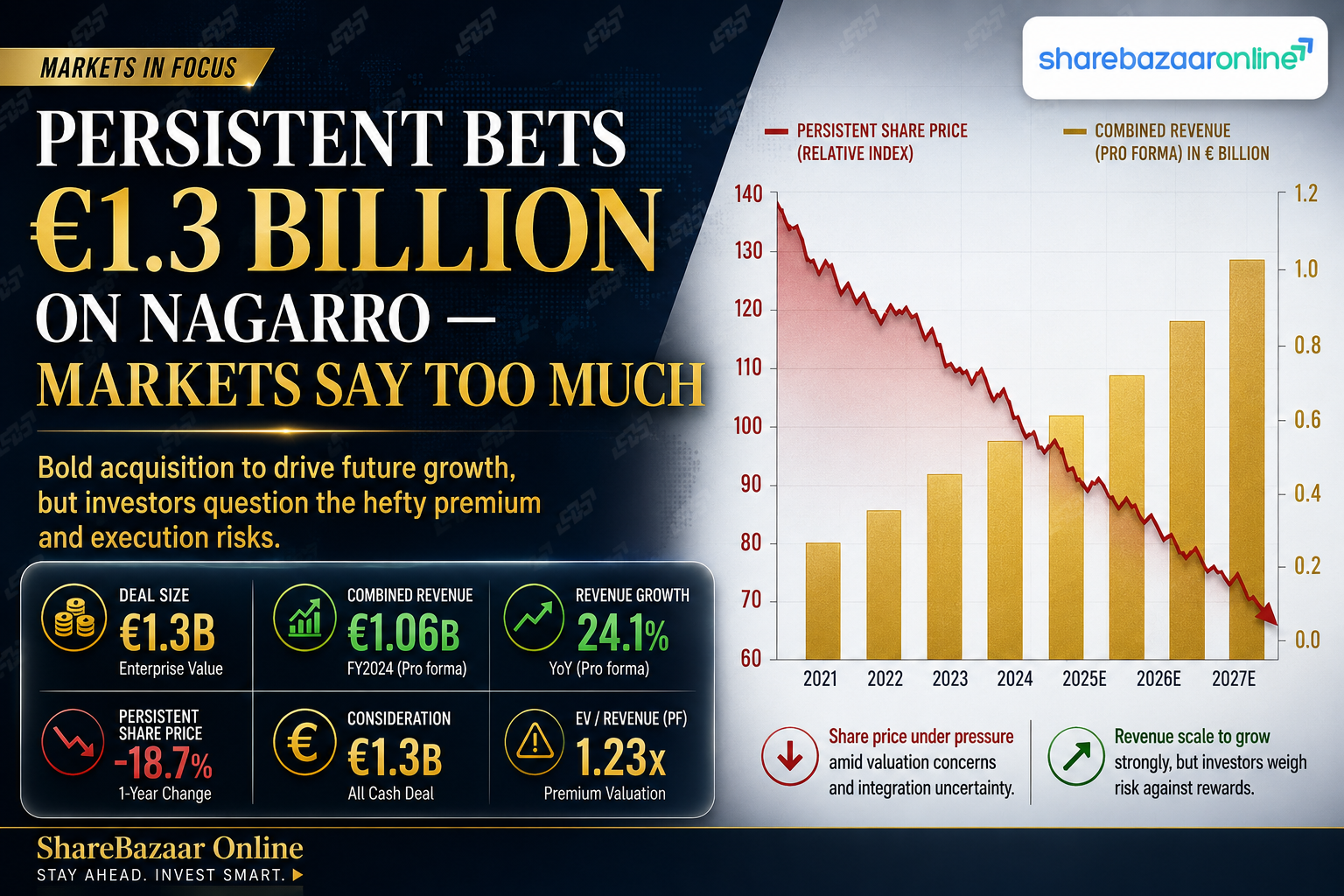
There's a particular kind of silence that follows a big acquisition announcement — the pause before the market decides whether it's watching genius or overreach. For Persistent Systems, that pause didn't last long. Within days of confirming it would acquire Germany-based Nagarro for roughly €1.3 billion, the Pune-headquartered IT firm watched its own stock slide nearly 11%.
That's an unusual reaction for a deal management is calling transformational. If it closes, the combined entity would become India's seventh-largest IT services company and, by Persistent's own reckoning, the world's second-largest digital engineering firm by revenue. On paper, that's the kind of headline that should send a stock higher, not lower.
So what's actually going on here?
The Number That Spooked The Street
Start with the price tag. Persistent is offering €81 for every share of Nagarro — a premium of almost 140% over where Nagarro was trading before the announcement. That's not a modest control premium; that's the kind of number that makes analysts reach for their calculators twice.
And the growth math doesn't obviously justify it. In FY26, Persistent's revenue grew around 17%. Nagarro, over the same period (CY25), managed closer to 3%. Stretch the comparison to a three-year view and the gap holds: Persistent's revenue has compounded at roughly 17% a year, versus about 5% for Nagarro. Margins tell the same story — Persistent runs operating margins near 16%, while Nagarro sits closer to 12%.
Put simply: Persistent is the faster-growing, more profitable business, and it's paying a steep premium to acquire the slower one. That's the arithmetic making investors uneasy.
Two Companies, One Origin Story
To understand why Persistent might still see value here, it helps to know where both firms came from.
Persistent was founded in Pune by Dr. Anand Deshpande, a former Hewlett-Packard Laboratories employee, at a time when most Indian IT firms were built around outsourced staffing — cheap engineering talent doing maintenance and back-office work for Western clients. Persistent bet on something different: outsourced product development, where it helped global tech companies actually build software and infrastructure rather than just supply headcount. Microsoft became an early client, and that relationship opened doors elsewhere. Today, Persistent operates in 21 countries and generates close to $1.6 billion (₹14,700 crore) in annual revenue.
Nagarro's path looks different but rhymes in places. Founded in Delhi in 1996 by Dr. Manas Human (formerly Manas Fuloria), it began life above a shop after two small engineering outfits merged. In 2011, it combined with German holding company Allgeier, which is how it ended up headquartered in Munich. It was spun off and listed independently on the Frankfurt Stock Exchange in 2020 with just over $500 million in revenue — a figure that has roughly doubled since. Today it builds custom software, AI systems, ERP platforms and IoT solutions across 40 countries.
Both firms, in other words, started in India, built their reputations on software engineering rather than staffing, and eventually went global. Their trajectories just diverged along the way.
Why €40 Might Not Be The Real Baseline
Here's where the story gets more interesting — and where the "140% premium" framing starts to look less damning.
Most comparisons anchor Nagarro's fair value to its pre-announcement price of roughly €33-40. But that price itself carries baggage. Last year, Matthew Earl — the activist short seller who first raised red flags on Wirecard before it collapsed — published a report questioning Nagarro's acquisitions, financial disclosures and governance. Short sellers make money when stocks fall, and reports like this one routinely dent investor confidence regardless of whether the allegations hold up.
In Nagarro's case, they didn't. The company commissioned an independent investigation, including a forensic review, which found no evidence of fraud or misconduct and concluded the allegations were unsubstantiated. But by then, the damage was already priced in. Nagarro's stock, which had traded around €70, had already crashed into the €33-40 band, and with revenue growth staying soft, it never fully recovered. At its 2021 peak, the stock had actually touched €200.
Viewed through that lens, Persistent's €81 offer looks less like a wild overpayment and more like a bet that Nagarro's stock had been trading well below where its underlying business justified.
The Strategic Case: Geography And Capability
Beyond valuation, there are two reasons Persistent may be willing to pay up.
The first is geographic. Nearly 80% of Persistent's current revenue comes from North America, with Europe contributing only around 8%. That's an increasingly lopsided mix at a moment when Europe is becoming the more interesting growth market. According to Kotak Institutional Equities, Indian IT firms grew their European revenue by 8.5% year-on-year in the January-March quarter, nearly double the 4.5% growth coming from the Americas. Folding Nagarro into Persistent could push Europe's share of the combined business to around 22% — a meaningful shift in exposure, and one that also softens a separate risk: tightening US immigration policy. The H-1B lottery is being replaced by a wage-weighted selection system, and a new $100,000 application fee has been added on top, making it costlier for Indian IT firms to keep sending engineers stateside. A Europe-headquartered subsidiary with its own local workforce reduces that dependency.
The second is capability. Nagarro is a formally designated implementation partner for OpenAI, with an established footprint in markets like Japan and the Middle East — relationships that would likely take Persistent years to build organically.
Add it up, and the deal starts to look less like a straightforward scale play and more like a shortcut to capabilities Persistent didn't have.
The Part That's Harder To Model: Culture
Even if the financial logic holds, integration is where these deals tend to get messy. Persistent runs on a fairly conventional corporate hierarchy. Nagarro doesn't — it operates through what are known as "two-pizza teams," a structure popularised by Amazon founder Jeff Bezos, where employees work in autonomous units of roughly five to ten people, small enough that two pizzas could feed the whole group. The logic is that smaller teams move faster and skip the bureaucratic layers that slow larger organisations down.
Merging that startup-like operating style into Persistent's more structured environment isn't a numbers problem — it's a people problem, and those are notoriously harder to solve on a spreadsheet.
To its credit, Persistent isn't rushing this. Nagarro is expected to keep operating largely independently for at least two years, retaining its existing management and operating model, before any deeper integration — or a potential delisting from the Frankfurt Stock Exchange — is considered.
Where This Leaves Investors
Management's own framing is straightforward: the combined company is expected to generate around $2.9 billion in annual revenue, and the deal is projected to be earnings-accretive in its very first year, excluding one-time transaction costs.
The market, for now, isn't buying that story at face value — hence the 11% drawdown in Persistent's stock. Whether that's a fair repricing of risk or an overreaction to a big number will depend on execution over the next two to three years, not the deal terms on paper.
For now, two narratives are sitting side by side. Investors believe Persistent has overpaid. Persistent believes it has bought itself a stronger, more diversified future. Only time — and a few quarters of integration data — will settle which one is closer to the truth.