

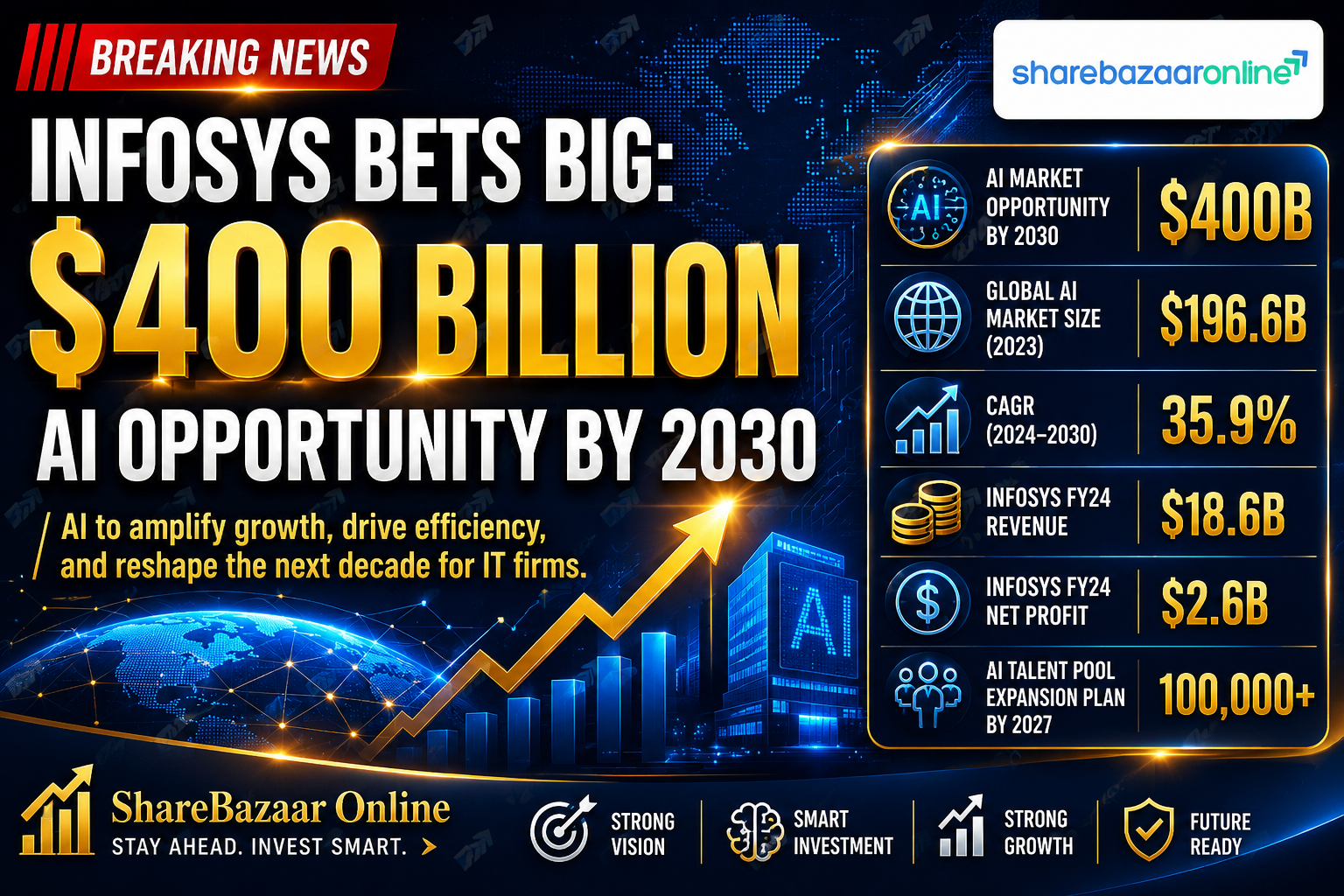
Bengaluru's biggest IT exporter just told its shareholders something that mattered far more than the usual AGM small talk. At Infosys's 45th Annual General Meeting on June 23, 2026, Chairman Nandan Nilekani put a number on the company's AI ambitions — somewhere between $300 billion and $400 billion by 2030. That's not a typo, and it's not vague futurism either. It's a working estimate of how big the AI-first enterprise services market could get, and Infosys wants a meaningful slice of it.
The timing is notable. This comes on the heels of a Q4 FY26 print that showed revenue at ₹46,402 crore, up 13% year-on-year, alongside a sharp jump in profitability — EBIT margin moved to 21% from 18.4% the previous quarter. Yet the company also trimmed its FY27 growth guidance to a constant-currency range of 1.5%-3.5%, lower than what the Street had been pencilling in earlier. So you have a company posting healthier margins, talking up a massive future opportunity, and simultaneously tempering near-term growth expectations. That contrast is exactly why this AGM is worth unpacking.
Why This Matters
For two years, the dominant narrative around generative AI and IT services has been one of existential anxiety — will coding automation gut the outsourcing model that built companies like Infosys? Nilekani used the AGM stage to directly confront that question, and his answer wasn't defensive. He argued AI is a force multiplier, not a replacement, for firms that move fast enough to use it.
That's a claim every investor in Indian IT should be testing rather than accepting at face value. The reason it matters is structural: if Nilekani is right, the entire IT services sector gets a multi-year demand tailwind as enterprises rebuild old systems around AI. If he's wrong, or only partially right, the gains accrue to a handful of large players with capital and client relationships deep enough to capture the new work — leaving smaller IT firms exposed.
Key Highlights
- Infosys projects a $300-400 billion AI-first services opportunity globally by 2030
- Annualised AI services revenue has crossed the $1 billion mark
- Roughly 90% of Infosys's top 200 clients are now engaged in AI initiatives with the company
- Q4 FY26 revenue: ₹46,402 crore, up 13% YoY from ₹40,925 crore in Q4 FY25
- EBIT rose 16.6% sequentially to ₹9,743 crore; EBIT margin expanded to 21%
- Profit before tax climbed 17% QoQ to ₹10,797 crore
- FY27 guidance: constant-currency revenue growth of 1.5%-3.5%, a downgrade from earlier estimates
- Infosys's market capitalisation stood at roughly ₹4.17 lakh crore as of June 23, 2026
- A new multi-year deal with semiconductor manufacturer GlobalFoundries was disclosed the same day, covering AI-led managed services across GF's enterprise IT operations
Detailed Analysis
Strip away the AGM theatre and there are really three separate stories being told at once.
The first is about revenue mix. Crossing $1 billion in annualised AI services revenue is a real milestone, not a vanity metric — it tells you AI work has moved from pilot projects to something that shows up meaningfully on the income statement. Nilekani's framing was specific: the real value isn't in AI tools writing code faster, it's in stitching AI models and autonomous agents into the transaction systems that actually run a business — ERP, core banking platforms, supply chain software. That's deliberately positioned as work that's hard to commoditise, because it requires institutional knowledge of a client's legacy architecture that a generic AI tool simply doesn't have.
The second story is about margins outpacing growth. A 21% EBIT margin against tepid 1.3% sequential constant-currency growth tells you Infosys is running a tighter ship rather than chasing volume. Cost discipline, not topline expansion, did the heavy lifting this quarter. That's a defensible strategy in a cautious global spending environment, but it's not the same thing as accelerating demand.
The third story, and arguably the one with the most market relevance, is the FY27 guidance cut. Lowering constant-currency growth guidance even as you talk up a $400 billion future opportunity is a signal that near-term enterprise IT budgets remain under pressure, even if AI-specific work is growing within that constrained budget. Investors reading only the AI headline risk missing this nuance.
Market Impact
Indian IT stocks tend to move in sympathy with each other on macro commentary, so Nilekani's remarks carry weight beyond Infosys alone. A credible articulation of a $400 billion addressable market — even a directional one — gives the sector a fresh narrative to rally around after a stretch of growth-guidance disappointments across the industry. At the same time, the FY27 guidance trim is a reminder that narrative and near-term numbers don't always move in the same direction, and the market will likely parse both before re-rating the stock meaningfully.
Sector Impact
The ripple effects extend across the IT services value chain. Larger players — Infosys, TCS, Wipro, HCLTech — have the balance sheets and AI tooling investments to compete for the kind of integration-heavy, governance-intensive work Nilekani described. Mid-tier and smaller IT firms, particularly those built around lower-cost coding and staffing models, face a tougher transition if enterprise clients increasingly demand AI-native delivery capability. The GlobalFoundries deal disclosed alongside the AGM is itself a useful data point — semiconductor and hardware-adjacent enterprises are now sourcing AI-led managed services from Indian IT majors, widening the addressable client base beyond traditional BFSI and retail verticals.
Opportunities
- Enterprises racing to modernise legacy systems creates sustained multi-year demand for integration specialists
- Infosys's existing footprint across 90% of its top 200 clients gives it a low-friction path to cross-sell AI work without new client acquisition costs
- New verticals like semiconductors (via the GlobalFoundries deal) expand the addressable market beyond conventional IT services clients
- Margin expansion shows the company can grow profitability even in a slow-growth revenue environment
Risks
- FY27 guidance cut signals continued caution in enterprise tech spending
- The $400 billion figure is a market-sizing estimate, not a contracted revenue pipeline — execution risk remains high
- Smaller competitors and in-house enterprise AI teams could erode the "must-use-an-outsourcer" assumption underlying the thesis
- Talent and pricing pressure: AI-native delivery requires different skill sets than traditional coding-heavy staffing models, raising retraining costs
Future Outlook
3-Month Outlook
Expect continued scrutiny of deal wins in the AI-led managed services category, with the GlobalFoundries-type engagements serving as a template the market will watch for repeatability. Near-term stock movement will likely track quarterly commentary on discretionary IT spending more than long-term AI sizing claims.
6-Month Outlook
If FY27 guidance trends toward the upper end of the 1.5%-3.5% range, expect the AI narrative to gain more credibility with institutional investors. A miss toward the lower end would likely overshadow even strong AI-specific revenue growth.
12-Month Outlook
The real test by mid-2027 will be whether AI services revenue growth meaningfully outpaces overall company growth, validating the idea that AI is additive rather than merely replacing traditional coding-and-testing revenue that's shrinking elsewhere in the business.
Expert Observation
The most useful thing in Nilekani's remarks wasn't the $400 billion figure — large market-sizing numbers are easy to produce and hard to verify. It was the specific framing of an "AI deployment gap" in large enterprises, tied to architecture, testing, governance and cybersecurity. That's a more falsifiable claim than a TAM estimate, and it's the one investors should track in coming quarters through deal disclosures rather than AGM rhetoric.
Investor Takeaway
For existing shareholders, the AGM commentary reinforces a "stay the course" case built on improving margins and a credible, if unproven, AI growth story — but it doesn't change the near-term reality of subdued revenue guidance. For prospective investors, the entry decision likely hinges more on valuation relative to FY27 guidance than on the long-dated AI opportunity, which is a 2030 story, not a 2026 one. Traders should watch quarterly AI-revenue disclosures and large-deal wins as the more immediate signal, rather than the headline TAM figure itself.
Conclusion
Nilekani's AGM address did what good corporate communication is supposed to do: it gave the market a forward-looking thesis without pretending the near-term numbers are perfect. Infosys is simultaneously defending its relevance against AI disruption fears and trying to position itself as a primary beneficiary of the same technology. Whether that duality holds up will be decided quarter by quarter, not by any single AGM speech — but the direction of travel, at least for now, looks more constructive than alarmist.
Track Infosys, TCS, and the broader IT pack in real time with ShareBazaarOnline's market dashboards — because in a sector this news-sensitive, the next data point is never far away.