

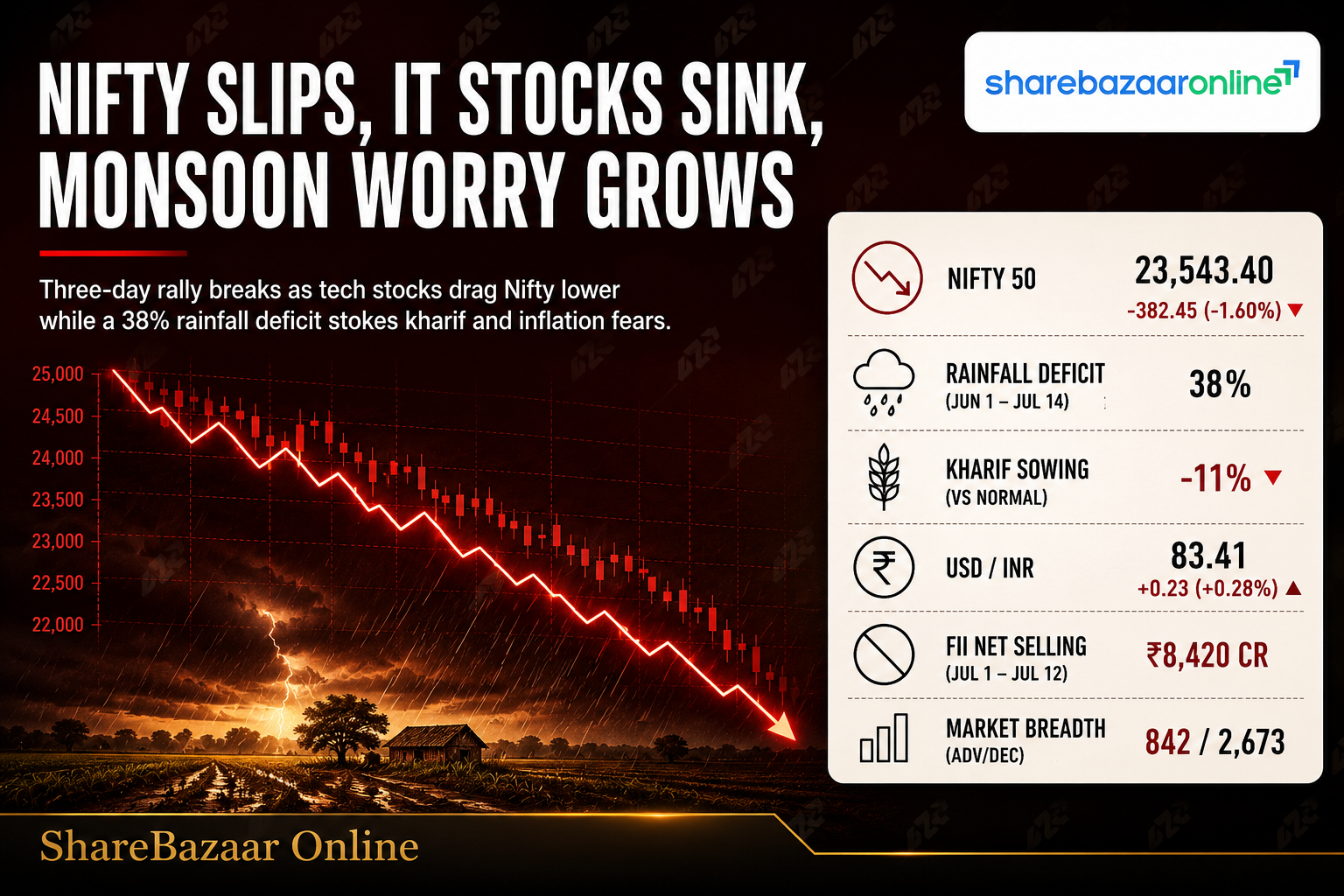
The three-session rally that had carried Indian equities through the week ran out of steam on Friday. The Nifty closed lower [CONFIRM: exact closing level and points lost], with the damage concentrated almost entirely in one pocket of the market — information technology. A sharp slide in IT counters pulled the broader index down even as several other sectors held their ground, a pattern that traders will be watching closely when the new week opens. Layered on top of the technical pullback is a slower-moving but potentially bigger worry: India's monsoon. Cumulative June rainfall is running 38% below normal, and with El Niño conditions still in play, the conversation on trading desks has quietly shifted from quarterly earnings to crop sowing.
Why This Matters
A one-day dip rarely tells the full story on its own, but this one arrives with a sector-specific fingerprint — IT — at a moment when the market had just strung together three positive sessions. That combination tends to put dip-buyers and profit-bookers on opposite sides of the same trade, and Monday's opening tick will likely reveal which camp has the upper hand. The monsoon angle matters for a different reason. India's rural economy, food inflation trajectory, and a meaningful slice of consumption-linked corporate earnings all lean on how the kharif season plays out. A rainfall shortfall this early in the season doesn't guarantee a bad outcome, but it does raise the stakes on every weather update between now and August.
Key Highlights
- Nifty ended lower on Friday, breaking a three-day winning streak
[CONFIRM: exact points/percentage change] - The decline was led by IT stocks, which saw a sharp sell-off
- June rainfall is tracking 38% below normal, with El Niño conditions cited as a contributing factor
- Analysts flagged risks to kharif sowing, food inflation, and rural demand if the monsoon stays delayed
- Kaynes Technology has entered the F&O ban period after crossing 95% of its market-wide position limit (MWPL)
- The rupee ended largely flat against the dollar after a choppy Friday session, but logged its best weekly performance in 11 weeks, helped by debt inflows
- Weakness in regional currencies offset the unwinding of long-dollar positions, capping the rupee's single-day move
Detailed Analysis
IT stocks have been the swing factor in this market for much of the year, and Friday's session reinforced that pattern. When the sector turns, it tends to turn hard, given the weight a handful of large-cap technology names carry in the index. [CONFIRM: name specific IT stocks/index move if available from full article — e.g., Nifty IT index points/percentage]. The rest of the market's relative resilience suggests this wasn't a broad risk-off day; it was a sector-specific air pocket, which is a meaningfully different setup for traders going into the new week than a market-wide reversal would be.
The monsoon data point deserves more attention than a single day's headline usually gets. A 38% deficit in cumulative June rainfall is not a marginal miss — it's the kind of number that, if it persists into July, starts showing up in sowing data for pulses, oilseeds, and coarse cereals within weeks. El Niño years have historically correlated with weaker, more erratic monsoon distribution across India, and markets have learned to price that risk into rural-consumption and agri-input stocks well before the actual harvest numbers arrive.
On the derivatives side, Kaynes Technology's entry into the F&O ban list is a structural, not a directional, signal. Crossing 95% of the market-wide position limit simply means open interest in the counter has become concentrated enough that exchanges restrict fresh derivative positions until it cools off. It doesn't say whether the stock goes up or down from here — but it does tell traders that fresh F&O bets on the name are off the table for now, and existing positions need to be managed within that constraint.
The rupee's story this week was about resilience rather than strength. A flat single-day close on Friday masked a tug-of-war between regional currency weakness — which usually drags the rupee down too — and the unwinding of long-dollar positions, which works in the rupee's favor. That those two forces roughly cancelled out on the day is itself informative: it suggests neither dollar bulls nor dollar bears had a clean run. Zoom out to the weekly picture, though, and the rupee had its best five-day stretch in 11 weeks, with debt inflows doing the heavy lifting. That's a detail income and bond-market watchers will note more than equity traders will, but it does speak to renewed foreign appetite for Indian debt at current yields.
Market Impact
The immediate market impact is concentrated in IT, where Friday's selling pressure will likely set the tone for how the sector opens next week [CONFIRM: specific index level for Nifty IT]. Beyond the index move itself, the bigger swing factor for the next few weeks isn't a single day's price action — it's the monsoon tracker. Every incremental rainfall update between now and the end of July has the potential to move sentiment in rural-facing sectors, regardless of what the headline index does.
Sector Impact
- IT: Under pressure; led Friday's decline. Watch for follow-through selling or a bounce at the start of the new week.
- FMCG / Consumer Staples: Indirectly exposed to the rural demand and food inflation angle; a prolonged rainfall deficit is a slow-burn negative.
- Agri-inputs (fertilizers, seeds, pesticides): Sensitive to sowing delays; near-term demand visibility could weaken if the deficit persists.
- Banking/NBFC (rural-focused): Asset quality in agri-linked loan books is a medium-term watch item if kharif output disappoints.
- Currency-sensitive exporters/importers: Limited near-term impact given the rupee's flat close, but the stronger weekly trend is a mild tailwind for importers and dollar-debt borrowers.
Opportunities
- A sector-specific IT pullback, rather than a broad market decline, can present selective entry points for investors who track the segment closely — subject to one's own risk assessment.
- Debt-market inflows strengthening the rupee on a weekly basis could be a signal for fixed-income investors watching yield-currency dynamics.
- Rural and agri-input stocks that have already priced in monsoon risk may see a relief move if rainfall recovers in July — a scenario worth monitoring rather than acting on prematurely.
Risks
- A persistent rainfall deficit raises the probability of weaker kharif output, which feeds directly into food inflation — a variable that influences both the RBI's rate stance and consumption-linked earnings.
- Continued weakness in IT majors could weigh on index-level sentiment if it spreads beyond a single session.
- The F&O ban on Kaynes Technology limits liquidity and flexibility for derivatives traders with existing exposure to the counter.
- Currency volatility, even when net-net flat, signals an unsettled tug-of-war between regional and domestic forces that could resolve in either direction.
Future Outlook
3-Month Outlook: The near-term narrative stays tied to two threads — whether IT stabilizes after Friday's drop, and whether June's rainfall deficit narrows in July. Markets will likely trade with one eye on both.
6-Month Outlook: By the time kharif sowing data and early harvest estimates firm up, the monsoon's actual impact on food inflation and rural demand will be far clearer than it is today. This is the window where the rainfall story moves from "watch item" to "earnings impact."
12-Month Outlook: A full kharif and rabi cycle will have played out, giving a clearer read on rural consumption trends, food inflation trajectory, and how much of this was a temporary scare versus a genuine drag on growth.
Expert Observation
Analysts tracking the session noted that the monsoon conversation has moved from a footnote to a genuine watch item for the market, a shift that tends to happen once a rainfall deficit crosses a threshold large enough to threaten sowing windows rather than just delay them by a few days.
Investor Takeaway
This is a session where the headline number (Nifty down) and the more important number (38% rainfall deficit) are pulling attention in different directions — and the second one matters more for positioning over the coming weeks than the first. Traders with short-term horizons will be watching whether IT's weakness extends into next week. Investors with a slightly longer horizon should be paying closer attention to monsoon trackers and any early commentary from FMCG, agri-input, and rural-lending companies about demand visibility. The rupee's resilience, meanwhile, is a quieter but real positive for anyone watching India's debt-market attractiveness to foreign investors.
Conclusion
Friday's session was a reminder that markets rarely move on a single clean narrative. A sector-specific IT selloff broke a three-day rally, a derivatives technicality put one more stock under F&O restrictions, and a currency that looked unremarkable on the day quietly had its best week in nearly three months. But the thread worth following into next week isn't any of those — it's the monsoon. A 38% rainfall deficit, if it doesn't narrow soon, has the kind of slow-building economic consequences that show up in inflation prints and rural demand data long after the day's index move is forgotten.
Stay ahead of every trade setup, F&O ban update, and macro trigger that moves Indian markets — only on ShareBazaarOnline. Bookmark our Markets page for daily pre-open analysis, and check our IPO and Unlisted Shares sections for opportunities beyond the index.