

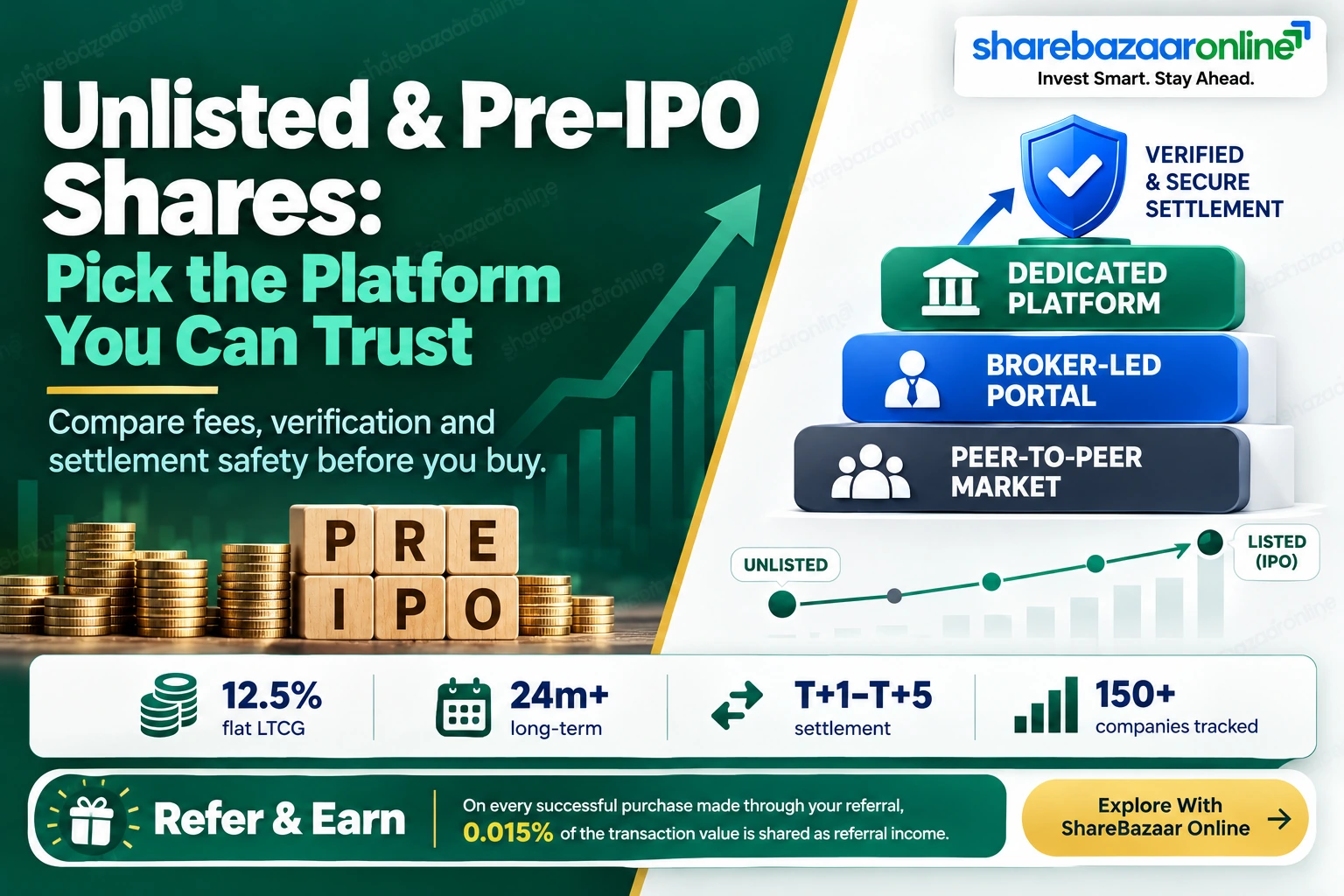
Best Platforms for Buying Unlisted and Pre-IPO Shares Compared: Fees, Verification and Trust
Retail money is flowing into India's unlisted market faster than the plumbing around it is maturing. Here is how to tell a secure channel from a risky one before you wire a single rupee.
Executive Summary
The pre-IPO and unlisted share market has moved from a dealer-driven corner of finance into something retail investors now shop for online. Demand is visible in search behaviour itself: terms like buy unlisted shares, best platform to buy unlisted shares in India and pre IPO investment platform have become steady monthly queries. The catch is that none of these trades clear on NSE or BSE. There is no order book, no exchange-set price and no automatic buyer protection. Everything rests on who you transact through and how carefully the paperwork is handled.
This guide breaks the market into the three channel types a buyer will actually encounter, walks through the end-to-end purchase from quote to demat credit, and sets out the verification and trust checks that separate a legitimate platform from a cash-in-a-stranger's-account trap. ShareBazaar Online sits in this picture as a research and verification layer, with tracked prices and availability across 150+ unlisted companies, ESOP listings and a broker comparison tool to help readers choose the safer route.
Why This Matters
When a popular name files its draft prospectus, the first instinct for many investors is to try to own it before the listing pop. That urge is exactly where mistakes happen. Unlisted shares change hands through private negotiation and a depository-level transfer, not through a regulated matching engine, so the price you are quoted, the authenticity of the shares and the safety of your payment all depend on the intermediary rather than on the system.
The gap between a trustworthy platform and a dubious one is not cosmetic. It decides whether your money is protected while shares move, whether you receive genuine stock credited to your own demat account, and whether you have enforceable documentation if something goes wrong. Choosing the channel well is the single biggest risk control an unlisted investor has.
Key Highlights
No Exchange Price
Unlisted shares have no live screen quote. Price is negotiated privately, which makes independent price-tracking essential.
Settlement Route
Shares move by off-market transfer through CDSL Easiest or NSDL Speed-e into your own demat account, typically in T+1 to T+5 working days.
Post-IPO Lock-In
Pre-IPO shares typically carry a six-month lock-in from the listing date before they can be sold.
Tax On Exit
Gains are long-term after a holding period of more than 24 months, taxed at a flat 12.5% without indexation from 23 July 2024.
Detailed Analysis
The Three Marketplace Types, and What Each Trades Off
Strip away the branding and every place that sells unlisted stock falls into one of three buckets. Each handles fees, verification and trust differently, and knowing which one you are dealing with tells you most of what you need to know about your risk.
Dedicated unlisted and pre-IPO platforms are the most structured option. They curate a list of available companies, publish indicative prices, run KYC on both sides and coordinate the demat transfer. Pricing is usually built into a spread or markup over their sourcing cost rather than a visible brokerage line, so the real question to ask is what price the platform paid versus what it is quoting you. Verification tends to be strongest here, because the platform's business depends on delivering genuine, demat-credited shares.
Broker-led and wealth-manager portals sit alongside a regulated broking or distribution business. For an investor who already holds a demat account with the group, the appeal is a familiar counterparty and consolidated holdings. Costs may appear as a transaction fee, an advisory charge or an embedded spread. The trust signal is the regulated parent entity, though buyers should still confirm the unlisted desk's exact process rather than assume it mirrors the listed-equity experience.
Peer-to-peer and dealer-network marketplaces connect buyers and sellers more directly, sometimes including ESOP holders selling their own stock. This is where the best prices and the worst outcomes both live. Fees can be lower, but verification and payment protection vary wildly. Any arrangement that asks you to pay a personal bank account, skips a signed agreement, or cannot show shares credited to a demat account should be treated as a red flag, not a bargain.
How the Buying Process Actually Works, Step by Step
The mechanics are the same regardless of channel, which is useful: if a platform skips any of these steps, that absence is itself the warning.
| Stage | What Happens |
|---|---|
| 1. Demat ready | You need an active demat account to receive the shares. Standard broker apps cannot execute the unlisted trade, but they can hold the stock once it arrives. |
| 2. KYC both sides | Buyer and seller share PAN, bank details and a Client Master Report (CMR/CML) from their depository participant. |
| 3. Confirm the stock | Check the exact company, the ISIN, the minimum lot and the indicative price against an independent source before agreeing. |
| 4. Paper the deal | A deal note or share purchase agreement records price, quantity and terms. This is your legal title trail. |
| 5. Transfer and pay | The seller moves shares via CDSL Easiest or NSDL Speed-e (or a delivery instruction slip). Payment runs through secure channels, often with an escrow-style hold, and stock is usually credited in T+1 to T+5 working days. |
Process reflects standard depository-based off-market transfer practice. Timelines and lot sizes vary by platform and company.
The Safety Features Worth Insisting On
A secure platform is identifiable by the protections it builds in rather than the returns it advertises. Four features do most of the work.
- Two-sided KYC on buyer and seller, not just a payment page. Proper identity and demat verification is the baseline.
- Escrow or structured settlement so money and shares are not left exposed. Payment should never land in an individual's personal account.
- Verified share provenance confirmed by ISIN and a transfer that credits your own demat account directly, so you can see genuine stock arrive.
- Legal documentation in the form of a signed deal note or share purchase agreement, which is what makes the title transfer enforceable.
Common Transaction Flows You Will Meet
ESOP Buyback / Sale
Employees liquidate vested stock options. Buyers get access to genuine company shares, but should confirm the seller's holding and the transfer path.
Secondary Sale
An existing investor exits before listing. Price is negotiated privately, so independent price tracking matters most here.
Pre-IPO Allotment
Shares acquired close to an IPO. Note that pre-IPO stock typically carries a six-month lock-in from the listing date before it can be sold.
Market Impact
The steady search demand for unlisted names, marquee pre-IPO companies and buying platforms shows the market broadening well beyond high-net-worth desks. As more first-time buyers arrive, the platforms that win are those that make pricing transparent and settlement safe, rather than those that simply promise the hottest allotment.
That shift rewards infrastructure. Independent price discovery, verified availability and clean documentation are becoming the competitive moat in a segment that historically ran on relationships and opacity.
Sector Impact
For depositories and the broking ecosystem, rising unlisted volumes push better rails for off-market settlement and clearer audit trails. For the companies themselves, an active secondary market gives employees and early backers a way to realise value ahead of listing, which can ease cap-table pressure.
For the platform layer, the direction of travel favours players that can prove provenance and protect payments, and squeezes informal dealer chains that cannot.
Opportunities
Early access to companies before the public listing, with the potential for value to be realised at IPO or through a strategic event.
Portfolio diversification into private businesses whose returns are not tied to daily listed-market swings.
A route for ESOP holders and early investors to exit, which steadily deepens secondary liquidity.
Better tooling for price tracking and verification is lowering the knowledge barrier that once kept retail buyers out.
Risks
- Low liquidity. Finding a buyer or seller can take weeks, and exits often hinge on a listing or acquisition that may be delayed.
- Subjective valuation. With no exchange price and limited disclosure, you are relying on negotiation and independent data rather than a live market.
- Counterparty and fraud risk. Informal networks, personal-account payments and missing paperwork are the recurring failure points.
- Lock-in and tax drag. Pre-IPO shares can face a six-month post-listing lock-in, and the current tax treatment offers no indexation on long-term gains.
Future Outlook
3-Month Outlook
Interest tends to track the IPO pipeline. Expect buying attention to concentrate around names rumoured to be heading for listing, keeping demand for verified prices high.
6-Month Outlook
Platforms are likely to compete harder on transparency and settlement safety, with escrow-style protections becoming a standard expectation rather than a differentiator.
12-Month Outlook
As off-market rails and investor awareness mature, the segment should tilt further toward structured platforms and away from opaque dealer chains.
Outlook is editorial interpretation based on current market trends, not a forecast of returns.
Expert Observation
The useful mental model is simple: in the listed market the exchange protects you, while in the unlisted market the platform does. That single difference reframes the whole decision. The question stops being "which company will pop at listing" and becomes "which channel will actually deliver genuine shares into my demat account against a protected payment." Investors who get that order right rarely end up in the horror stories.
Investor Takeaway
Before committing, run a short due-diligence checklist:
- Confirm the platform runs KYC on both buyer and seller.
- Insist on escrow or structured settlement; never pay a personal account.
- Match the ISIN and verify shares credit directly to your own demat account.
- Get a signed deal note or share purchase agreement before any payment.
- Cross-check the quoted price against an independent tracker.
- Confirm any applicable lock-in and understand the tax and stamp-duty costs on both legs.
Treat price as the last filter, not the first. The cheapest quote on an unverified channel is usually the most expensive mistake.
Conclusion
Buying unlisted and pre-IPO shares is no longer exotic, but it is still a market where safety is self-selected. The channel you choose, the verification you demand and the documentation you keep are what stand between an early-stage opportunity and an avoidable loss. Compare platforms on fees, verification and trust in that order of scrutiny, and let independent data rather than a sales pitch set your price.
Frequently Asked Questions
What is the safest way to buy unlisted shares in India?
Which platform types exist for buying pre-IPO shares?
Do I need a demat account to buy unlisted shares?
How are unlisted shares actually transferred to me?
What documents do I need to buy unlisted shares?
Is there stamp duty on buying unlisted shares?
How are gains on unlisted shares taxed?
Can I sell pre-IPO shares immediately after the company lists?
How do I know the unlisted price I am quoted is fair?
What are ESOP and secondary-sale transactions?
What is the biggest red flag on an unlisted share platform?
How can ShareBazaar Online help me buy more safely?
Disclaimer
This article is for information and educational purposes only and is not investment, legal or tax advice. Unlisted and pre-IPO shares carry high risk, low liquidity and limited disclosure, and prices are not set by any exchange. Tax rates, stamp duty, lock-in rules and platform processes can change and may vary by case. Verify current rules and specific platform terms from official sources and consult a registered adviser before investing. ShareBazaar Online does not guarantee any outcome or return.