

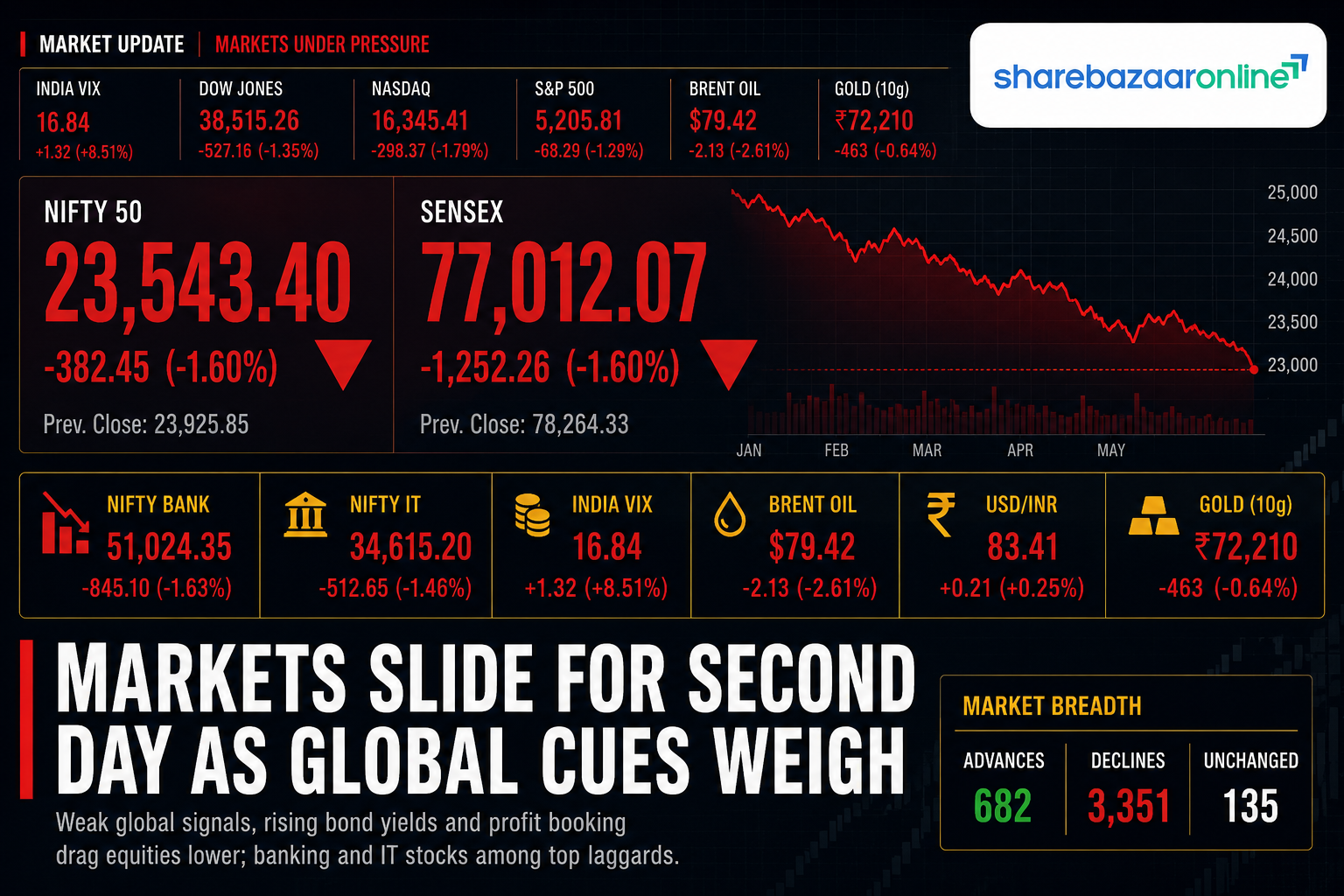
Stock Market Today, June 22: IT Stocks Extend Friday's Rout, Nifty Slips Below 23,950 in Early Trade
Monday mornings on Dalal Street rarely start gently after a week that ended on a sour note, and June 22 was no exception. The benchmark indices opened the week on the back foot, with the same culprit from Friday's session — information technology stocks — once again setting the tone before the opening bell had even finished ringing.
By 9:40 am, the Nifty 50 was trading 0.86% lower, while the Sensex had slipped 0.97%. Earlier in the session, the damage was sharper still: the Nifty touched an intraday low of 23,938, a fall of nearly 1%, and the Sensex dropped as much as 1.07% to 76,578. What makes this drawdown notable is the source. IT stocks account for roughly 8.5% of the Nifty 50's total weight, yet their selloff alone pulled the index down by more than 120 points — a disproportionate hit that tells its own story about sentiment in the sector right now.
Why This Matters
This isn't an isolated wobble. It's a continuation. Friday's session had already seen the Sensex shed close to 607 points to close at 76,803, with the Nifty slipping below the psychologically important 24,000 mark and touching an intraday low of 23,902. That move snapped a five-session winning streak for both indices — a streak that had been quietly built on steady buying in financials, pharma and realty stocks. The trigger was an overnight guidance cut from Accenture, which trimmed its revenue growth outlook for the current financial year to a 3-4% band from an earlier 3-5% range, citing pressure on its consulting business tied to tensions in West Asia. That single data point was enough to spark a punishing rout in Indian IT ADRs, and the BSE IT index ended Friday down 3.65%, touching a fresh 52-week low of 26,634.
For investors, the read-through is straightforward but uncomfortable: when a global IT bellwether flags weaker demand, the market doesn't wait to find out if Indian peers are insulated. It sells first and asks questions later.
Key Highlights
- GIFT Nifty, the early proxy for Nifty 50 sentiment, was actually trading higher by 0.52% at 24,173 as of 6:56 am — a signal that didn't translate into a positive domestic open once trading began.
- US equity-index futures told a mixed story too: S&P 500 futures were down 0.72% and Euro Stoxx 50 futures slipped 0.17% ahead of the Indian open.
- The Nifty's June futures contract was down 0.48% at 24,077, trading at a premium of 63.9 points to the spot index — a premium that, while still positive, has narrowed from levels seen during last week's rally.
- On the options front, maximum Call open interest sits at the 25,000 strike for the June 23 expiry, while maximum Put open interest is concentrated at 23,500 — effectively bracketing the range traders are positioning for this week.
- Kaynes Technology is the lone name in the F&O ban period today.
- US markets were shut on Friday, June 19, for the Juneteenth federal holiday, meaning Wall Street's last tradable cues are now a session old — a detail that matters when GIFT Nifty and US futures appear to be sending conflicting signals.
Detailed Analysis
The story underneath the headline numbers on Friday was almost entirely an IT story. Infosys was the single biggest loser on the Nifty 50, falling 6.5% to close at ₹1,054, while Tata Consultancy Services, Tech Mahindra, HCL Technologies, Mahindra & Mahindra, Wipro, Reliance Industries and Kotak Mahindra Bank all declined between roughly 0.9% and just over 3%. The damage wasn't confined to large caps either — the sector-wide IT index's slide to a 52-week low suggests the market is repricing growth assumptions across the board, not just for the two largest players.
What kept the broader market from falling further was a fairly resilient set of gainers. Eternal, Bharti Airtel, Power Grid, Nestle India, NTPC, ITC, Apollo Hospitals and Sun Pharma all closed in the green on Friday, and market breadth on the NSE was tilted only mildly negative, with 1,762 advancing stocks against 1,523 decliners. That's not the breadth profile of a market in panic — it's one where a single, concentrated sector is doing most of the damage while the rest of the tape holds up reasonably well.
There was a genuine bright spot in the background too. The signing of a US-Iran peace deal sent crude oil prices lower, which is typically read as a tailwind for an oil-importing economy like India. Brent crude was trading near $79.11 a barrel, down close to 0.93% on the day. But that macro positive simply wasn't large enough to offset the gravitational pull of an IT sector that makes up a meaningful slice of corporate earnings and investor portfolios.
India VIX, the market's volatility gauge, spiked 5.2% intraday on Friday to 13.33, before easing slightly to 12.97 — still up 2.37% — heading into Monday's session. That's a modest but real uptick in hedging demand, consistent with a market that just snapped a winning streak and is now trying to figure out whether Friday's selloff was a one-day overreaction or the start of something more durable.
Overnight, Wall Street offered a layer of reassurance. The Dow Jones Industrial Average closed up 0.14% at 51,584.84, the Nasdaq Composite jumped 1.86% to 26,529.90, and the S&P 500 gained 1.06% to settle at 7,519.91. European markets were mixed but broadly firm — the DAX rose 0.40%, the CAC 40 edged up 0.05%, while the FTSE 100 dipped 0.16% and the STOXX 50 was nearly flat. That kind of overnight strength usually supports a positive domestic open, which is presumably why GIFT Nifty was indicating gains before the cash market opened. The fact that Nifty and Sensex still slipped into the red within the first hour underscores just how much weight the IT-led selling carries right now.
Market Impact
The flow data adds useful context. Foreign institutional investors sold a net ₹1,025.20 crore worth of Indian equities on June 18, continuing a pattern of intermittent FII selling through the month — interspersed with brief buying days like June 17 (+₹101.60 crore) and June 15 (+₹200 crore). Domestic institutional investors, on the other hand, have been the steadier hand, buying a net ₹3,516.80 crore on June 18 alone, and posting even larger inflows of ₹5,341.30 crore on June 12 and ₹4,224.50 crore on June 11. This FII-sell, DII-buy dynamic has effectively been cushioning the market through bouts of foreign outflows, and it's likely to remain the key support mechanism if global IT-related jitters persist.
Sector Impact
IT remains the sector to watch closely this week. A 52-week low on the sector index is not a small technical event — it raises the question of whether FY27 earnings estimates across the sector need to be trimmed, given that US clients, particularly in consulting-adjacent verticals, appear to be tightening budgets. Banking and financial services also slipped on Friday alongside PSU banks, private banks, realty, consumer durables and oil & gas — a fairly broad-based softness outside of IT, even if less severe. Pharma, metals and healthcare were the relative outperformers, and that pattern could persist if investors rotate out of richly-valued IT names into defensives.
Corporate actions reported through the morning add further texture. Reliance Industries has filed the proposed IPO of Jio Platforms with the exchanges for approval — a development that, if it progresses, would be one of the largest listing events in Indian market history and is already drawing attention as a long-term sector catalyst for telecom and digital services. Sun Pharma announced it will acquire a 100% stake in Innovcare Lifesciences for ₹271.2 crore, expanding its presence in pharmaceutical marketing and distribution. In defence manufacturing, Bharat Forge signed a ₹425 crore contract with the Ministry of Defence to supply gas turbine generators to the Indian Navy, while Goodluck India secured a ₹255 crore order for long-range empty shells — both signs that the defence order pipeline remains active. On the regulatory side, Aurobindo Pharma disclosed that the US FDA issued five observations following a pre-approval inspection at its Eugia Steriles unit in Andhra Pradesh, conducted between June 10 and June 19 — a development worth monitoring for any follow-through on plant status.
In the primary market, Turtlemint Fintech's IPO saw 45% overall subscription on Day 1, with qualified institutional buyers at 73% and retail investors at 29% — a reasonably encouraging early book-build that suggests appetite for fintech-linked listings hasn't dried up despite the secondary market's IT-led wobble.
Opportunities
For investors with a slightly longer horizon, the current setup offers a few angles worth weighing. The DII-led buying cushion suggests domestic flows continue to view dips as accumulation opportunities, particularly in financials, pharma and consumption names that have held up better than IT. The pullback in IT valuations, while uncomfortable in the near term, could eventually create entry points for investors who believe the sector's medium-term AI-and-digital-transformation demand story remains intact, even if near-term guidance is being trimmed. The Jio Platforms IPO filing also opens up a thematic opportunity to track developments in India's telecom-and-digital ecosystem ahead of what could be a landmark listing.
Risks
The most immediate risk is that the IT slowdown signaled by Accenture's guidance cut is not a one-off but the start of a broader reset in expectations for the sector, which would pressure earnings estimates for Indian IT majors through the rest of FY27. A sustained pickup in India VIX would also be worth watching — volatility spikes of this kind can either fade quickly or compound if FII selling intensifies. Persistent FII outflows, even if currently offset by DII buying, remain a risk if the gap widens meaningfully. Globally, any reversal in the still-fragile geopolitical calm around West Asia could also undo the modest tailwind from lower crude prices.
Future Outlook
3-Month Outlook: Expect continued volatility in IT counters as the market digests whether Accenture's guidance cut is sector-wide or company-specific, with quarterly results from Indian IT majors likely to be the next major catalyst. The Nifty's 23,800-24,000 zone is being watched as a near-term support band by technical analysts, with 24,200-24,600 as the upside resistance zone if buying resumes.
6-Month Outlook: Much will depend on how the Jio Platforms IPO process unfolds and whether DII inflows remain strong enough to absorb any sustained FII selling. A stabilization in global crude prices, if the West Asia peace process holds, could provide an ongoing macro tailwind for India's import bill and inflation trajectory.
12-Month Outlook: The structural themes — defence manufacturing order inflows, financialization of savings supporting DII flows, and the eventual resolution of IT sector growth concerns — are likely to shape the broader market narrative over the next year, alongside how large primary market events like Jio Platforms are absorbed by investor liquidity.
Expert Observation
Market technicians have flagged the 23,800-24,000 band as an important support zone for the Nifty, with the view that any corrective dip toward this region could attract buying interest as long as the index holds above it. On the upside, a sustained move past 24,100 would be needed to validate further strength toward the 24,200-24,600 zone. The narrowing Nifty futures premium and the concentration of Put open interest at 23,500 suggest options traders are currently pricing a relatively contained downside for this week, even as the spot index trades below recent highs.
Investor Takeaway
The headline message for June 22 is one of sector divergence rather than a broad-based market breakdown. IT is under genuine pressure, and that pressure is large enough to move the entire index given the sector's market-cap concentration, but the rest of the market — financials, pharma, defence-linked names, FMCG — is showing far more resilience. Investors holding IT-heavy portfolios may want to reassess sector weightings, while those with diversified exposure to financials, pharma and consumption are likely better positioned to weather this particular bout of volatility. Keep an eye on the FII/DII tug-of-war and on how the Jio Platforms IPO filing develops, as both will shape sentiment over the coming weeks.
Conclusion
Monday's session is a reminder that markets rarely move in a straight line, and that a single piece of guidance from a global IT major thousands of miles away can ripple through Dalal Street with real force. The good news, if there is any, is that the damage so far looks contained to a specific sector rather than the entire market, and domestic institutional buying continues to provide a floor. Whether this turns into a deeper correction or a brief pause before the next leg up will likely hinge on how IT earnings commentary develops over the next few weeks, and whether DII flows can keep outpacing FII selling.
Stay ahead of every market move with ShareBazaarOnline. Track live Sensex and Nifty levels, FII/DII data, IPO subscription status and stocks to watch — all in one place, updated through the trading day.