

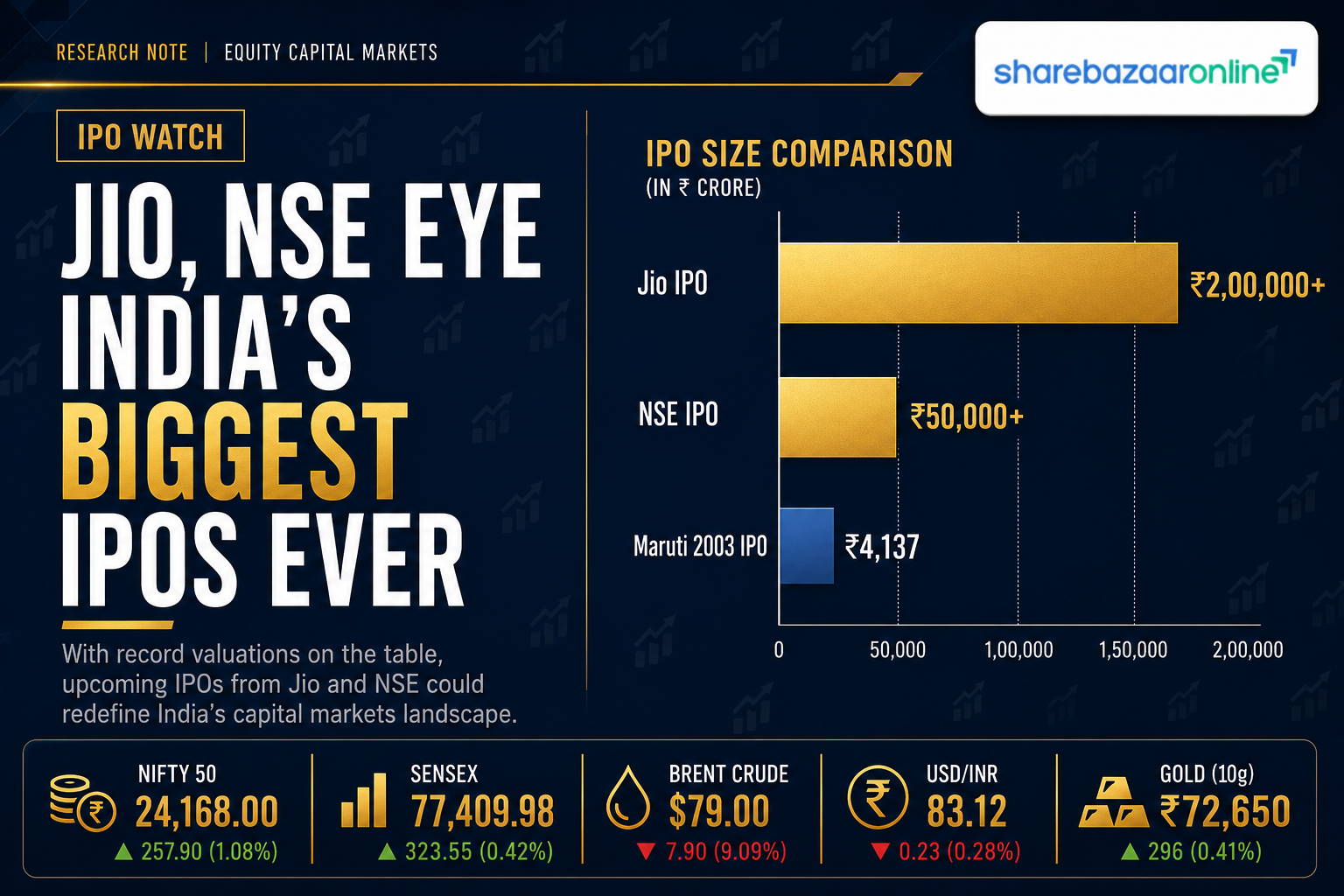
India's primary market is staring down its biggest test in two decades. Reliance Jio Platforms and the National Stock Exchange have both moved to go public within days of each other, and between them they could pull in close to $7 billion from investors. That kind of number hasn't been seen in Dalal Street's IPO calendar before. But size alone has never been the thing that decides whether an IPO actually makes money for the people who buy into it. India has been here before — with names just as big, just as hyped, and the outcomes were not always kind to retail investors.
Why This Matters
Every few years, India gets an IPO that's bigger than a listing — it becomes a cultural moment. Maruti was that moment in 2003. Reliance Power was that moment in 2008. Paytm was that moment in 2021. Two of those three left investors badly burned. Jio and NSE now carry the same weight of expectation, and the comparison investors keep reaching for is Maruti — not because the businesses are alike, but because Maruti is the gold standard for what a "good" mega-IPO can eventually deliver. Whether that comparison holds up is the question that actually matters for anyone deciding whether to apply.
Key Highlights
- NSE filed its draft papers on June 17, 2026, targeting a raise north of $3 billion through a complete offer-for-sale — meaning existing shareholders are cashing out, not the company raising fresh capital.
- Jio Platforms followed two days later, on June 19, with papers for a fresh-issue IPO of roughly 27 crore equity shares at Rs 10 face value, expected to be worth $4 billion or more.
- Jio's FY26 numbers: net profit of Rs 30,049.1 crore, revenue from operations of Rs 1,46,885.3 crore, and EBITDA margins of 51.9%.
- NSE is the world's largest derivatives exchange by contract volume and India's most widely held unlisted company, with close to 2,00,909 shareholders already on its books.
- Both listings are tentatively expected around July 2026, pending SEBI's review window.
- Grey market premium activity on both counters had not meaningfully kicked in at the time of filing — an early signal that the market hasn't yet priced in runaway demand the way it did for Paytm.
Detailed Analysis
Strip away the hype and what you have are two very different businesses being judged by the same yardstick. NSE is a regulated monopoly-like infrastructure business — it earns from the plumbing of the market itself, transaction fees, data services, listing fees. It doesn't need the IPO money for growth; this is pure OFS, an exit for existing shareholders. Jio is the opposite — a fresh issue, meaning the capital raised goes straight onto the company's balance sheet, presumably to fund further build-out in telecom, fibre and digital services.
That structural difference matters more than most retail investors realise. An OFS-heavy listing like NSE's tells you the IPO is primarily a liquidity event for people who got in early — promoters, PE investors, employees with stock options. A fresh-issue IPO like Jio's tells you the company itself believes it needs the capital to grow. Neither structure is inherently good or bad, but they invite different questions. With NSE, the question is whether the price reflects the business today. With Jio, the question is whether the growth being funded justifies the price being paid for it now.
This is exactly the fork in the road that separated Maruti from Reliance Power and Paytm. Maruti's 2003 IPO was priced at a modest Rs 125 a share, the government divesting a 25% stake at a valuation that, with hindsight, undersold the business badly. The issue was oversubscribed roughly 10 to 13 times, and on listing day the stock closed at Rs 164 — a listing-day gain of around 31-32%. Within six months it had touched Rs 375. Two decades on, an investor who held from the IPO was sitting on returns north of 75 times their money, with the stock briefly crossing the Rs 13,000 mark.
Reliance Power and Paytm tell the opposite story. Reliance Power's 2008 IPO arrived on a wave of retail euphoria and collapsed almost as quickly. Paytm raised $2.5 billion in November 2021 — India's largest IPO at the time — backed by SoftBank and Ant Group, priced at the top of its range, and oversubscribed despite open scepticism about valuation. It fell 27% on debut day, wiping out a chunk of investor wealth almost instantly and becoming something of a watershed moment: the point where India's public markets stopped rewarding growth stories with no profit attached.
The pattern across the disappointments is consistent. Heavy media attention. Pricing that assumes years of future growth are already baked in. Retail money chasing the story more than the balance sheet. And often, an IPO that's really a payday for early private investors rather than a capital-raise for the business. Maruti avoided that trap mostly because it was underpriced relative to what the business went on to deliver — a function of how the government structured a 2003-era disinvestment, not necessarily a repeatable pricing discipline.
Market Impact
A combined $7 billion of paper hitting the market is large enough to move broader sentiment in India's primary market regardless of how either stock performs individually. Big anchor allocations, FII interest, and the sheer visibility of these names tend to pull retail attention toward IPOs more broadly — sometimes indiscriminately. If Jio and NSE list well, expect a wave of "IPO season" enthusiasm across smaller upcoming issues too. If either disappoints, expect a chilling effect on retail subscription numbers for unrelated IPOs in the following quarters, much like Paytm's debut dented sentiment well beyond fintech.
Sector Impact
For market infrastructure and broking, an NSE listing forces re-rating conversations across exchanges, depositories, and capital-market intermediaries listed or planning to list — what multiple does a regulated monopoly deserve, and does that read-through apply to peers. For telecom and digital services, a Jio listing puts a market-determined value on Reliance's digital arm for the first time, which has implications for how analysts value the broader Reliance Industries stock, and for how Airtel and Vodafone Idea get benchmarked against a newly public Jio.
Opportunities
- Price discovery clarity: For the first time, the market gets to put an independent valuation on India's largest telecom-digital business and its dominant exchange, rather than relying on private deal benchmarks.
- Portfolio access: Retail and institutional investors who've wanted exposure to either business finally get a direct route in, instead of indirect exposure through Reliance Industries shares or grey-market unlisted NSE stock.
- Index inclusion potential: Issues of this size typically draw index-fund flows post-listing, which can support price stability once the initial volatility settles.
Risks
- Valuation creep: The bigger and more anticipated an IPO, the higher the temptation to price in optimism rather than current fundamals — the exact trap that caught Paytm.
- OFS overhang for NSE: Because it's a pure offer-for-sale, post-listing supply from existing shareholders looking to monetise further could weigh on the stock.
- Macro timing: Two enormous issues landing close together could split liquidity, with one listing potentially cannibalising demand or pricing power from the other.
- Regulatory timeline risk: SEBI's review process can extend timelines, and DRHP-to-listing gaps of more than the typical month aren't unusual, particularly for issues of this scale.
Future Outlook
3-Month Outlook: Expect continued regulatory back-and-forth with SEBI, price-band speculation, and anchor investor conversations. Grey market premium activity, if it appears, will be the first real signal of retail appetite.
6-Month Outlook: Assuming a July listing window holds, both stocks should be trading and the market will have begun forming a verdict — listing-day performance, early volume trends, and whether index inclusion conversations have started.
12-Month Outlook: This is where the Maruti comparison actually gets tested. A year out, the relevant question won't be the listing-day pop — it'll be whether Jio's growth funded by fresh capital and NSE's monopoly-like earnings power are translating into earnings growth that justifies whatever multiple the market assigned at debut.
Expert Observation
Market veterans who've tracked India's IPO cycles tend to make one point repeatedly: the size of an IPO and the quality of an IPO are two completely separate conversations, and investors conflate them at their own cost. NSE and Jio are, by most measures, genuinely strong businesses — that part isn't really in dispute. The dispute, if there is one, will be about the price investors are asked to pay for that quality, and whether that price already assumes a Maruti-style outcome before the company has had a single quarter as a public business.
Investor Takeaway
Don't anchor your decision to the Maruti story or the Paytm story — anchor it to the actual price band, the actual fundamentals disclosed in the final prospectus, and the actual structure of the issue. NSE's pure-OFS structure means your money funds an exit for existing holders, not new growth — that's not disqualifying, but it changes what you're paying for. Jio's fresh-issue structure means the capital should show up in future growth — track whether it does. Strong financials (Jio's 51.9% EBITDA margin is a genuinely good number) reduce risk but don't eliminate valuation risk. Wait for price-band disclosure and grey market signals before forming a subscription view, and size any IPO allocation as you would any single-stock bet — not as a guaranteed Maruti repeat.
Conclusion
Jio and NSE have the fundamentals to be talked about in the same breath as Maruti. Whether they end up there, or end up in the Paytm and Reliance Power column, will be decided by something far less exciting than brand power or media buzz — the price band, the post-listing supply, and whether the businesses keep compounding the way Maruti did for the two decades after its own modest, oversubscribed, unglamorous 2003 debut.
Track live IPO updates, price-band alerts, and grey market premium movement for Jio and NSE only on ShareBazaarOnline — your trusted source for India's primary market intelligence.