

Zerodha US Stocks: Indian Investors Can Now Buy Apple, Nvidia and S&P 500 ETFs From Kite
India's largest retail broker has opened a public beta for US equity investing, routing money through the GIFT City framework and offering fractional shares from as little as one dollar. Here is what the rollout actually changes for the ordinary investor.
Executive Summary
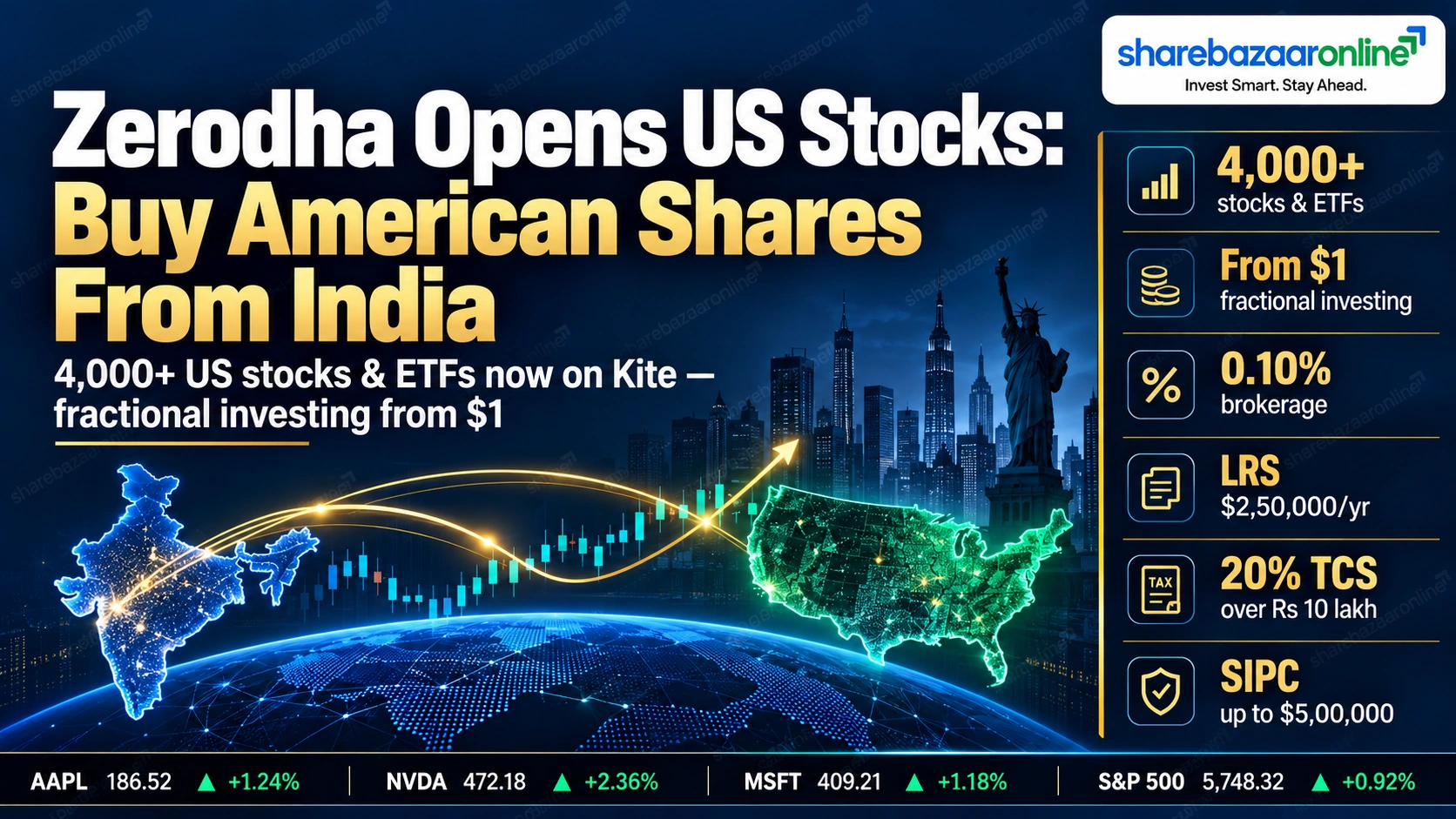
Zerodha has started letting resident Indian clients invest in US-listed stocks and ETFs directly from their existing accounts, with the feature live in public beta on a dedicated Kite beta build. The broker is working with Viewtrade, a US broker-dealer, in association with India INX Global Access (INX-GA), which operates inside the GIFT City IFSC and carries approval under the Global Access Provider regulations.
Clients get access to more than 4,000 US stocks and ETFs, the ability to buy fractional shares from USD 1, and familiar charting through TradingView and ChartIQ. The catch for every new entrant is the plumbing: money moves abroad under the Reserve Bank's Liberalised Remittance Scheme, not as a routine transfer, which brings in bank-level checks, currency conversion charges and a 20% Tax Collected at Source once yearly remittances cross ₹10 lakh.
Key Numbers at a Glance
Instruments Available
4,000+
US-listed stocks and ETFs
Minimum Entry
USD 1
Via fractional shares on eligible stocks/ETFs
LRS Annual Ceiling
USD 2,50,000
Per financial year, across all banks and purposes
Brokerage
0.10%
Minimum USD 0.01, maximum USD 10 per order
First Transfer Minimum
USD 50
USD 100 from the second transfer onwards
Investor Protection
USD 5,00,000
SIPC cover if the US broker-dealer fails
Figures as disclosed by Zerodha for the public beta. Charges and features can change; confirm on the broker's official pages before transacting.
Why This Matters
US investing is not new to Indian retail. Platforms such as INDmoney, Vested, Groww and a clutch of bank-backed broking arms have offered it for years. What changes now is who is carrying the demand. Zerodha sits on the country's deepest retail client base, so a feature it ships tends to move from niche to mainstream faster than the same feature elsewhere.
There is a business story underneath the product story. Zerodha's revenue slipped for the first time in more than a decade after regulators tightened the screws on index derivatives, and global investing is one of the few adjacent lines that lets the broker grow without leaning on the F&O volumes that triggered that squeeze. For investors, the practical upside is cost and convenience: holding US equities inside the same app that already holds your Indian portfolio, with fractional access that makes a single Nvidia or Microsoft share reachable on a modest budget.
Key Highlights
Who can sign up
Individual accounts of resident Indians only. NRI, minor and non-individual accounts such as HUF and corporate entities are not supported in the beta. The account must be active, with Aadhaar-based KYC completed, a signature on record, and name plus date of birth matching PAN records.
How funding works
Money is remitted abroad under LRS straight from a supported bank account, not from the Kite trading balance. Supported banks at launch are HDFC, ICICI, Axis, Kotak Mahindra and IDFC FIRST, with more promised.
What you can hold
More than 4,000 US-listed stocks and ETFs, spanning large technology, AI, semiconductor and cloud names, plus index ETFs tracking the S&P 500 and Nasdaq-100 and a range of sector and thematic funds.
What is off the table
No derivatives, no short selling and no margin or leverage for resident Indians under LRS. Crypto-linked products and leveraged or inverse ETFs are also unavailable while the broker seeks regulatory clarity.
Detailed Analysis
The regulatory route: GIFT City, not a loophole
The structure is the whole point. Zerodha is not sending client money to a random overseas brokerage. Trades are routed through Viewtrade, a US broker-dealer, in association with India INX Global Access, the BSE-linked platform operating inside the GIFT City IFSC under IFSCA oversight and the Global Access Provider framework. This is the same GIFT City pathway that regulators have been steering cross-border retail flows toward, and it is why a bootstrapped broker could finally ship a product it had flagged as "long-pending" for years.
Transaction charges
| Charge | Rate | Applies on |
|---|---|---|
| Brokerage | 0.10% (min USD 0.01, max USD 10) | Buy and sell |
| IGST | 18% | On the brokerage amount |
| SEC fees | 0.00206% | Sell trade value |
| FINRA fees | 0.0195% | Sell quantity |
| IFSCA turnover fee | 0.005% | Trade value (buy and sell) |
Currency conversion is charged separately and attracts GST: ₹45 up to ₹25,000; 0.18% for ₹25,001–₹1,00,000; 0.09% for ₹1,00,001–₹10,00,000; and 0.018% above ₹10,00,000.
US market hours in IST
| Session | Until Fri, 30 Oct | From Mon, 2 Nov |
|---|---|---|
| Pre-market | 1:30 PM – 7:00 PM | 2:30 PM – 8:00 PM |
| Regular | 7:00 PM – 1:30 AM | 8:00 PM – 2:30 AM |
| Post-market | 1:30 AM – 5:30 AM | 2:30 AM – 6:30 AM |
Orders execute only during the regular session. Anything placed outside it is stored as an after-market order and sent at the next open. The one-hour shift from 2 November reflects the end of US daylight saving time.
Order mechanics that differ from Indian markets
Buying is flexible: enter a rupee-equivalent dollar amount or a share quantity, as a market or limit order, with fractional quantities on eligible instruments. The guardrails are stricter than at home. An identical order placed within 30 seconds of the last one is rejected to block accidental duplicates. You cannot place a sell order in a stock while a buy order in the same stock is still open, because that would be a self-trade. Fractional orders cannot be modified, only cancelled and re-placed, and selling is blocked on the ex-date of a reverse split or a name or symbol change.
Settlement, dividends and withdrawals
US trades settle on a T+1 basis, and investors can buy and sell using their own funds. Dividends are paid in USD into the US trading account after US withholding tax, generally 25%, and can be reinvested or pulled back to the bank. Withdrawals, the tradebook and the ledger surface on Console within about two days of a trade. GTT orders, price alerts, basket orders and SIPs for US stocks are flagged as coming later.
Market Impact
Zerodha entering US investing does not add a new category; it raises the stakes in an existing one. The incumbents built their pitch on being the only easy way for an Indian to own a slice of the Magnificent Seven. That exclusivity thins out the moment the broker with the largest active client base offers the same shelf inside an app those clients already open every morning.
Expect the competitive response to show up in pricing and onboarding friction rather than in product breadth, since the underlying GIFT City rails are broadly shared. The LRS pipe, with its bank checks and TCS trigger, remains the real speed limit for everyone, which means the winners will be judged on how smoothly they handle remittance, conversion costs and reporting rather than on who lists the most tickers.
Sector Impact
For the broking and fintech sector, this is another signpost that GIFT City is becoming the default corridor for retail cross-border flows. The IFSCA's Global Access Provider framework gives brokers a cleaner regulatory story than the older workaround routes, and the more large players that plug in, the stronger the case becomes for banks to widen their list of supported remittance partners.
There is a second-order effect for domestic asset managers and international feeder funds. Cheap, direct, fractional access to US equities competes with mutual-fund routes that carry their own expense ratios and, in several cases, capping limits on fresh overseas investment. If direct US investing scales, product teams on the mutual-fund side will feel pressure to justify the wrapper.
Opportunities
Genuine diversification
Direct exposure to companies and themes that simply are not listed in India, from frontier AI and semiconductor names to the deepest ETF market in the world.
Low entry cost
Fractional investing from USD 1 lets new investors build positions in high-priced shares without needing the full share price upfront.
A natural currency hedge
Dollar-denominated holdings can cushion a portfolio when the rupee weakens, something a purely domestic book cannot offer.
One portfolio, one app
Consolidated tracking of Indian and US holdings with a USD–INR toggle removes the need to juggle a separate overseas platform.
Risks
Currency works both ways
A rising rupee or an adverse swing at conversion can erode returns even when the underlying stock rises in dollar terms.
Tax and cash-flow drag
The 20% TCS beyond ₹10 lakh of annual remittance locks up cash until it is reclaimed in the ITR, and US dividend withholding takes a bite before money lands.
Beta-stage limitations
Batch-based account activation, a limited supported-bank list, no bid/ask depth yet and missing tools like SIPs and GTT mean the experience is still maturing.
Remittance friction
LRS transfers pass through extra bank checks and can take up to two or three business days, so funding is slower than topping up an Indian trading balance.
Future Outlook
3-Month View
Expect staggered, batch-wise account activation as the beta widens, early feedback on funding timelines, and competitors sharpening fee messaging in response. The supported-bank list is the near-term bottleneck to watch.
6-Month View
A move from beta to general availability is plausible, likely alongside the promised SIPs, GTT, price alerts and basket orders. Wider bank coverage and smoother remittance would be the clearest signs the product has matured.
12-Month View
If adoption holds, the broker has signalled interest in more geographies and UCITS ETFs. The structural question for the year is whether direct US investing starts pulling flows away from overseas mutual-fund routes. Timelines here are not officially confirmed and remain an editorial read.
Expert Observation
"The headline is access, but the real test is friction. Fractional shares and a 0.10% brokerage are attractive, yet the investor's effective cost is decided by currency conversion and the TCS drag on cash flow. Treat US investing as a long-horizon diversification decision, not a quick way to chase whatever US name is trending this week."
— ShareBazaar Online editorial view
Investor Takeaway
If you have wanted direct US exposure and have been waiting for a low-cost, familiar interface, this materially lowers the barrier. Before you remit, map the full cost: brokerage plus IGST, the exchange-level SEC, FINRA and IFSCA fees on the US side, currency conversion charges, and the TCS once you cross ₹10 lakh of annual remittance.
Keep expectations grounded for the beta. Activation is in batches, only five banks are supported for funding at launch, and several convenience features are still on the roadmap. For most retail investors, a steady, diversified allocation to broad US ETFs will usually make more sense than concentrated single-stock bets placed late at night during the US session.
Conclusion
Zerodha bringing US stocks into Kite is less about inventing something new and more about normalising it for the mass retail investor. The GIFT City route gives the rollout a solid regulatory footing, the pricing is competitive, and fractional access removes the sticker shock of a four-figure share. The friction that remains, remittance timelines, conversion costs and TCS, is the same friction every participant faces. Used with a clear plan and realistic cost accounting, it is a useful addition to a diversified portfolio; treated as a shortcut to US market momentum, it is as risky as any concentrated bet.
Frequently Asked Questions
Who is eligible to invest in US stocks through Zerodha?
Can I use my existing Kite balance to buy US stocks?
Which banks are supported for adding funds?
What is the minimum amount needed to start?
How much brokerage does Zerodha charge on US trades?
What is the LRS limit and how does TCS apply?
Can I trade US futures, options or use margin?
What is the settlement cycle for US stocks?
How are dividends on US stocks handled?
Is my money safe if the US broker fails?
Why are some ETFs, including Bitcoin ETFs, unavailable?
When do US markets open in Indian time?
Disclaimer
This article is for informational and educational purposes only and does not constitute investment, tax or legal advice. Figures, charges, eligibility rules and features are based on Zerodha's disclosures for the public beta and can change without notice; verify all details on the broker's official pages before acting. Investing in US securities carries market, currency and regulatory risks, and past performance is not indicative of future results. Editorial observations are the view of ShareBazaar Online and are clearly distinct from disclosed facts. Please consult a SEBI-registered adviser and a qualified tax professional for guidance specific to your situation.
Track Markets Smarter with ShareBazaar Online
Compare brokers, follow IPOs and unlisted shares, and get investor-first market insight in one place.