

Executive Summary
Jio Platforms Limited (JPL), the Reliance Industries subsidiary that houses the Jio telecom and digital businesses, has launched a primary IPO structured entirely as a fresh issue of up to 270,000,000 equity shares of face value ₹10 each. There is no offer for sale, which means every rupee raised flows into the company rather than to existing shareholders. The RHP, dated October 14, 2026, lists the issue on both the BSE and the NSE, with the NSE as the designated stock exchange.
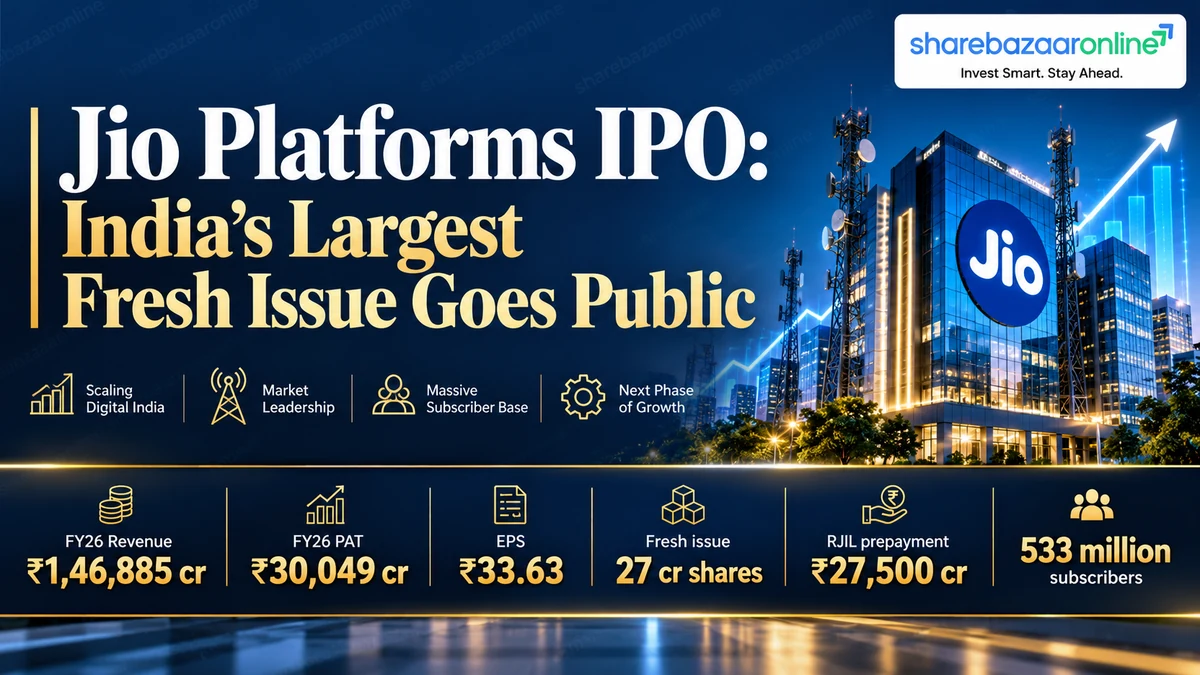
The company reported revenue from operations of ₹1,46,885 crore and profit after tax of ₹30,049 crore for FY26 on a restated consolidated basis, with basic earnings per share of ₹33.63. The headline use of proceeds is the prepayment of up to ₹27,500 crore of borrowings at the material subsidiary, Reliance Jio Infocomm Limited (RJIL), with the balance going toward general corporate purposes. The price band had not been disclosed in the RHP and will be announced ahead of the opening date.
Why This Matters
Jio is not coming to the market as a loss-making growth story asking investors to fund its runway. Its cash generation has already turned decisively. EBITDA less cash capital expenditure rose from roughly ₹1,449 crore in FY24 to about ₹42,071 crore in FY26, a swing that reflects how quickly the heaviest phase of the 5G build is receding in the rear-view mirror. For retail investors who have watched the IPO queue fill with companies that burn money, a self-funding platform with falling capex intensity is a different proposition.
The issue also matters for its sheer scale and cap table. With Google and Meta already holding a combined stake of around 17.6% from their 2020 investments of more than ₹77,000 crore — and neither selling in this IPO — the offer gives public investors entry into a business whose ownership already blends telecom with global technology capital.
Key Highlights
The Offer
- Fresh issue of up to 27 crore equity shares, face value ₹10 each
- No offer for sale — 100% primary capital raise
- Employee reservation up to ₹500 crore; RIL shareholders reservation up to ₹2,500 crore
- Anchor bidding: October 19, 2026
- Issue opens October 21, closes October 23, 2026
- Listing on BSE and NSE (NSE designated)
The Business
- FY26 revenue from operations: ₹1,46,885 crore
- FY26 profit after tax: ₹30,049 crore; basic EPS ₹33.63
- Q1 FY27 revenue: ₹39,173 crore; PAT ₹7,764 crore
- Net worth of ₹3,41,779 crore as at June 30, 2026
- 533 million subscribers; around 60% of India's mobile data traffic
- Proceeds to prepay up to ₹27,500 crore of RJIL borrowings
Detailed Analysis
A fresh issue aimed squarely at deleveraging
The structure is unusually clean. Of the money raised, up to ₹27,500 crore is earmarked to prepay external commercial borrowings sitting at RJIL — dollar- and yen-denominated term loans arranged with a syndicate of global banks to fund the 5G network build. The RHP states that the amount used for general corporate purposes will not exceed 25% of gross proceeds. Prepaying this debt lowers interest cost, improves net leverage and lifts the net asset value backing each share — a straightforward balance-sheet repair rather than an acquisition war chest.
Earnings that compound, not just grow
Revenue from operations climbed from ₹1,09,558 crore in FY24 to ₹1,46,885 crore in FY26, while profit after tax moved from ₹21,423 crore to ₹30,049 crore over the same window. The more telling shift is in capital intensity: cash capex fell from about 48.8% of revenue in FY24 to 23.3% in FY26, so a larger share of operating cash now converts into free cash flow instead of being swallowed by network spend.
From connectivity to a controlled interface
Jio's own framing is that connectivity is the customer-acquisition engine, not the final product. Affordable data — reported at around ₹7.9 per GB — built a base of 533 million users, who are then moved onto interfaces Jio controls: MyJio with 215.9 million monthly active users, more than 27 million home-broadband connections, and JioTeleOS on the household television. Those interfaces distribute commerce, advertising, cloud, enterprise software and AI services, each adding a layer of engagement and revenue on top of the original SIM.
Market Impact
An all-primary issue of this size reshapes near-term liquidity. Because there is no offer for sale, the capital does not recycle to selling shareholders; it enters the company and, in large part, retires debt. That tends to concentrate demand from domestic institutions, insurers and pension funds that have been under-allocated to a pure-play Jio exposure until now, alongside the retail and RIL-shareholder reservations built into the structure.
With the price band still to be fixed, the market's valuation debate will crystallise only once the band is published. Until then, the sensible reference points are the disclosed earnings base — ₹30,049 crore of FY26 profit and ₹33.63 of basic EPS — rather than any implied multiple.
Sector Impact
The listing arrives with Jio's competitive lead concentrated where it matters most for revenue. In the mid-tier B-circles — a roughly $13 billion pool growing near 9% a year — Jio is reported to hold about 46% against Airtel's 37%. The two are closely matched in the faster-growing C-circles, while Airtel still leads the metros, the smallest and slowest-growing segment. Fixed wireless access has become a second front: Jio's AirFiber footprint of about 14 million connections gives it a reported 78% share of that market and more than 42% of India's fixed-broadband base.
For the broader telecom and digital-media sector, a listed Jio sets a visible benchmark for how the market values connectivity bundled with advertising, commerce and AI distribution — a comparison every rival and every connected-TV platform will now be measured against.
Opportunities
Home broadband and FWA
A standalone 5G core plus 700 MHz spectrum lets JioAirFiber push speeds that wireless rivals linking 5G to older 4G cores struggle to match, turning an earlier, costlier technology choice into a broadband lead.
Advertising across the household
With around 65 million connected-TV households in India and connected-TV ad spend growing 42% in 2025, JioAds is positioned to coordinate a TV impression with a follow-up offer on the same household's phone — a measurable, cross-screen model.
Exporting the 5G stack
The 2018 Radisys acquisition and a cumulative patent portfolio of 6,817 filings give Jio the software and IP to pursue global fixed-wireless and 5G-deployment opportunities it sizes in the hundreds of billions of dollars.
AI and enterprise distribution
Ventures with Meta on enterprise AI and the distribution of Google's premium AI subscription through Jio point to monetisation layers that extend well beyond the recharge.
Risks
- Deferred spectrum liabilities. Jio carries about ₹1,04,514 crore in deferred spectrum payments, spread over a schedule that runs into the early 2040s. The annual burden is falling relative to revenue — from 4.04% in FY24 to 3.22% in FY26 — but the absolute obligation remains large.
- Pricing and valuation. The price band is not yet disclosed, so investors cannot assess the issue's valuation until it is announced.
- Promoter and group concentration. As a Reliance subsidiary with proceeds routed to prepay RJIL borrowings, Jio's fortunes remain closely tied to the wider Reliance group's strategy and execution.
- Regulatory and competitive intensity. Tariff dynamics, spectrum policy and a well-capitalised competitor in Airtel can all pressure margins and market share.
- No prior trading history. As a first-time listing, the shares have no established market, and post-listing price behaviour cannot be assured.
Future Outlook
3-Month Outlook
The immediate window is about price discovery and listing. Watch the price band, anchor allocation on October 19, subscription demand across QIB, NII and retail, and the take-up of the RIL-shareholder reservation.
6-Month Outlook
Attention shifts to the first post-listing results and whether the FY26 profit trajectory and falling capex intensity carry into the new fiscal, along with early signals on broadband and advertising monetisation.
12-Month Outlook
Over a year, the investment case rests on execution across the flywheel: converting the subscriber base into higher-value broadband, advertising, cloud and AI revenue, continued deleveraging after the IPO prepayment, and whether the global 5G-stack ambition begins to show commercial traction. All of this remains subject to competitive and regulatory developments and is not a forecast of returns.
Expert Observation
What separates this offer from a conventional telecom listing is the timing within Jio's own capital cycle. The company is coming public after the costliest years of its 5G build, with capex intensity more than halved and free cash flow turning sharply positive. The decision to raise only fresh capital and direct it at debt prepayment suggests a management focused on strengthening the balance sheet before chasing the next leg of growth — a sequencing that income-oriented and long-horizon investors tend to read favourably. The open question, as always with a marquee IPO, is the price at which that quality is offered, and that answer is still pending.
Investor Takeaway
Jio Platforms enters the market as a profitable, cash-generating platform rather than a growth gamble, with a clean all-primary structure and proceeds aimed at deleveraging. The disclosed FY26 earnings base is strong and the operating momentum is real. The missing variable is valuation: with no price band yet, the deciding factor — what investors pay for that earnings stream — cannot be judged. Prospective applicants should review the final price band, the full RHP risk factors, and their own objectives before deciding, and should treat this analysis as information, not a recommendation to subscribe.
Conclusion
The Jio Platforms IPO closes a long chapter of speculation about when India's biggest digital-telecom business would reach the public market. The RHP paints a picture of a company past its heaviest investment phase, generating substantial profit and using fresh capital to clean up its balance sheet rather than to survive. For retail and institutional investors alike, the quality of the asset is well documented in the filing. The verdict now hinges on the one number the prospectus leaves blank — the price.
Frequently Asked Questions
When does the Jio Platforms IPO open and close?
What is the size and type of the Jio Platforms IPO?
What is the Jio Platforms IPO price band?
Where will Jio Platforms shares be listed?
How will Jio use the IPO proceeds?
What were Jio Platforms' FY26 financials?
Is there a reservation for Reliance Industries shareholders?
Who are the promoters and major investors in Jio Platforms?
How large is Jio's subscriber and broadband base?
What is the main financial risk disclosed for Jio?
Who is the registrar to the Jio Platforms IPO?
Disclaimer
This article is for informational and educational purposes only and is based on the Red Herring Prospectus of Jio Platforms Limited dated October 14, 2026 and related company disclosures. It is not investment, legal or tax advice, and it is not a recommendation to buy, sell or subscribe to any security. Figures are as disclosed in the referenced sources; certain details, including the issue price band, were not available at the time of writing. Investments in securities are subject to market risks. Investors should read the complete RHP, including the risk factors, and consult a SEBI-registered financial advisor before making any investment decision. ShareBazaar Online does not guarantee any returns.
Stay Ahead with ShareBazaar Online
Track every major IPO, corporate action and market move with research-backed coverage built for Indian retail investors.
Explore ShareBazaar Online