

Executive Summary
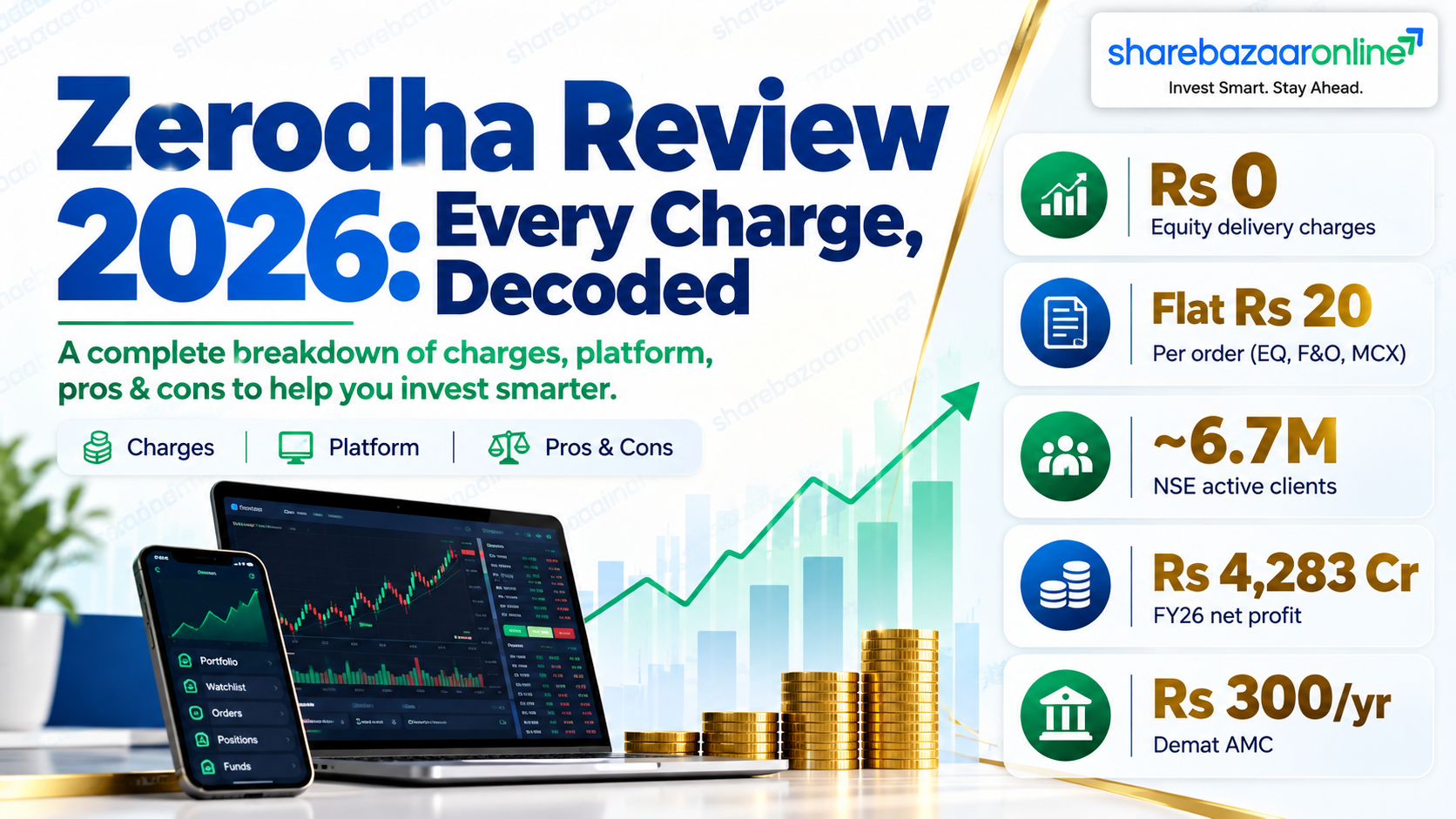
Zerodha remains the benchmark that every new discount broker in India is measured against. It pioneered flat-fee trading in 2010, and sixteen years later the core pricing promise still holds: ₹0 brokerage on equity delivery, a flat ₹20 (or 0.03%, whichever is lower) on intraday and futures, and a flat ₹20 per executed order on all options. Its Kite trading platform and Console reporting suite continue to set the usability bar for the industry.
What has changed is the business around that promise. Regulatory shifts in 2024 and 2025 — SEBI’s “true-to-label” charge rule and tighter derivatives norms — wiped out a large slice of broker rebate income and cooled the retail options frenzy. Zerodha’s own disclosures for FY26 show net profit up barely 1% and brokerage income down nearly 11%. For an investor choosing a broker today, the verdict is nuanced: Zerodha is still one of the safest, cleanest and most cost-efficient accounts you can open, but it is no longer the only serious option in a crowded field.
Why This Matters
Picking a stockbroker is one of the few financial decisions a retail investor makes only once every several years, yet it quietly shapes every rupee of cost after that. A difference of ₹20 per order sounds trivial until you are an active trader placing hundreds of orders a month, or a long-term investor paying nothing on delivery for a decade. The account you open also decides which platform you stare at daily, how fast your money moves, and how your tax statements are generated at year-end.
Zerodha’s scale makes it a default choice for first-time investors — but the firm’s slowing growth and the SEBI-driven reset of broking economics mean the “just open a Zerodha account” reflex deserves a fresh look in 2026. This review focuses on the four things that actually decide the choice: real charges, the platform experience, honest pros, and honest cons.
Key Highlights
Equity Delivery Brokerage
₹0
Free on all delivery trades and direct mutual funds
Intraday & Futures
₹20 cap
0.03% or ₹20 per executed order, whichever is lower
All Options (Eq / Currency / Commodity)
Flat ₹20
Per executed order, regardless of lot size
NSE Active Clients
~6.7 million
Roughly 14.9% market share (NSE, mid-2026)
Demat AMC
₹300 / yr
Plus GST; ₹0 under BSDA up to ₹4 lakh holdings
FY26 Net Profit
₹4,283 Cr
Up about 1% year-on-year, per company disclosures
Detailed Analysis: Zerodha Charges in 2026
The headline that pulls most searches — “Zerodha brokerage charges” — has a refreshingly short answer. Delivery investing costs nothing in brokerage. Buy a stock, hold it for years, sell it, and Zerodha takes no cut on the trade itself. Direct mutual funds through its Coin platform are free too. For a buy-and-hold investor, that is the whole story on brokerage.
Active traders meet the flat-fee model. Intraday equity and equity futures are charged 0.03% of turnover or ₹20 per executed order, whichever works out lower. Every options contract — equity, currency or commodity — is a flat ₹20 per executed order, which is where Zerodha’s cost advantage used to be sharpest against percentage-based full-service brokers. One detail worth knowing: if an account runs a negative balance or a cash-margin shortfall above ₹5 lakh, F&O brokerage doubles to ₹40 per order.
Brokerage by Segment
- Equity delivery₹0
- Equity intraday0.03% / ₹20
- Equity futures0.03% / ₹20
- Equity optionsFlat ₹20
- Currency / commodity futures0.03% / ₹20
- Currency / commodity optionsFlat ₹20
- Direct mutual funds (Coin)₹0
Account & Maintenance Costs
- Trading account AMC₹0
- Demat AMC (non-BSDA)₹300/yr + GST
- BSDA (up to ₹4 lakh)₹0
- DP charge on sell₹13.5 + GST / scrip
- Call & Trade₹50 / order
- Online account opening (RI)₹0 (free)
Online account opening for a resident individual is free per Zerodha’s current disclosure; the offline route may carry a charge. Statutory levies (STT, exchange, SEBI, GST, stamp duty) apply on top of brokerage and are not broker income.
The number that trips up new investors is the DP (depository participant) charge: ₹13.5 plus GST per scrip on any day you sell from your demat. It is flat, not percentage-based, so it stings small sells more than large ones. Combined with the ₹300 demat AMC, the real-world annual cost of a Zerodha account for a modest delivery investor is low but not literally zero — a distinction the “free” headline tends to blur.
Report 1C: Investor Complaints on NSE
A useful, often overlooked check before choosing any broker is the exchange’s own complaint record. NSE’s “Report 1C – Redressal of complaints lodged by clients against trading members” tracks, financial year by financial year, how many complaints a member received against its active-client base. For Zerodha Broking Limited, the figures stay strikingly low relative to its scale.
| Financial Year (NSE) | Active Clients | Complaints Received | Ratio |
|---|---|---|---|
| 2026–27 (current, partial) | 67,96,854 | 327 | 0.0048% |
| 2025–26 | 68,62,233 | 734 | 0.0107% |
| 2024–25 | 78,88,964 | 1,075 | ~0.01% |
| 2023–24 | 73,92,836 | 567 | <0.01% |
| 2022–23 | 63,92,902 | 446 | <0.01% |
Source: NSE Report 1C (complaints against trading members), as disclosed for Zerodha Broking Limited. FY 2026–27 is in progress, so its figures are partial. The resolved/pending breakdown is not available in the accessed disclosure — Data Not Available in the Official Report for those fields; verify on NSE directly. A low complaint ratio is useful context, not an endorsement or ranking of the broker by any exchange or regulator.
How to Open a Zerodha Account
Zerodha opens a combined demat and trading account (equity, F&O, currency and commodity segments) for resident individuals, with minor and NRI accounts available separately. A resident Indian whose mobile number is linked to Aadhaar can complete the whole thing online; anyone without an Aadhaar-linked mobile uses the offline route.
Documents you need
- PAN
- Aadhaar linked to your mobile (for OTP e-sign)
- Bank proof — cancelled cheque or statement showing account number, IFSC & MICR
- Income proof — only if you want F&O / commodity (salary slip, ITR, Form 16, bank statement, etc.)
- Signature + a live camera (in-person verification)
Online steps (resident individual)
- Start on the Kite app or signup.zerodha.com; verify mobile & email via OTP
- Enter PAN and date of birth; choose segments and accept terms
- Complete Aadhaar KYC via DigiLocker (OTP + PIN)
- Add personal details and link your bank (UPI or manual)
- Do the camera-based in-person verification and add your signature
- E-sign the forms with Aadhaar OTP; upload bank/income proof if prompted
Online account opening for a resident individual is free per Zerodha’s current disclosure. Zerodha states the account is typically activated within 48 working hours of e-signing, after which login credentials are emailed; orders can be placed only once the exchanges activate the account. Track your application or get help at support.zerodha.com. Never share your actual PAN, Aadhaar or bank numbers publicly. Charges, documents and timelines can change — confirm the current details on Zerodha’s official account-opening page before applying.
The Platform: Kite, Console & the Ecosystem
Zerodha’s platform is the real reason many traders stay. Kite, available on web and mobile, is clean, fast and famously uncluttered — charts powered by TradingView and ChartIQ, GTT (Good Till Triggered) orders for set-and-forget entries and exits, basket orders, and a well-regarded market-depth view. Two features stand out for investor protection: “Nudge,” which flags risky or illiquid trades before you place them, and the “Kill Switch,” which lets you lock yourself out of a segment to curb impulsive trading.
Reporting lives in Console, Zerodha’s back-office, where profit-and-loss, holdings and ready-to-file tax statements are generated — a genuinely strong point at filing season. Around these sit Coin for zero-commission direct mutual funds, Kite Connect for developers building trading APIs, and a partner ecosystem that includes Varsity (free investor education), Streak (no-code algo trading), Sensibull (options strategy), smallcase (thematic baskets), GoldenPi (bonds) and Ditto (insurance advisory).
Broking-Industry Impact
Zerodha did not just build a business; it reset the economics of Indian broking. The flat-fee model it introduced forced full-service incumbents to launch discount arms and pushed brokerage toward zero across the industry. That success is now the source of its pressure. When price is already near the floor, there is little room left to compete on cost — so newer rivals compete on app design, onboarding speed and marketing spend, areas where a deliberately low-key, bootstrapped firm chooses not to chase.
The regulatory reset sharpened this. SEBI’s “true-to-label” rule, effective October 2024, stopped brokers from pocketing the gap between what exchanges charge and what clients pay. Zerodha’s disclosed net transaction charges fell to zero in FY26 from around ₹400 crore a year earlier. Tighter derivatives rules — fewer weekly expiries, larger contract sizes and upfront premium collection — then cooled the retail options volumes that had been a profit engine for every discount broker.
Where Zerodha Sits in the Sector
By active clients, Zerodha still commands roughly 14.9% of NSE’s registered base of around 6.7 million accounts in mid-2026 — a commanding position, but a share that has drifted down steadily since 2023 as app-first rivals added users faster. The firm’s response has been to stay profitable rather than to chase growth at any cost: FY26 net profit held near ₹4,283 crore even as brokerage income slipped about 11%, cushioned by interest income on client funds and a mutual-fund book that has scaled into lakhs of crores of assets.
The sector story for investors is therefore one of maturity, not disruption. The land grab for first-time demat accounts is slowing, and brokers are shifting toward wealth products, lending against securities and advisory. Zerodha’s refusal to take outside funding or pursue a listing keeps it insulated from the quarterly growth pressure that pushes some rivals toward aggressive, sometimes risky, monetisation.
Opportunities (The Pros)
Genuinely low, predictable cost
Free delivery, free direct mutual funds, and a hard ₹20 cap on trades make long-term investing close to cost-free and trading costs easy to predict.
Best-in-class platform & reporting
Kite is fast and distraction-free; Console’s tax and P&L statements save real time at filing season.
Stability and trust
Profitable, bootstrapped, no external investors and no listing pressure — a reassuring profile for holding money with a broker.
Investor-first design
Nudge warnings, the Kill Switch and the free Varsity education library point users away from reckless trading rather than toward it.
Risks (The Cons)
No 3-in-1 bank integration
Unlike bank-backed brokers, Zerodha is not linked to a savings account, so funds move via UPI or transfer rather than seamlessly.
Support can lag at peak times
With millions of clients, ticket-based support is a recurring complaint during high-volatility sessions.
Occasional peak-load outages
Like most high-volume brokers, Kite has seen technical glitches on volatile days — a real risk for active traders.
Flat fees less edge on small options
A flat ₹20 is costly relative to tiny trades, and a few rivals now undercut on specific segments or offer zero-fee hooks.
Future Outlook
3-Month View
Pricing is unlikely to change. Expect incremental Kite and Console updates and steady, not spectacular, client additions as the account-opening surge normalises.
6-Month View
Watch for deeper pushes into wealth, bonds and loan-against-securities as broking revenue stays capped by the SEBI charge reset.
12-Month View
Market-share defence against app-first rivals becomes the key storyline. Zerodha’s bet is that trust and stability retain serious investors even as cheaper hooks tempt newcomers.
What To Monitor
NSE active-client share trends, any revision to demat AMC or DP charges, platform uptime on volatile days, and new SEBI norms on data protection and derivatives.
Expert Observation
A recurring theme in Zerodha’s own public communication is caution about data and conduct — and that lands squarely within the Digital Personal Data Protection Act, 2023. Under the DPDP framework, a stockbroker handling KYC, bank and trading data is a “Data Fiduciary” bound to collect data only for a specified purpose with clear consent, to let clients access and correct their data, and to report any breach. For investors, the practical read is simple: platform trust is now a regulated obligation, not a courtesy. A broker’s security posture and data handling belong on the checklist alongside brokerage and AMC.
Editorial analysis by the ShareBazaar Online research desk. This is interpretation, not a company statement, legal opinion, tax opinion or investment recommendation.
Investor Takeaway
For a long-term, delivery-focused investor, Zerodha is still close to an ideal first account — zero delivery brokerage, free direct mutual funds, strong reporting and a stable parent. For a high-frequency options trader, the flat ₹20 is competitive but no longer uniquely cheap, so it is worth comparing segment-by-segment against newer rivals. The deciding factors in 2026 are rarely headline brokerage; they are DP charges, demat AMC, platform reliability on volatile days and the quality of support when something goes wrong. Map those four against how you actually trade before you open — or switch — an account.
Conclusion
Zerodha in 2026 is a mature market leader rather than the insurgent it once was. The charges that made it famous are intact, the platform is still among the best in the country, and the business is profitable and self-funded. The caveats — slowing client growth, flat-fee math that favours larger trades, and the usual peak-load niggles — are real but manageable for most investors. If you value cost discipline, clean technology and institutional stability, it remains a strong default. If you trade in ways where a specific rival undercuts it, the gap is now small enough that comparison genuinely pays.
Frequently Asked Questions
What are Zerodha’s brokerage charges in 2026?
Is equity delivery really free on Zerodha?
What is the Zerodha demat account annual maintenance charge (AMC)?
What are Zerodha’s account opening charges?
What is the DP charge on Zerodha and when is it applied?
What are Zerodha’s options trading charges?
Which platforms does Zerodha offer?
How many clients does Zerodha have in 2026?
Is Zerodha safe and SEBI-registered?
What is Zerodha’s complaint record on NSE?
Does Zerodha charge for mutual fund investments?
What are the main drawbacks of using Zerodha?
Is Zerodha good for beginners in 2026?
Disclaimer
Compare Brokers the Smart Way with ShareBazaar Online
Charges, platforms and real pros and cons — side by side. Make your broking decision with clear, verified data instead of marketing hype.