

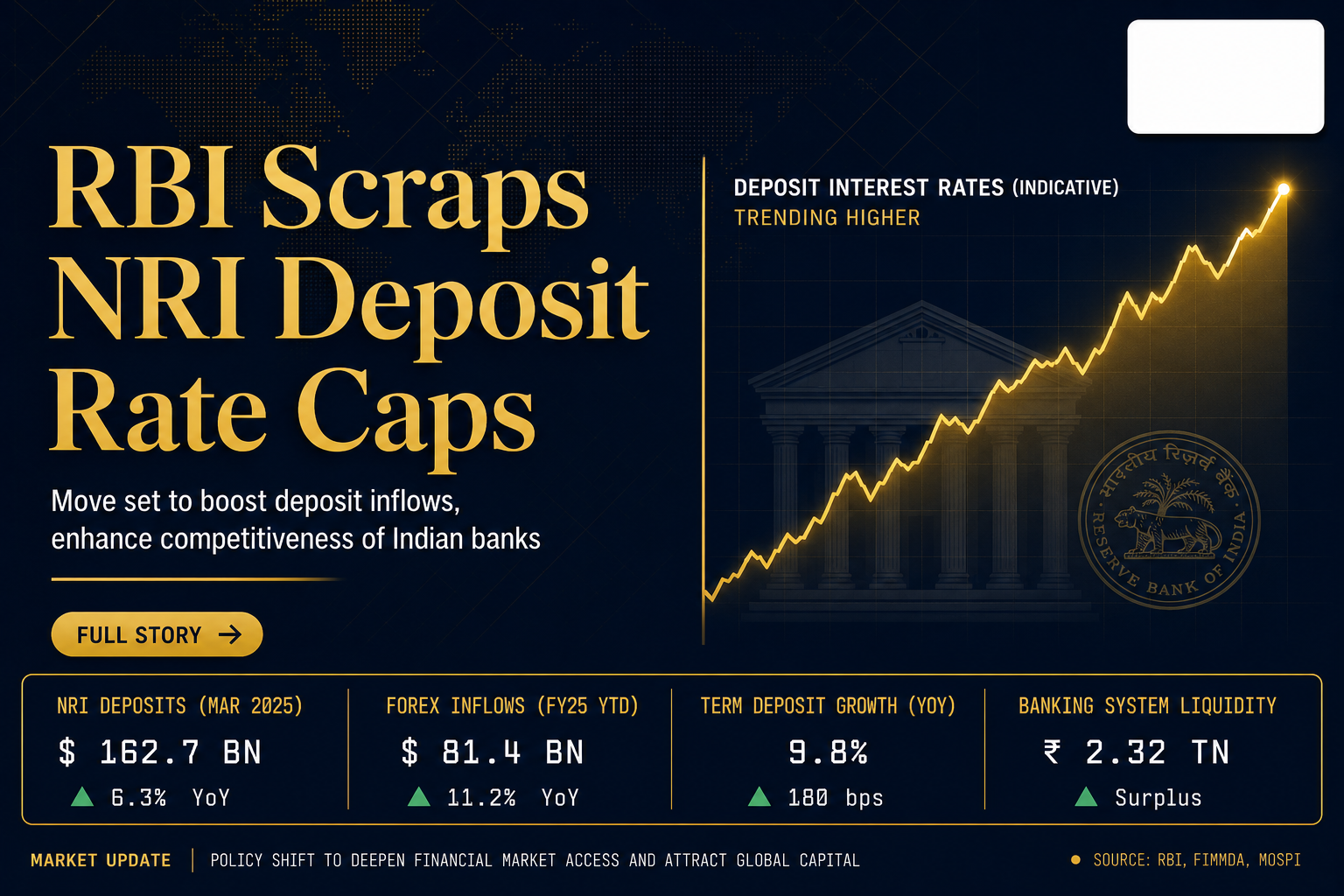
The Reserve Bank of India has pulled back one of its longest-standing guardrails on foreign currency deposits. Effective June 17, 2026, banks no longer face a ceiling on the interest they can offer on fresh FCNR(B) deposits in the three-to-five-year bucket, and a similar cap has been lifted on NRE deposits with tenors of three years or more. The window stays open till September 30, 2026. It's a narrow, time-boxed move on paper, but the timing and scale of what it's meant to unlock — SBI Research has pencilled in $55-65 billion, or roughly ₹5.2-6.2 lakh crore, of inflows for FY27 — make this one of the more consequential banking-sector decisions of the year.
Why This Matters
India's external account has been under quiet but persistent strain. Foreign portfolio investors have been net sellers in Indian equities for stretches this year, oil prices have stayed elevated, and geopolitical tension in West Asia hasn't helped sentiment around the rupee. Rather than reach for a blunt instrument like a rate hike, the RBI has gone back to a tool it trusts: paying NRIs more to park dollars, pounds and other hard currency in Indian banks. The central bank tried this in 2013 during the taper tantrum and it worked — close to $34 billion came in within three months. This time the ambition is even bigger.
Key Highlights
- RBI withdrew the interest rate ceiling on fresh FCNR(B) deposits with maturities of three to five years, effective June 17, 2026.
- A parallel cap on NRE deposit rates for tenors of three years and above has also been scrapped.
- Both relaxations run until September 30, 2026, after which the earlier rate framework reverts unless RBI extends it.
- The amendment comes under Section 35A of the Banking Regulation Act, 1949, and modifies the RBI's Commercial Banks – Interest Rate on Deposits Directions, 2025.
- Transfers from NRO to NRE accounts are specifically excluded from the relaxed rate benefit.
- Banks had already begun repricing aggressively after RBI's special swap window: SBI raised FCNR(B) rates by up to 295 basis points, HDFC Bank by up to 260 bps, Karur Vysya Bank to 7% from 2.63%, and AU Small Finance Bank to 7.1%.
- Outstanding FCNR(B) deposits stood at $33.8 billion as of March 2026, against $32.8 billion a year earlier.
Detailed Analysis
What makes this move different from a routine regulatory tweak is the machinery sitting behind it. Before this relaxation, FCNR(B) deposits in the three-to-five-year bucket were capped at the overnight alternative reference rate (or swap rate) plus 350 basis points. That ceiling effectively put a lid on how aggressive banks could get even when they wanted to chase NRI money. RBI has now taken that lid off entirely for this specific bucket, while leaving the one-to-three-year tenor untouched — a deliberate signal that the central bank wants longer-duration, stickier foreign currency on bank balance sheets, not short-term hot money that can exit just as fast as it arrived.
There's a second layer to this that matters for anyone trying to size the opportunity. Earlier this month, RBI rolled out a special swap facility that absorbs most of the hedging cost banks would otherwise bear on these deposits — estimated at around 3.5 percentage points. That single change is what allowed lenders to suddenly offer 190 to 300 basis points more without squeezing their margins. Removing the rate ceiling now is the second half of that playbook: banks have the cost relief, and now they have the room to actually use it.
The NRE side of the change is narrower in scope but arguably just as meaningful for retail-facing NRI banking. NRE and NRO deposit rates in India have always been tethered to what banks pay on comparable domestic rupee term deposits — a rule that remains in force for shorter tenors and for NRO accounts. For NRE deposits of three years and above, that tether is gone for now, giving banks a freer hand to price competitively against what NRIs could earn parking the same rupee-equivalent money elsewhere.
Market Impact
For the banking sector, this is a deposit-mobilisation story first and a balance-sheet story second. SBI Research's base case has FCNR(B) alone pulling in $40-45 billion, with the broader package — including swap facilities for ECBs, FCCBs and overseas foreign-currency borrowings — adding another $15-20 billion. Put together, that's enough to lift system-wide deposit growth toward 14.5-15% in FY27 and meaningfully narrow the credit-deposit gap that has been a recurring worry for Indian banks chasing loan growth without matching deposit support.
On the currency side, the read-through is constructive for the rupee. SBI Research's updated balance-of-payments estimate has swung from a projected deficit of $65-70 billion to a potential surplus of $5-10 billion for FY27 once these inflows are factored in — a swing large enough to change the conversation around current account financing for the year. The current account deficit itself is now expected to stay contained at 1.5-1.7% of GDP.
Sector Impact
Banks with an established NRI franchise stand to gain the most ground. SBI's dedicated FCNR(B) Advantage Deposit Scheme, HDFC Bank's aggressive repricing, and smaller, nimbler players like AU Small Finance Bank and Karur Vysya Bank pushing peak rates above 7% all point to a competitive scramble for diaspora deposits over the next 100-odd days. For NBFCs and corporates that rely on ECB and FCCB routes, the parallel swap facility on overseas borrowings opens a cheaper financing channel at a time when domestic credit costs remain elevated. Insurance and wealth management players catering to NRI clients will likely see this as a fresh product conversation to have with customers who have, until now, defaulted to US treasuries or local-market fixed income.
Opportunities
NRIs sitting on dollar, pound or other hard-currency savings now have a genuine arbitrage window. Banks are offering deposit rates of roughly 5.5-6% on FCNR(B) paper, comfortably ahead of the approximately 4.2% available on three-year US Treasuries, with no currency conversion risk on the deposit itself since FCNR(B) is held in foreign currency. For NRE depositors with a three-year-plus horizon, the lifted cap means more banks competing harder for that business through September 30. Domestic banks gain access to a cheaper, RBI-subsidised funding pool at a moment when loan growth continues to outpace deposit growth industry-wide.
Risks
The relaxation is explicitly temporary, and that creates its own pressure: anyone hoping to lock in today's elevated rates needs to act before the September 30 deadline, after which pricing could snap back toward the old framework unless RBI extends it. There's also a fairness question already surfacing in public discussion — domestic rupee depositors aren't seeing anything close to this kind of rate uplift, even as banks roll out red-carpet pricing for NRI dollar deposits. For banks themselves, locking in three-to-five-year liabilities at unusually high rates carries a cost-of-funds risk if global rates fall faster than expected over that horizon. And while the SBI Research inflow estimate is built on credible assumptions, actual mobilisation will depend on global liquidity conditions that are, by Barclays' and MUFG's more conservative estimates, tighter than they were in 2013.
Future Outlook
3-Month Outlook
Expect a visible wave of bank-level rate announcements through July and August as lenders compete for NRI deposits before the September 30 window shuts. FCNR(B) inflows should start showing up meaningfully in RBI's forex reserve data and bank deposit growth numbers within this stretch.
6-Month Outlook
If inflows track anywhere near SBI Research's estimate, the rupee should find a sturdier floor and current account financing pressure should ease, giving RBI more room to manage monetary policy without leaning on currency intervention as heavily.
12-Month Outlook
By mid-2027, the real test will be whether this was a one-off liquidity bridge or whether RBI extends and formalises the relaxed framework. The 2013 precedent suggests these windows tend to get used opportunistically and then close — banks that built strong NRI relationships during this period will likely retain a durable deposit-franchise edge.
Expert Observation
Market commentary around this move keeps circling back to one comparison: 2013. Back then, a similar FCNR(B) swap scheme pulled in about $34 billion in just three months and is widely credited with stabilising a rupee that was in genuine free-fall. This time, the starting point is less dire, but the toolkit is familiar enough that bank treasury desks and forex strategists are already framing September 30 as the next big date to watch on the calendar — not unlike a policy deadline ahead of a rate decision.
Investor Takeaway
For NRI depositors, the window between now and September 30 looks like the most attractive entry point for FCNR(B) and longer-tenor NRE deposits seen in years, with rates climbing past 7% at some lenders. For equity investors, the read-through is more about macro stability than direct stock-picking — a steadier rupee and improved forex reserves reduce one of the tail risks that has weighed on FII sentiment toward Indian equities, which is constructive for banking, NBFC and rate-sensitive sectors broadly. Bank stocks with strong NRI deposit franchises — SBI, HDFC Bank, and select private and small finance banks pushing aggressive FCNR(B) schemes — are worth tracking for deposit-growth commentary in the coming quarters.
Conclusion
This isn't a headline-grabbing rate cut or a dramatic forex intervention — it's a quieter, more technical move that nonetheless tells you a lot about where RBI's priorities sit right now. By making it cheaper and easier for banks to chase NRI deposits, the central bank is buying itself breathing room on the external account without touching the repo rate. Whether it delivers anywhere close to the ₹5.2-6.2 lakh crore SBI Research has modelled will become clearer well before the September 30 deadline arrives.
Track every RBI policy move, bank rate revision, and rupee data point as it breaks — only on ShareBazaarOnline. Bookmark our Markets desk for real-time coverage of NRI deposit schemes, banking sector earnings, and forex trends that move your portfolio.