

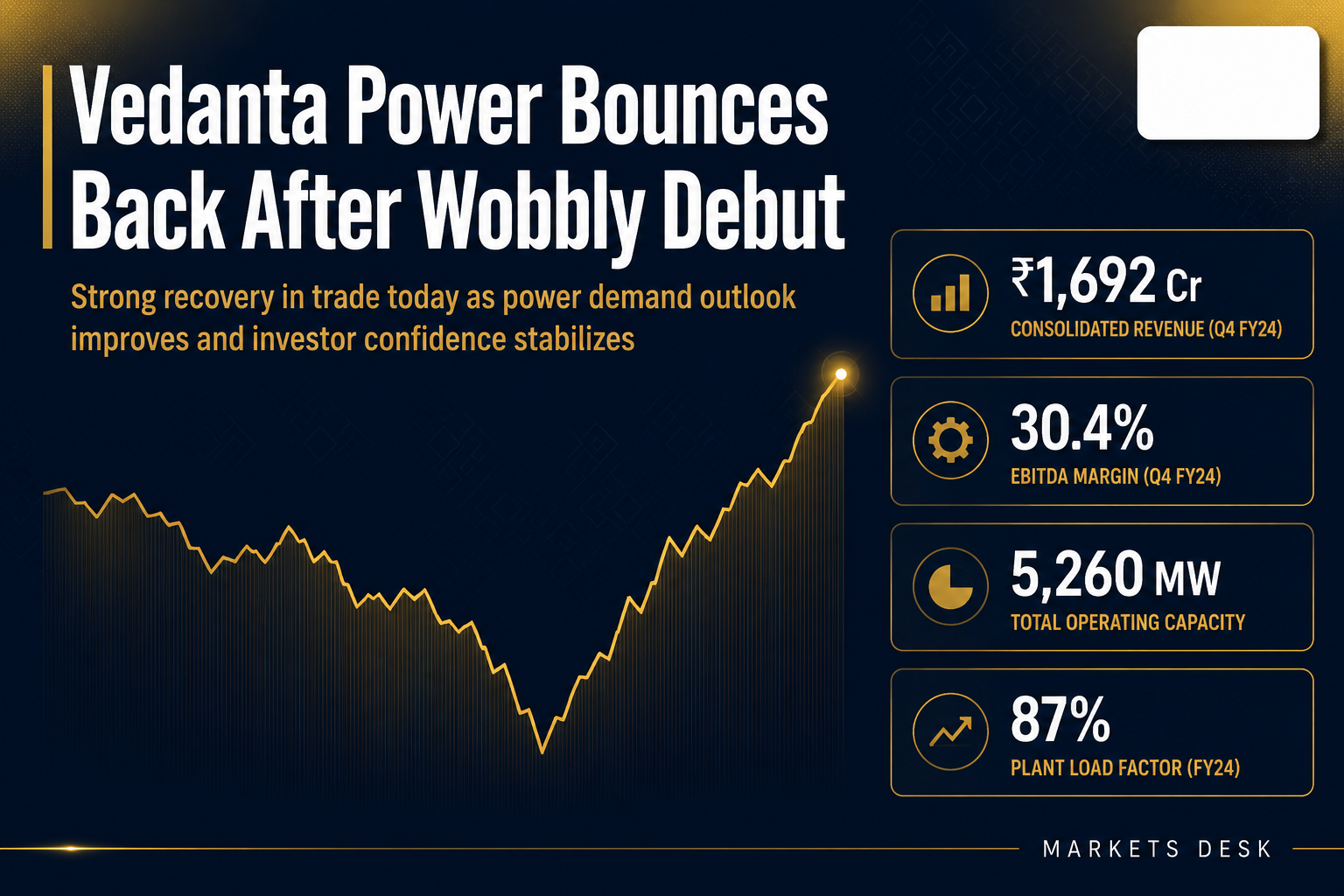
Vedanta Power Bounces Back After Wobbly Debut — What It Signals For the Demerged Entities
The first week of trading for Vedanta's four newly demerged businesses was always going to be watched closely, and Tuesday gave investors their first real signal of how the market plans to price each piece separately. Shares of Vedanta Power Ltd advanced in trade, climbing 4.88 per cent to hit a day high of Rs 42.95, a day after the stock had ended its debut session lower. For a stock that didn't exist as a standalone listed entity a week earlier, that's a meaningful early data point.
Why This Matters
Demergers are messy in the first few sessions almost by design. Index funds need to rebalance, arbitrage desks need to figure out fair value, and retail shareholders who didn't ask for four new stock symbols in their demat account often sell first and ask questions later. Vedanta Power was one of four companies — alongside Vedanta Iron and Steel Ltd, Vedanta Aluminium Metal Ltd and Vedanta Oil and Gas Ltd — that listed on the exchanges on Monday, June 15. Watching which of the four finds buyers first tells you something about where the market thinks the real value sits inside what used to be one diversified conglomerate.
Key Highlights
- Vedanta Power climbed to a day high of Rs 42.95, up 4.88 per cent in Tuesday's session
- The stock had closed its debut day lower before recovering
- Three sister entities — Iron and Steel, Aluminium Metal, and Oil and Gas — listed on the same day
- Eligible Vedanta shareholders who held the stock before the record date of May 1, 2026, received one share each of Vedanta Aluminium Metal, Vedanta Power, Vedanta Oil and Gas and Vedanta Iron and Steel for every Vedanta share held Business Today
- On debut day, Vedanta Iron and Steel closed 5.30 per cent higher while Vedanta Oil and Gas and Vedanta Aluminium Metal both settled 5 per cent lower, hitting their lower circuit limits
- Vedanta Power itself closed debut day with a modest gain of 0.24 per cent.
Detailed Analysis
What's notable here isn't the size of the move — 4.88 per cent on a sub-Rs 50 stock is still a small absolute number — it's the direction of the rotation. The day-one results split the four entities into two clear camps: the businesses tied to commodity price cycles (Oil and Gas, Aluminium) got hit with lower circuits, while the businesses tied to steadier, contracted cash flows (Power, and notably Iron and Steel) held up or gained. That's not a coincidence. Power generation businesses typically carry long-term power purchase agreements that insulate revenue from commodity swings, and the market appears to be pricing that defensiveness in almost immediately, even with limited trading history to lean on.
Vedanta's demerger itself was approved by the NCLT in December last year, which means this listing has been a long time coming — institutional desks have had months to model out sum-of-the-parts valuations. The early price action suggests those models are now getting tested in real time, and the commodity-linked units are facing more skepticism than the steadier power business. Upstox
Market Impact
For the broader Vedanta Resources structure, a smooth-ish demerger matters beyond just these four stocks. Vedanta Chairman Anil Agarwal has hinted at a possible overseas relisting of parent Vedanta Resources, though he's said such a move is unlikely before the next three years. A demerger that settles down cleanly — where each business finds a stable, independently-justified price — strengthens the case that unbundling unlocks value, which is the entire thesis institutional investors will be testing over the coming weeks.
Sector Impact
This isn't just a Vedanta story. India's broader trend of conglomerates splitting into focused, sector-pure listed entities (Reliance's earlier moves, the Adani group's structure, and now Vedanta) gives investors a template to study. If Vedanta Power and Vedanta Iron and Steel continue to outperform their commodity-linked siblings, expect renewed debate among other diversified Indian conglomerates about whether demerger-driven re-rating is worth the operational complexity of running four separate listed companies instead of one.
Opportunities
Investors who already held Vedanta stock before the May 1 record date now effectively own a basket of four specialized businesses instead of one diversified one — and they get to choose which to hold and which to trim. Vedanta Power's early resilience, paired with Iron and Steel's stronger debut, suggests these may be the two entities institutional desks are accumulating first, particularly for investors looking for steadier, less commodity-cyclical exposure within the broader metals and mining space.
Risks
The flip side is real: Vedanta Oil and Gas and Vedanta Aluminium Metal both hit their 5 per cent lower circuits on debut, and commodity-linked businesses remain exposed to global price swings that are entirely outside management's control. There's also a liquidity constraint worth flagging for new shareholders — the T+1 settlement structure means investors who received these shares can't immediately flip them on listing day, which can exaggerate early price moves in either direction as supply and demand work themselves out over the following sessions.
Future Outlook
3-Month Outlook: Expect continued volatility as institutional ownership patterns settle and index inclusion decisions get made for each of the four entities. Price discovery in newly demerged stocks typically takes 60–90 trading sessions to stabilize.
6-Month Outlook: The commodity-linked entities (Aluminium, Oil and Gas) will likely track global metal and crude benchmarks more closely than they did as part of the combined Vedanta structure, while Power should continue trading on its own merits — utilization rates, power purchase agreement renewals, and capacity expansion plans.
12-Month Outlook: If the sum-of-the-parts thesis holds, the combined market capitalization of the four entities should, over time, reflect a premium to what Vedanta traded at as a single conglomerate — assuming each business can demonstrate it's better off being valued independently rather than buried inside a diversified holding structure.
Expert Observation
Sector analysts have generally framed conglomerate demergers as value-unlocking events precisely because diversified holding companies tend to trade at a discount to the sum of their individual businesses — investors struggle to value a single stock that's simultaneously exposed to power generation, aluminium smelting, oil exploration, and steel production. The early split in performance between Vedanta Power and the commodity-linked units is a textbook example of that discount starting to unwind, business by business.
Investor Takeaway
If you're holding shares across all four demerged entities, this is the moment to actually look at each business on its own terms rather than treating them as a single Vedanta position. Power's steadier debut suggests the market is rewarding predictability over scale right now — worth factoring in if you're deciding which of the four to hold for the long run and which to trade more tactically.
Conclusion
One day's price action doesn't make a trend, but it does offer the first real clue about how the market plans to treat Vedanta's four newly independent businesses. Power's bounce-back, paired with Iron and Steel's stronger debut, suggests defensiveness is being rewarded early — while the commodity-cyclical units will need more time, and probably more clarity on global metal and crude prices, before investors commit.
Track all four Vedanta demerged stocks in real time, compare performance side by side, and get our take on which one fits your portfolio — only on ShareBazaarOnline.