

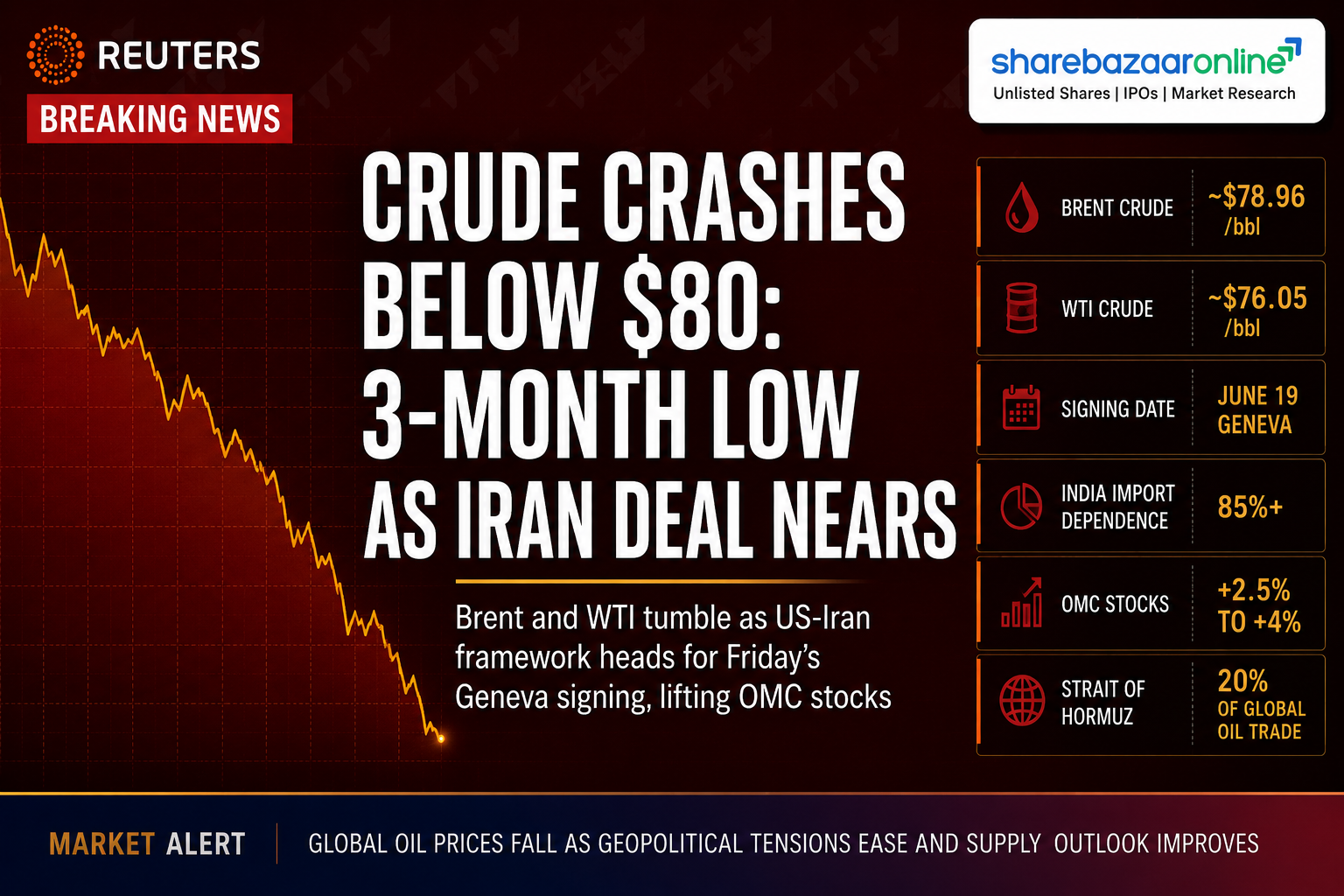
Crude Oil Crashes Below $80 as US-Iran Deal Heads for Geneva Signing — What It Means for Your Portfolio
There's a particular kind of relief that shows up in oil markets when a war finally looks like it's ending. You can see it in the charts. Brent crude, the global benchmark that had spent the better part of four months trading like a barometer for Middle East anxiety, slid to its lowest level since early March this week, dropping toward $79 a barrel. WTI followed it down into the mid-$70s. For a market that had been bracing for prices to stay elevated indefinitely, the speed of the retreat has been almost as notable as the retreat itself.
The trigger is straightforward enough on paper: Washington and Tehran have signaled they're ready to put pen to paper on a framework agreement, with a formal signing ceremony expected in Geneva on June 19. The deal, as both sides have described it, would reopen the Strait of Hormuz to commercial shipping and lift the US blockade on Iranian ports. What it actually contains in terms of nuclear provisions remains a separate, 60-day conversation — but for now, traders are pricing in the headline, not the fine print.
That distinction matters more than it might seem.
Why This Matters
Oil prices don't move in straight lines, and they rarely move for simple reasons. This decline is happening against a backdrop where more than four months of conflict had pushed crude into territory most analysts hadn't planned for. The Strait of Hormuz — the narrow channel between Iran and Oman that carries roughly a fifth of the world's oil and LNG trade — had been effectively choked off for stretches of that period. Gulf producers lost output. Shipping insurers got nervous. Tanker operators rerouted where they could and waited where they couldn't.
So when a deal that promises to unwind all of that gets announced, the market's first instinct is to sell the fear premium. That's exactly what's happened. The question every trading desk is now asking isn't whether the news is good — it clearly is — but whether the market has gotten ahead of itself.
Key Highlights
- Brent crude fell to around $78.96 a barrel, its first close below $80 since March
- WTI crude dropped roughly 5.8% to settle near $76.05 a barrel
- The framework agreement is scheduled for formal signing in Geneva on June 19
- The deal would reopen the Strait of Hormuz and end the US blockade on Iranian ports
- A separate 60-day negotiation track will address Iran's nuclear program
- Indian oil marketing companies — HPCL, BPCL, and IOCL — rallied between 2.5% and 4% on the news
- Upstream producers ONGC and Oil India moved lower on the same news, reflecting the opposite earnings exposure
- Despite the drop, prices remain meaningfully above pre-conflict levels from earlier this year
Detailed Analysis
What's striking about this move is how cleanly it splits the energy trade into winners and losers within the same sector — something retail investors often miss when they think of "oil stocks" as one basket.
Refiners and fuel retailers benefit when crude gets cheaper, because their raw material costs fall while their selling prices — especially in regulated markets like India's — adjust more slowly. That's the mechanical reason HPCL, BPCL, and IOCL have been climbing even as the broader narrative around oil sounds bearish. Upstream producers like ONGC and Oil India sit on the other side of that same trade: their revenue is directly tied to the price of the crude they pump, so a falling benchmark squeezes their realizations.
There's also a structural argument worth taking seriously, and it's one that several analysts have been making in the days since the announcement. The International Energy Agency's most recent assessment pointed to more than 14 million barrels per day of supply that had been shut in since the conflict escalated, with cumulative losses from Gulf producers running past a billion barrels. That kind of damage doesn't reverse the moment a press release goes out. Ships still need insurers willing to cover Hormuz transits again. Production needs to physically come back online. None of that happens on the same timeline as a market's initial sentiment swing.
Rystad Energy's chief economist captured this tension well in a note circulated this week, framing the gap between sentiment and supply as the thing traders should be watching most closely. Markets have, in effect, priced in the best-case outcome before the mechanics of that outcome have actually played out.
Market Impact
For broader equity markets, the read-through has been mostly positive. Lower crude flows through to lower input costs across aviation, logistics, chemicals, and consumer goods — sectors that had been quietly absorbing higher fuel and freight costs for months. In India specifically, the benefits extend further: a softer oil import bill eases pressure on the current account, takes some heat off the rupee, and gives the Reserve Bank of India a little more breathing room on the inflation side of its rate calculus.
That said, the rally in risk assets has come with a caveat attached from multiple corners of the market. Traders who lived through earlier false starts in this conflict — and there have been several — are reluctant to treat this signing as the final word until ships are actually moving through Hormuz on a normal, sustained basis. As one tanker industry executive put it bluntly this week, belief will come from watching vessels transit safely and repeatedly, not from a signing ceremony alone.
Sector Impact
Oil Marketing Companies (HPCL, BPCL, IOCL): Direct beneficiaries. Lower crude reduces their cost of goods sold faster than regulated retail prices typically adjust, which can widen marketing margins — at least temporarily, and assuming the government doesn't use the room to cut retail fuel prices instead.
Upstream Producers (ONGC, Oil India): Negatively exposed. Their revenue per barrel falls in lockstep with the benchmark, which is why both stocks moved lower even as the broader market cheered the news.
Aviation and Logistics: Indirect beneficiaries. Jet fuel and freight costs make up a significant chunk of operating expenses in these sectors, so sustained crude weakness should show up in margin commentary over the next couple of quarters.
Banking and Rate-Sensitive Sectors: A softer inflation outlook, driven partly by cheaper fuel, gives the RBI more flexibility — a dynamic that tends to be read favorably by bond markets and, by extension, rate-sensitive equities.
Opportunities
Investors looking at this development have a few distinct angles worth weighing. Oil marketing companies offer the most direct, near-term read on falling crude, though the extent of the benefit depends heavily on how much pricing room the government allows them to keep versus passing through to consumers. Aviation and logistics names offer a more indirect but potentially longer-duration opportunity if fuel costs stay soft through the year. And for investors with a macro lens, a stable-to-lower oil import bill supports the broader case for rupee stability and a less aggressive rate path from the RBI — both of which tend to be constructive for equities generally.
Risks
The single biggest risk hanging over this entire narrative is implementation. Framework agreements between adversarial governments have a well-documented history of slipping, stalling, or unraveling between announcement and execution — and this conflict has already produced more than one premature signal of de-escalation. Should the June 19 signing fail to produce a durable, transparent agreement, particularly around the unresolved nuclear provisions, the risk is that crude snaps back sharply, just as it has after previous false starts.
There's a second-order risk too: even in a best-case scenario where the deal holds, the physical normalization of Gulf shipping and production could take considerably longer than markets are currently pricing. A gap between "deal signed" and "supply actually restored" leaves room for renewed volatility in either direction.
Future Outlook
3-Month Outlook
Expect continued volatility tied to headline risk around the implementation of the agreement. If the Strait of Hormuz shows consistent, verified shipping traffic in the weeks following the June 19 signing, prices likely consolidate in a lower range, with technical support eyed near the 200-day moving average. Any visible friction in the nuclear-provision talks could quickly reverse sentiment.
6-Month Outlook
Assuming the deal broadly holds, the focus shifts to how quickly shut-in Gulf production returns to the market. Given the scale of the supply losses cited by the IEA, most forecasts still see the global oil market in a deficit through at least the fourth quarter of 2026, which argues against prices collapsing back to pre-conflict levels even if the geopolitical premium continues unwinding.
12-Month Outlook
A full normalization scenario would likely see oil settle into a range still somewhat elevated versus pre-conflict levels, reflecting the lasting cost of rebuilding shipping confidence, insurance frameworks, and Gulf production capacity. For India, a year of comparatively stable energy costs would be a meaningful tailwind for inflation management and fiscal planning, provided no fresh disruption emerges from the unresolved nuclear negotiation track.
Expert Observation
The most useful framing to come out of this week's commentary is the distinction between sentiment and supply. Markets are exceptionally good at repricing quickly on a single headline. They're far less good at anticipating how long the physical rebuild of shipping routes, insurance coverage, and production capacity actually takes. That gap is where the next leg of volatility, in either direction, is most likely to come from.
Investor Takeaway
This is a moment to separate the trade from the thesis. The trade — buying OMCs, trimming upstream exposure, leaning into rate-sensitive sectors — has already played out substantially in the days following the announcement. The thesis — that a durable peace meaningfully lowers India's energy import burden and supports macro stability — is sound, but its payoff depends entirely on an agreement holding through implementation, not just signing. Investors chasing the initial move without a clear view on execution risk are taking on more uncertainty than the headline suggests.
Conclusion
Markets have done what markets do: priced in the good news quickly and left the harder questions — will the deal hold, will the Strait actually reopen on schedule, will Gulf production return as fast as hoped — for the weeks ahead to answer. The June 19 signing in Geneva is a real milestone, but it's a milestone, not a finish line. For investors, that distinction is the difference between reading this as a one-time repricing event and reading it as the start of a longer, choppier path back to normal.
Stay ahead of every market-moving development with ShareBazaarOnline's real-time coverage of crude oil, OMC stocks, and sector-specific investor analysis. Track unlisted shares, IPO updates, and broker insights — all in one place, built for serious Indian investors.