

India Falls Out of MSCI Emerging Markets Top 10 — And the Story Is Bigger Than You Think
For the first time in over two decades, not one Indian company features in the ten largest holdings of the world's most followed emerging markets benchmark. What got India here — and what it tells us about the index itself — is a story worth paying close attention to.
The List Has Changed. And So Has the Index.
At its peak in 2024, India commanded a weight in the MSCI Emerging Markets Index that gave it serious clout with global fund allocators. HDFC Bank and Reliance Industries sat comfortably at the 7th and 8th positions in the benchmark. Foreign portfolio investors were net buyers. The narrative of India as the decade's standout emerging market was everywhere.
That framing hasn't aged well in 2026.
As of this week, neither HDFC Bank nor Reliance is inside the top 10. Both have slipped to the 11th and 12th positions respectively, with individual weights that have each fallen below 0.8%. India's total share of the MSCI EM Index now stands at 10.8% — a six-year low and, by some estimates, roughly half the weight the country held just two years ago.
The last time India had zero representation in the MSCI EM top 10 was before 2000. The trigger then is different from the trigger now. Back then, it was a question of market size. Today, it's a question of what the index has become.
What Took India's Seat
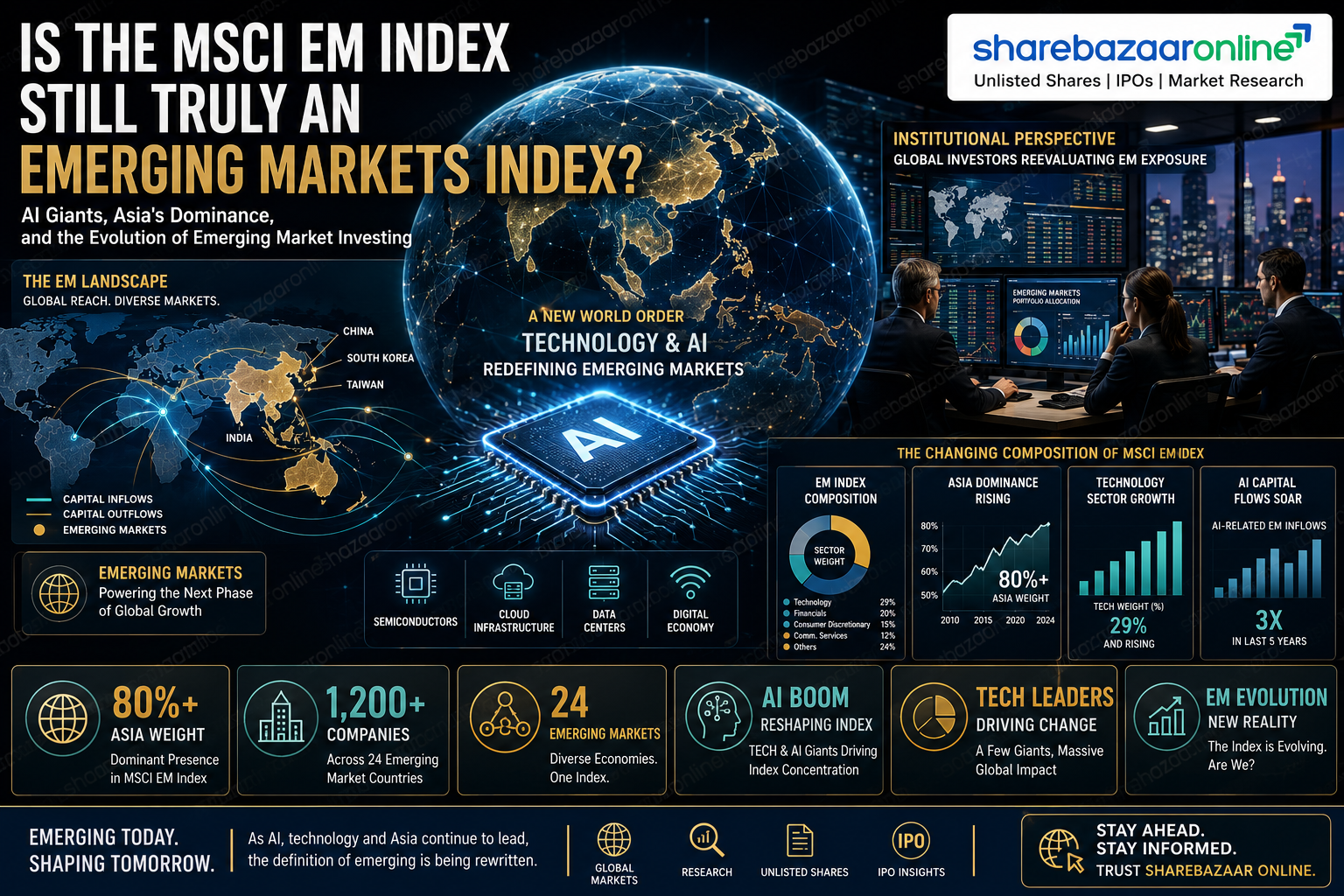
The top of the MSCI EM Index today looks less like an emerging market scoreboard and more like a global semiconductor supply chain directory.
Taiwan Semiconductor Manufacturing Company — better known as TSMC — commands 14.46% of the entire benchmark. Samsung Electronics follows at 7.78%. SK Hynix, which has become one of the critical suppliers of high-bandwidth memory chips used in AI accelerators, holds 6.60%. Together with Tencent at 2.72%, just four names absorb nearly 31% of what is supposedly a diversified exposure to dozens of developing economies.
Zoom out a little further. Taiwan, South Korea, and China — collectively — account for approximately 70% of the MSCI EM Index. The rest of the world, including India, Brazil, South Africa, Indonesia, and Mexico, is left dividing the remaining 30%.
India didn't fall because Indian stocks collapsed in isolation. The Nifty 50 is down roughly 11% in the first five months of 2026. But the MSCI EM Index returned over 25% in the same period, driven almost entirely by the AI-semiconductor trade. When your index constituents are rising at multiples of your own market's pace, your relative weight compresses even if your absolute numbers are unchanged.
It's a crowding-out effect driven by the AI infrastructure boom, not by any fundamental failure of India's domestic economy.
What This Means for Indian Investors and FPI Flows
The mechanism matters more than the headline number.
A significant portion of foreign money in Indian equities doesn't arrive via stock-picking. It arrives through passive funds and ETFs that track the MSCI EM Index. When India's weight in that index falls, passive fund managers mechanically reduce their India exposure — not because they've turned bearish on the country, but because the index math demands it.
This creates a self-reinforcing dynamic. FPIs have already pulled approximately ₹2.8 lakh crore out of Indian equities in 2026, adding to the ₹1.66 lakh crore that left in 2025. Some of this is active selling on valuations and currency concerns. But a meaningful chunk is the passive unwind that comes with a falling index weight.
Actively managed EM funds face the same arithmetic, just more quietly. Portfolio managers who benchmark against MSCI EM don't face a mandate crisis when India's weight falls — they simply face less obligation to own Indian names. A fund that was previously "overweight India" at 12% allocation can become "neutral" on India without buying or selling a single share, simply because the benchmark itself shifted.
A Benchmark in an Identity Crisis
Here is the question that isn't getting enough attention: what exactly are investors buying when they purchase an MSCI EM Index fund today?
The honest answer is this — they are buying a large, concentrated bet on the global AI hardware supply chain, wrapped inside an emerging markets label.
TSMC is the world's dominant manufacturer of advanced logic chips. Every frontier AI model, every large data centre build-out, every next-generation GPU depends on wafers that come from TSMC's fabs in Taiwan. Samsung and SK Hynix are the primary producers of the high-bandwidth memory that powers the AI inference stack. These are not emerging market consumer stories. They are critical nodes in a global technology infrastructure cycle.
The MSCI EM category was coined in the 1980s to bundle together economies that were still catching up — less mature capital markets, faster growth trajectories, higher risk profiles, lower income levels. That logic made sense when the index was built. The problem is the world has moved on but the label hasn't.
India's consumption economy, Brazil's commodity exports, Saudi Arabia's capital spending programmes, and TSMC's semiconductor wafer output sit inside the same benchmark bucket. What meaningful macro risk do they share? Very little.
The South Korea Wildcard
South Korea adds an additional dimension to this conversation.
Despite being the home of Samsung, SK Hynix, and a technology ecosystem that punches well above the weight of most "developing" economies, South Korea remains classified in MSCI's Emerging Markets bucket. That classification has been contested for years. As of this month, there is reportedly a greater than 60% probability that South Korea will be placed on MSCI's watch list for potential reclassification to Developed Market status.
If that happens, the consequences cascade through the index in ways that will take time to digest. South Korea's exit would reduce the semiconductor concentration slightly but would also hollow out a substantial portion of the index. India's relative weight would mechanically rise — not because of any outperformance, but because the denominator would shrink.
It's a reminder that the MSCI EM Index is not a static measure of anything. It is a dynamic construct that responds to capital market developments, geopolitical shifts, and corporate valuations — and investors relying on it for long-term strategic allocation decisions should account for that volatility.
Sector Impact: Where India Stands Alone
India's absence from the technology-driven MSCI EM leadership is partly structural. The country simply doesn't have a large-cap semiconductor or AI hardware manufacturer in its listed space. That's not a failure — it's a statement of where India's economy currently sits in the global value chain.
What India does have is a large and growing domestic consumption story, a maturing financial services sector, a pharmaceutical industry with global reach, and a technology services sector that generates significant export revenues. None of these sectors captures the imagination of a global fund manager chasing AI-driven returns in 2026. But all of them speak to a different and arguably more durable form of economic development.
The risk, for Indian markets, is that for as long as global capital is chasing semiconductor themes, India's story remains underappreciated in benchmark-driven allocations.
Opportunities for Indian Investors
For domestic investors, the MSCI weight compression carries a silver lining that gets buried under the bearish headlines.
When foreign institutional ownership in Indian large-caps is structurally lower — driven not by fundamentals but by benchmark mechanics — it creates entry points that patient investors can use. HDFC Bank and Reliance Industries, both of which have seen significant FPI reduction this year, are not weaker businesses because they fell out of the MSCI top 10. Their market positions, balance sheets, and earnings power are unchanged by the ranking.
India's semiconductor gap is also being taken seriously at the policy level. If domestic semiconductor and electronics manufacturing gains meaningful scale over the next three to five years, the index story could look very different.
Risks Worth Tracking
The MSCI EM Index, as currently constituted, carries concentrated risks that many passive investors may not fully appreciate.
The benchmark's 25% return in the first five months of 2026 has been powered almost entirely by the AI capex buildout. That cycle has been extraordinarily strong — but cycles turn. If AI infrastructure spending slows, if geopolitical friction around Taiwan chips escalates, or if any of the key semiconductor companies disappoint on earnings, the MSCI EM Index could face a correction that surprises investors who thought they owned "diversified emerging market exposure."
For India specifically, the risks are different — currency depreciation, sustained FPI selling pressure, and a global environment that continues to reward technology hardware over financial services and consumption.
Future Outlook
3-Month Outlook: India's MSCI weight is unlikely to recover meaningfully in the near term. The Nifty would need to significantly outperform the global semiconductor names to shift the index math. FPI flows will remain driven by global risk appetite and the trajectory of the rupee. Watch for any South Korea watch-list announcement — it could introduce a near-term mechanical boost for India's relative weight.
6-Month Outlook: By year-end, the key variables are India's corporate earnings cycle, any moderation in the AI chip trade, and the pace of domestic capex recovery. If Indian large-caps post earnings upgrades and semiconductor valuations cool, the weight gap could narrow. The RBI's stance on liquidity and the fiscal position heading into Q3 will shape FPI sentiment.
12-Month Outlook: The structural story for India in global indices is a slow rebuild. It will require either a broadening of the AI trade — which could bring Indian IT services back into focus — or a rotation from growth to value themes globally, which would favour India's financial and consumption-driven names. The semiconductor gap won't close quickly, but capital eventually follows earnings, and India's earnings quality remains competitive within the EM universe.
Expert Observation
"The MSCI EM Index has quietly transformed from a diversified exposure to developing economies into a concentrated bet on the global AI infrastructure supply chain. Investors using it as a proxy for broad emerging-market growth need to reckon with that gap between the label and the current reality."
The index's evolution is not a flaw in its design — it's a reflection of where market capitalisation has migrated. The question every EM investor now needs to ask is whether that's still the exposure they want.
Investor Takeaway
📌 Don't read India's MSCI slide as a verdict on the Indian economy. It is primarily a reflection of where global capital is concentrated today — in semiconductor and AI hardware names that India doesn't host in its listed markets.
📌 Passive EM funds carry hidden concentration risk. A fund tracking the MSCI EM Index today has more than 30% exposure to four companies, three of which are in the semiconductor supply chain. That's a thematic bet, not a geographical one.
📌 FPI outflows from India carry a structural and a cyclical component. The structural piece — passive rebalancing — will continue for as long as India's index weight compresses. The cyclical piece will reverse when the valuation gap between India and the semiconductor names normalises.
📌 South Korea's potential reclassification to Developed Markets is a near-term catalyst to watch. If it happens, India's mechanical weight in the MSCI EM Index rises without India needing to do anything at all.
📌 Selective large-cap Indian names — particularly those with compressed FPI ownership and strong fundamentals — may offer better risk-adjusted entry points now than when they sat in the MSCI top 10.
Conclusion
India falling out of the MSCI EM top 10 is a milestone that carries genuine market significance. But reading it purely as an India story misses the larger point.
The MSCI Emerging Markets Index has, over time, become something its original architects probably didn't design it to be: a concentrated exposure to the global AI hardware cycle, labelled as a diversification tool for developing economies. That's not a scandal — it's just how indices work when markets run hard in one direction for long enough.
For Indian investors, the immediate consequence is continued pressure on FPI flows. The medium-term implication is that patient positioning in high-quality Indian companies now — while benchmark-driven selling compresses prices — could prove rewarding when capital rotates back.
And for anyone using the MSCI EM Index as a diversification lens, this moment is as good a time as any to look under the hood of what the benchmark actually holds today.
Want to track India's unlisted and listed market movements before they hit the index?
👉 Explore pre-IPO opportunities, unlisted share prices, and FPI flow data — only on ShareBazaar Online.