

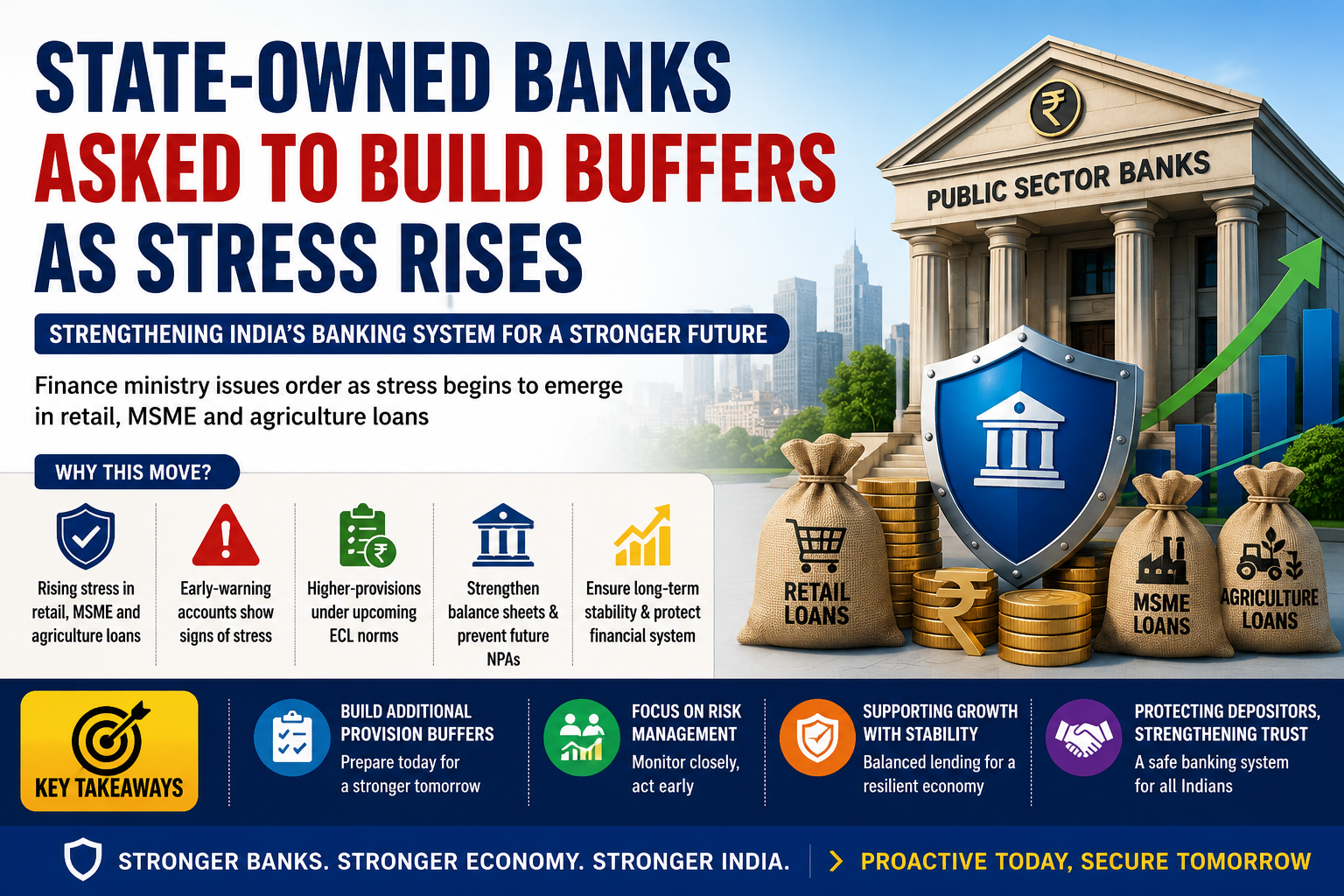
Finance Ministry Urges Public Sector Banks to Strengthen Financial Buffers
India's banking sector is entering a phase of increased caution as the Finance Ministry has advised Public Sector Banks (PSBs) to build additional provisioning buffers against emerging stress in retail, MSME, and agriculture loan portfolios.
The move comes amid rising concerns over early-warning loan accounts and the possibility of higher credit costs under upcoming expected credit loss (ECL) norms. Government officials and banking regulators are closely monitoring asset quality trends to ensure that banks remain adequately capitalized and prepared for potential deterioration in credit quality.
The directive was reportedly communicated through the Department of Financial Services (DFS) during a review meeting with the heads of public sector banks. The primary objective is to strengthen risk management practices and prevent stressed accounts from slipping into Non-Performing Assets (NPAs).
Why Are Public Sector Banks Being Asked to Build Buffers?
Although India's banking sector has reported strong profitability and improved balance sheets in recent years, regulators are beginning to observe signs of stress in specific lending segments.
The key areas of concern include:
- Retail loans
- MSME loans
- Agriculture loans
- Restructured loan accounts
- Early-warning stress accounts
Financial authorities want banks to proactively create provisions before loan defaults increase significantly.
This approach is aimed at protecting bank profitability and maintaining financial stability if economic conditions worsen.
Rising Stress in MSME and Agriculture Loans
The Micro, Small and Medium Enterprises (MSME) sector continues to play a vital role in India's economy. However, rising borrowing costs, global uncertainty, and weaker demand conditions have increased repayment pressures for many businesses.
Similarly, agricultural borrowers continue to face challenges from:
- Weather-related disruptions
- Input cost inflation
- Commodity price volatility
- Income uncertainty
Banking experts believe these sectors could witness higher delinquency levels if economic conditions remain challenging.
Retail Loan Segment Also Under Watch
India's retail lending market has expanded rapidly over the past few years.
Segments witnessing strong growth include:
- Personal loans
- Credit cards
- Consumer durable financing
- Vehicle loans
- Housing finance
While retail loans have historically demonstrated better repayment behavior, regulators are closely monitoring unsecured lending growth due to concerns about rising household leverage.
The Reserve Bank of India (RBI) has already taken steps in recent years to moderate excessive growth in unsecured retail credit.
Expected Credit Loss (ECL) Norms Could Increase Provisions
One of the biggest reasons behind the government's caution is the upcoming implementation of the Expected Credit Loss (ECL) framework.
Under the ECL model, banks will be required to recognize potential future losses earlier rather than waiting for actual defaults to occur.
Key features of ECL include:
- Forward-looking risk assessment
- Early recognition of credit deterioration
- Higher provisioning requirements
- Improved transparency in financial reporting
- Alignment with global accounting standards
The framework is expected to strengthen India's banking system but could initially increase provisioning expenses for banks.
Current Asset Quality Position of Public Sector Banks
Despite emerging concerns, India's public sector banks remain in a relatively strong position.
Recent improvements include:
- Lower Gross NPAs
- Higher profitability
- Stronger capital adequacy ratios
- Improved recovery mechanisms
- Better risk management systems
Government officials have emphasized that the advisory is precautionary in nature and not a response to any immediate systemic risk.
Impact on Banking Stocks and Investors
Investors should closely monitor developments in the banking sector because additional provisioning can affect:
Positive Impacts
- Stronger balance sheets
- Improved investor confidence
- Better long-term financial stability
- Reduced future credit shocks
Potential Challenges
- Lower short-term profitability
- Higher provisioning expenses
- Pressure on return ratios
- Increased capital requirements
However, analysts generally view proactive provisioning as a positive step for the long-term health of the banking system.
Key Highlights
- Finance Ministry has advised PSBs to build additional provisioning buffers.
- Stress is emerging in retail, MSME, and agriculture loan portfolios.
- Banks are being encouraged to strengthen monitoring and recovery efforts.
- Upcoming ECL norms may increase provisioning requirements.
- Public sector banks currently remain well-capitalized and profitable.
- The move is aimed at preventing future growth in NPAs.
- Regulators are focusing on long-term banking stability.
What This Means for India's Banking Sector
The latest directive signals a shift toward preventive risk management rather than reactive measures.
The government and regulators want banks to:
- Identify risks earlier
- Improve asset quality monitoring
- Strengthen balance sheets
- Prepare for future economic uncertainties
This proactive approach could help India's banking sector remain resilient even if credit conditions become more challenging in the coming years.
Conclusion
India's Finance Ministry has taken a precautionary step by asking public sector banks to build additional provisioning buffers amid signs of stress in retail, MSME, and agriculture loans. While the banking sector remains fundamentally strong, regulators are focusing on early risk identification and stronger capital protection.
The move reflects a broader effort to ensure that Indian banks remain well-prepared for evolving credit risks while supporting sustainable economic growth.
Quick Summary
- Public sector banks asked to increase provisioning buffers.
- Stress emerging in retail, MSME, and agriculture loans.
- ECL norms likely to increase future provisioning requirements.
- Banking sector remains profitable and well-capitalized.
- Focus is on preventing future NPAs and strengthening financial stability.