

SRTT Meeting Freeze Clouds the Race to Find Tata Sons' Next Chairman
Bombay House has a succession clock ticking, and a regulatory lock it cannot open on its own. A day after N Chandrasekaran told Tata Trusts he would not seek another term as Tata Sons chairman, the trusts that control India's largest conglomerate moved to set up a committee to find his replacement. The problem is procedural, not personal: one of the two trusts that must sign off on that committee is currently barred from even holding a meeting.
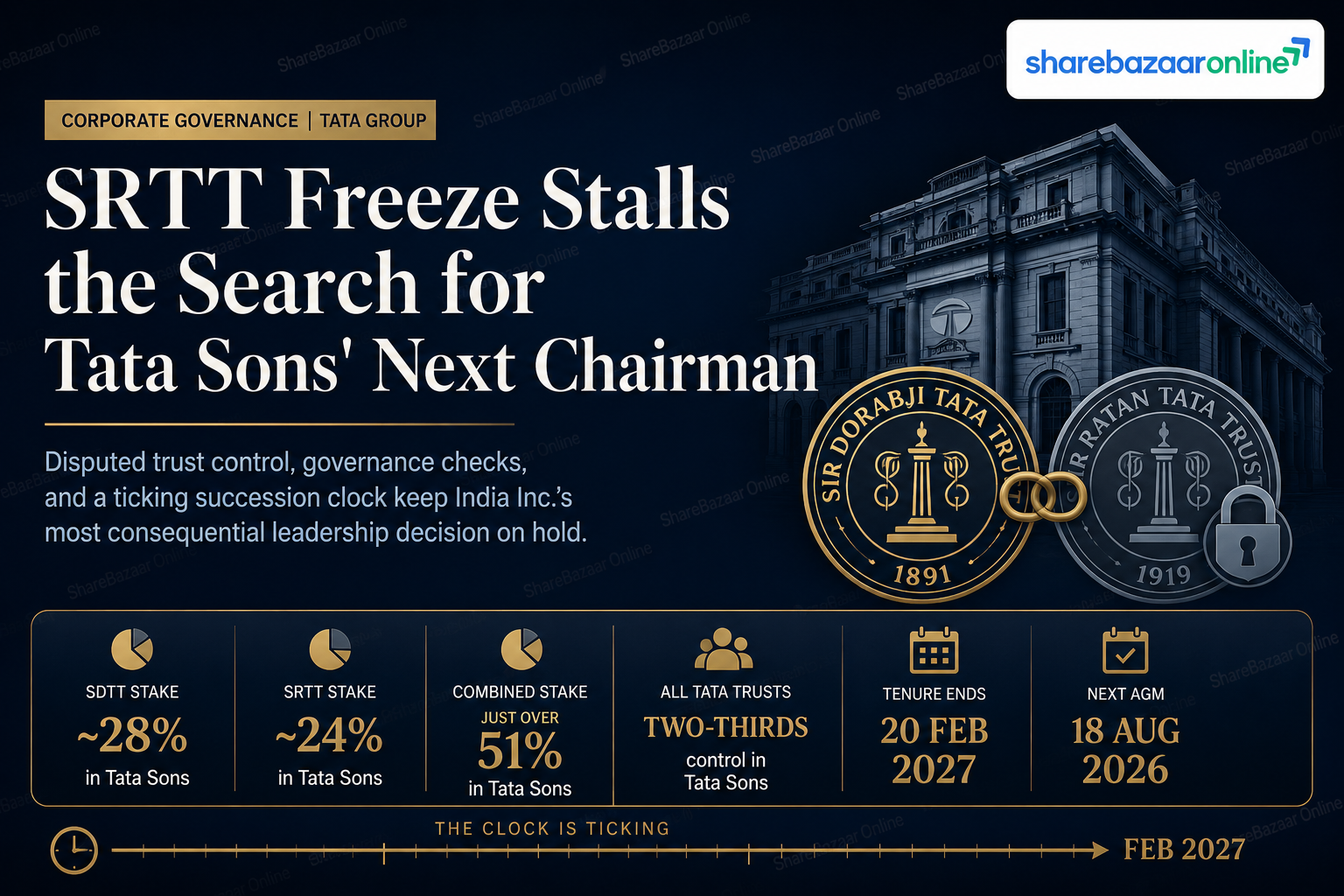
Sir Ratan Tata Trust (SRTT), a 24% shareholder in Tata Sons, has been stopped from convening trustee meetings by the Maharashtra Charity Commissioner. Until that freeze lifts, the wheels of one of corporate India's most closely watched leadership transitions stay jammed, with the calendar running down toward Chandrasekaran's exit date of February 20, 2027.
Executive Summary
Sir Dorabji Tata Trust (SDTT), the largest single shareholder in Tata Sons with a stake of nearly 28%, has passed a resolution to begin forming a selection committee to recommend the next chairman of the group's holding company. The trigger was a letter dated August 12, 2026, in which Chandrasekaran told the trusts' nominee directors he would not offer himself for reappointment once his tenure ends in February 2027.
Under the Articles of Association of Tata Sons, SDTT and SRTT must jointly decide who sits on that selection panel. SRTT cannot participate right now because the Maharashtra Charity Commissioner froze its decision-making powers earlier this year over a dispute about the trust's board composition. With the Tata Sons annual general meeting set for August 18, the freeze also raises quorum questions for the holding company's most important governance event of the year.
Why This Matters
Tata Sons sits at the apex of a group that spans salt to software, from Tata Consultancy Services and Tata Motors to Titan, Tata Steel and Air India. Who runs the holding company shapes capital allocation, strategy and boardroom culture across dozens of listed and unlisted companies. A leadership handover at the top is rarely a quiet event, and this one is unfolding under a legal cloud that few succession playbooks anticipated.
For investors, the story is less about a single name and more about process risk. The market values the Tata group partly for its governance stability. A transition that stalls on a regulatory technicality, during the window before a sitting chairman departs, tests that reputation and puts a spotlight on how the trusts resolve their internal disagreements.
Key Highlights
Chandrasekaran steps aside
In a letter dated August 12, 2026, the Tata Sons chairman told nominee directors he will not seek reappointment. His current tenure runs until February 20, 2027.
SDTT starts the search
Sir Dorabji Tata Trust, holding close to 28% of Tata Sons, resolved to initiate a selection committee "as soon as possible" under the Tata Sons Articles of Association.
SRTT is frozen
The Maharashtra Charity Commissioner has barred Sir Ratan Tata Trust, a 24% shareholder, from holding trustee meetings pending an inquiry into its board composition.
Joint sign-off required
The Articles require SDTT and SRTT to jointly decide the members of the selection committee, so the process cannot formally begin while SRTT stays sidelined.
Five-member panel
Tata Trusts is expected to nominate three of the five members of the search committee, which would also include eminent outside personalities.
AGM in focus
The Tata Sons AGM is scheduled for August 18. Article 86 requires a quorum that includes a representative jointly chosen by SRTT and SDTT.
Detailed Analysis
The knot at the top of the structure
Tata Trusts collectively own roughly two-thirds of Tata Sons, and the two anchor trusts, SDTT and SRTT, together hold a little over half. That concentration is the source of the group's governance strength in normal times and its bottleneck now. The Articles of Association hand the two trusts a joint say over the selection committee, a design meant to force consensus. With SRTT unable to meet, consensus has no venue.
The Charity Commissioner's directive did not appear out of nowhere. It followed complaints about how the trust's board is composed, including questions around life-time trustee appointments. The regulator restricted SRTT from convening meetings until an inspector's inquiry into its trustee composition is completed and a report submitted. That inquiry, rather than the succession itself, is now the gating item for the entire transition.
A shrinking runway
Chandrasekaran, who joined the Tata Sons board in October 2016 and became executive chairman soon after, leaves a little over six months of formal runway once the August notice is counted. Succession at a conglomerate of this scale is not a quick exercise. A committee has to be seated, a shortlist built, candidates assessed and a recommendation carried back to the board. Every week the SRTT freeze holds is a week the clock keeps moving without that work formally starting.
The options on the table
People close to the trusts are said to be weighing two paths: wait for the Charity Commissioner to lift the freeze, or approach the courts for a faster resolution. Each carries trade-offs. A regulatory clearance keeps the matter inside the administrative process but offers no fixed timeline. A court route could compress the schedule, yet it also drags a private governance dispute further into public view.
Market Impact
Tata Sons is unlisted, so there is no single ticker for the market to price this on. The read-through instead flows to the group's listed companies, where investors watch for any sign that strategy or capital allocation could drift during an unsettled handover. Leadership continuity at the holding company has historically been treated as a background comfort by the market; a contested or delayed process can turn that comfort into a question mark.
In practice, the near-term market reaction is likely to hinge on headlines about the freeze and the AGM rather than on operating fundamentals, which remain company-specific. Investors tracking Tata names should separate governance noise at the parent from the earnings drivers of each subsidiary, and avoid reading a trust-level procedural delay as an operating signal for any one business.
Sector Impact
The Tata group's footprint means the story touches multiple sectors at once: IT services, automobiles, steel, consumer and jewellery, financial services, hospitality and aviation. None of these businesses changes overnight because of a delay in seating a selection committee. What the episode does highlight is the growing scrutiny of trust and holding-company governance in India, an area regulators and investors alike have paid closer attention to in recent years.
The wider signal for corporate India is about succession design. Founder and promoter structures that concentrate control in trusts or family vehicles gain stability, but they can also inherit single points of failure when a regulatory action lands on one node. Boards across the market may revisit how their own succession triggers hold up under legal stress.
Opportunities
Clarity as a re-rating trigger
A clean resolution of the freeze and an orderly committee could remove an overhang and let the market refocus on the operating strength of individual Tata companies.
Fundamentals stay intact
The delay sits at the trust level, not in the businesses. Investors who track earnings can treat governance headlines and company performance as separate threads.
A governance case study
However the trusts resolve the deadlock, the outcome will offer a live template for how India's promoter-controlled groups handle top-level succession under regulatory pressure.
Watchlist discipline
Periods of uncertainty reward investors who follow disclosures closely and act on confirmed information rather than speculation about candidates.
Risks
Timeline slippage
With a fixed February 2027 exit date, a prolonged freeze compresses the search window and raises the odds of a rushed or interim arrangement.
Governance perception
A public trust dispute at the parent can dent the stability premium the market has long attached to Tata group governance.
Quorum and AGM friction
Article 86's requirement for a jointly chosen SRTT-SDTT representative means the freeze can complicate an already sensitive AGM.
Headline volatility
News flow around court moves or regulatory decisions could drive short-term swings in Tata-linked stocks that are unrelated to operating results.
Future Outlook
3-Month Outlook
The immediate focus is whether the Charity Commissioner lifts the SRTT freeze or the trusts seek a court remedy, and how the August 18 AGM is handled given the quorum requirement. Expect the near term to be driven by procedural milestones rather than a named successor.
6-Month Outlook
If the deadlock clears, the window opens for the selection committee to be seated and to begin evaluating candidates. A visible, structured process within this period would reassure the market that the timeline to February 2027 remains manageable.
12-Month Outlook
By this horizon the group would ideally have clarity on its next chairman well ahead of the handover. The manner of resolution, smooth consensus or contested process, will shape how investors read Tata group governance for years, not just quarters.
Expert Observation
The instructive part of this episode is not the identity of the next chairman but the mechanics that govern how that person is chosen. A structure built to force consensus between two trusts works cleanly only when both can act. When a regulator removes one from the table, the same design that ensures balance becomes a chokepoint. Seasoned market watchers will read the coming weeks as a test of institutional resilience: can the Tata system route around a blocked node without sacrificing the deliberation that has defined its succession history? The answer will say more about the group's governance maturity than any single appointment.
Investor Takeaway
Treat this as a governance and process story at the holding-company level, not a fundamental change in any Tata business. Watch three markers: the status of the Charity Commissioner's inquiry into SRTT, whether the trusts move court for a faster fix, and how the August 18 AGM resolves the quorum question.
Investors in listed Tata companies are better served by tracking each company's earnings and capital plans than by trading on speculation about who the next chairman might be. Confirmed disclosures from the exchanges and the trusts remain the only reliable guide here.
Conclusion
The Tata group has begun the most consequential leadership exercise since 2016, and it has begun with a hurdle no one chose. A meeting freeze on Sir Ratan Tata Trust has put the joint decision that seats the selection committee out of reach for now, even as the SDTT resolution shows intent to move quickly. With Chandrasekaran's exit fixed for February 2027, the coming weeks of regulatory and legal maneuvering will determine whether this transition stays orderly or turns into a race against the clock. For investors, patience and a focus on verified facts will matter more than early guesses about the successor.
Frequently Asked Questions
Why could the Tata Sons chairman selection be delayed?
What is SRTT and why is it frozen?
When does N Chandrasekaran's term as Tata Sons chairman end?
What did Sir Dorabji Tata Trust decide?
How much of Tata Sons do the trusts own?
How many members will the selection committee have?
Why is the August 18 AGM significant?
Can the trusts go to court to resolve the deadlock?
Is Tata Sons a listed company?
Does this delay affect the operations of Tata group companies?
When did Chandrasekaran join Tata Sons?
What should investors watch next?
Disclaimer
This article is for informational purposes only and does not constitute investment, legal or financial advice. Figures and dates are based on publicly available reports at the time of writing and may change as the situation develops. Securities markets carry risk; readers should verify details independently and consult a registered financial adviser before making investment decisions. ShareBazaar Online is not responsible for actions taken on the basis of this content.
Stay Ahead With ShareBazaar Online
Track India's biggest corporate stories, IPOs, unlisted shares and market moves in one place. Follow ShareBazaar Online for verified, investor-first coverage.
Explore ShareBazaar Online