
Dividend Status
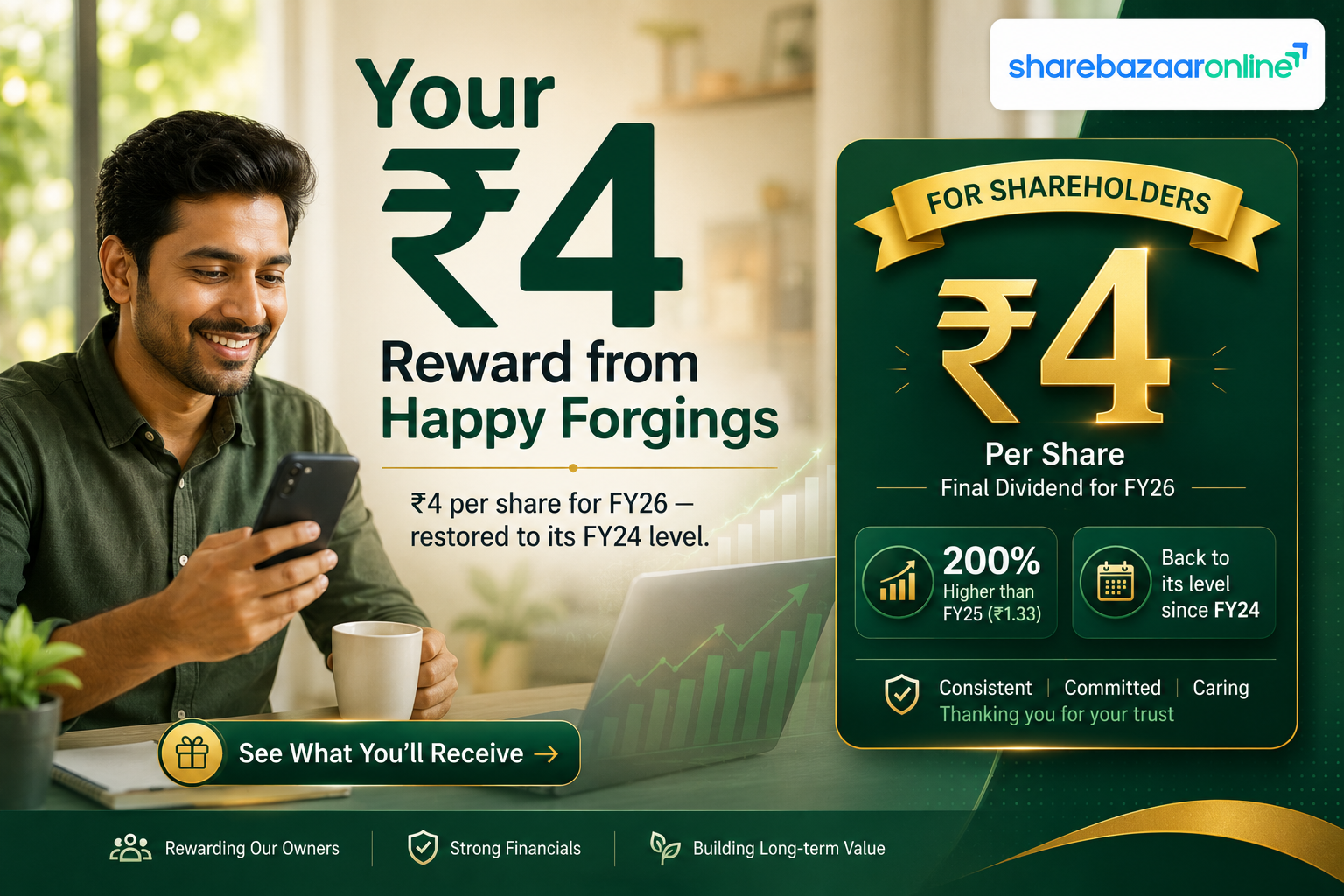
Happy Forgings Limited has recommended a final dividend of ₹4.00 per share for FY2025-26. The record date is 20 July 2026 (Monday), which has not yet passed as on 18 July 2026. However, the dividend is still subject to shareholder approval at the 47th AGM on 27 July 2026. Under the T+1 settlement cycle, the last cum-dividend trading session was Friday, 17 July 2026; the stock is expected to trade ex-dividend from 20 July 2026. Payment is expected within 30 days of the AGM (last year's dividend was paid on 28 August 2025).
Dividend Snapshot
Company data from BSE/NSE filing dated 21 May 2026. ISIN, price & yield sourced from exchange market data (NSE/BSE), 9 July 2026.
Dividend Announcement Summary
At its board meeting held on Thursday, 21 May 2026 (2:30 p.m. to 4:10 p.m.), the Board of Directors of Happy Forgings Limited recommended a final dividend of ₹4.00 per equity share of face value ₹2.00 each, fully paid-up, for the financial year 2025-26. In simple terms, shareholders are being offered ₹4 for every share held — equal to 200% of the ₹2 face value. The payout is subject to member approval at the ensuing 47th Annual General Meeting on 27 July 2026 (held via video conferencing).
The results were audited by S.R. Batliboi & Co. LLP with an unmodified (clean) opinion on both standalone and consolidated statements. Alongside the dividend, the Board also cleared an increase in its captive solar power project from 25 MW to 35 MW, raising planned investment from ₹120 crore to ₹170 crore — a sign that the company continues to prioritise capacity and cost projects. Note the company has not separately disclosed the total dividend outflow, payment date, or a standalone management commentary on the dividend in this filing. (Total outflow, promoter income and coverage figures below are computed by ShareBazaar Online from the audited results.)
Key Dates Timeline
Under India's T+1 settlement, the ex-date and record date fall on the same day (20 July 2026). Investors needed to own the shares by the close of Friday, 17 July 2026 to appear on the register on the record date. Remote e-voting for the AGM runs from 24–26 July 2026. As no payment date is disclosed, the dividend would legally have to be paid within 30 days of AGM approval — i.e. on or before roughly 26 August 2026.
Dividend Yield Analysis
The dividend yield is very low, at roughly 0.25%. In plain terms, a shareholder buying at ~₹1,574 earns just ₹4 of dividend on a ₹1,574 investment. This is not an income stock. The low yield is a direct result of a high share price relative to a modest payout — the company deliberately retains most of its profit to fund growth. The yield sits below the forgings/auto-ancillary peer average of ~0.6–0.8% and far below classic dividend payers. Reality check: the yield is low because of a rich valuation (P/E ~46–48x) and a low payout policy — not because of a special dividend or a collapsing share price.
CMP and yield figures sourced from NSE/BSE market data (Tickertape/Groww/Kotak), July 2026; announcement-day price derived from the 4.5% post-result fall on 22 May 2026.
Dividend History Analysis
| Financial Year | Type | DPS (₹) | % of FV | Trend |
|---|---|---|---|---|
| FY 2023-24 | Final | 4.00 | 200% | First dividend post-IPO |
| FY 2024-25 | Final | 3.00 | 150% | ▼ Cut of 25% |
| FY 2025-26 | Final | 4.00 | 200% | ▲ Restored (+33%) |
Happy Forgings listed only in December 2023, so its dividend record is short (three years). The pattern is not yet consistent: the maiden ₹4 dividend for FY24 was cut to ₹3 in FY25 (a 25% reduction that drew negative commentary), and has now been restored to ₹4 for FY26. This ₹4 is therefore best read as a recovery to the earlier level, not a new high. Because the company has changed its dividend twice in two years, ShareBazaar Online classifies it as an Irregular / Early-Stage Payer rather than a Consistent Payer. There have been no special dividends and no suspensions.
Dividend history sourced from exchange filings and dividend trackers (TipRanks, SimplyWall.st, Trendlyne).
Financial Performance Analysis (Consolidated, FY26)
| Metric (₹ Crore) | FY2025-26 | FY2024-25 | Growth |
|---|---|---|---|
| Revenue from Operations | 1,546.34 | 1,408.89 | +9.8% |
| Total Income | 1,577.15 | 1,446.34 | +9.0% |
| Profit Before Tax | 401.98 | 359.55 | +11.8% |
| Net Profit (PAT) | 301.63 | 267.44 | +12.8% |
| EPS (Basic, ₹) | 31.99 | 28.39 | +12.7% |
Operating leverage was positive in FY26: profit grew faster than revenue (PAT +12.8% vs revenue +9.8%), showing margins expanded rather than compressed. The Q4 EBITDA margin was strong at ~31.5%, and Q4 alone saw revenue jump +20.4% YoY to ₹424 crore with net profit up +23.6% YoY to ₹83.56 crore — a sign the second half accelerated.
Return ratios are solid but not spectacular: ROE of ~14.5% and ROCE of ~18.3%. These reflect a capital-intensive business investing heavily for the future. The longer-term concern is a modest ~5–6% five-year sales CAGR against a premium P/E of ~46–48x, which places a heavy burden on future growth delivery.
FY figures from the audited consolidated results (21 May 2026). ROE/ROCE and growth commentary sourced from result analyses (MarketsMojo, Trade Brains, Univest), 2026.
Cash Flow Analysis
Cash quality is high: operating cash flow of ₹444.67 crore comfortably exceeds reported PAT of ₹301.63 crore (OCF/PAT ~1.47x), meaning profits are backed by real cash, not just accounting entries. Receivables actually fell during the year (a working-capital release), which is a healthy sign.
Key negative finding to highlight: Despite strong operating cash flow, free cash flow was marginally negative in FY26 because the company spent ~₹461 crore on capex — more than its entire ₹444.67 crore operating cash flow. This means the ₹37.75 crore dividend is not being funded out of surplus free cash this year; it is funded from a mix of strong earnings and the company's large cash/investment reserves. This is typical for a company in a heavy investment phase, but it is why the dividend stays small.
Cash-flow line items from the audited consolidated cash-flow statement (₹ lacs converted to ₹ crore).
Balance Sheet Strength
The balance sheet is a genuine strength. The company is effectively free of long-term debt; its only borrowings are short-term working-capital lines (₹329.62 crore). Net worth stands at ₹2,128 crore. During FY26 the company also prepaid ₹152.76 crore of IPO-earmarked borrowings and deployed ₹171.13 crore into plant & machinery. A debt-free capital structure gives it plenty of room to keep paying (and gradually raising) dividends even while investing heavily.
Balance-sheet items from the audited consolidated statement of assets & liabilities as at 31 March 2026.
Dividend Sustainability Analysis
On earnings and cash-reserve strength, the dividend is highly sustainable — it consumes only 12.5% of profit and is covered 8x by earnings. The one caveat is that in a heavy-capex year like FY26, it is not covered by free cash flow, so it leans on reserves. Given the debt-free balance sheet, this is comfortable — but it also explains why the payout stays modest.
Bottom line: Happy Forgings can easily afford ₹4/share; affordability is not the issue. The real story is a deliberate low-payout, high-reinvestment policy. Investors should expect capital appreciation, not dividend income, to be the main return driver.
Peer Comparison
| Company | Div Yield | Payout | ROE | Debt Profile |
|---|---|---|---|---|
| Happy Forgings | ~0.25% | ~12.5% | ~14.5% | Effectively debt-free |
| MM Forgings | ~1.3% | ~15.3% | Moderate | Leveraged |
| Bharat Forge | ~0.6% | Higher | Moderate | Leveraged (global ops) |
| Ramkrishna Forgings | ~0.3% | Low | Moderate | Moderately leveraged |
Among listed forging peers, Happy Forgings offers one of the lowest dividend yields (~0.25%) — below MM Forgings (~1.3%) and Bharat Forge (~0.6%). However, it stands out on balance-sheet quality, being effectively debt-free where several peers carry meaningful borrowings. Its ROCE of ~18.3% is respectable for the sector. In short, peers offer more income; Happy Forgings offers a cleaner balance sheet and a growth-reinvestment tilt. Peer yields/ratios are approximate and vary with daily prices.
Peer data sourced from TipRanks, IIFL, INDmoney and result commentaries, 2026. Figures approximate.
Promoter Impact Analysis
With promoters owning 78.48%, roughly ₹29.6 crore of the ₹37.75 crore dividend flows to the promoter group, leaving about ₹8.1 crore for all public shareholders combined. This is normal for a promoter-heavy company. Importantly, promoter holding is high and reportedly un-pledged, which is generally read as a sign of confidence. Mutual-fund holding rose ~304 bps in Q4 FY26, indicating growing domestic-institution interest. For minority shareholders, the takeaway is that the dividend is small in absolute terms, but it aligns promoters and minorities in the same low-payout, reinvest-for-growth approach.
Shareholding pattern sourced from Groww/5paisa/Screener (latest available quarter), 2026. DII figure aggregates mutual funds, insurers and other domestic institutions.
Taxation Analysis
Since 1 April 2020, dividends in India are taxable in the hands of the investor at their applicable income-tax slab rate (there is no separate Dividend Distribution Tax anymore). The company must deduct TDS at 10% under Section 194 if total dividend paid to a resident shareholder in a financial year exceeds ₹5,000 (20% if PAN is not provided). The TDS is not an extra cost — it is adjustable against your final tax liability when you file your return.
Worked Example — investor in the 30% slab holding 1,000 shares
*On an assumed cost of ₹1,574/share. In this example the ₹4,000 gross dividend is below the ₹5,000 TDS threshold, so no TDS is deducted — but the full ₹4,000 is still added to taxable income and taxed at slab. A 30%-slab investor keeps only ~₹2,752.
This is general information, not tax advice. ShareBazaar Online is not a tax advisor; please consult a qualified professional for your specific situation.
Key Risks
1. Cyclical end-markets. Revenue depends heavily on commercial vehicles, tractors and off-highway/industrial equipment. A downcycle in CV or farm demand can directly hit volumes and profits.
2. Rich valuation. At a P/E of ~46–48x against a modest ~5–6% five-year sales CAGR, any earnings miss could trigger a sharp de-rating. The stock is priced for growth it must still deliver.
3. Heavy ongoing capex. With ~₹450–500 crore capex planned for FY27 plus a ₹170 crore solar project, free cash flow may stay thin or negative, capping dividend growth.
4. Raw-material & commodity risk. Steel is the primary input. Volatile steel prices can squeeze margins if cost pass-through to OEM customers lags.
5. Customer concentration & OEM dependence. Forging suppliers typically rely on a limited set of large OEM clients; loss of, or pricing pressure from, a key customer is a material risk.
6. Low income appeal. With a ~0.25% yield and an inconsistent payout record (a cut in FY25), income-focused investors get little cushion during price drawdowns.
What To Monitor
1. Free cash flow turn. Watch whether OCF starts exceeding capex as the current investment cycle matures — the trigger for higher future dividends or buybacks.
2. Revenue & order momentum. Track quarterly revenue growth and management commentary on CV, tractor, exports and non-auto (defence, industrial) order pipelines.
3. Margin trajectory. The Q4 FY26 EBITDA margin of ~31.5% is a high bar — monitor whether margins hold as new capacity ramps and steel prices move.
4. ROE/ROCE direction. A move toward 18–20% ROE would justify the premium; a slide below 12–13% would raise value-creation concerns.
5. Institutional flows. Mutual-fund and FII accumulation (MF holding rose ~304 bps in Q4 FY26) signals professional conviction — track each quarterly shareholding update.
6. Dividend consistency. After a cut (FY25) and restore (FY26), watch whether the ₹4 level holds or grows — the test of a maturing dividend policy.
Conclusion
Happy Forgings' ₹4 final dividend for FY2025-26 restores the payout to its FY24 level after a dip to ₹3 in FY25. The positives are clear: a debt-free balance sheet, high cash quality (OCF of ₹444.67 crore > PAT of ₹301.63 crore), a low 12.5% payout with 8x earnings cover, and improving Q4 momentum (revenue +20.4%, PAT +23.6% YoY).
The negatives / cautions are equally clear: a tiny ~0.25% yield, an inconsistent three-year dividend record, marginally negative free cash flow in a heavy-capex year, and a premium P/E of ~46–48x that leaves little room for error. This is fundamentally a growth-and-reinvestment story, not a dividend-income story. ShareBazaar Online presents the facts, the numbers and the risks — the decision on whether it fits your portfolio is yours to make.
Frequently Asked Questions
What dividend has Happy Forgings announced for FY2025-26?
What is the Happy Forgings dividend yield?
What is the record date for the Happy Forgings dividend?
What is the ex-date for the dividend?
When will the Happy Forgings dividend be paid?
Who is eligible to receive the dividend?
How is the Happy Forgings dividend taxed?
Is the Happy Forgings dividend sustainable?
What is the Happy Forgings dividend history?
How much is the total dividend outflow and promoter share?
Why is the dividend yield so low?
What should investors monitor going forward?
Was the audit opinion clean?
Does Happy Forgings have debt?
Disclaimer
This article is published by ShareBazaar Online for informational and educational purposes only and does not constitute investment, financial, legal or tax advice, nor a recommendation to buy, sell or hold any security. Figures marked as computed or estimated are derived by ShareBazaar Online from the company's audited results; externally sourced figures (market price, yield, shareholding, peer data) are drawn from public sources including NSE/BSE, Screener, Groww, TipRanks, MarketsMojo and SimplyWall.st and may change. We do not guarantee the accuracy, completeness or timeliness of any data. Securities investments are subject to market risks; past performance and past dividends do not guarantee future results. Please read all offer/scheme documents and consult a SEBI-registered investment adviser and a qualified tax professional before making any decision. ShareBazaar Online and its authors accept no liability for any loss arising from the use of this content.