
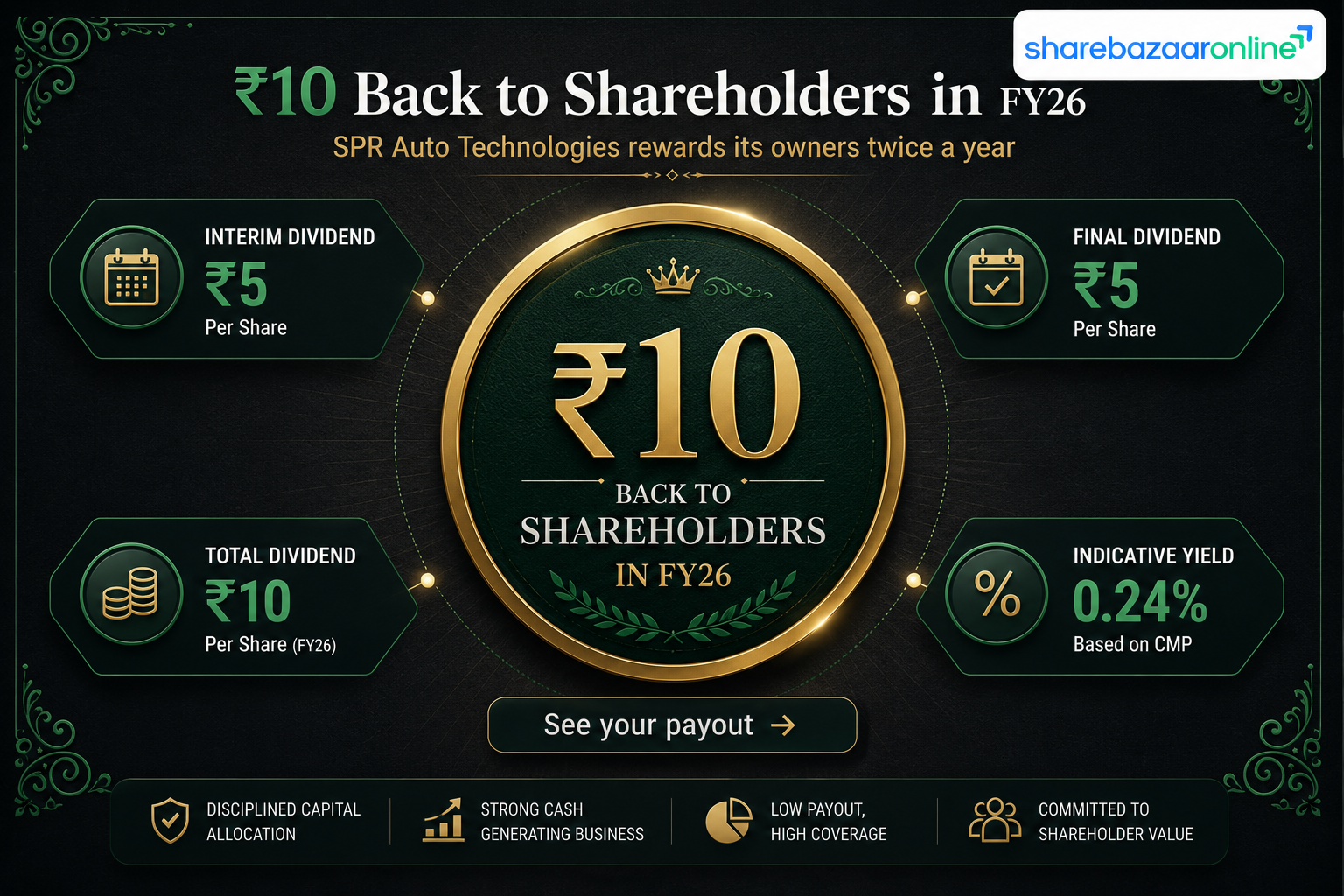
SPR Auto Technologies (SHRIPISTON) — Final Dividend ₹5/Share, FY 2025-26
Record Date Mon, 20 July 2026 has not yet passed (today is 18 July 2026). The ₹5 final dividend is subject to shareholder approval at the 62nd AGM on 27 July 2026.
Dividend Snapshot
Company
SPR Auto Technologies Ltd
Formerly
Shriram Pistons & Rings Ltd
NSE Symbol
SHRIPISTON
BSE Code
544344
ISIN
INE526E01018
Face Value
₹10
Dividend Type
Final Dividend
Final Dividend
₹5.00 / share (50%)
Interim (already paid)
₹5.00 / share (50%)
Total FY26 Dividend
₹10.00 / share (100%)
Yield (final, on CMP)
~0.12%
Yield (FY26 total)
~0.24%
CMP reference: ₹4,176 (NSE close, 15 July 2026, Source: Screener.in). All ₹-crore figures below are converted from the company's ₹-million filing (₹10 million = ₹1 crore).
Dividend Announcement Summary
At its Board Meeting on 11 May 2026, SPR Auto Technologies (formerly Shriram Pistons & Rings) recommended a Final Dividend of ₹5 per equity share of ₹10 face value for the financial year 2025-26. This is in addition to the ₹5 interim dividend declared on 2 February 2026 and paid the same month.
So a shareholder holding one share through FY26 receives ₹10 in total — a 100% payout on face value, but only about 8.6% of the year's earnings (more on that below). The final dividend is subject to approval at the 62nd AGM on 27 July 2026, with payment to be completed within 30 days of that declaration (i.e., by roughly late August 2026).
The same board meeting also approved audited FY26 results, the re-appointment of two directors, a cost-auditor appointment, and — importantly for shareholders — an enabling resolution for a Qualified Institutions Placement (QIP) of up to ₹10,000 million (₹1,000 crore) mainly to repay borrowings and fund capex/acquisitions.
Key Dates Timeline
*Ex-date not separately disclosed in the company filing; range reflects public market-data vendors under T+1 settlement.
Dividend Yield Analysis
Yield on latest price (₹4,176, 15 Jul 2026)
Final ₹5 ÷ ₹4,176 = 0.12%
Total FY26 ₹10 ÷ ₹4,176 = 0.24%
Yield near announcement (~₹3,300, mid-May 2026)
Final ₹5 ÷ ~₹3,300 = ~0.15% · Total ₹10 = ~0.30%
Reality check
The yield is very low mainly because the share price has run up sharply — the stock is up roughly 66% over one year and trades near its 52-week high of ₹4,421 (Source: Groww/Screener). The dividend itself (₹10) is unchanged from FY25.
SHRIPISTON's 10-year dividend yield has ranged from 0.22% to 2.28% (median ~0.75%). The current ~0.24% sits at the bottom of its own history — a classic sign of price appreciation outpacing payout, not a distressed high-yield situation. (Source: GuruFocus.)
Dividend History Analysis
| Financial Year | Interim | Final | Total / Share | Type |
|---|---|---|---|---|
| FY 2025-26 | ₹5 | ₹5* | ₹10 | Semi-annual |
| FY 2024-25 | ₹5 | ₹5 | ₹10 | Semi-annual |
| ~FY 2017 (adj.) | — | ~₹4 | Split-adjusted | |
*FY26 final subject to AGM approval. Historical figures adjusted for the 2-for-1 stock split effective July 2023. (Sources: TipRanks, SimplyWall.st, TradingView.)
The dividend has grown from about ₹4 (split-adjusted) in 2017 to ₹10 today — a compound growth of roughly 12% a year. The company pays twice a year (an interim around February and a final around July/August).
Consistency caveat: third-party analysis notes the dividend has been cut at least once in its listed history, so it is not a flawless track record. The payout ratio has stayed low and stable (roughly 7–29%, median ~10%).
Classification: Consistent-but-modest payer — reliable twice-yearly cheques, but a small slice of profits, in a cyclical business.
Financial Performance Analysis (Operating Leverage)
Standalone FY26 vs FY25
Consolidated FY26 vs FY25
⚠ Why profit grew slower than sales (standalone):
Revenue rose ~11% but PAT rose only ~3%. Two things ate into the gains: (1) finance costs nearly doubled — from ₹24.8 cr to ₹49.5 cr — as the company took on debt (NCDs + commercial papers) to fund acquisitions; and (2) an exceptional item of ₹23.7 cr was booked for a new labour-code provision. Operating margin also slipped ~84 basis points to 20.43%. On a consolidated basis, sales jumped 25.6% largely because the newly acquired Grupo Antolin interiors/lighting businesses were added — but their lower margins dilute the group's profitability.
Cash Flow Analysis
Cash is fact — profit is opinion
OCF (₹534.5 cr) exceeds PAT (₹513.7 cr) — a healthy sign that reported profits are backed by real cash, not just accruals.
After modest capex, free cash flow is about ₹418 cr — which comfortably covers the ₹44 cr total FY26 dividend nearly 9.5 times over.
How is the dividend funded? Clearly from current earnings and operating cash — not from borrowings or asset sales. The large ₹1,763 cr investing outflow this year was for the acquisitions, funded separately by debt, not the dividend.
Balance Sheet Strength
The balance sheet remains conservatively geared: even after debt-funded M&A, net-debt-to-EBITDA is a low 0.70x and net-debt-to-equity just 0.23x (per the debenture covenant statement).
Watch item: gross borrowings rose steeply this year, and consolidated goodwill jumped to ₹1,322.6 cr after the ₹1,708 cr Grupo Antolin acquisition. Return ratios (ROE ~17–18%) are solid but partly diluted by ₹2,376 cr of investments in subsidiaries (standalone) that have yet to fully contribute.
Dividend Sustainability Analysis
Verdict: Sustainable
With only ~8.6% of profit paid out, earnings covering the dividend nearly 12 times, and free cash flow covering it ~9.5 times, the ₹10 dividend is very safe. The bigger question is not safety but size — management deliberately keeps the payout small so it can plough cash into growth, capex and acquisitions.
Peer & Sector Comparison
| Metric | SHRIPISTON | Auto-Components Sector |
|---|---|---|
| Dividend yield | ~0.24% | ~2.2% (median) |
| Payout ratio | ~8.6% | Typically 15–35% |
| ROE | ~17–18% | Varies widely |
| Net debt / EBITDA | 0.70x | Low-geared peers 0–1x |
| Forward P/E | ~28x | ~29x (industry avg) |
SHRIPISTON's dividend yield is ranked below ~90% of auto-parts companies (industry median ~2.2% vs its ~0.24%). It is decidedly not a high-yield stock — investors here are paid mostly through capital appreciation (the stock is up ~66% in a year), not dividends. Its low leverage and healthy ROE are relative strengths. (Sources: GuruFocus, Yahoo Finance, Simply Wall St.)
Promoter Impact Analysis
The promoter group (led by the Deepak Shriram family trusts and group entities) holds 43.75%, so it collects roughly ₹19.25 cr of the ₹44 cr FY26 payout. The remaining ~56% (~₹24.75 cr) flows to public, retail and institutional shareholders.
Because the payout is small relative to profits, the dividend is not a promoter cash-extraction tool — the family's larger interest is share-price growth. Promoters reported no pledged/encumbered shares as of 31 March 2026. (Source: exchange filing.)
Dividend Taxation Analysis
How Indian dividend tax works
Since April 2020, dividends are taxed in the investor's hands at their income-tax slab rate (there is no longer a separate dividend distribution tax).
TDS: the company deducts 10% TDS (Section 194) if total dividend paid to a resident in a financial year exceeds ₹10,000 (threshold raised from ₹5,000 effective FY2025-26). Submit Form 15G/15H if eligible; TDS is 20% without a valid PAN.
Worked example — 1,000 shares
At exactly ₹10,000, no TDS is triggered (threshold is "exceeds ₹10,000"); one extra share would trigger 10% TDS. Consult a tax adviser for your slab.
Key Risks
- EV / ICE transition: the core business (pistons, rings, engine valves) is tied to internal-combustion engines; long-term electrification is a structural headwind for that product line.
- Rising finance costs & leverage: interest cost nearly doubled (to ₹49.5 cr standalone) and gross borrowings rose to fund the ₹1,708 cr Grupo Antolin acquisition.
- Integration & margin dilution: the newly acquired interiors/lighting businesses run at lower margins and add ₹1,322 cr of goodwill that must earn its keep.
- QIP dilution: the approved ₹1,000 cr QIP will issue fresh equity, diluting existing shareholders and per-share metrics.
- Raw-material inflation: aluminium and input costs pressured margins — operating margin already fell ~84 bps to 20.43%.
- Cyclicality: auto-component demand tracks the vehicle cycle and exports, both of which can turn quickly.
- Very low yield: at ~0.24%, this is not an income stock; total return depends almost entirely on price, which sits near a 52-week high (~28x P/E).
- Approval & regulatory: the final dividend still needs AGM sign-off (27 July 2026), and a ₹23.7 cr labour-code provision reflects unfinished regulatory rule-making.
What To Monitor
- QIP execution — its final size, issue price, timing and how much dilution it creates.
- Debt trajectory — whether net-debt-to-EBITDA stays near 0.7x or climbs as capex/M&A continue.
- Acquisition integration — revenue and margin ramp-up of the Antolin interiors/lighting units and whether group margins recover.
- Diversification — progress in EV components, marine and defence segments the company has flagged as growth areas.
- Margins & input costs — direction of operating margin and aluminium prices quarter to quarter.
- Payout policy — whether the dividend rises with earnings or stays capped near ~8–10% of profit.
- Working capital — receivables and inventory turnover, which affect cash conversion.
- Export demand & forex — the company is a large exporter, so global demand and currency matter.
Conclusion
The positives: SPR Auto Technologies is declaring a ₹5 final dividend (₹10 total for FY26) that is extremely well covered — ~8.6% payout, ~11.7x earnings coverage, ~9.5x free-cash-flow coverage — on the back of growing revenue, strong operating cash flow and a low-geared balance sheet (net debt/EBITDA 0.70x, ROE ~17–18%).
The negatives: the yield is tiny (~0.24%) and near the bottom of its own 10-year range, finance costs have doubled, margins are compressing, goodwill and debt have risen sharply after a large acquisition, and a ₹1,000 cr QIP will dilute shareholders. This is a growth-and-reinvestment story with a token dividend, not an income play.
For an eligible shareholder, the ₹5 final is a small, safe cheque. For anyone buying for the dividend, the yield is far below the ~2.2% auto-parts sector median. We present the facts; the decision is yours.