
STATUS: RECORD DATE PASSED — PAYMENT PENDING
The record date (16 July 2026) and ex-date (16 July 2026) are over. Only shareholders on the register as of 16 July 2026 qualify. This dividend can no longer be captured by buying now. Payment is due on or before 21 August 2026.
Dividend Snapshot
Dividend Announcement Summary
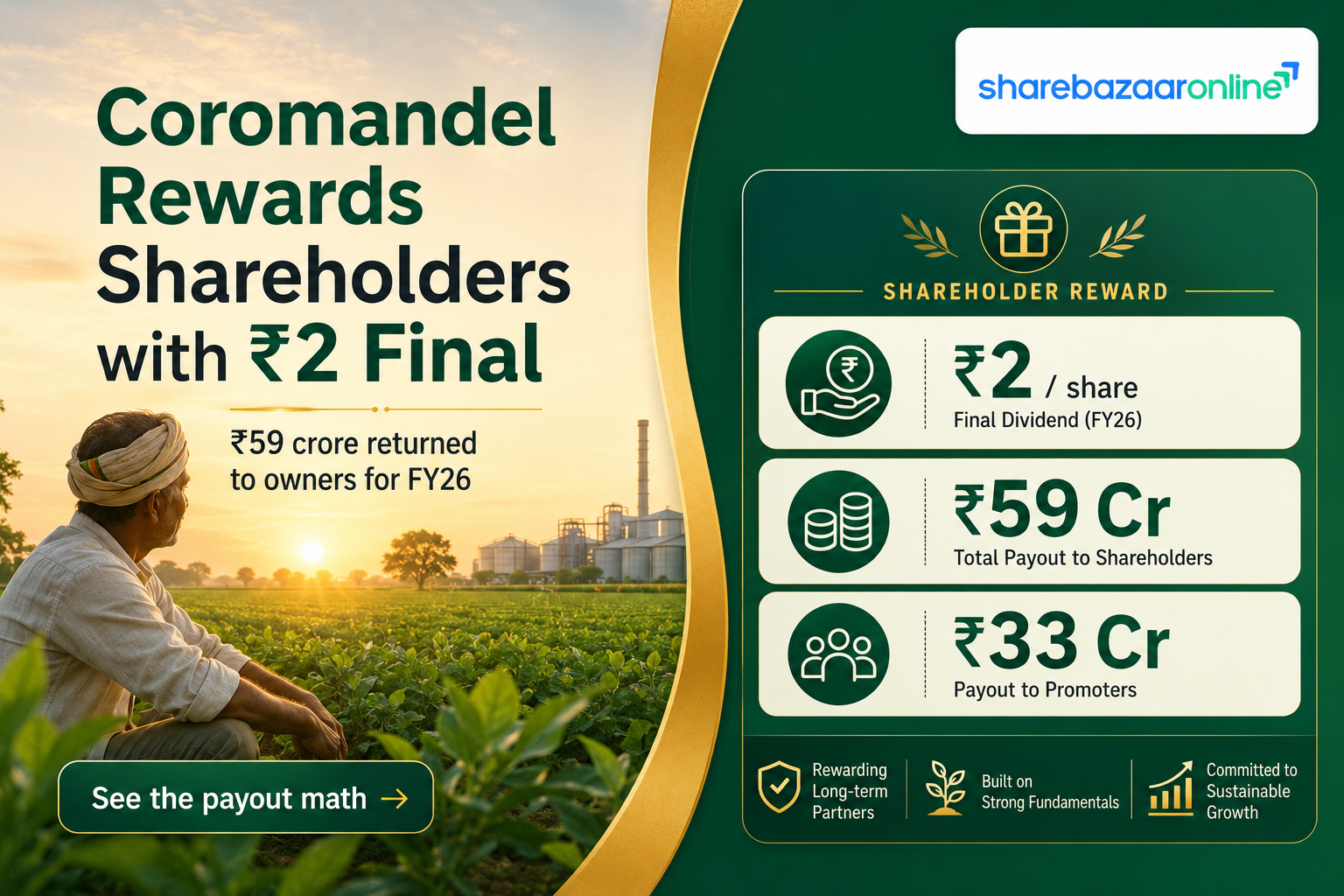
At its board meeting on 7 May 2026, the Board of Coromandel International recommended a final dividend of ₹2 per equity share (200% of the ₹1 face value) for the financial year 2025–26.
Because it is a final dividend, it still needs shareholder approval at the 64th Annual General Meeting on 23 July 2026. The company has fixed 16 July 2026 as the record date and will pay on or before 21 August 2026 (within 30 days of declaration, as required by the Companies Act, 2013).
This final dividend comes on top of a ₹9 interim dividend that Coromandel had already declared in January 2026, taking the total FY26 payout to ₹11 per share.
The same board meeting approved the audited FY26 results, the re-appointment of statutory auditors S R Batliboi & Associates LLP, and a corporate guarantee of up to USD 15.5 million for its Senegal subsidiary Baobab Mining & Chemicals.
Key Dates Timeline
Dividend Yield Analysis
Yield on the ₹2 final dividend
Yield on full-year payout (₹11)
The key takeaway: the headline "200% dividend" sounds large, but 200% is on a ₹1 face value — so it is just ₹2 in rupee terms. Against a share price near ₹2,000, the income return is tiny. Coromandel's ~0.55% trailing yield sits below the top-quartile of Indian dividend payers (~1.3%) but above the market's bottom quartile.
Dividend History Analysis
| Financial Year | Interim | Final | Total / Share |
|---|---|---|---|
| FY 2025–26 | ₹9 | ₹2 | ₹11 |
| FY 2024–25 | ₹6 | ₹9 | ~₹15 |
| FY 2023–24 | — | ₹6 | ₹6 |
| FY 2022–23 | ₹6 | ₹6 | ₹12 |
| FY 2021–22 | ₹6 | ₹6 | ₹12 |
| FY 2020–21 | ₹6 | ₹6 | ₹12 |
| FY 2019–20 | — | ₹12 | ₹12 |
Figures compiled from public dividend-history sources (TipRanks, BlinkX, stockanalysis.com, Investing.com). The interim/final split for older years varies slightly by source; the FY26 final of ₹2 is taken directly from the company filing. Face value has been ₹1 throughout this period.
Classification: Consistent Payer
Coromandel has paid a dividend every year for over a decade — it is a consistent payer. The amount, however, is cyclical: it tracks profits and cash needs rather than following a fixed policy.
⚠ The notable signal this year
The final dividend has been cut sharply — from ₹9 (FY25 final) to ₹2 (FY26 final). Total FY26 payout of ₹11 is also below FY25's ~₹15. This lower final follows a very weak fourth quarter (see below).
Financial Performance Analysis (FY26)
We analyse consolidated numbers as the primary view (they include all subsidiaries), and flag standalone where it changes the story.
| Consolidated (₹ Cr) | FY26 | FY25 | Change |
|---|---|---|---|
| Revenue from operations | 31,479.54 | 24,085.24 | +30.7% |
| Profit before tax | 2,617.14 | 2,727.55 | −4.0% |
| Net profit (total) | 1,898.14 | 2,054.71 | −7.6% |
| PAT (owners of company) | 1,956.15 | 2,066.46 | −5.3% |
| EPS (basic) | ₹66.41 | ₹70.23 | −5.4% |
| Q4 PAT (owners) | 139.93 | 579.67 | −75.9% |
⚠ The core red flag: revenue up 30%, profit down
Consolidated revenue rose +30.7%, yet net profit fell 7.6%. Most of the revenue jump is not organic — it reflects the consolidation of newly acquired NACL Industries (a subsidiary from 8 August 2025) and other acquisitions. The fourth quarter was the pressure point: Q4 profit collapsed ~76% YoY to ₹139.93 Cr.
The healthier standalone picture
On a standalone basis (the parent alone), FY26 net profit actually rose 3.5% to ₹2,008.58 Cr (EPS ₹68.19) and PBT rose 6.1%. In short: the core fertiliser & crop-protection business is doing fine — the consolidated weakness comes from loss-making and newly acquired subsidiaries.
Why Profit Fell While Revenue Rose
Cost lines that outpaced revenue (consolidated)
One-offs and drags
- Drone-subsidiary (Dhaksha) impairment of ₹70.56 Cr taken as an exceptional item in Q4, driven by delayed order execution.
- Subsidiary losses: eight subsidiaries together posted a net loss of about ₹181 Cr for the year.
- Higher interest burden as borrowings and acceptances rose after the NACL acquisition.
In plain terms: Coromandel bought growth (NACL, drones, Senegal mining) that added revenue but also added costs, interest and one-time write-downs faster than it added profit. This is a classic case of negative operating leverage in the consolidated entity during an acquisition-heavy year.
Cash Flow Analysis
| Consolidated (₹ Cr) | FY26 | FY25 |
|---|---|---|
| Operating cash flow (OCF) | 1,557.54 | 2,463.61 |
| Capex (PPE + intangibles) | (1,540.47) | (850.64) |
| Free cash flow (OCF − capex) | ~17.07 | ~1,613 |
| Dividend paid in year | 528.84 | 352.82 |
⚠ Two cash-flow warnings
- OCF fell ~37% (from ₹2,464 Cr to ₹1,558 Cr), mainly as working capital (inventories, receivables) absorbed cash.
- Free cash flow was almost nil (~₹17 Cr) because capex nearly doubled to ₹1,540 Cr for expansion.
How the dividend is funded
Because FY26 free cash flow (~₹17 Cr) does not cover even this small ₹2 final (₹59 Cr outflow), the dividend is effectively funded from earnings and large cash reserves, not from current-year surplus cash. On a standalone basis FCF was healthier (~₹103 Cr), covering the final ~1.8x. The heavy capex — not weakness in the dividend itself — is what consumed the cash.
Reported profit vs cash: Consolidated PAT of ₹1,898 Cr converted into only ₹1,558 Cr of operating cash and near-zero free cash this year. That gap is normal in a big investment year but worth watching — sustained low FCF alongside dividends would eventually rely on the balance sheet.
Balance Sheet Strength
Liquidity (consolidated, 31 Mar 2026)
Debt (consolidated, 31 Mar 2026)
Strong. Even after an acquisition-heavy year, liquid resources (~₹2,334 Cr) comfortably exceed total borrowings (₹867 Cr), leaving Coromandel in a net-cash position with total equity of ₹13,133 Cr. Note that current borrowings rose (from ~₹147 Cr) largely due to NACL consolidation, and separately the company reports ~₹5,022 Cr of "acceptances" (supplier trade credits within the normal working-capital cycle), which are not conventional debt.
Dividend Sustainability Analysis
Verdict: Sustainable (but deliberately conservative)
The ₹2 final is tiny relative to earnings and cash — covered ~33x by EPS and ~40x by liquid resources. There is no affordability risk. The low payout (~16% of full-year profit) reflects a deliberate choice to retain cash for capex and acquisitions rather than any inability to pay. The one caveat: the sharp cut in the final dividend signals management is being cautious after a weak Q4 and a capital-hungry year.
Peer Comparison
| Company | Div. Yield | Payout | Notes |
|---|---|---|---|
| Coromandel Intl. | ~0.55% | ~16–17% | Net cash; capex-heavy |
| Chambal Fertilisers | ~1.9–2.2% | ~23% | Higher income payer |
| Deepak Fertilisers | ~0.7–0.9% | ~14% | Growth + expansion |
| Chemicals sector avg. | ~0.7% | — | Industry benchmark |
On yield, Coromandel (~0.55%) is at the low end of its fertiliser peers — well below Chambal (~2%). On quality, however, Coromandel screens strongly: long-run average ROE around 20% and ROCE in the high-teens to mid-30s% depending on the period, with a net-cash balance sheet. It is priced as a growth compounder (P/E ~26–30, P/B ~4.7–5.0), not as an income stock.
Promoter Impact Analysis
Shareholding (Mar 2026)
Who gets the dividend rupees
Across the full-year ₹11 payout (~₹324 Cr), promoters receive roughly ₹183 Cr. Because promoters and minority investors are paid the same ₹2 per share, the distribution is proportional and fair — there is no special-class benefit. Worth noting: promoter holding has edged down (56.96% → 56.35% over the year) and FIIs trimmed their stake, so institutional sentiment softened during FY26.
Taxation Analysis
Since FY 2020–21, dividends in India are taxable in the hands of the investor at their applicable income-tax slab rate (there is no separate Dividend Distribution Tax anymore).
TDS: The company deducts 10% TDS under Section 194 if your total dividend from that company in a financial year exceeds ₹10,000 (threshold raised from ₹5,000 with effect from FY 2025–26). Below that, no TDS is deducted — but the dividend is still taxable and must be reported in your return. Submit Form 15G/15H if eligible to avoid TDS.
Worked example — investor holding 1,000 shares
| Gross dividend (1,000 × ₹2) | ₹2,000 |
| TDS (below ₹10,000 threshold → nil) | ₹0 |
| Tax at 30% slab (+4% cess) | ₹624 |
| Net dividend in hand | ₹1,376 |
| Post-tax effective yield (@ ~₹1,985/sh) | ~0.07% |
For a 30% slab investor, tax roughly erases a third of an already small dividend. Lower-slab investors keep more. This is illustrative — consult a tax adviser for your situation.
Key Risks
- Subsidy & regulatory dependence: A large part of the fertiliser business relies on government nutrient subsidy. Subsidy timing and policy changes swing both receivables (₹2,168 Cr outstanding) and margins.
- Raw-material & currency volatility: Phosphoric acid, ammonia and rock phosphate are imported and dollar-priced. Input-cost inflation squeezed margins in FY26 and can recur.
- Acquisition integration risk: NACL, the Senegal mining assets and the drone (Dhaksha) business are still being integrated. Subsidiary losses (~₹181 Cr) and a ₹70.56 Cr drone impairment already dented FY26 consolidated profit.
- Monsoon & agri-cycle sensitivity: Demand depends on rainfall, sowing and farm economics — a weak season directly hits volumes.
- Earnings momentum: Q4 FY26 profit fell ~76% YoY and FIIs trimmed stakes; if quarterly weakness persists, the dividend could stay low.
- Capex absorbing cash: Near-zero consolidated free cash flow this year means the balance sheet, not current cash generation, is currently supporting shareholder returns.
What To Monitor
- Quarterly profit recovery: Does Q1 FY27 reverse the Q4 collapse, or is margin pressure structural?
- NACL turnaround: Whether the acquired crop-protection subsidiaries move from loss to profit and stop dragging consolidated earnings.
- Free cash flow normalisation: As the current capex cycle matures, watch for FCF returning to the ₹1,000 Cr+ range seen historically.
- Subsidy receivables: Track the ₹2,168 Cr government-subsidy receivable and how quickly it converts to cash.
- Payout policy: Whether management restores a higher final dividend next year or keeps it conservative to fund growth.
- Promoter & FII holding: Any further decline could signal weakening insider/institutional conviction.
Conclusion
Coromandel International's ₹2 final dividend for FY26 is best understood as a small, safe, but deliberately trimmed distribution. It is covered ~33 times by earnings and ~40 times by liquid resources, so affordability is not in doubt.
The more important context is the business, not the payout: consolidated revenue jumped 30% on acquisitions, yet profit fell 7.6% and Q4 profit crashed ~76% — a genuine operating-leverage warning driven by subsidiary losses, a drone impairment and higher costs. Reassuringly, the standalone core business grew profit 3.5% and the balance sheet remains net cash.
For income seekers, a ~0.55% trailing yield offers little. For growth investors, the dividend is a minor by-product of a capex-and-acquisition story whose payoff still has to show up in consolidated profits. We present the facts, positives and risks — the decision is yours.