
Dividend Status
RECORD DATE REACHED — PAYMENT PENDING
Lupin's Board recommended the ₹18 per share final dividend on 07-May-2026. As per exchange data the ex-date/record date falls on 17-Jul-2026. Because this is a final dividend, it must still be approved by shareholders at the 44th AGM on 04-Aug-2026, after which payment is made within 30 days (historically early September). So this is not a completed payout yet — eligibility is being fixed now and the cash lands post-AGM. If you are reading this after 17-Jul-2026, you needed to hold the stock before the ex-date to qualify.
Dividend Snapshot
Company
Lupin Limited
NSE / BSE
LUPIN / 500257
ISIN
INE326A01037
Face Value
₹2
Dividend Type
Final Dividend
Dividend / Share
₹18 (900%)
Yield (at ₹2,495)*
0.72%
Payout Ratio
~15%
Total Outflow
₹822.92 Cr
Coverage (EPS/DPS)
6.5x
Financial Year
FY2025-26
AGM Date
04-Aug-2026
*Latest CMP ₹2,495 as on 15-Jul-2026 (NSE). Yield changes with price. Source: NSE / Screener.
Dividend Announcement Summary
At its Board meeting on 07-May-2026, Lupin's directors unanimously approved the audited standalone and consolidated results for FY2025-26 and recommended a final dividend of ₹18 per equity share — equal to 900% of the ₹2 face value. The company disclosed a total dividend distribution of ₹822.92 crore (₹8,229.2 million). The auditors, B S R & Co. LLP, issued an unmodified (clean) opinion on both sets of accounts.
This is Lupin's largest annual dividend to date and comes on the back of a record year: consolidated revenue rose to ₹27,958 crore and consolidated profit after tax jumped to ₹5,355 crore. Management framed the payout as reflecting the company's "long-term outlook." No special or interim dividend was declared — this is a single annual final dividend, in line with Lupin's usual once-a-year pattern.
Key Dates Timeline
Announcement / Board Meeting
07-05-2026
Ex-Date / Record Date (per exchange data)
17-07-2026
AGM (shareholder approval)
04-08-2026
Payment Date (within 30 days of AGM)
Expected early Sep-2026
Note: Exact payment date is declared after the AGM. Historically Lupin pays in the first week of September. Verify on NSE/BSE before trading. Source: NSE/BSE, exchange dividend calendars.
Dividend Yield Analysis
Yield at Announcement (~₹2,050, early May 2026)*
≈ 0.88%
₹18 ÷ ~₹2,050 × 100
Yield at Latest CMP (₹2,495, 15-Jul-2026)
0.72%
₹18 ÷ ₹2,495 × 100
In plain English: yield is the annual dividend divided by the share price. At today's price of about ₹2,495, ₹18 works out to a 0.72% yield — modest. This is a classic growth stock, not an income stock. You buy Lupin for capital appreciation and earnings growth; the dividend is a small bonus, not the reason to own it.
Importantly, the yield fell from ~0.88% to ~0.72% not because the dividend shrank (it actually rose 50%, from ₹12 to ₹18), but because the share price rallied ~20% from around ₹2,050 in early May to ₹2,495 by mid-July. That is the healthy reason a yield can compress — a rising price, not a falling one.
*Announcement-period price is an approximation from market data around 07-08 May 2026 (stock traded ~₹1,920–2,100). Exact 07-May close not separately disclosed. Source: Univest, Business Standard, NSE.
Dividend History Analysis
| Financial Year | Dividend / Share | Dividend % | Type |
|---|---|---|---|
| FY2026 | ₹18.00 | 900% | Final (proposed) |
| FY2025 | ₹12.00 | 600% | Final |
| FY2024 | ₹8.00 | 400% | Final |
| FY2023 | ₹4.00 | 200% | Final |
| FY2022 | ₹4.00 | 200% | Final |
| FY2021 | ₹6.50 | 325% | Final |
| FY2020 | ₹6.00 | 300% | Final |
| FY2019 | ₹5.00 | 250% | Final |
| FY2018 | ₹5.00 | 250% | Final |
| FY2017 | ₹7.50 | 375% | Final |
| FY2016 | ₹7.50 | 375% | Final |
Lupin has paid a dividend every single year for the last decade — that makes it a Consistent Payer. But the ride was not a smooth staircase. Between FY2016 and FY2023 the payout actually drifted down and stayed choppy (from ₹7.50 to as low as ₹4.00), tracking a rough patch of US pricing pressure and plant issues.
The turnaround is recent and steep: ₹4 → ₹8 → ₹12 → ₹18 across FY2023 to FY2026. The dividend has quadrupled in three years, and the latest ₹18 is a fresh all-time high. So while Lupin is a reliable payer, the big jumps are a new phenomenon driven by a sharp earnings recovery — not a long, steady compounding record like a classic FMCG dividend name. Read the growth as "profit-linked," which means it can also soften if profits soften.
Financial Performance Analysis (Consolidated)
| Metric (₹ Cr) | FY26 | FY25 | Growth |
|---|---|---|---|
| Revenue from Ops | 27,958 | 22,708 | +23.1% |
| Operating Profit | 8,816 | 5,278 | +67.0% |
| OPM % | 32% | 23% | +9 pts |
| PAT (total) | 5,355 | 3,306 | +62.0% |
| EPS (₹, after excep.) | 116.75 | 71.95 | +62.3% |
FY26 was a strong operating-leverage year: revenue grew 23% but operating profit grew 67%, and margins expanded from 23% to 32%. When profit grows nearly 3x faster than sales, it usually means costs are being spread over a bigger base and product mix is improving (here, higher-value US complex generics and gross margin of ~75%).
A caution flag: reported PAT and EPS are flattered by exceptional gains. On a before-exceptional basis, consolidated basic EPS was ₹128.45; after exceptionals it was ₹116.75 — this year exceptionals were a net negative at the consolidated level (litigation provisions), while the standalone books carried a large one-time divestment gain. Judge the business on the operating trend, not the headline profit.
Standalone vs Consolidated: Standalone PAT (₹6,367 Cr) is actually higher than consolidated PAT (₹5,355 Cr) this year because the parent booked a large one-time slump-sale gain on transferring its OTC and API R&D businesses to subsidiaries. For a group as global as Lupin (28+ subsidiaries), the consolidated numbers are the right lens — they capture the whole business including the US, and that is what we use throughout this analysis.
Cash Flow Analysis
Operating Cash Flow FY26
₹7,334 Cr
vs PAT ₹5,355 Cr — OCF comfortably exceeds profit
Free Cash Flow FY26
₹5,527 Cr
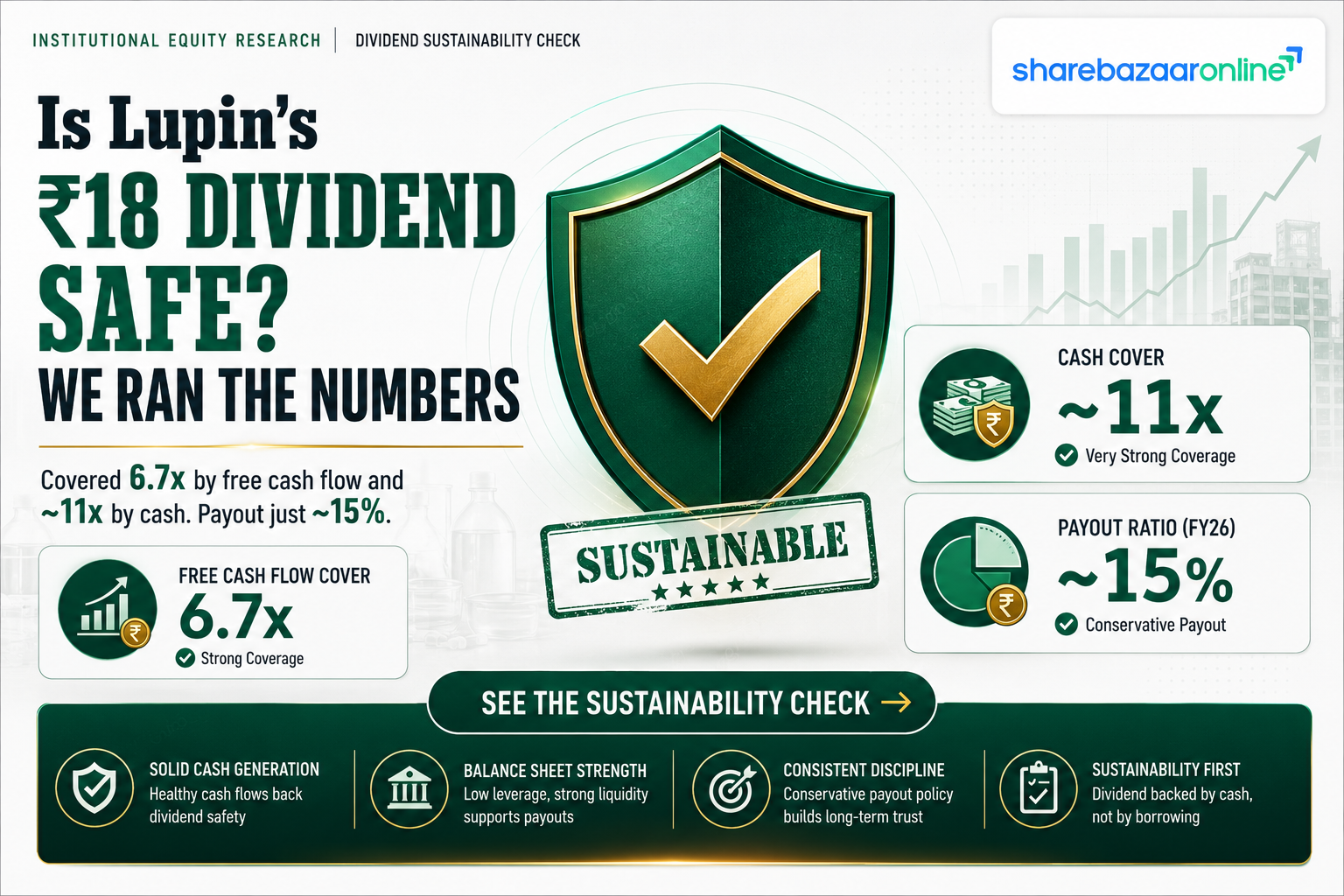
After ~₹2,055 Cr capex — covers ₹823 Cr dividend 6.7x
Here is where Lupin looks genuinely healthy. Reported profits are opinions; cash is fact — and the cash backs up the profit. Operating cash flow of ₹7,334 crore is higher than PAT of ₹5,355 crore, giving a cash-conversion (CFO/Operating Profit) of about 98%. That tells you the earnings are "real" and not stuck in paper receivables. OCF also more than doubled from ₹3,000 crore in FY25.
How is the dividend funded? Entirely out of current-year free cash flow. FCF of ₹5,527 crore covers the ₹823 crore dividend nearly seven times over. The company is not borrowing to pay you, and it is not selling assets to fund the dividend. This is the strongest possible footing for a payout.
One thing to watch, not to fear: receivables and inventory remain heavy. Trade receivables rose ~₹738 crore and inventory ~₹586 crore during the year, and the working-capital cycle is long (inventory ~303 days). That is normal for a global generics maker, but it means a chunk of profit is always tied up in the pipeline — worth monitoring if growth slows.
Balance Sheet Strength
Lupin sits on a liquid pool of roughly ₹9,230 crore (cash + current investments + bank balances) against total borrowings of about ₹6,616 crore — so on a net basis the company is effectively net-cash. Equity of ₹22,513 crore dwarfs debt, and the credit rating profile is strong (ICRA-rated). The ₹823 crore dividend is a rounding error against this balance sheet: the cash pool alone covers the dividend more than 11 times. Affordability is simply not in question. The one nuance: current borrowings rose during the year (partly to fund the VISUfarma acquisition, closed 01-Apr-2026), so keep an eye on how quickly that is repaid.
Dividend Sustainability Analysis
Verdict
SUSTAINABLE
Low payout, deep cash, strong FCF cover — with the caveat that the size of the payout tracks profits.
Cash position: Yes — ₹9,230 Cr liquid pool covers the dividend ~11x.
FCF cover: Yes — ₹5,527 Cr FCF covers ₹823 Cr dividend 6.7x.
Payout ratio: Low at ~15% — room to raise dividends for years.
Debt trend: Net-cash; debt is not rising to fund dividends.
Earnings trend: Growing fast (PAT +62%, 5-yr profit CAGR ~37%).
Coverage: EPS ₹116.75 vs DPS ₹18 = 6.5x cushion.
The dividend is very safe in absolute rupee terms — a ₹823 crore payout barely dents a company throwing off ₹5,500 crore of free cash. The honest caveat is about the growth of the dividend, not its safety. Because Lupin keeps the payout ratio low (~15%) and links dividends to profit, a future dip in US generics pricing or a big litigation hit could keep the dividend flat rather than growing. Safe: yes. Guaranteed to keep leaping 50% a year: no.
Peer Comparison
| Company | Div Yield | Payout | ROE | ROCE |
|---|---|---|---|---|
| Lupin | 0.72% | ~15% | 29.1% | 30.3% |
| Dr Reddy's | 0.62% | 21.6% | 11.5% | 14.1% |
| Sun Pharma | ~0.4% | ~20% | ~16% | ~18% |
| Natco Pharma | 0.62% | ~15% | 16.9% | 17.1% |
| Aurobindo Pharma | ~0.34% | ~12% | ~13% | ~14% |
The whole Indian pharma pack is a low-yield group — dividend yields cluster around 0.3%–0.7%, well below the broader market. So Lupin's 0.72% is middle-of-the-pack on yield but sits comfortably at the top on return ratios: its ROE of ~29% and ROCE of ~30% are the best in this comparison, roughly double Dr Reddy's. Translation: Lupin pays a small dividend but is currently the most efficient at turning capital into profit. Peer figures marked "~" are approximate/rounded from public screeners; verify before use. Source: Screener, TipRanks, ValueResearch.
Promoter Impact Analysis
The promoter family (the Gupta family) owns 46.85%, so roughly ₹385 crore of the ₹823 crore payout flows to promoters. That is a large sum, but the distribution is proportional — every shareholder gets the same ₹18 per share, so minority investors are treated identically. Two reassuring points: (1) the payout ratio is low, so the company is not being drained to enrich promoters at the cost of reinvestment; and (2) promoter holding has been broadly stable (~47% for years, only a marginal drift down), signalling no unusual selling. This looks like a normal, aligned capital-return, not a promoter-friendly cash grab.
Taxation Analysis
Since April 2020, India follows a classical dividend tax system. The company no longer pays Dividend Distribution Tax; instead, the dividend is fully taxable in your hands at your income-tax slab rate. If your total dividend from a company crosses ₹10,000 in a financial year, the company deducts TDS at 10% (under Section 194) before paying you — 20% if you have not provided a PAN. You claim credit for this TDS when filing your return.
Worked Example — 1,000 shares at ₹18/share, investor in 30% slab
| Gross Dividend (1,000 × ₹18) | ₹18,000 |
| TDS deducted @10% (as > ₹10,000) | ₹1,800 |
| Amount credited to bank (after TDS) | ₹16,200 |
| Final tax @31.2% (30% + 4% cess) | ₹5,616 |
| Balance tax payable (₹5,616 − ₹1,800) | ₹3,816 |
| Net dividend in hand (after all tax) | ₹12,384 |
| Effective post-tax yield (at ₹2,495) | ≈ 0.50% |
Illustrative. Surcharge may apply at higher incomes. Lower slabs pay less; those below the taxable limit can file Form 15G/15H to avoid TDS. Not tax advice — consult a professional.
Key Risks
1. US generics pricing & concentration: The US is the biggest profit engine (US sales jumped ~57% in Q4). US price erosion, a single big product losing exclusivity, or a plant warning letter can swing earnings — and with them, future dividends.
2. US tariff / macro overhang: A 26% US reciprocal tariff announced in April 2026 created uncertainty for Indian exporters and triggered FII outflows. Any escalation is a direct risk to US-heavy Lupin.
3. Litigation & antitrust provisions: Lupin carries antitrust litigation exposure (cumulative ~₹582 Cr provision) plus settlements (e.g. Astellas/Mirabegron USD 90 Mn). Adverse outcomes hit profits and cash.
4. Exceptional-item dependence: FY26 headline profit was shaped by one-off divestment gains (standalone) and litigation charges (consolidated). Strip these out and the "true" run-rate is lower than the reported figure suggests.
5. Rich valuation: At a P/E of ~18–19 on already-elevated FY26 earnings, a lot of good news is priced in. If margins normalise from the current ~32% peak, the stock (and dividend growth) could de-rate.
6. Working-capital intensity: Long inventory (~303 days) and heavy receivables tie up cash. A demand slowdown could pressure cash conversion and, indirectly, payout growth.
What To Monitor
1. EBITDA margin trajectory: Can Lupin hold the ~32% operating margin, or does it drift back toward the low-20s as US pricing normalises? This is the single biggest driver of future dividends.
2. US pipeline & FTF launches: Track ANDA approvals (430 filed / 344 approved) and the 52 First-to-File opportunities, including 22 exclusive ones — these are the future profit pool.
3. USFDA plant status: Any inspection outcome, EIR, or warning letter on key sites directly affects US supply and earnings.
4. Payout-ratio policy: Watch whether management lifts the payout ratio above ~15%. A higher policy ratio would signal confidence and mean faster dividend growth.
5. VISUfarma & acquisition integration: The ₹2,090 Cr VISUfarma deal (closed Apr-2026) and current-borrowings uptick — monitor debt repayment and whether acquisitions add to cash flow.
6. Working-capital cycle: Inventory and receivable days — improvement frees cash; deterioration signals demand or channel stress.
Conclusion
Positives
Record year — revenue +23%, PAT +62%, best-in-class ROE (~29%) and ROCE (~30%). Dividend at an all-time-high ₹18 (up 50%), backed by ₹5,527 Cr free cash flow and a ~₹9,230 Cr liquid pool. Payout ratio is low (~15%), leaving huge room to grow. Consistent 10-year payer; unmodified auditor opinion.
Negatives & Watch-outs
The 0.72% yield is small — this is a growth stock, not an income play. Headline profits lean on exceptional items. Heavy US dependence exposes Lupin to pricing, tariffs, and litigation. Margins are at a cyclical high (~32%) and valuation is full. Dividend size tracks profits, so it can plateau if earnings soften.
Bottom line for a dividend lens: The ₹18 dividend is comfortably affordable and sustainable, but it is a modest cash return on a high-quality, fast-growing, US-exposed business. Investors chasing yield will find it thin; investors who own Lupin for growth get a rising dividend as a bonus. Weigh the positives, negatives, risks and monitoring points above and decide based on your own goals.
Frequently Asked Questions
What dividend has Lupin announced for FY2025-26?
What is the dividend yield on Lupin shares?
What is the record date for the Lupin dividend?
What is the ex-date and why does it matter?
When will the Lupin dividend be paid?
Who is eligible to receive the dividend?
How is the Lupin dividend taxed?
Is the Lupin dividend sustainable?
What is Lupin's dividend history?
What should investors monitor going forward?
How does Lupin's yield compare with pharma peers?
Why did the yield fall even though the dividend rose?
Should I look at standalone or consolidated numbers?
Disclaimer
This analysis is for informational and educational purposes only and does not constitute investment, financial, legal or tax advice, nor a recommendation to buy, sell or hold any security. Figures disclosed by the company are drawn from Lupin's 07-May-2026 exchange filing; market data (price, yield, shareholding, ratios, peer figures, record/ex-dates) are sourced from public providers such as NSE/BSE, Screener, TipRanks and others as of mid-July 2026 and may change. Some peer and announcement-date figures are approximate and marked accordingly. Prices and dates must be independently verified on the NSE/BSE websites before acting. ShareBazaar Online and its authors accept no liability for any loss arising from the use of this content. Please consult a SEBI-registered investment adviser and a qualified tax professional before making any decision. Securities markets are subject to risk; past performance is not indicative of future results.