
STATUS: UPCOMING — RECORD DATE PASSED, TENDERING WINDOW OPENS 21 JULY 2026
As of 16 July 2026, the record date of 15 July 2026 has passed. Only shareholders who held Orbit Exports shares in their demat account on that date are eligible. The tendering window is scheduled to open on 21 July 2026 and close on 27 July 2026. This report is written as an as-announced analysis of an offer that has not yet opened for tendering. Entitlement ratios and final acceptance data will only be known once the Letter of Offer is dispatched and the window closes.
Orbit Exports Buyback 2026 — At a Glance
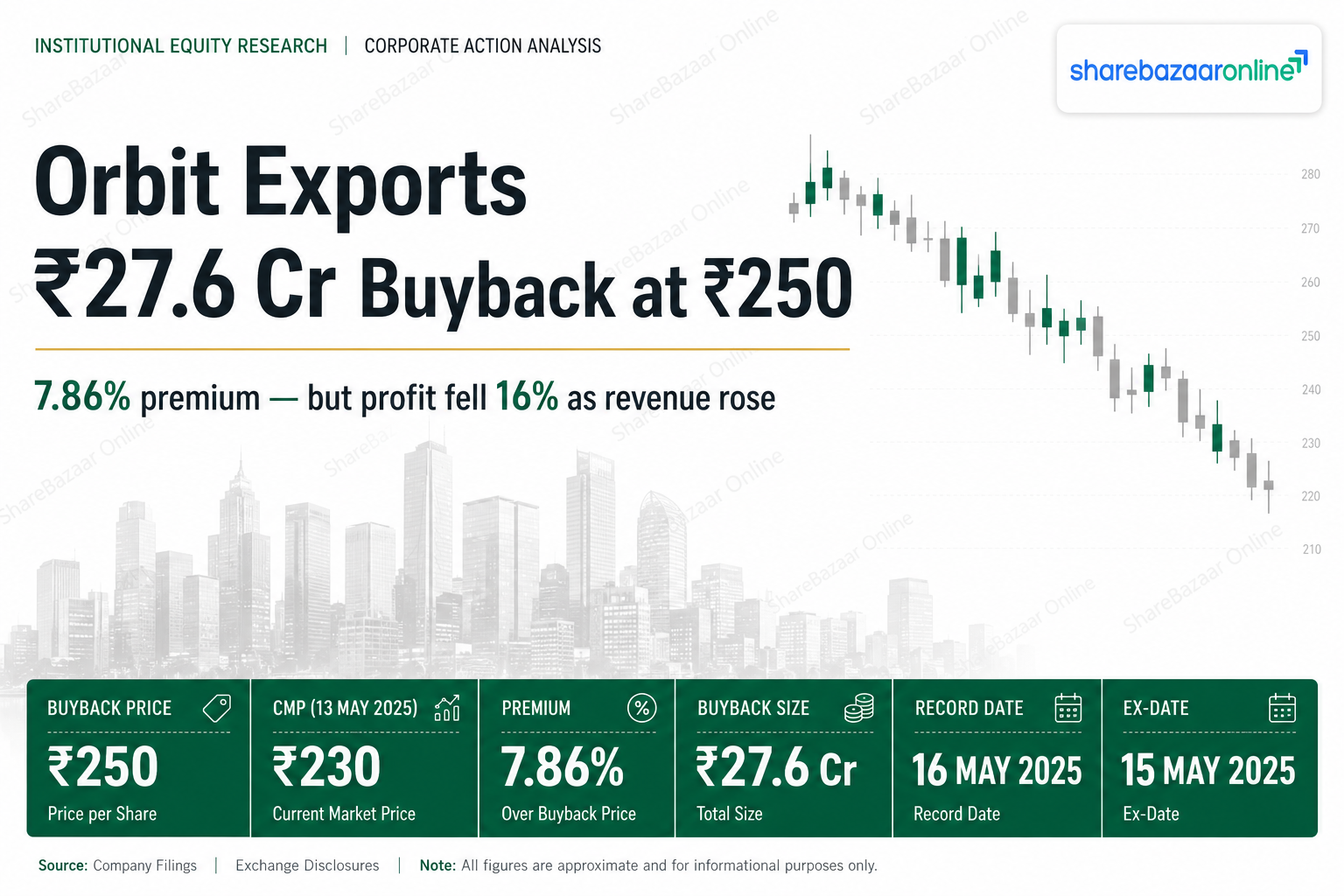
Orbit Exports Limited, a Mumbai-based novelty-fabric and jacquard weaver, is buying back up to 11,04,000 equity shares at ₹250 per share through the tender offer route — a mechanism where the company invites eligible shareholders to offer ("tender") their shares back to the company at a fixed price, and accepts them on a proportionate basis. The total outlay is capped at ₹27.60 crore. Below the headline premium sits a more complicated story: profit fell while revenue rose, and the offer is funded comfortably from the year's own cash generation.
Buyback Price
₹250
CMP (9 Jul 2026)
₹231.78
Premium
7.86%
Buyback Size
₹27.60 Cr
Shares Bought
11,04,000
% of Capital
4.16%
Route
Tender Offer
Promoter Participation
None
CMP is the NSE closing price on 9 July 2026, the date the Public Announcement was published (Symbol: ORBTEXP). Source: NSE / Screener / Business Today. Premium computed as (250 − 231.78) ÷ 231.78 × 100.
Key Dates & Timeline
| Event | Date | What it means |
|---|---|---|
| Board Meeting | 7 July 2026 | Board approved the buyback proposal. |
| Public Announcement | 8–9 July 2026 | Formal offer details published in newspapers. |
| Record Date | 15 July 2026 | The cut-off day. You must hold shares on this date to be eligible. |
| Tendering Opens | 21 July 2026 | First day you can offer your shares back to the company. |
| Tendering Closes | 27 July 2026 | Last day to tender. Window stays open 5 working days. |
Record date and tender window sourced from the company Public Announcement and Screener corporate filings (tender opens 21 July 2026). "Ex-date" in the tender context is effectively the record date − 1 trading day; exact ex-date for entitlement will be confirmed in the Letter of Offer.
The Premium, Honestly: Why the Headline Number Is Not Your Return
The company frames the offer around premiums it quotes against various volume-weighted averages. Against the plain closing price on the Public Announcement date (NSE close of ₹231.78 on 9 July 2026), the premium works out to 7.86%. That is the gross premium on the shares that actually get accepted. It is not what you earn on your whole holding.
The reason is the acceptance ratio — the proportion of your tendered shares the company actually buys. Because this is a small ₹27.60 crore offer covering just 4.16% of capital, and because promoters (66.05% of the company) are sitting it out, the shares available for the public pool are limited. Your real pre-tax return is the premium multiplied by the acceptance ratio:
Blended pre-tax return = Premium % × Acceptance Ratio %
The entitlement ratio has not yet been published (it comes with the Letter of Offer, and is often revised by corrigendum). Promoter non-participation raises the public entitlement, which helps. Below is an illustrative scenario table. These acceptance ratios are assumptions, not disclosed figures — treat them as a framework, not a forecast.
| Scenario | Assumed Acceptance | Gross Premium | Blended Pre-Tax Return* |
|---|---|---|---|
| Best case | 100% | 7.86% | ~7.86% |
| Base case | 40% | 7.86% | ~3.14% |
| Worst case | 20% | 7.86% | ~1.57% |
*Blended return applies only to the accepted portion and ignores taxes, brokerage and the price risk on the un-accepted shares you are left holding. Acceptance percentages are illustrative assumptions pending the Letter of Offer, not company disclosures. The actual entitlement and acceptance ratio are Not Disclosed by Company at this stage.
Financial Performance: Revenue Up, Profit Down (Consolidated FY26)
We analyse consolidated numbers, because Orbit runs subsidiaries (Orbit Inc., Orbit Elegance Trading LLC) and associates whose flows distort the standalone picture. The headline finding of this section: revenue grew but profit shrank. A buyback shrinks the share count — it does not repair a margin problem.
| Metric (Consolidated) | FY26 | FY25 | Change |
|---|---|---|---|
| Revenue from Operations | ₹226.67 Cr | ₹213.70 Cr | +6.07% |
| Net Profit (PAT) | ₹32.61 Cr | ₹39.01 Cr | −16.40% |
| Net Cash from Operations | ₹57.37 Cr | ₹33.00 Cr (approx) | Strongly positive |
| Total Equity / Net Worth | ₹307.46 Cr | — | — |
| Investments (Treasury) | ₹72.39 Cr | ₹37.21 Cr | +94.5% |
Operating leverage worked in reverse
Revenue rose about 6% yet PAT fell about 16%. That gap is the real story. The strain was sharpest in the fourth quarter, where consolidated Q4 net profit collapsed to ₹1.00 crore from ₹6.61 crore a year earlier, and quarterly operating margin fell to roughly 15.5% from about 23%. No buyback fixes that.
Cash is a fact; profit is an opinion
The good news: operating cash flow of ₹57.37 crore comfortably exceeded reported PAT of ₹32.61 crore. Cash generation is genuine, not accounting-led. The ₹27.60 crore buyback is therefore funded from the year's own earnings and cash — not from borrowings or old reserves being drained.
Consolidated figures from Orbit Exports FY26 audited results (board approved 9 May 2026), as reported via EquityBulls, Free Press Journal, ScanX and Screener. FY25 OCF (₹33 Cr) is an approximate comparative from MarketsMojo. Net worth and treasury figures from FY26 audited consolidated statements.
The Idle-Capital Question
Orbit's investments (largely financial/treasury holdings) nearly doubled to ₹72.39 crore from ₹37.21 crore, even as fixed assets in the core manufacturing business shrank. When a large slice of net worth sits in financial instruments rather than in the operating business, return on equity is dragged down — the company earns a modest return because a chunk of its equity is parked, not deployed.
The ₹27.60 crore buyback is about 9% of the ₹307 crore consolidated net worth. Read charitably, it is a first, tentative step at returning idle capital to shareholders. Read critically, it is small relative to the treasury build-up — a partial answer to a capital-allocation question the company has not fully resolved.
Promoter Non-Participation: Two Effects, Both True
The promoter and promoter group, holding 66.05% (1,75,11,659 shares), have confirmed they will not tender. This has two consequences, and honest analysis reports both:
- It helps you. Because promoter shares are excluded from the entitlement calculation, the public shareholders' entitlement ratio rises. More of your tendered shares can be accepted than would otherwise be the case.
- It also helps them. When the company extinguishes shares bought only from the public, the promoters' percentage stake creeps up — passively, without spending a single rupee. Post-buyback, promoter control rises even though their share count is unchanged.
The company confirms this will not trigger an open offer and that public shareholding stays above the minimum threshold.
The Tax Reality After October 2024 (Read This Before You Tender)
This is the single most important part of the report for anyone in a high tax bracket. Since 1 October 2024, buyback proceeds are taxed very differently, and it changes the maths dramatically:
- The entire buyback amount you receive is treated as a deemed dividend and taxed at your slab rate — not as capital gains.
- You get no deduction for what you originally paid for the shares against that dividend income.
- Your original purchase cost instead becomes a capital loss, which you can carry forward for up to 8 assessment years to offset future capital gains.
- The company deducts TDS on the gross buyback amount before paying you.
Worked example — a 30% slab investor tenders 100 shares
| Shares accepted (assume all 100) | 100 |
| Buyback proceeds @ ₹250 | ₹25,000 |
| Taxed as dividend @ 30% (+ cess) | −₹7,800 (approx) |
| Net cash in hand | ~₹17,200 |
| Assumed original cost (@ ₹232) | ₹23,200 → booked as capital loss |
The plain conclusion: for a top-bracket investor, a ~8% gross premium can be almost entirely consumed by a 30%-plus dividend tax on the full proceeds. The arbitrage largely disappears. The capital-loss carry-forward has value only if you have future capital gains to set it against.
This is general information, not tax advice. Actual liability depends on your slab, surcharge, cess and holding. ShareBazaar Online is not a tax advisor — consult a qualified professional.
Financial Engineering vs Business Performance
A buyback lifts earnings per share by shrinking the denominator — fewer shares means the same profit divided across a smaller base, so EPS mechanically rises by roughly 4%–4.5% here. That is arithmetic, not achievement. Orbit did not earn more money because of the buyback; it simply spread the same (in fact, lower) profit over fewer shares. Readers should not confuse a higher EPS with a healthier business. The business question — why did margins compress and profit fall while revenue grew? — remains open regardless of the buyback.
Offer Mechanics, Managers & Registrar
| Particular | Detail |
|---|---|
| Manager to the Buyback | Saffron Capital Advisors Private Limited |
| Registrar | MUFG Intime India Private Limited (formerly Link Intime) |
| Company Broker | Choice Equity Broking Private Limited |
| Designated Exchange | BSE (listed on both BSE & NSE) |
| Face Value | ₹10 per share |
| Small Shareholder Reservation | 15% of the offer reserved for holders with ≤ ₹2,00,000 of shares on record date |
| Debt/Equity post-buyback | 0.02:1 (well within the 2:1 statutory cap) |
Key terms explained: Extinguishment means the bought-back shares are permanently cancelled and destroyed, reducing the total share count. Entitlement ratio is the number of shares you are allowed to tender per shares held, set by category. Record date is the ownership cut-off; ex-date is the trading day from which a new buyer no longer gets the entitlement.
Positives, Negatives & What to Monitor
Positives
- Strong operating cash flow (₹57.37 Cr) fully funds the offer from earnings.
- Debt is negligible; post-buyback debt/equity a tiny 0.02:1.
- Promoter non-participation lifts public entitlement.
- 15% reservation genuinely helps small shareholders.
Negatives / Risks
- PAT fell ~16% while revenue rose ~6% — margin compression.
- Q4 FY26 profit collapsed ~85% YoY — a worsening trend, not a one-off.
- Modest ~7.86% gross premium, largely erased by slab-rate tax for top brackets.
- Rising treasury / idle capital signals an unresolved allocation question.
Monitoring factors
- The entitlement ratio in the Letter of Offer (and any corrigendum revising it).
- The final acceptance ratio once tendering closes on 27 July 2026.
- Q1 FY27 results for signs of whether the margin slide is stabilising.
- Textile export demand from US/EU markets and currency movement.
ShareBazaar Online does not issue Buy, Sell or Hold recommendations. We present the facts, the risks and the dates; the decision is yours.
Frequently Asked Questions
What is the Orbit Exports buyback price and premium?
The buyback price is ₹250 per share. Against the NSE closing price of ₹231.78 on 9 July 2026 (the Public Announcement date), that is a premium of about 7.86%.
When is the record date and tender window?
The record date was 15 July 2026. The tendering window is scheduled to open on 21 July 2026 and close on 27 July 2026.
Will I get the full 7.86% return?
No. You earn the premium only on shares actually accepted. Your real return is the premium multiplied by the acceptance ratio, and then reduced further by tax. The entitlement and acceptance ratio are not yet disclosed.
How is the buyback taxed?
Since 1 October 2024, the entire proceeds are taxed as a deemed dividend at your slab rate, with no deduction for cost. Your purchase cost becomes a carry-forward capital loss. For a 30% slab investor, this consumes most of the premium.
Are promoters participating?
No. The promoter group (66.05%) will not tender. This raises the public entitlement and passively increases their control percentage after extinguishment.
Disclaimer
This report is prepared by ShareBazaar Online for informational and educational purposes only and does not constitute investment, legal or tax advice, nor a Buy, Sell or Hold recommendation. Figures marked as sourced from the company are drawn from the Public Announcement dated 8–9 July 2026; market prices and financial performance figures are sourced from NSE, Screener, EquityBulls, Free Press Journal, ScanX and other public sources with dates cited inline, and may have changed since publication. The CMP used for premium calculation is the NSE close of ₹231.78 on 9 July 2026. Entitlement and acceptance ratios are not yet disclosed by the company. Securities investments are subject to market risk; please read all offer documents (the Letter of Offer in particular) carefully and consult a SEBI-registered adviser and a qualified tax professional before acting. ShareBazaar Online accepts no liability for decisions taken on the basis of this report.