
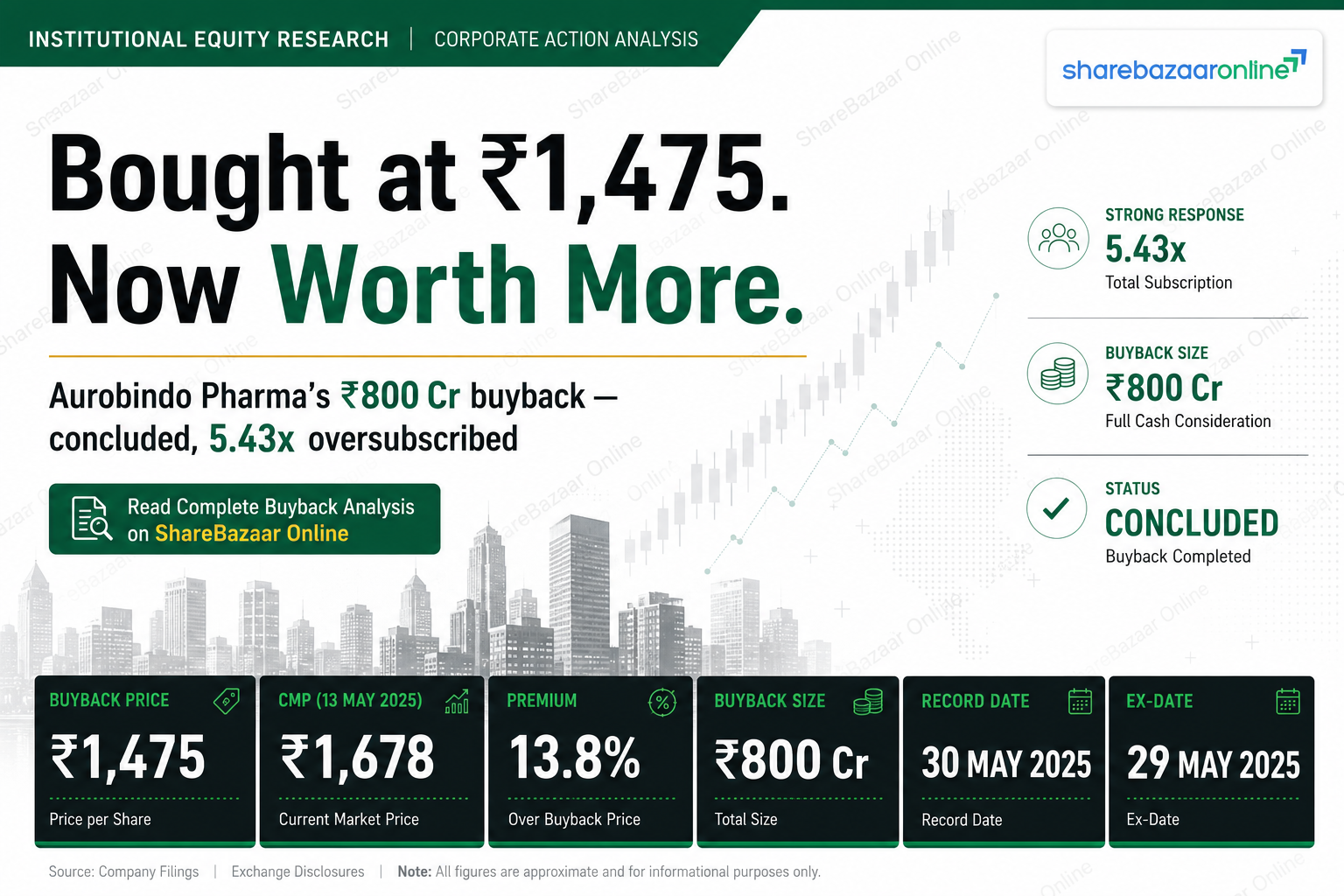
STATUS: BUYBACK CLOSED, SETTLED & EXTINGUISHED — THIS IS A CONCLUDED CORPORATE ACTION
The Aurobindo Pharma buyback is over. The tendering window closed on 29 April 2026, settlement was completed on 7 May 2026, and all 54,23,728 shares were extinguished on 14 May 2026. You can no longer participate.
This report is a post-mortem, not a live opportunity. Read it to understand how the offer actually played out — the acceptance ratio, the tax outcome, and one uncomfortable fact: the stock has since climbed above the buyback price. Anyone still looking at ₹1,475 as an entry or exit is working from stale numbers.
Buyback At A Glance
Buyback Price
₹1,475
Size
₹800 Cr
Shares Bought
54,23,728
% of Capital
0.93%
Premium (vs announce)
10.04%
Oversubscription
~5.43x
Route
Tender Offer
Current Price
~₹1,547
Aurobindo Pharma Limited (NSE: AUROPHARMA, BSE: 524804) bought back 54,23,728 equity shares of face value ₹1 each at ₹1,475 per share, deploying ₹799.998 crore of the ₹800 crore authorised, through the tender-offer route. The offer was reserved into two buckets — a small-shareholder (retail) category and a general category. Below, we walk through what the offer paid, who got their shares accepted, and what it meant after tax. Current price of ~₹1,547 is the NSE closing quote for 15 July 2026 (Business Standard); the buyback figures are from the company's Letter of Offer dated 21 April 2026 and its post-buyback filings.
The One Fact Everyone Missed
Aurobindo bought back its shares at ₹1,475. Within weeks of settlement the stock touched a fresh 52-week high near ₹1,585, and it currently trades around ₹1,547 — roughly 5% above the price the company paid.
Read that again. Shareholders who tendered handed over stock at ₹1,475 that is now worth ~₹1,547. Shareholders who did nothing — who never tendered a single share — are today sitting on a higher price and a marginally larger ownership stake, because the buyback shrank the share count. In hindsight, the "premium" was a temporary one, and the market more than closed the gap.
A "buyback" is when a company uses its own cash to purchase its shares back from investors and cancel ("extinguish") them, permanently reducing the number of shares in the market. A "tender offer" means the company invites you to offer your shares at a fixed price; you are not forced to sell.
How The Premium Was Actually Calculated
The headline premium depends entirely on which market price you compare against. Here is the honest maths, with the reference price and its date stated in every case:
| Reference Price Used | Price (NSE) | Date | Premium at ₹1,475 |
|---|---|---|---|
| Close on Board Meeting date (announcement) | ₹1,340.40 | 6 April 2026 | 10.04% |
| Close on Record Date (arbitrageur entry) | ₹1,386.00 | 17 April 2026 | 6.42% |
| 3-month VWAP before intimation date | ~₹1,211 | to 31 March 2026 | 21.82% |
| Current market price | ~₹1,547 | 15 July 2026 | −4.7% (discount) |
Formula used: Premium % = ((₹1,475 − Reference Price) ÷ Reference Price) × 100. The company's own Letter of Offer quoted 21.82% over the three-month NSE VWAP and 10.04% over the board-meeting closing price. Both are true; they simply flatter the offer to different degrees. Against today's price the "premium" has become a discount.
3-month VWAP price is derived from the 21.82% premium disclosed in the Letter of Offer; current price per NSE via Business Standard, 15 July 2026.
Acceptance Ratio — What Tendering Shareholders Actually Got
The acceptance ratio is the single most important number in any buyback, and the one most reports bury. It is the share of the stock you offered that the company actually bought. The rest is returned to you. Aurobindo's offer was oversubscribed roughly 5.43 times — the registrar logged 26,568 valid bids for 2,94,73,022 shares against just 54,23,728 on offer — so most tendered shares came back.
| Scenario | Acceptance | Premium (vs record-date ₹1,386) | Blended pre-tax return* |
|---|---|---|---|
| Best case (tender only up to entitlement) | 100% | 6.42% | ~6.4% |
| ACTUAL OUTCOME — Retail / Small Shareholder | ~71% (≈99 of 140 shares) | 6.42% | ~4.6% |
| General category (large holders) | Materially lower (est. mid-teens %) | 6.42% | ~1% |
| Blended across all shares tendered | ~18.4% | 6.42% | ~1.2% |
Blended pre-tax return = Premium % × Acceptance Ratio %. A retail investor who tendered near the record-date price of ₹1,386 captured the full 6.42% premium on the ~71% of shares accepted — a blended ~4.6% pre-tax on the amount tendered. A large general-category holder saw far less accepted, so their blended return was closer to ~1%. The headline 6.42% was never the return anyone actually earned.
There is a silver lining that is specific to this offer: the shares that came back unaccepted were not a loss. The stock rose from ~₹1,386 at the record date to ~₹1,547 now, so returned shares appreciated ~12%. For once, the "trapped" portion of a tender bet worked out — because the market re-rated, not because of the buyback.
*Retail acceptance of ~71% is sourced from public buyback-tracking commentary (99 of 140 shares accepted in the retail category). Exact category-wise final basis of acceptance beyond retail is not fully disclosed in our sources; the general-category and blended figures are estimates derived from the ~5.43x overall oversubscription and are flagged as such.
Business Performance — The Part No Buyback Can Fix
A buyback returns cash; it does not run the business. Here is how Aurobindo actually performed, on a consolidated basis (the right lens for a company with 30-plus subsidiaries — standalone numbers are distorted by intra-group flows). Figures converted to ₹ Crore from the Letter of Offer.
| Consolidated (₹ Cr) | FY23 | FY24 | FY25 | 9M FY26 |
|---|---|---|---|---|
| Revenue from operations | 24,855 | 29,002 | 31,724 | 24,800 |
| Operating EBITDA* | — | 5,843 | 6,583 | 5,055 |
| EBITDA margin | — | 20.15% | 20.75% | 20.38% |
| PAT (owners of the company) | 1,928 | 3,173 | 3,486 | 2,583 |
| Finance costs | 140 | 290 | 457 | 286 |
Operating leverage worked in FY25. Revenue grew +9.4%, but EBITDA grew faster at +12.7%, lifting the EBITDA margin ~60 basis points from 20.15% to 20.75%. That is the healthy direction — profits rising faster than sales.
But two lines ate into the flow-through to the bottom line. Consolidated PAT rose only +9.9% — slower than EBITDA — for two clear reasons. First, finance costs jumped 57.8% (from ₹290 Cr to ₹457 Cr) as gross debt climbed. Second, the effective tax rate rose from 27.5% to 31.1%. So the real FY25 story is: strong operating leverage, partly given back below the operating line. A buyback changes none of that.
*Operating EBITDA computed as PBT (before exceptional items and JV share) + Depreciation + Finance costs − Other income, per the disclosed consolidated statements. FY23 EBITDA not computed as the disclosed FY23 line items were restated. Full-year FY26 consolidated revenue of ~₹33,653 Cr and PAT of ~₹3,505 Cr (per public data after the 21 May 2026 results) are shown for context only and are outside the Letter of Offer.
Cash, Funding & What The Company Did Not Disclose
Reported profit is an opinion; cash is a fact — so we always test the cash statement. Here we hit a genuine limit: the Letter of Offer does not contain a cash flow statement, a full balance sheet, or a trade-receivables schedule. That means operating cash flow versus net profit, free cash flow, and receivables-vs-revenue growth are all Not Disclosed by Company in the offer document. Readers who want that detail must go to the full FY26 annual report.
What we can confirm on funding: the ₹800 crore was paid from free reserves and internal accruals, not borrowings. The board explicitly confirmed no bank or institutional borrowings were used. Crucially, this was funded from the balance-sheet treasury, not the year's earnings — an important distinction. Consolidated free reserves stood at ₹30,522 crore, so the ₹800 crore buyback consumed just 2.62% of them. This was a small draw on a very large cash pile.
Idle Capital & The Return-On-Equity Question
Aurobindo carries a large equity base earning a modest return. Consolidated net worth is ₹30,580 crore, and consolidated Return on Net Worth is 11.40% — respectable, but not the mid-to-high teens you would expect from a franchise trading at a premium multiple. When a company holds this much capital and earns ~11% on it, the reasonable question is whether all of that equity is being put to work.
Against that backdrop, an ₹800 crore buyback — 2.62% of free reserves and just 0.93% of shares — is a token gesture, not a capital-allocation decision. It nudges ratios rather than resetting them. It is a tentative answer to the idle-capital question, not a full one. The company's stated aim of "improving return ratios" is technically achieved, but only at the margin.
Financial Engineering vs Real Earnings — Pre & Post Buyback
A buyback lifts earnings per share by shrinking the number of shares, not by earning more. Readers must not confuse the two. With only 0.93% of shares retired, the lift here is real but tiny. The company's own disclosed pre/post figures (consolidated, assuming full acceptance) make the point:
| Consolidated metric | Pre-Buyback | Post-Buyback | Change |
|---|---|---|---|
| Basic EPS (₹) | 59.81 | 60.37 | +0.9% |
| Return on Net Worth | 11.40% | 11.71% | +31 bps |
| Book Value per Share (₹) | 526.52 | 517.58 | −1.7% |
| Net Worth (₹ Cr) | 30,580 | 29,780 | −₹800 Cr |
| Total Debt / Equity | 0.26 | 0.27 | Slightly up |
EPS rose less than 1% and RoNW improved 31 basis points — both purely mechanical, from a smaller denominator. Book value per share actually fell, because cash left the balance sheet. None of this reflects a rupee of extra profit earned.
Promoters Participated — And Their Grip Still Tightened
Unlike many buybacks where promoters abstain, Aurobindo's Promoter & Promoter Group did tender — collectively offering up to 54,33,000 shares, a figure that alone exceeds the entire buyback size. They were subject to the same proportionate acceptance as everyone else.
Here is the mechanic worth understanding: even though promoters sold shares into the buyback, their percentage ownership still rose, from 51.82% to 51.88%. Because the buyback cancels shares and shrinks the total, promoter voting power edged up by 0.06 percentage points without them buying a single additional share. The company confirms this does not amount to a change of control — the promoter group already controls the company — but the direction is clear: buybacks quietly consolidate insider control while returning cash to those who exit.
Taxation — The Rules Changed On 1 April 2026 (Read Carefully)
This is the part most templates and older articles now get wrong. Buyback tax in India has flipped three times, and the date the money reaches you decides which rule applies. Aurobindo's consideration was paid on 7 May 2026 — which puts it squarely under the new capital-gains regime, not the deemed-dividend rule many investors still remember.
| Period buyback consideration paid | How it was taxed |
|---|---|
| Up to 30 Sep 2024 | Company paid buyback tax; shareholder received proceeds tax-free |
| 1 Oct 2024 – 31 Mar 2026 | Entire proceeds taxed as deemed dividend at slab rate; no cost deduction; cost became a capital loss |
| 1 Apr 2026 onward (APPLIES HERE) | Taxed as capital gains on the actual gain only (consideration − cost), under Section 69 of the Income-tax Act, 2025 |
Because this buyback settled in May 2026, a resident shareholder is taxed only on the gain, not the whole cheque:
- Listed shares held over 12 months: Long-term capital gains at 12.5% (with the ₹1.25 lakh annual equity exemption).
- Listed shares held 12 months or less: Short-term capital gains at 20%.
- Securities Transaction Tax applies, since the tender ran through the exchange mechanism.
- Promoters face an additional levy taking their effective rate to about 22% (domestic company) or 30% (individual/other).
Worked example — retail arbitrageur (30% slab), listed shares
Buys 100 shares near record date at ₹1,386, tenders, and ~71 are accepted at ₹1,475. Gain on accepted shares = 71 × (₹1,475 − ₹1,386) = ₹6,319. Held under 12 months, so STCG at 20% = ₹1,264. Net gain ≈ ₹5,055. The investor's 30% income-tax slab is irrelevant — only the 20% STCG rate on the gain applies.
This is the key correction: under the old (Oct 2024–Mar 2026) deemed-dividend rule, a 30%-slab investor would have paid slab rate on the entire ₹1,475 and the arbitrage would have largely evaporated. Under the rule that actually applies to this buyback, only the gain is taxed at 20% — so the arbitrage math is meaningfully more favourable than under the regime it replaced.
Tax treatment summarised from the Letter of Offer's own taxation note (Section 69, Income-tax Act, 2025) and corroborated by public tax commentary on the 1 April 2026 shift back to capital-gains treatment. This is general information, not tax advice; ShareBazaar Online is not a tax adviser. Individual outcomes depend on holding period, residency and other income — consult a qualified professional.
About The Company
Aurobindo Pharma Limited, incorporated in 1986 and listed since 1995, is a Hyderabad-based, vertically integrated generics and Active Pharmaceutical Ingredient (API) maker with 30-plus manufacturing sites and a strong presence in the US and Europe. It spans oral solids, injectables, biosimilars and specialty formulations across therapy areas including anti-infectives, cardiovascular, CNS and antiretrovirals. Its backward integration into APIs supports cost and supply-chain control.
This was the company's second buyback in under two years — the previous one (51,36,986 shares at ₹1,460) settled in August 2024. Both were small, tender-route offers of under 1% of capital, consistent with a pattern of modest, periodic cash returns rather than a large capital-structure reset.
Risks & What To Monitor Now
- USFDA scrutiny: subsidiary Eugia Pharma received an "Official Action Indicated" (OAI) classification — an ongoing regulatory overhang for a US-heavy generics business.
- Rising finance costs: up ~58% in FY25; worth watching as the company funds acquisitions such as the US$250 million Lannett purchase.
- Effective tax rate creep: up from 27.5% to 31.1%, compressing the flow-through from EBITDA to PAT.
- Modest RoNW on a large equity base: ~11.4% consolidated raises a capital-allocation question the small buyback does not resolve.
- Promoter/SEBI litigation: a promoter-group writ petition tied to an old SEBI matter; the Telangana High Court's handling has no direct financial impact but remains a governance data point.
- Valuation: the stock now trades well above the ₹1,475 buyback price and near 52-week highs — the offer no longer sets a floor.
Key Dates (All Concluded)
| Event | Date |
|---|---|
| Board Meeting (approval) | 6 April 2026 |
| Public Announcement | 7 April 2026 |
| Record Date | 17 April 2026 |
| Buyback Opened | 23 April 2026 |
| Buyback Closed | 29 April 2026 |
| Settlement of bids | 7 May 2026 |
| Extinguishment of shares | 14 May 2026 |
"Record date" = the cut-off on which you had to hold shares to be eligible. "Extinguishment" = the permanent cancellation of the bought-back shares, reducing total share capital.
Frequently Asked Questions
Can I still participate in the Aurobindo Pharma buyback?
No. The offer closed on 29 April 2026, settled on 7 May 2026, and the shares were extinguished on 14 May 2026. It is fully concluded.
What was the acceptance ratio?
The offer was oversubscribed ~5.43x. Retail (small shareholder) acceptance was ~71% (about 99 of every 140 shares tendered). Large general-category holders saw materially lower acceptance.
How is the buyback taxed for me?
Because consideration was paid after 1 April 2026, it is taxed as capital gains on the gain only — 12.5% long-term (over 12 months) or 20% short-term (12 months or less) for listed shares — not as deemed dividend at your slab rate.
Was tendering worth it?
On the shares accepted, retail investors captured a ~6.4% premium over the record-date price — a blended ~4.6% pre-tax after the acceptance ratio. But the stock has since risen above ₹1,475, so shares that were returned unaccepted also appreciated, and non-participants did well too.
Disclaimer
This report is prepared by ShareBazaar Online for informational and educational purposes only. It is not investment, legal or tax advice, and it is not a recommendation to buy, sell or hold any security. Figures are drawn from Aurobindo Pharma Limited's Letter of Offer dated 21 April 2026, its post-buyback and extinguishment filings, and publicly available market data (share prices per NSE via Business Standard as of 15 July 2026; acceptance and tax details corroborated by public sources cited in-text). Financial data is analysed on a consolidated basis. Some figures — including category-wise final acceptance and full-year FY26 numbers — are estimates or lie outside the offer document and are flagged as such. Markets carry risk and past performance does not guarantee future results. Please consult a SEBI-registered investment adviser and a qualified tax professional before acting. ShareBazaar Online accepts no liability for decisions taken on the basis of this report.