
⚠ STATUS: BUYBACK COMPLETED & CLOSED — THIS IS NOT A LIVE OPPORTUNITY
This buyback is over. The tendering window ran from 5 February 2026 to 11 February 2026, settlement was completed on 18 February 2026, and all 8,93,129 equity shares were extinguished by 23–26 February 2026. The company bought back the full ₹58.5 crore offer size (100% of the offer). You can no longer tender shares. This report is a post-mortem analysis of a concluded corporate action, not a call to participate.
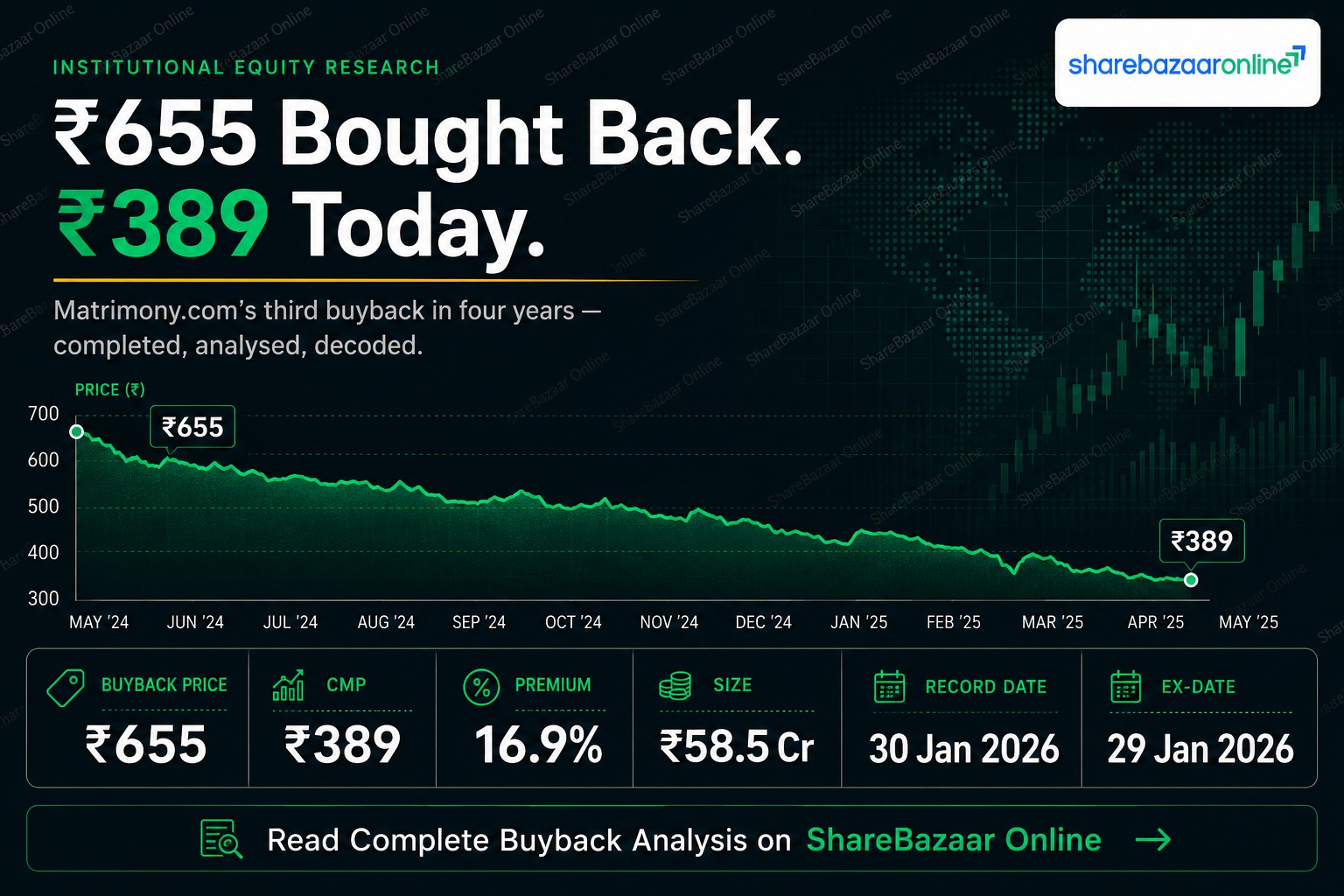
One number frames everything below: the buyback price was ₹655. As of 19–20 June 2026, the stock traded near ₹389 (source: NSE/BSE quotes via Kotak Neo, Bajaj Broking, Yahoo Finance). Shareholders who did not tender have watched the price fall roughly 41% below the buyback price. The buyback provided no lasting price support.
Buyback At A Glance
Manager to the Buyback: Saffron Capital Advisors Private Limited. Registrar: KFin Technologies Limited. Designated exchange: BSE. NSE symbol: MATRIMONY · BSE code: 540704. Face value ₹5. Figures marked as market prices are cited from public exchange/aggregator quotes; all other figures are from the company's Letter of Offer dated 3 February 2026.
What Actually Happened
Matrimony.com Limited — the Chennai-based operator of BharatMatrimony and hundreds of community portals — ran a tender-offer buyback. In a tender offer, the company invites eligible shareholders to sell (“tender”) a set number of their shares back to it at a fixed price, on a proportionate basis. Your entitlement ratio is the fixed proportion of your holding the company is obliged to accept; anything you tender above that is only accepted if other shareholders leave a shortfall.
The board approved the plan on 15 December 2025, shareholders cleared it by postal ballot on 20 January 2026, and the buyback committee fixed the final price of ₹655 the same day. The record date (the date on which you had to already own the shares to qualify) was 30 January 2026. Tendering opened 5 February and closed 11 February 2026. Accepted shares were paid for and then extinguished — permanently cancelled and removed from the share count — by 23–26 February 2026.
This was Matrimony.com's third buyback in roughly four years, and each has been struck at a progressively lower price — a pattern we return to below. The whole offer was completed: paid-up capital fell from ₹1,078.17 lakh to ₹1,033.51 lakh, and promoter holding rose to 56.96%.
The Premium — And Which Price It Was Measured Against
A buyback premium is only as honest as the reference price you compare it to. The company quoted several. The one that matters most to a shareholder deciding on the offer is the market price just before tendering — not a three-month average from months earlier.
| Reference price (NSE close) | Date | Price (₹) | Premium of ₹655 |
|---|---|---|---|
| Board meeting close | 15 Dec 2025 | 518.45 | 26.34% |
| Final-terms date close | 20 Jan 2026 | ~561.75 | 16.60% |
| Public Announcement close | 21 Jan 2026 | 560.35 | 16.89% |
| Record date close | 30 Jan 2026 | 517.35 | 26.61% |
| Current market price | ~20 Jun 2026 | ~389 | n/a — offer closed |
The realistic headline was a premium of roughly 16.6%–16.9% over the pre-offer market price. Reference-price prices and the ₹655/premium disclosures are from the company's Letter of Offer; the ~₹389 current price is from public NSE/BSE quotes dated ~20 June 2026. The 26%+ figures only appear when you anchor to prices from December or to the record-date close, which is why premium framing needs a stated date every time.
Why The Headline Premium Was Never The Return
In a proportionate tender offer, only a fraction of what you tender is actually bought. The acceptance ratio is that fraction. Your real one-time pre-tax gain is roughly the premium multiplied by the acceptance ratio, because the unaccepted shares stay with you and remain exposed to the market. Entitlement here was 8 shares per 75 held for small shareholders (≈10.67%) and 4 per 45 for everyone else (≈8.90%).
| Scenario | Premium | Acceptance | Blended pre-tax return* |
|---|---|---|---|
| Worst — general holder, entitlement only | 16.9% | ~8.9% | ~1.5% |
| Base — general holder, modest spillover | 16.9% | ~12% | ~2.0% |
| Best — small shareholder, high acceptance | 16.9% | ~35%+ | ~6%+ |
| ACTUAL OUTCOME | Full offer completed — all 8,93,129 shares bought back and extinguished (100% of offer size). Small-shareholder reserved bucket was 1,33,970 shares against 12,54,989 eligible small-shareholder shares, so reserved-category acceptance was structurally limited; per-shareholder acceptance ratios were not separately disclosed in accessible filings. | ||
*Blended return = premium × acceptance ratio, one-time and pre-tax, assuming unaccepted shares are sold at the pre-offer price. That last assumption is where this deal turned ugly. Anyone who bought in near the record date at ~₹517–560 specifically to tender was left holding roughly 88%–91% of their position unaccepted — and that residual is now worth ~₹389. A ~30% price fall on the unaccepted majority swamps a 1.5%–2% blended premium many times over. The arbitrage was real on paper and a loss in practice for late buyers.
The Real Story: Revenue Slipped, Profit Fell Faster
We analyse consolidated numbers throughout — standalone figures for a company with subsidiaries are distorted by intra-group flows. The operating picture, not the buyback, is the headline. Revenue from operations went sideways-to-down while profitability compressed.
| Consolidated (₹ Cr) | FY23 | FY24 | FY25 | FY24→FY25 |
|---|---|---|---|---|
| Revenue from operations | 455.77 | 481.36 | 455.84 | −5.3% |
| Operating EBITDA | 67.44 | 72.14 | 58.27 | −19.2% |
| EBITDA margin | 14.80% | 14.99% | 12.78% | −221 bps |
| Profit before tax | 55.93 | 64.71 | 57.82 | −10.6% |
| Net profit after tax | 46.67 | 49.55 | 45.28 | −8.6% |
This is negative operating leverage: revenue fell 5.3%, but operating EBITDA fell nearly four times as fast at 19.2%, because absolute operating costs (₹407.22 Cr) fell only 2.8% while revenue dropped harder. Fixed costs don't shrink as fast as a shrinking top line, so margins gave up 221 basis points in a single year. The company's summary disclosure aggregates costs into one “total expenses” line, so the exact cost head that drove the compression is Not Disclosed by Company in the Letter of Offer. Early FY26 offered no relief: Q2 FY26 (quarter ended Sept 2025) consolidated net profit was just ₹7.76 Cr, and the trailing EPS visible in June 2026 (~₹16) sits well below FY25's ₹20.57 — the earnings slide continued after the buyback.
Follow The Cash — And Notice Where The Profit Comes From
Reported profit is an opinion; cash is a fact. Two honest caveats first: the Letter of Offer does not include a cash flow statement, so operating cash flow, free cash flow and trade-receivables trends are Not Disclosed by Company in this document and cannot be independently verified here. The company states the buyback was funded entirely from free reserves and internal accruals / current investments — i.e. from the balance sheet, not from a single year's earnings — and confirms it is debt-free with no borrowed funds used.
The finding that is visible in the numbers is more important. Strip the FY25 profit into its parts:
About half of FY25 pre-tax profit came from the company's cash pile, not from matchmaking. Net finance income alone was ₹23.44 Cr. A debt-free company earning that much interest is sitting on a large idle treasury — and that reframes the buyback entirely (next section).
The Idle-Capital & ROE Question
When a big slice of a company's equity sits in fixed deposits and current investments, reported return on equity is being propped up by interest income rather than the core business. Matrimony.com's consolidated return on net worth of 18.74% in FY25 looks healthy, but two things flatter it: roughly half the profit is treasury income, and the net-worth denominator has been deliberately shrunk — consolidated net worth fell from ₹291.5 Cr (FY24) to ₹241.6 Cr (FY25), a 17% drop, via the FY24 buyback and heavy dividends.
That is the real logic of this buyback: a company generating cash faster than it can reinvest, holding a treasury it earns a modest yield on, chipping away at that surplus. Returning ₹58.5 Cr is a partial, tentative answer to a capital-allocation problem — not evidence of a thriving operating business. Serial capital return can lift ROE arithmetically while the underlying business stands still.
Financial Engineering vs Business Performance
A buyback lifts earnings per share by shrinking the number of shares — the denominator — not by earning more. Readers should never confuse the two. The company's own post-buyback projections make the mechanics clear.
| Consolidated metric | Pre-Buyback | Post-Buyback | Effect |
|---|---|---|---|
| Basic EPS (₹) | 20.57 | 21.44 | +4.2% |
| Return on net worth | 18.74% | 24.73% | up (smaller equity) |
| Book value per share (₹) | 112.04 | 88.58 | −20.9% |
| P/E (NSE, audited basis) | 24.82 | 23.82 | marginally lower |
EPS rises a modest 4.2% purely because there are fewer shares — the buyback is only 4.14% of capital. But book value per share falls ~21%, because the company paid ₹655 for shares carrying ~₹112 of book value (nearly six times book). Paying a large premium to book to cancel shares mechanically lifts ROE and EPS while reducing the net assets backing each remaining share. The company did not earn more; it simply spread the same earnings over a slightly smaller base at the cost of book value.
The Promoter Non-Participation Mechanic
The promoter and promoter group — holding 54.61% before the offer — chose not to tender. This has two simultaneous effects, and both are true:
- It raised everyone else's entitlement. Because promoter shares were removed from the pool used to compute public entitlement, the public got a larger share of the fixed ₹58.5 Cr — a genuine benefit to participating public shareholders.
- It raised promoter control for free. With the share count shrinking and promoters not selling, their stake climbed to 56.96% — a 2.35 percentage-point gain in ownership without spending a single rupee. Public float fell from 45.39% to 43.04%.
This is a recurring pattern here. The promoter also made open-market purchases of 2,89,702 shares in the months before the buyback, and across three successive buybacks the promoter share has been steadily creeping up. Post-buyback aggregator data in mid-2026 shows promoter holding around 58%, consistent with continued accumulation. Passive control consolidation, funded by company cash, is a structural feature of these serial buybacks — worth watching for its long-term implications for minority shareholders.
Three Buybacks, Falling Prices — A Pattern
This is the company's third buyback since 2022, and each has been struck at a lower price than the last — tracking a stock that has more than halved from its 2022 highs.
| Year | Price (₹) | Size | Shares |
|---|---|---|---|
| FY2022-23 | 1,150 | ₹75.0 Cr | 6,52,173 |
| FY2023-24 | 1,025 | ₹72.0 Cr | 7,02,439 |
| FY2025-26 (this offer) | 655 | ₹58.5 Cr | 8,93,129 |
Buyback prices fell ₹1,150 → ₹1,025 → ₹655, and offer sizes shrank too. Regular capital return is shareholder-friendly in principle, but a chain of buybacks at steadily lower prices, against stagnant revenue and compressing margins, reads less like conviction in a growing business and more like recycling surplus cash from a maturing one. And the ₹655 price still proved to be well above where the stock settled — ~₹389 by June 2026.
Tax: The Post-October-2024 Reality (Read This)
Since 1 October 2024, buyback proceeds are taxed very differently, and it materially changes the maths for high-bracket investors. The rules that applied to this offer:
- The entire buyback amount is a deemed dividend, taxed at your slab rate — not at a low capital-gains rate.
- No deduction is allowed for what you paid to buy the shares, against that dividend.
- Your purchase cost becomes a capital loss, which you can carry forward up to 8 assessment years to offset future capital gains.
- TDS of 10% (residents) applies under Section 194; STT of 0.10% also applies as the trade runs through the exchange.
| Buyback consideration (10 × ₹655) | ₹6,550 |
| Treated as deemed dividend | ₹6,550 (full) |
| Tax at 30% + 4% cess (31.2%) | −₹2,043.60 |
| Net cash after tax | ₹4,506.40 |
| Cost (10 × ₹560) becomes carried-forward capital loss | ₹5,600 |
| Value of that loss if fully set off later (@12.5% LTCG) | up to ₹700 (future, conditional) |
Compare with simply selling in the market at ₹560 before the record date: proceeds ₹5,600 with little or no gain to tax for a recent buyer. Tendering nets ~₹4,506 in hand plus a conditional future shield worth up to ₹700 — versus ₹5,600 from an ordinary sale. For a top-bracket investor, the 16.9% headline premium is entirely consumed — and then some — by slab-rate dividend tax. The arbitrage largely disappears. It was most attractive to zero/low-tax and small shareholders; least attractive to those in the 30%+ bracket.
Illustrative only; ignores surcharge and individual circumstances. This is not tax advice — consult a qualified tax adviser. This is a sensitive financial-decision area and outcomes depend on your personal tax position.
Key Dates (All Passed)
| Board meeting | 15 Dec 2025 |
| Postal ballot result / final price fixed | 20 Jan 2026 |
| Public Announcement | 21–22 Jan 2026 |
| Record date | 30 Jan 2026 |
| Tendering window | 5–11 Feb 2026 |
| Settlement of bids | 18 Feb 2026 |
| Extinguishment completed | 23–26 Feb 2026 |
Balance Sheet: Positives & Concerns
- Debt-free with a strong cash/treasury position.
- Buyback funded entirely from free reserves, no borrowings.
- Consistent record of returning capital (3 buybacks + regular ₹5 dividends).
- Reserved quota gave small shareholders a structurally better deal.
- Full offer completed and shares extinguished on schedule.
- Revenue −5.3%, EBITDA −19.2%, margin −221 bps in FY25.
- ~50% of pre-tax profit is treasury income, not core business.
- Buyback price ₹655 vs ~₹389 now — no price support; ~30% fall.
- Successive buybacks at falling prices (₹1,150→₹1,025→₹655).
- Promoter control creeping up at no cost to promoters.
- Book value per share −21% post-buyback; no cash-flow statement in the LOO.
This report presents facts and risks and deliberately offers no buy, sell or hold recommendation. Any decision is yours.
Frequently Asked Questions
Can I still tender my shares in this buyback?
No. The window closed on 11 February 2026 and the shares were extinguished by late February 2026. The offer is fully concluded.
What was the buyback price and premium?
₹655 per share — about a 16.6%–16.9% premium over the pre-offer market price (~₹560, NSE close around the announcement). The stock now trades near ₹389.
Why did the promoters not participate?
By abstaining, they lifted the public's entitlement and let their own stake rise from 54.61% to 56.96% without spending anything — a benefit to participating public holders and a passive control gain for promoters at the same time.
How was the buyback taxed?
Under post-October-2024 rules, the whole amount is a deemed dividend taxed at your slab rate, with no cost deduction; your purchase cost becomes a carry-forward capital loss. High-bracket investors saw most of the premium eroded by tax.
Did the business justify the buyback?
The buyback returned surplus cash, but FY25 saw revenue down 5.3% and operating EBITDA down 19.2%, with about half of profit coming from treasury income. It read more as capital allocation from a cash-rich, maturing business than a signal of operating strength.
Disclaimer
This report is prepared by ShareBazaar Online for information and educational purposes only. It is not investment, legal or tax advice, and contains no buy, sell or hold recommendation. Company financials, offer terms, dates, ratios and premium figures are drawn from Matrimony.com Limited's Letter of Offer dated 3 February 2026; market prices (including the ~₹389 current price) and the buyback completion/extinguishment status are cited from public exchange and news sources dated up to June 2026 and may have changed since. Figures involving computation (EBITDA, margins, blended returns, tax examples) are our own workings and are indicative. Securities markets carry risk; past performance is no guarantee of future results. Please consult a SEBI-registered investment adviser and a qualified tax professional before acting. ShareBazaar Online accepts no liability for decisions taken based on this report.