
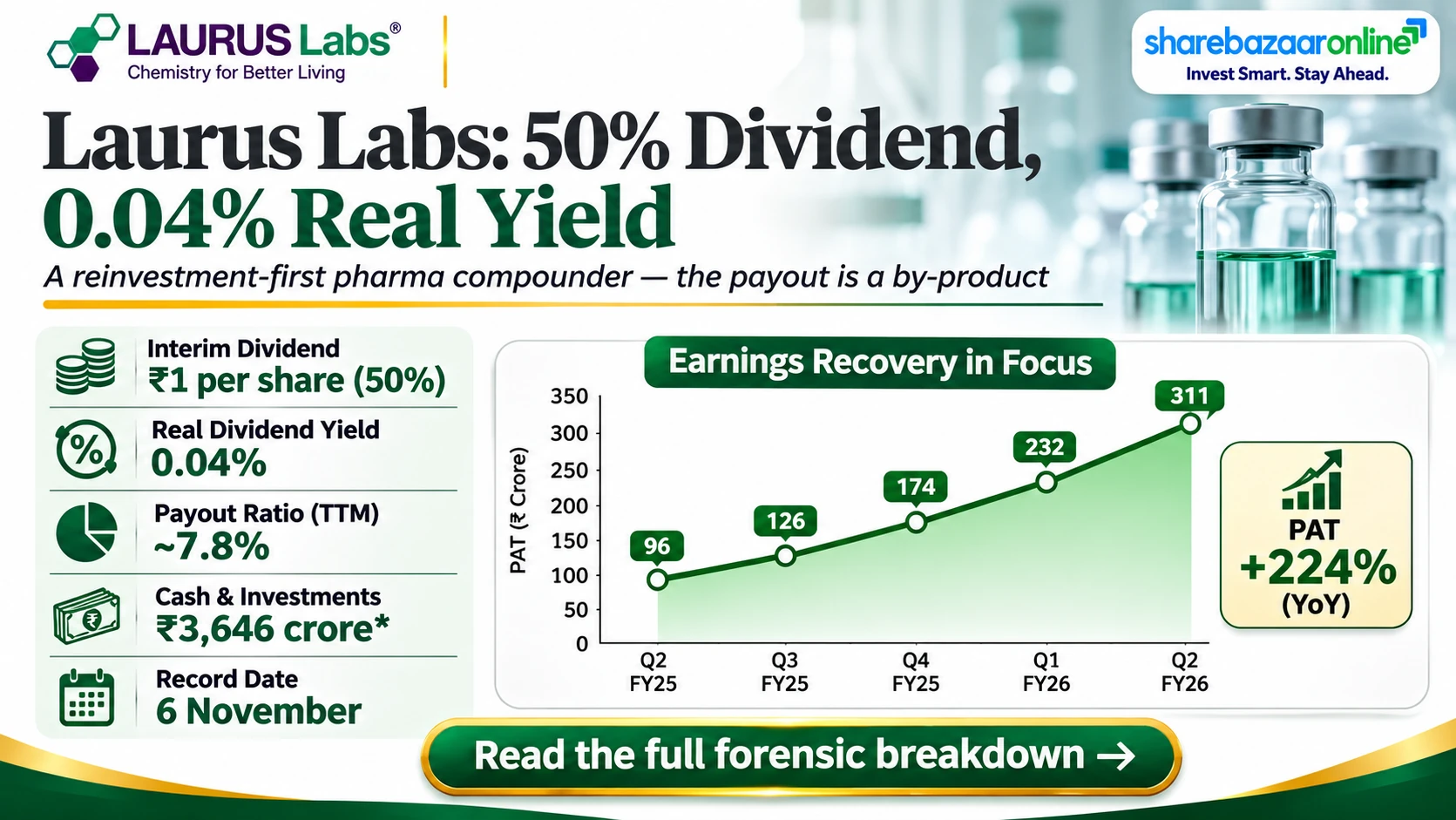
Dividend Snapshot – Laurus Labs Limited
Laurus Labs Limited (NSE: LAURUSLABS, BSE: 540222) has declared an interim dividend of Re. 1.00 per equity share for FY 2026-27, the first interim payout of the financial year. On a face value of ₹2, the headline works out to 50% — but on the market price the real dividend yield is just 0.04%. The announcement was made alongside a record September quarter in which net profit rose 126% year-on-year.
Company Overview – Laurus Labs Limited
Founded in 2005 and headquartered in Hyderabad, Laurus Labs Limited is a research-driven pharmaceutical and biotechnology company. It is the world’s leading third-party supplier of antiretroviral (ARV) Active Pharmaceutical Ingredients and also operates in oncology APIs, generic finished dosage forms, a fast-growing CDMO (contract development and manufacturing) synthesis business, and biotechnology through Laurus Bio. The company runs 11+ facilities approved by the USFDA, EMA, WHO and other global regulators. In Q2 FY27, CDMO contributed roughly 41% of revenue, up from about 31% a year earlier, marking a structural shift toward higher-margin custom synthesis work for global innovators.
Financial Analysis – Laurus Labs Limited
Laurus Labs is in a sharp earnings recovery. Trailing-twelve-month revenue stands at ₹7,823 Cr with net profit of ₹1,332 Cr and an operating margin of 30% — a dramatic turnaround from FY24, when margins collapsed to 15% and net profit fell to just ₹162 Cr. The operating margin has climbed every quarter from 14% (Jun 2024) to 34% (Sep 2026). Return on equity has recovered to 18.3% and return on capital employed to 17.8%. The dividend, however, is tiny relative to this profit base: the ₹54 Cr outflow is barely 4% of trailing net profit, signalling that Laurus is firmly a growth-reinvestment company, not an income stock.
Laurus Labs Dividend History Table
| Fiscal Year | EPS (₹) | DPS (₹) | Payout % |
|---|---|---|---|
| FY2018-19 | 1.76 | 0.30 | 17% |
| FY2019-20 | 4.77 | 0.50 | 10% |
| FY2020-21 | 18.33 | 2.00 | 11% |
| FY2021-22 | 15.40 | 2.00 | 13% |
| FY2022-23 | 14.67 | 2.00 | 14% |
| FY2023-24 | 2.98 | 0.80 | 27% |
| FY2024-25 | 6.64 | 1.20 | 18% |
| FY2025-26 | 16.46 | 2.00 | 12% |
| FY2026-27* | 14.97 (H1) | 1.00* | – |
*FY27 figure is the first interim dividend only; more may follow. DPS derived from reported payout ratio × EPS (Screener.in, consolidated) and cross-checked against declared dividends. Face value ₹2 throughout the period shown.
Expert Commentary – Laurus Labs Limited
The most important thing for investors to understand about this Laurus Labs dividend is the gap between the 50% headline and the 0.04% real yield. The “50%” refers only to face value (₹1 on a ₹2 share), not to what an investor earns on the ₹2,323 market price. At this scale the dividend is a token gesture of shareholder return, dwarfed by the stock’s price movement — Laurus is up roughly 133% over one year. The signal worth reading is that even after a 126% jump in quarterly profit, management chose to keep the payout small and retain cash for its CDMO and fermentation capacity expansion, consistent with a reinvestment-led strategy rather than a dividend-distribution one.
Future Outlook – Laurus Labs Limited
Laurus has guided toward its CDMO and Animal Health/Crop Protection projects reaching peak potential by FY27-28, and its Laurus Bio subsidiary is commissioning a 400 KL microbial fermentation facility in Vizag. On 29 October 2026 the company also announced an agreement to acquire 60% of Galenvs Sciences, signalling continued capital deployment into growth rather than distribution. For dividend-focused readers, the practical takeaway is that payouts are likely to stay modest in absolute yield terms while earnings and capacity scale. Dividend growth, if it comes, will more plausibly track rising profits than a deliberate shift to a high-payout policy. None of this is a forecast of a specific future dividend, which the company has not disclosed.
Laurus Labs Dividend Announcement Summary
At its board meeting on 29 October 2026, the Board of Directors of Laurus Labs Limited approved the payment of an interim dividend of Re. 1.00 per equity share (50% of the ₹2 face value) for the financial year 2026-27, under Regulation 42 of SEBI (LODR) Regulations, 2015. The company fixed 6 November 2026 as the record date to determine shareholder eligibility, with the dividend payable on or after 19 November 2026. The declaration accompanied Laurus’s Q2 FY27 results, which reported consolidated net profit of ₹441 Cr (up 126% YoY) on revenue of ₹2,206 Cr (up 33% YoY). This is an interim dividend and does not require separate AGM approval for payment.
Key Dates Timeline – Laurus Labs Dividend
*Under India’s T+1 settlement cycle, the ex-dividend date typically coincides with the record date. Investors should confirm the ex-date against the official NSE/BSE corporate-action circular. To be eligible, shares must be held as of the record date, 6 November 2026.
Laurus Labs Dividend Yield Analysis
The headline “50%” dividend is calculated on face value and is not an investor’s actual return. On real market prices the yield is negligible:
In plain terms, an investor holding ₹1 lakh of Laurus Labs shares receives roughly ₹43 from this interim dividend. The yield is low not because of a weak dividend relative to history, but because the share price has risen so sharply — a classic case where yield compression reflects strong price performance, not a problem.
Laurus Labs Dividend History Analysis
Laurus Labs is best classified as a consistent but cyclical payer. It has paid a dividend every year since FY2017, usually in two interim tranches, and has never suspended its payout. However, the absolute dividend tracks earnings closely: when net profit collapsed in FY2023-24 (EPS fell to ₹2.98), the full-year dividend was cut to ₹0.80 from ₹2.00. As earnings recovered, the payout rebuilt to ₹1.20 (FY25) and ₹2.00 (FY26). The payout ratio has stayed in a disciplined 10–27% band, confirming that Laurus prioritises reinvestment. There is no multi-year uninterrupted dividend-growth streak here — the pattern is earnings-linked, not progressive.
Laurus Labs Financial Performance Analysis
| ₹ Cr | FY22 | FY23 | FY24 | FY25 | FY26 | TTM |
|---|---|---|---|---|---|---|
| Revenue | 4,936 | 6,041 | 5,041 | 5,554 | 6,813 | 7,823 |
| Net Profit | 832 | 793 | 162 | 358 | 890 | 1,332 |
| OPM % | 29% | 26% | 15% | 19% | 26% | 30% |
The story is operating leverage in reverse and then forward. In FY24, revenue fell only ~17% but net profit collapsed ~80% as margins halved on weak ARV pricing and under-utilised capacity. The recovery since has been equally geared: TTM revenue is up 23% but net profit is up 96%, as the higher-margin CDMO mix and better utilisation restored profitability. This volatility is exactly why the dividend is kept small and earnings-linked.
Laurus Labs Cash Flow Analysis
Cash generation comfortably funds the dividend. In FY26, operating cash flow was ₹1,624 Cr and free cash flow was ₹560 Cr, against a dividend outflow of just ~₹54 Cr for this interim.
The dividend is paid entirely from current cash generation, not from reserves or borrowings. FY26 free cash flow turned strongly positive (₹560 Cr) after years of heavy capex, giving ample headroom. The one watch-point is that free cash flow has historically been thin or negative during capex-heavy years, so the generous cover reflects a strong FY26 rather than a permanent condition.
Laurus Labs Balance Sheet Strength
Laurus carries moderate leverage. As of September 2026, borrowings stood at about ₹2,625 Cr against reserves of ₹5,953 Cr and investments of ~₹310 Cr, leaving net debt (excluding operating cash) in the region of ₹2,200–2,300 Cr. This is manageable against TTM operating profit of ₹2,381 Cr, but it is not a net-cash balance sheet, and capital work-in-progress has risen to ₹1,282 Cr as the company builds new capacity. The key implication for the dividend: Laurus is simultaneously carrying debt, funding large capex, and paying a dividend — which is sustainable only because the payout is deliberately small relative to cash flow. A materially larger dividend would compete directly with debt reduction and growth capex.
Laurus Labs Dividend Sustainability
On all four tests — earnings, operating cash, free cash flow and liquidity — the current dividend is very comfortably covered. Verdict: Sustainable. The caveat is that sustainability here means the small payout is easily affordable; it does not imply the dividend will grow. Because the dividend is explicitly earnings-linked, a future profit downturn (as in FY24) could again lead to a lower absolute payout even though the dividend remains well covered at the time.
Peer Comparison – Laurus Labs Dividend vs Pharma Peers
| Company | Div Yield | Payout % | ROE | ROCE |
|---|---|---|---|---|
| Laurus Labs | 0.09% | ~12% | 18.3% | 17.8% |
| Divi’s Labs | ~0.38% | ~31% | 16.5% | 22.0% |
| Neuland Labs | ~0.16% | low | 28.5% | 27.5% |
| Granules India | ~0.20% | low | – | – |
Among API and CDMO peers, Laurus Labs has one of the lowest dividend yields and payout ratios. Divi’s Laboratories, the sector’s dividend benchmark, pays out roughly 31% of profit at a ~0.38% yield. Laurus’s sub-15% payout underlines its reinvestment-first stance. Its profitability (18.3% ROE) is competitive but below Neuland’s. The takeaway: Laurus is chosen for growth exposure, not dividend income — peers offer modestly higher yields if income is the priority.
Promoter Impact Analysis – Laurus Labs Dividend
Of the ~₹54 Cr total dividend outflow, the promoter group (holding 27.47% as of September 2026) will receive about ₹14.8 Cr. Foreign institutional investors, who have raised their stake sharply to 30.84%, will collect ~₹16.6 Cr, while domestic institutions (11.86%) receive ~₹6.4 Cr and the public (29.85%) ~₹16.1 Cr.
Because the payout is small and distributed pro-rata, no shareholder class is disproportionately favoured. Notably, FIIs now out-hold the promoter group and are the single largest beneficiary — a sign of rising institutional conviction rather than promoter cash extraction.
Taxation Analysis – Laurus Labs Dividend
Dividends are taxable in the hands of the shareholder at their applicable income-tax slab rate. Under Section 194, a company deducts TDS at 10% only if total dividend paid to a resident shareholder exceeds ₹10,000 in the financial year (threshold raised from ₹5,000 effective FY2025-26); without a valid PAN, TDS is 20%. Non-residents are taxed under Section 195.
Worked example — investor holding 1,000 shares
Even below the TDS threshold, the full dividend remains taxable and must be reported in the ITR. For this holding the after-tax yield is roughly 0.03% at the current price. This is general information, not tax advice.
Key Risks – Laurus Labs Limited
- Earnings volatility: FY24 showed net profit can fall ~80% on margin compression, which historically triggers a lower absolute dividend.
- Negligible income return: At ~0.04% yield, the dividend offers virtually no income cushion; total return depends almost entirely on the share price.
- Valuation risk: The stock trades at a P/E near 94x and ~21x book value after a 133% one-year run, leaving little room for earnings disappointment.
- Leverage and capex: ~₹2,625 Cr of borrowings and rising capital work-in-progress compete with dividends for cash.
- Customer and product concentration: Dependence on ARV APIs and a handful of CDMO clients exposes revenue to pricing and order-timing swings.
What to Monitor – Laurus Labs Limited
- CDMO revenue share: Whether it holds above ~40% and drives the margin mix higher.
- Operating margin trajectory: Sustaining the 30%+ OPM achieved in recent quarters.
- Free cash flow: Whether FY26’s strong ₹560 Cr FCF persists as capex continues.
- Debt reduction: Direction of borrowings and capital work-in-progress as new facilities commission.
- Full-year FY27 payout: Whether further interim dividends follow this Re. 1 and how the full-year payout ratio settles.
- Galenvs acquisition and Laurus Bio: Integration and the ramp of the Vizag fermentation facility.
Should You Consider Laurus Labs for Dividend Income? – Conclusion
Laurus Labs’ Re. 1 interim dividend for FY2026-27 is best understood as a token shareholder return from a company in growth mode, not an income proposition. The 50% headline is a face-value figure; the real yield is about 0.04%. The dividend is extremely well covered — 8x on earnings, 30x on operating cash — so sustainability is not in question, but the payout is deliberately kept small so cash can fund CDMO expansion, debt and acquisitions. The dividend is consistent but earnings-linked, and was cut as recently as FY24. Income-focused investors will find far more on offer elsewhere; the Laurus story is about profit growth and capacity scale-up, with the dividend a minor by-product. This article presents positives, negatives and risks so readers can decide for themselves; it contains no buy, sell or hold recommendation.
Frequently Asked Questions About Laurus Labs Dividend
What dividend has Laurus Labs announced in 2026?
What is the Laurus Labs dividend yield?
What is the record date for the Laurus Labs dividend?
What is the ex-dividend date?
When will the Laurus Labs dividend be paid?
Who is eligible for the Laurus Labs interim dividend?
How is the Laurus Labs dividend taxed?
Is the Laurus Labs dividend sustainable?
What is the Laurus Labs dividend history?
Why is the dividend yield so low if the dividend is 50%?
What is the Laurus Labs dividend outflow and who benefits?
What should investors monitor after this dividend?
Disclaimer
This article is for informational and educational purposes only and does not constitute investment, financial, legal or tax advice. ShareBazaar Online is not a SEBI-registered investment adviser. Nothing here is a recommendation to buy, sell or hold any security. Dividend details are based on the company’s official exchange filing dated 29 October 2026; financial figures are sourced from Screener.in, company disclosures and exchange data and may be subject to revision. Market prices and yields change continuously. Taxation depends on individual circumstances and prevailing law. Investors should verify all dates and figures against official NSE/BSE circulars and consult a qualified professional before making any decision. Investments in securities are subject to market risks; past performance is not indicative of future results.