
Dividend Snapshot – CARE Ratings Limited
CARE Ratings Limited (NSE: CARERATING) has declared an interim dividend of ₹10 per equity share for the financial year 2026-27, alongside its Q2 FY27 results announced on 29 October 2026. On a face value of ₹10, the headline works out to a 100% dividend — but on the market price of about ₹1,637, the real interim dividend yield is only 0.61%. This is the face-value illusion every dividend investor should understand before reading the headline.
Company Overview – CARE Ratings Limited
CARE Ratings Limited, which operates under the CareEdge brand, is India's second-largest credit rating agency, established in 1993. The company rates debt instruments across sectors, with leadership positions in BFSI and infrastructure, and has diversified into analytics, consulting, ESG and sustainability services through subsidiaries. It is listed on both NSE (CARERATING) and BSE (534804), with ISIN INE752H01013 and a face value of ₹10 per share. A notable structural feature is that CARE Ratings has no identifiable promoter — it is a professionally managed, widely held company, with institutions owning the majority stake. As of the latest market data, its market capitalisation stands at approximately ₹4,932 crore (Source: Screener.in), making it a small-cap name within the capital markets space.
Financial Analysis – CARE Ratings Limited
CARE Ratings delivered a strong first half of FY27. On a consolidated basis, Q2 FY27 revenue from operations rose 20.4% year-on-year to ₹164.1 crore, while quarterly net profit (owners) grew 26.8% to ₹71.8 crore. For H1 FY27, consolidated revenue increased 19.8% to ₹275.8 crore and profit (owners) climbed 26.3% to ₹104.1 crore.
The company reported strong return ratios — ROE of ~19.7% and ROCE of ~26.3% (Source: Screener.in) — and is almost debt-free, with borrowings of about ₹24 crore being largely lease liabilities. Operating profit margin for Q2 FY27 was a healthy ~52%, reflecting the high operating leverage of the ratings business.
CARE Ratings Limited Dividend History Table
| Financial Year | Interim (₹) | Final (₹) | Total DPS (₹) | Payout % |
|---|---|---|---|---|
| FY2026-27* | 10.00 | TBD | 10.00+ | — |
| FY2025-26 | 8.00 | 14.00 | 22.00 | ~39% |
| FY2024-25 | 7.00 | 11.00 | 18.00 | ~39% |
| FY2023-24 | 6.00 | 9.00 | 15.00 | ~53% |
| FY2022-23 | — | — | ~25.00 | ~89% |
| FY2021-22 | — | — | ~17.00 | ~67% |
*FY27 final dividend not yet declared. Payout % is dividend as a share of PAT. Figures compiled from exchange filings, Trendlyne and Screener.in; the ₹14 final for FY26 went ex-dividend in June 2026.
Expert Commentary – CARE Ratings Limited
The real story in this CARE Ratings dividend announcement is not the ₹10 per share — it is the 25% jump in the interim payout, up from ₹8 in FY26. The board has effectively front-loaded a larger interim cheque on the back of a genuinely strong H1, where profit grew faster than revenue (+26.3% vs +19.8%), signalling positive operating leverage rather than earnings bought with one-off income.
Equally important, this ₹10 interim dividend is only the first instalment of FY27. If history repeats, a larger final dividend typically follows in June. Investors chasing the "100%" headline should instead track the full-year dividend and its real market yield of roughly 1.3%, which is modest for an income-focused portfolio.
Future Outlook – CARE Ratings Limited
CARE Ratings enters the second half of FY27 with momentum: a record Q2, expanding margins, and a near debt-free, cash-rich balance sheet. The ratings cycle tends to strengthen when corporate bond issuance and bank lending pick up, and management is diversifying revenue through analytics, ESG and global/IFSC subsidiaries to reduce dependence on the cyclical core ratings business.
A disclosed near-term change is the agreed sale of a 9.90% stake each to State Bank of India and NSE IFSC in subsidiary CareEdge Global IFSC Limited, which would reduce CARE's holding to 80.20%. For dividend investors, the sustainability question is straightforward: with interim coverage of 3.5x on H1 earnings and over 9x on liquid cash, the payout looks comfortable, though the yield remains income-light.
Dividend Announcement Summary – CARE Ratings Limited
At its board meeting on 29 October 2026, the Board of Directors of CARE Ratings Limited declared and approved an interim dividend of ₹10 per equity share (face value ₹10 each) for FY 2026-27. The company fixed 6 November 2026 as the record date under Regulation 42 of the SEBI Listing Regulations to determine shareholder eligibility.
The dividend will be paid or dispatched to eligible shareholders within the timelines prescribed under the Companies Act, 2013. As an interim dividend, it is declared and paid by the Board directly and does not require separate shareholder approval at the AGM, though it will be noted in the annual accounts. The same board meeting also approved Q2 FY27 results and a non-independent director appointment.
CARE Ratings Limited Key Dates Timeline
*Under India's T+1 settlement, the ex-dividend date generally coincides with the record date. Investors should confirm the exact ex-date against the official NSE/BSE corporate-action notice. The company has not separately disclosed a specific payment date beyond the statutory timeline.
CARE Ratings Limited Dividend Yield Analysis
This is where retail investors are most often misled. The announcement of a "100% dividend" simply means ₹10 on a ₹10 face value — it says nothing about your actual return. The dividend yield is what matters, and it is calculated on the share's market price, not its face value.
Interim yield on CMP (₹1,637)
0.61%
Trailing 12-month yield
~1.34%
At the market price of around ₹1,637, this ₹10 interim dividend alone delivers a yield of just 0.61%. Counting the full trailing-twelve-month payout of about ₹22, the yield is roughly 1.34% (Source: Screener.in; CMP via NSE/BSE data) — below many fixed-deposit rates. CARE Ratings is a capital-appreciation and quality story more than a high-yield income stock.
CARE Ratings Limited Dividend History Analysis
CARE Ratings has a long and consistent dividend-paying record, having declared dividends in every recent financial year, typically split into an interim and a final payout. The per-share dividend has risen steadily: total DPS grew from ₹15 in FY24 to ₹18 in FY25 and ₹22 in FY26, and the FY27 interim of ₹10 is 25% higher than the previous year's interim.
The company has not cut or suspended its dividend in recent years, and has occasionally paid large special dividends in the past (for example in 2014 and 2018). On this record, CARE Ratings qualifies as a consistent dividend payer, with a clear upward trend in absolute payout even as the payout ratio has normalised to around 39-44% of profit.
CARE Ratings Limited Financial Performance Analysis
CARE Ratings shows genuine positive operating leverage — the hallmark of a healthy ratings business. In Q2 FY27, revenue grew 20.4% while total expenses rose only 16.5%, allowing net profit to expand a faster 26.8%. This is the opposite of the margin-compression warning sign, where revenue rises but profit falls.
Over the longer run, the company has compounded profit at roughly 27% over three years and 14% over five years (Source: Screener.in). Importantly, the profit growth is operating-led rather than flattered by other income, which has stayed broadly stable at around ₹15 crore a quarter. This earnings quality is what underpins the rising dividend.
CARE Ratings Limited Cash Flow Analysis
Reported profit is an opinion; cash is a fact — and here CARE Ratings scores well. The company has a strong track record of converting earnings into cash, with operating cash flow consistently exceeding operating profit (CFO/EBITDA above 100% in most years). In FY26, operating cash flow was ₹148 crore and free cash flow about ₹140 crore (Source: Screener.in).
The ₹10 interim dividend translates into an outflow of roughly ₹30.1 crore. That is comfortably funded by current earnings and internal cash generation — not by borrowings, asset sales or drawing down reserves. For a near debt-free, asset-light business, this is exactly the funding profile a dividend investor wants to see.
CARE Ratings Limited Balance Sheet Strength
CARE Ratings runs a fortress balance sheet. It is almost entirely debt-free — the roughly ₹24 crore of "borrowings" are essentially lease liabilities. Against this, consolidated liquid resources (cash, bank balances and current investments) stood at about ₹294.6 crore, and total cash plus investments at roughly ₹367 crore as of September 2026, leaving a net cash position of around ₹343 crore.
Put simply, the company holds about 9.8 times the interim dividend outflow in liquid resources alone, and over 12 times counting all investments. With a book value near ₹333 per share and reserves exceeding ₹970 crore, the dividend poses no strain whatsoever on the balance sheet.
CARE Ratings Limited Dividend Sustainability Analysis
On every standard test, this dividend scores well:
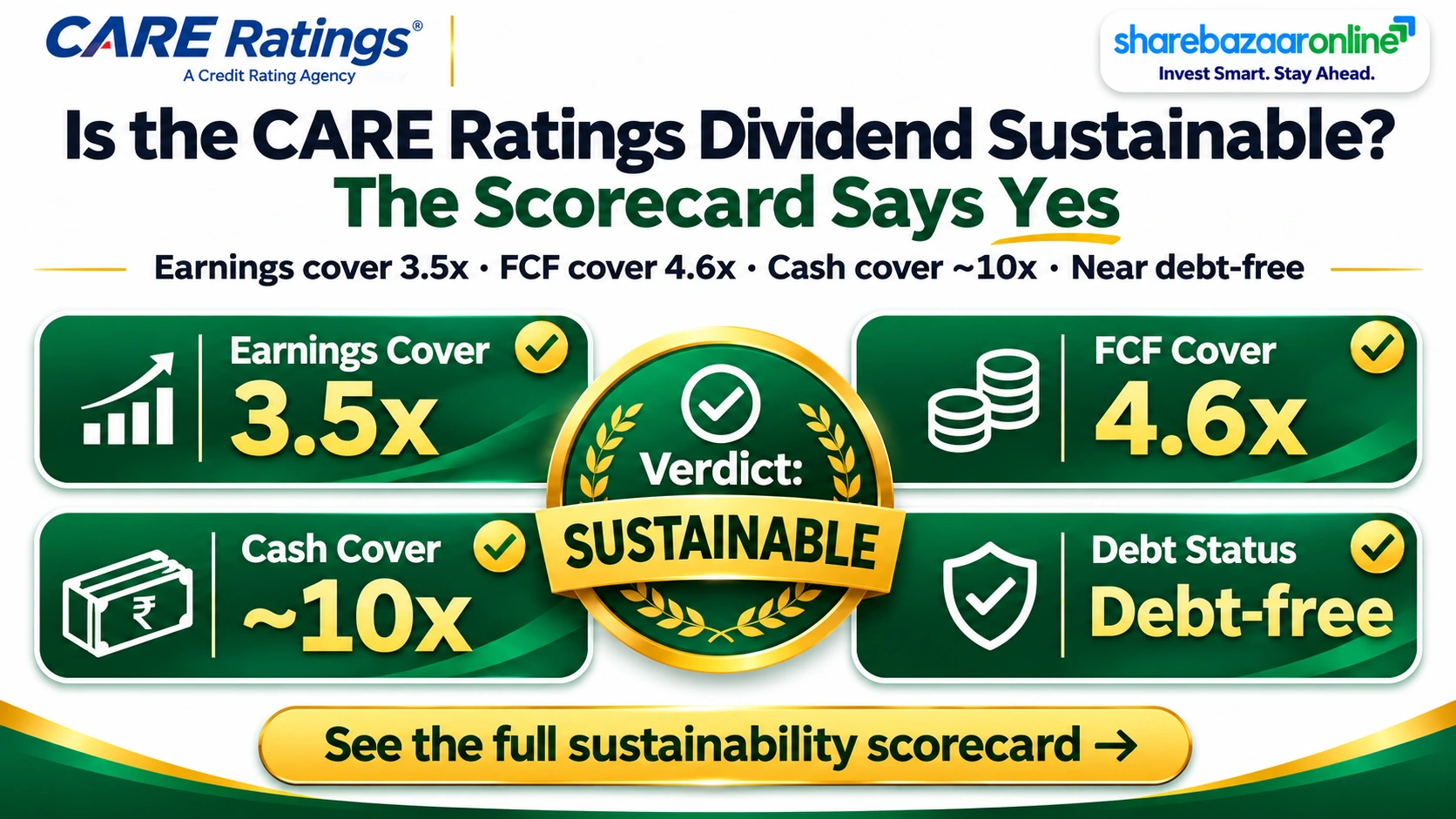
- Earnings coverage: H1 EPS of ₹34.6 covers the ₹10 interim 3.5 times; TTM EPS of ₹64 covers it 6.4 times.
- Cash-flow coverage: FY26 free cash flow of ₹140 crore covers the ₹30.1 crore outflow about 4.6 times.
- Liquidity coverage: liquid resources cover the outflow nearly 10 times.
- Debt position: the company is almost debt-free, so the dividend is not funded by leverage.
With earnings growing, cash conversion strong and no debt, the interim dividend is assessed as Sustainable. The only caveat is cyclicality: ratings revenue can soften if bond issuance and credit growth slow.
CARE Ratings Limited Peer Comparison
| Rating Agency | Div. Yield | Payout % | ROE | P/E |
|---|---|---|---|---|
| CARE Ratings | ~1.34% | ~44% | ~18-20% | ~25-27 |
| CRISIL | ~1.3-1.4% | ~58-60% | ~27% | ~38 |
| ICRA | ~2.1-2.4% | ~64% | ~15% | ~21-26 |
Among listed credit rating agencies, ICRA offers the highest dividend yield (~2.1-2.4%) and the most generous payout ratio, while CRISIL has the strongest ROE (~27%) but trades at a premium valuation. CARE Ratings sits in the middle on yield, carries the lowest payout ratio of the three, and is the cheapest of the pure ratings plays on P/E — retaining more earnings for growth. All three are near debt-free. (Source: Screener.in, Value Research, company peer data)
CARE Ratings Limited Promoter Impact Analysis
Here CARE Ratings is genuinely different from most Indian companies: it has zero promoter holding. The company is professionally managed and widely held, so 100% of the dividend flows to non-promoter shareholders — institutions and the public alike.
Of the total interim outflow of about ₹30.1 crore, roughly ₹9.7 crore goes to domestic institutions (DIIs, ~32.2%), about ₹7.1 crore to foreign investors (FIIs, ~23.6%), and around ₹13.3 crore to the public (~44.2%) (holdings per Sep-2026 pattern, Screener.in). With no promoter group capturing a disproportionate share, the dividend is a cleanly distributed, minority-friendly reward.
CARE Ratings Limited Taxation Analysis
Since FY2020-21, dividends are taxed in the hands of shareholders at their applicable income-tax slab rate — there is no separate Dividend Distribution Tax. The company must deduct TDS at 10% once total dividends paid to a resident shareholder exceed ₹10,000 in a financial year (20% if PAN is not provided; 20% plus surcharge/cess for NRIs, subject to any DTAA relief). From 1 April 2026, these provisions sit under Section 393 of the Income-tax Act, 2025 (formerly Section 194).
Worked Example — investor holding 1,000 shares, 30% slab:
- Gross dividend: 1,000 × ₹10 = ₹10,000
- TDS @10%: ₹0 (dividend does not exceed the ₹10,000 threshold)
- Tax at 30% slab + 4% cess: ₹3,120
- Net dividend in hand: ₹6,880
- Effective post-tax yield on CMP: ~0.42%
Note: a holding of, say, 2,000 shares would cross the threshold — gross ₹20,000, TDS ₹2,000, ₹18,000 credited — with the full slab tax still payable on filing. This is a general illustration, not tax advice.
CARE Ratings Limited Key Risks
- Cyclicality of ratings revenue: income depends on corporate bond issuance and bank credit growth, which slow in weak economic cycles.
- Regulatory and reputational risk: credit rating agencies operate under intense SEBI oversight; any rating lapse can damage franchise value and invite penalties.
- Low real dividend yield: at ~1.3% trailing yield, the stock offers limited income support and is vulnerable if growth expectations fade.
- Competitive intensity: CRISIL (larger, more diversified) and ICRA compete directly, pressuring pricing and market share.
- Subsidiary and stake-sale execution: the planned CareEdge Global IFSC stake sale and overseas expansion carry integration and execution risk.
What To Monitor – CARE Ratings Limited
- FY27 final dividend: watch the June 2026-27 announcement to judge the full-year payout and whether the rising trend continues.
- Revenue mix diversification: growth in analytics, ESG and consulting revenue versus the cyclical core ratings business.
- Operating margins: whether the ~50%+ quarterly OPM is sustained as the company scales newer segments.
- Bond market and credit-growth trends: the primary demand driver for ratings volumes.
- CareEdge Global IFSC stake sale: completion of the SBI/NSE IFSC transaction and its impact on consolidated earnings.
Conclusion – Should You Consider CARE Ratings Limited for Dividend Income?
CARE Ratings' ₹10 interim dividend is a 25% increase backed by strong, operating-led earnings growth, abundant cash and a debt-free balance sheet — a genuinely sustainable payout. The positives are clear: consistent dividend history, high earnings quality, fortress liquidity and a cleanly distributed, promoter-free shareholding.
The negatives are equally clear for income seekers: the real market yield of about 1.3% is modest, the business is cyclical, and the "100%" headline reflects face value, not return. CARE Ratings reads as a quality-and-growth stock that happens to pay a rising dividend, rather than a pure dividend-income play. Investors should weigh these positives, negatives, risks and monitoring points against their own objectives.
Frequently Asked Questions About CARE Ratings Limited Dividend
What dividend has CARE Ratings announced?
What is the CARE Ratings dividend yield?
What is the record date for the CARE Ratings dividend?
What is the ex-dividend date for CARE Ratings?
When will the CARE Ratings dividend be paid?
Who is eligible for the CARE Ratings interim dividend?
How is the CARE Ratings dividend taxed?
Is the CARE Ratings dividend sustainable?
What is CARE Ratings' dividend history?
What should investors monitor after this dividend?
Does CARE Ratings have a promoter, and who gets the dividend?
How does CARE Ratings' dividend compare with CRISIL and ICRA?
Disclaimer
This article is for informational and educational purposes only and does not constitute investment, financial, legal or tax advice. ShareBazaar Online is not a SEBI-registered investment adviser. It does not offer any buy, sell or hold recommendation on CARE Ratings Limited or any other security. Dividend figures, dates and corporate-action details are based on the company's official exchange disclosures dated 29 October 2026; market prices, ratios, dividend history and peer data are sourced from public providers such as Screener.in, Trendlyne and the NSE/BSE and may change. Investors should verify all details against official NSE/BSE notices and consult a qualified financial or tax adviser before making any investment decision. Past dividend performance is not a guarantee of future payouts.