
Dividend Snapshot – Symphony Limited
Symphony Limited (NSE: SYMPHONY, BSE: 517385) has declared a 2nd Interim Dividend of ₹2 per share for FY2026-27 on a face value of ₹2 — a headline 100% that, on the market price of about ₹491, works out to a real yield of just 0.41% for this single payout. The record date is 4 November 2026. Total cash going out is a modest ₹13.73 crore.
Dividend Per Share
₹2.00
2nd Interim, FY2026-27 (100% on ₹2 face value)
Real Yield on CMP (₹491)
0.41%
Trailing-12-month payout (₹10) ≈ 2.0%
Record Date
04-Nov-2026
Announced 29-Oct-2026
Total Dividend Outflow
₹13.73 Cr
~21% of H1 FY27 consolidated profit
Company Overview – Symphony Limited
Founded in 1988 in Ahmedabad and led by Chairman Achal Bakeri, Symphony Limited is the world’s largest maker of evaporative air coolers, with roughly 97% of revenue from air coolers sold across residential, commercial and industrial segments in India and over 60 countries. It follows an asset-light, outsourced-manufacturing model and owns overseas arms in Mexico (IMPCO), China (GSK), Australia (Climate Technologies) and the USA (Bonaire). The business is seasonal and weather-sensitive, with sales peaking ahead of summer. Symphony Limited carries a ₹2 face value, around 6.87 crore shares and a market capitalisation near ₹3,371 crore. Promoters hold 73.42%.
Symphony Limited Financial Analysis
Q2 FY27 (consolidated) revenue rose to ₹275 crore from ₹210 crore a year earlier, and net profit climbed to ₹24 crore from ₹17 crore. For H1 FY27, revenue was ₹653 crore and profit ₹64 crore, with EPS of ₹9.33. This is a sharp recovery from FY26, which ended in a consolidated loss of ₹141 crore after a one-time Australia impairment. A ₹6 crore exceptional charge dented Q2, but the core air-cooling segment profit improved. The headline numbers look healthy; the important caveat is that FY26’s loss means the longer-term earnings trend is still uneven and dependent on a normal summer.
Symphony Limited Dividend History
| Announcement | Type | DPS (₹) | Ex / Record Date |
|---|---|---|---|
| 29-Oct-2026 | 2nd Interim FY27 | 2.00 | 04-Nov-2026 |
| 04-Aug-2026 | 1st Interim FY27 | 1.00 | 11-Aug-2026 |
| 15-May-2026 | Final FY26 | 5.00 | 17-Jul-2026 |
| 28-Jan-2026 | Interim FY26 | 2.00 | 03-Feb-2026 |
| 06-Nov-2025 | Interim FY26 | 1.00 | 12-Nov-2025 |
| 05-Feb-2025 | Interim FY25 | 2.00 | 11-Feb-2025 |
Compiled from NSE/BSE corporate-action records. Screener dividend payout ratio averaged ~19.6% over the period; FY26 payout was distorted by a loss year.
Expert Commentary on Symphony Limited’s Dividend
The eye-catching part of this announcement is the “100%” tag — but that is simply ₹2 measured against a ₹2 face value, a legacy convention that tells investors nothing about return. On the real market price of about ₹491, this ₹2 payout is 0.41%; even the full trailing-year payout of roughly ₹10 is around 2%. The more meaningful signal is the balance sheet: Symphony Limited is near debt-free, sitting on about ₹479 crore of cash and investments, so a ₹13.73 crore outflow is covered roughly 35 times over. The dividend is comfortably affordable; it is not, however, a high-yield proposition.
Symphony Limited Dividend Outlook
Symphony Limited has shifted to a pattern of multiple interim dividends through the year, having already paid ₹1 (August) and now ₹2 (November) in FY27, with a final dividend typically following the March results. With H1 profit back to ₹64 crore, a strong cash position and borrowings slashed to ₹46 crore, the capacity to maintain regular payouts is intact. The swing factor is operating performance: air-cooler demand hinges on summer intensity and the turnaround at loss-making overseas units. Investors should treat the near-term distribution as steady and cash-backed, while watching whether earnings can sustainably exceed the dividend without drawing on reserves, as happened in FY26.
Dividend Announcement Summary – Symphony Limited
At its board meeting on 29 October 2026, Symphony Limited approved unaudited Q2/H1 FY27 results and declared a 2nd interim dividend of ₹2 per equity share (100%) of ₹2 face value for FY2026-27. The total payout is ₹13.73 crore. The record date for determining eligible shareholders is 4 November 2026.
As an interim dividend declared by the board, it does not require separate AGM approval before payment, though it is placed before members for noting. The declaration was filed under Regulation 30 and 33 of SEBI (LODR) Regulations, 2015. The payment date was not specified in the filing; under the Companies Act, interim dividends are paid within 30 days of declaration.
Key Dates Timeline – Symphony Limited Dividend
Announcement Date
29 October 2026
Record Date
4 November 2026
Ex-Dividend Date
4 November 2026 (inferred, T+1)
Payment Date
Not Disclosed by Company (within 30 days of declaration)
Under India’s T+1 settlement, the ex-date typically coincides with the record date; this is inferred pending the official NSE/BSE corporate-action circular.
Symphony Limited Dividend Yield Analysis
The “100%” headline is the face-value illusion: it compares ₹2 to the ₹2 face value, not to the price you pay. On the market price near ₹491, this single interim yields 0.41%; measured against the announcement-day price of ₹511.60 it is 0.39%. Adding up Symphony Limited’s trailing-12-month dividends (₹2 + ₹5 + ₹1 + ₹2 = ₹10) gives a more realistic yield of about 2.0%, broadly in line with the stock’s 10-year average near 1%. The real-world takeaway: this is a steady, modest income stock, not a high-yield one.
Symphony Limited Dividend History Analysis
Symphony Limited has paid dividends consistently for well over a decade, which marks it as a consistent payer rather than an irregular one. However, the payout has not been a smooth upward line: amounts have varied with the earnings cycle, and the payout ratio has swung from the teens to near 90% in weak-profit years such as FY20. Most tellingly, in FY26 — a loss year — Symphony still paid a ₹5 final plus interims, meaning distributions came out of accumulated reserves, not current profit. The record supports reliability of payment, but investors should note the amount is tied to a cyclical, weather-driven business.
Symphony Limited Financial Performance Analysis
On a consolidated basis, Q2 FY27 revenue grew ~31% YoY to ₹275 crore and PAT ~44% to ₹24 crore; H1 revenue was ₹653 crore with PAT of ₹64 crore. Operating margin at the core air-cooling segment improved, but a ₹6 crore exceptional item (relating to the Pathways Retail receivable) weighed on the quarter. The longer backdrop matters: five-year sales growth has been a muted ~5% and FY26 swung to a loss on the Australia (Climate Holdings) impairment. So the H1 recovery is real and welcome, yet it sits on top of a volatile multi-year profit record, which is why the dividend’s sustainability must be judged on cash and balance-sheet strength, not reported profit alone.
Symphony Limited Cash Flow Analysis
Cash is the real story. Reported H1 operating cash flow was a striking ₹326 crore — but note that operating profit before working-capital changes was only ₹87 crore. The gap of about ₹239 crore came from a one-off working-capital release: inventories fell ₹95 crore and receivables ₹86 crore as the post-summer season unwound. That is a seasonal cash harvest, not recurring earnings. Even so, after just ₹6 crore of capex, free cash flow of roughly ₹320 crore covers this ₹13.73 crore dividend about 23 times. Actual dividend paid in H1 was ₹41 crore. The dividend is being funded from genuine cash, not borrowings.
Symphony Limited Balance Sheet Strength
Symphony Limited’s balance sheet is a clear strength. As at 30 September 2026 (consolidated), it held about ₹479 crore in cash and investments (₹27 crore cash + ₹452 crore investments) against borrowings of only ₹23 crore — a sizeable net-cash position of roughly ₹456 crore. Over the half-year, total debt (including leases) was cut from ₹173 crore to about ₹46 crore. Reserves stood near ₹552 crore and total equity ₹566 crore, with a book value around ₹82 per share. This liquidity is what makes a ₹13.73 crore distribution a non-event for solvency.
Symphony Limited Dividend Sustainability Analysis
Earnings Coverage
4.7x
H1 consol EPS ₹9.33 / ₹2
FCF Coverage
~23x
H1 FCF ~₹320 Cr / outflow
Cash Coverage
~35x
₹479 Cr liquid / outflow
Debt Position
Net Cash
Borrowings cut to ~₹46 Cr
On all four tests — earnings, free cash flow, cash and debt — the payout clears comfortably. Verdict: Sustainable, with one caveat: the size of future dividends still depends on a cyclical, weather-sensitive earnings base, as FY26’s reserve-funded payout showed.
Symphony Limited Peer Comparison
| Company | Approx. Dividend Yield | Debt Profile |
|---|---|---|
| Symphony Limited | ~1.5–2.0% (TTM) | Net cash |
| Voltas | ~0.5% | Low debt |
| Blue Star | ~0.4% | Modest debt |
| Havells India | ~0.7% | Net cash |
| Bajaj Electricals | ~0.6% | Low debt |
Within consumer durables, Symphony Limited’s trailing yield sits at the higher end of its peer set, reflecting both a healthier payout habit and a share price that has fallen sharply over the past year. Yields shown are approximate market figures and move with price.
Symphony Limited Promoter Impact Analysis
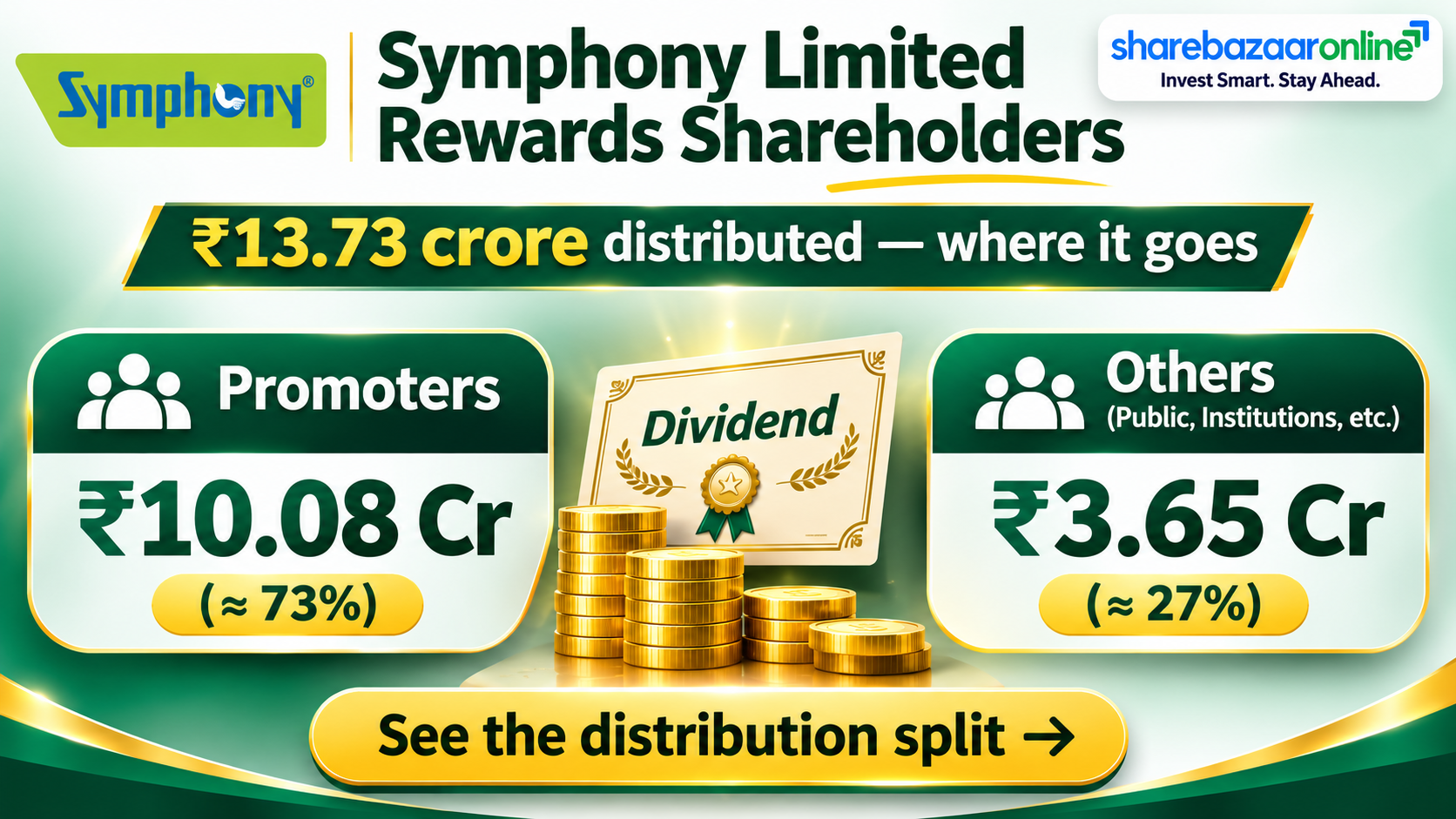
With promoter holding at 73.42%, the Bakeri family and associated entities receive the lion’s share of this distribution: about ₹10.08 crore of the ₹13.73 crore outflow. The remaining ₹3.65 crore flows to public, FII (2.20%) and DII (7.18%) holders combined. A notable trend is the decline in FII holding, from about 6.17% a year ago to 2.20% now, while public/retail holding has risen to 17.19%. High, stable promoter ownership aligns the family’s interest with regular dividends — a payout that benefits them proportionally while remaining open to all shareholders on the record date.
Symphony Limited Dividend Taxation Analysis
Since FY2020-21, dividends are taxed in the hands of the investor at their slab rate (Dividend Distribution Tax is abolished). The company deducts TDS under Section 194 at 10% only if total dividend from Symphony Limited exceeds ₹10,000 in a financial year (threshold raised in Budget 2025).
Worked Example — 1,000 shares at ₹2 interim
- Gross dividend: 1,000 × ₹2 = ₹2,000
- TDS: Nil (below ₹10,000 threshold)
- Tax at 30% slab: ₹600
- Net in hand: ₹1,400
- Effective post-tax yield on CMP: ~0.29%
Illustrative only; actual tax depends on each investor’s slab and total dividend income.
Key Risks – Symphony Limited
- Seasonality & weather dependence: ~97% of revenue is air coolers; a mild or delayed summer directly hits sales, profit and the size of future dividends.
- Overseas drag: FY26’s loss stemmed from the Australia (Climate Holdings) impairment; subsidiaries in Australia, Mexico and China remain a profitability risk.
- Weak multi-year growth: five-year sales growth of only ~5% and a volatile profit record limit earnings-led dividend growth.
- Reserve-funded payouts: FY26 dividends were paid despite a loss, drawing on reserves — not repeatable indefinitely if profits stay weak.
- Share-price decline: the stock is down sharply over the past year, and the “yield” partly reflects a falling price, not a rising dividend.
What To Monitor – Symphony Limited
- Summer demand & channel inventory: the swing factor for FY27 full-year earnings and the final dividend.
- Overseas turnaround: whether Climate Technologies (Australia), IMPCO and GSK return to profit after the impairment reset.
- Operating margin trend: core air-cooling segment margin recovery versus raw-material and ad-spend pressure.
- Working-capital normalisation: whether the H1 cash release reverses as inventory rebuilds ahead of next summer.
- Dividend vs profit gap: whether future payouts are funded by current earnings rather than reserves.
Conclusion – Symphony Limited Dividend
Symphony Limited’s 2nd interim dividend of ₹2 is best read in two parts. The headline “100%” is a face-value artefact — the real yield on the ₹491 price is just 0.41%, and roughly 2% on a trailing-year basis. What stands out instead is quality of funding: a near debt-free balance sheet, ₹479 crore of liquidity and strong half-year cash flow make the payout secure and cover it many times over. The open questions are growth and consistency — a cyclical, weather-driven business that posted a loss in FY26 and has grown sales only modestly. The positives are affordability and reliability; the negatives are modest yield and earnings volatility. Investors can weigh these facts for themselves.
Frequently Asked Questions About Symphony Limited Dividend
What dividend has Symphony Limited announced?
What is the Symphony Limited dividend yield?
What is the record date for the Symphony Limited dividend?
What is the ex-dividend date for Symphony Limited?
When will the Symphony Limited dividend be paid?
Who is eligible for the Symphony Limited interim dividend?
How is the Symphony Limited dividend taxed?
Is the Symphony Limited dividend sustainable?
What is Symphony Limited’s dividend history?
Does the Symphony Limited interim dividend need AGM approval?
How much dividend income do promoters of Symphony Limited receive?
What should investors monitor in Symphony Limited?
Disclaimer
This article is for informational and educational purposes only and is based on publicly disclosed company filings and third-party market data believed to be reliable as of publication. Market price, yield and shareholding figures are approximate and change with market movements. Nothing here is investment, legal or tax advice, nor a recommendation to buy, sell or hold any security. ShareBazaar Online is not a SEBI-registered investment adviser. Taxation depends on individual circumstances; please consult a qualified professional. Investors should verify all details with the official NSE/BSE corporate-action circulars and the company’s filings before acting, and conduct their own due diligence.