
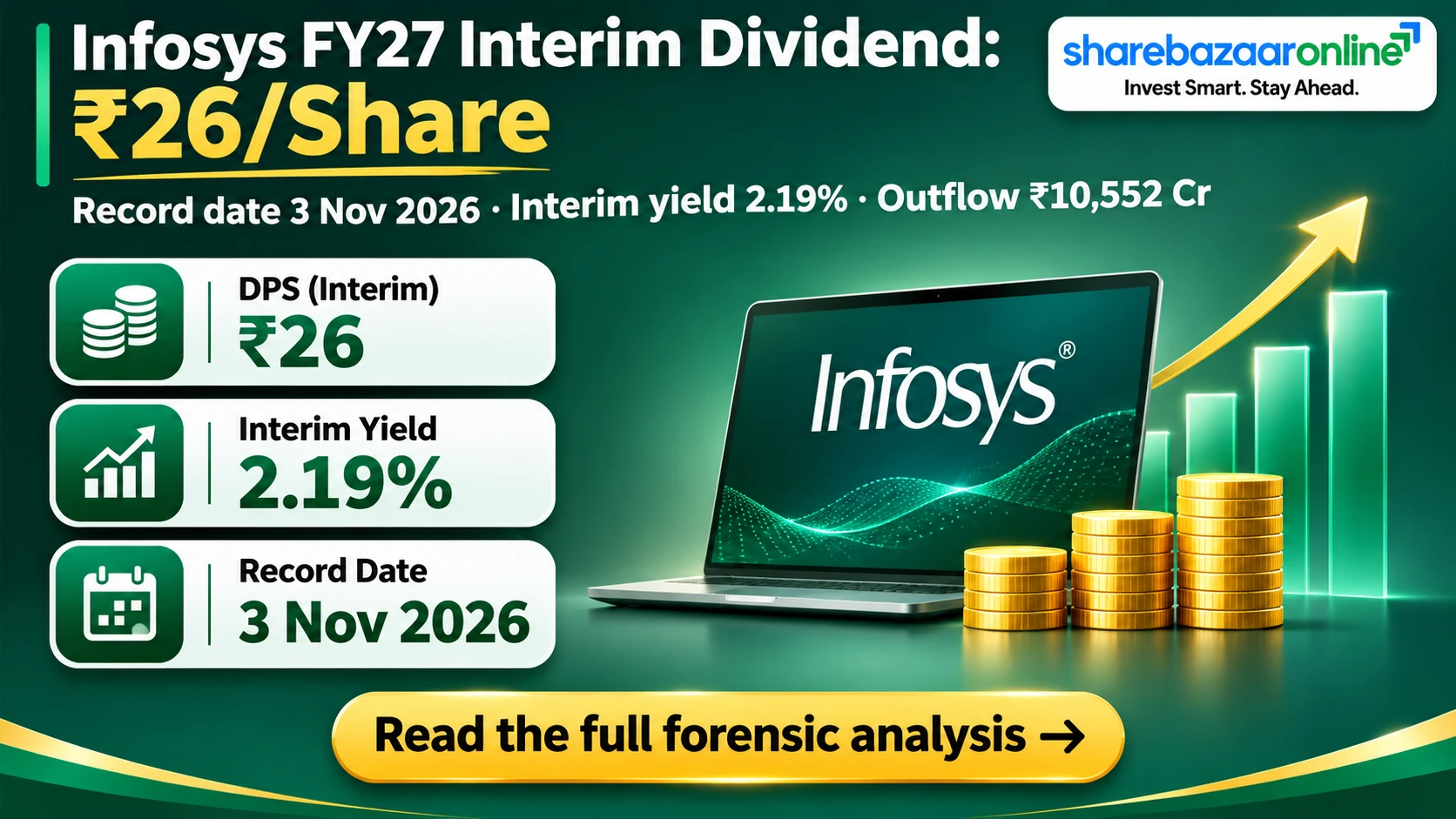
Dividend Snapshot – Infosys Limited
Infosys Limited has declared its first interim dividend of ₹26 per equity share for FY2027, alongside strong Q2 FY27 consolidated results. On a face value of just ₹5, the headline reads 520% — but the real cash return for an investor buying at the market price of about ₹1,185 is a far more modest 2.19% for this interim payout. The record date is 3 November 2026 and the money reaches bank accounts on 11 November 2026.
Dividend Per Share
₹26.00
Dividend Type
Interim (FY27)
Interim Yield (at ₹1,185)
2.19%
Record Date
3 Nov 2026
Payment Date
11 Nov 2026
Total Interim Outflow
₹10,552 Cr
Infosys Limited Company Overview
Infosys Limited (NSE: INFY, BSE: 500209, ISIN: INE009A01021) is India’s second-largest IT services company, headquartered in Bengaluru. It serves 2,060 active clients across financial services, manufacturing, retail, energy and life sciences, with a workforce of 332,542 employees as of 30 September 2026. The company reports a market capitalisation of roughly ₹4,80,908 crore, trades at a P/E of about 15.2, and carries a book value of ₹244 per share. Infosys is a structurally cash-generative business with return on equity of 31.9% and return on capital employed of 40.0%, which is the engine behind its long record of twice-yearly dividends and periodic buybacks.
Infosys Limited Financial Analysis at a Glance
For the quarter ended 30 September 2026, Infosys posted consolidated revenue of ₹49,244 crore (up 10.7% YoY) and net profit of ₹7,823 crore (up 6.2% YoY), at a steady operating margin of 21.0%. For the first half of FY27, revenue reached ₹97,454 crore (up 12.3% YoY) with net profit of ₹15,592 crore (up 9.1%). Half-year EPS stands at ₹38.51, comfortably above the ₹26 interim dividend. Large-deal TCV of $5.2 billion (62% net new) and AI-led work now at 10.5% of revenue point to a durable earnings base supporting the payout.
Infosys Limited Dividend History Table
The table below tracks Infosys’s interim dividend and total per-share payout by financial year. The current ₹26 interim is the highest in the company’s history and extends an unbroken year-on-year rise in the October interim since FY21.
| Financial Year | Interim (₹) | Final / Special (₹) | Total (₹) | Payout Ratio |
|---|---|---|---|---|
| FY21 | 12.00 | 15.00 | 27.00 | 59% |
| FY22 | 15.00 | 16.00 | 31.00 | 59% |
| FY23 | 16.50 | 17.50 | 34.00 | 58% |
| FY24 | 18.00 | 28.00* | 46.00 | 73% |
| FY25 | 21.00 | 22.00 | 43.00 | 67% |
| FY26 | 23.00 | 25.00 | 48.00 | 66% |
| FY27 | 26.00 | Final pending | 26.00 so far | — |
*FY24 includes a ₹8 special dividend alongside the ₹20 final. Payout ratios sourced from Screener.in consolidated data; per-share amounts as declared by the company.
Expert Commentary on the Infosys Limited Dividend
The 520% headline is a face-value optical illusion that retail investors should read carefully: it is ₹26 measured against a ₹5 face value, not a 520% return. The number that matters is the 2.19% interim yield on the market price. What stands out analytically is consistency — Infosys has lifted its October interim every year for six years, from ₹15 to ₹26, a roughly 11.6% annual growth rate. The payout is funded from current earnings, not reserves: half-year EPS of ₹38.51 covers the interim 1.48 times. This is a reward backed by cash generation rather than financial engineering.
Infosys Limited Dividend Outlook
Based only on disclosed information, Infosys follows a stated capital allocation policy of returning up to 85% of free cash flow to shareholders over a five-year period through dividends and buybacks, with a progressive dividend policy. If the historical pattern holds, a final dividend for FY27 would typically be declared with the March-quarter results in April 2027; however, no final dividend has been announced, and this article does not predict future corporate actions. The near-term driver to watch is whether large-deal momentum ($5.2 billion TCV this quarter) and AI-led revenue convert into sustained net-profit growth, which is what ultimately underwrites a rising payout.
Infosys Limited Dividend Announcement Summary
At its board meeting held on 22–23 October 2026, Infosys approved its audited Q2 and H1 FY27 financial results and declared an interim dividend of ₹26 per equity share of face value ₹5. The company fixed 3 November 2026 as the record date and 11 November 2026 as the payment date. Shareholders whose names appear in the register of members or in depository records as of the record date are eligible to receive the dividend. The total cash outgo on this interim dividend works out to approximately ₹10,552 crore across 405.83 crore shares outstanding. All figures are drawn directly from the company’s stock-exchange filing.
Infosys Limited Key Dates Timeline
Announcement Date
23 October 2026
Ex-Dividend Date
3 November 2026
Record Date
3 November 2026
Payment Date
11 November 2026
Under India’s T+1 settlement regime, the ex-dividend date and the record date fall on the same trading day. Investors must hold the shares before the ex-date to be eligible.
Infosys Limited Dividend Yield Analysis
The 520% figure in headlines is simply ₹26 expressed against the ₹5 face value — it is not an investment return. On the market price of about ₹1,185, this interim dividend yields 2.19%; at the announcement-day price of ₹1,153.80 it was 2.25%. Adding the FY27 final-of-FY26 payout, the trailing twelve-month yield is about 4.30%, which is healthy for a large-cap IT name. The elevated trailing yield partly reflects a falling share price — the stock trades well below its 52-week high of ₹1,728 — so investors should recognise that part of the yield comes from price weakness, not only from dividend growth.
Infosys Limited Dividend History Analysis
Infosys qualifies as a consistent and progressive dividend payer. Over the last six financial years the interim dividend has risen every single year — ₹12, ₹15, ₹16.50, ₹18, ₹21, ₹23 and now ₹26 — with no cuts or suspensions. Total per-share dividends grew from ₹27 in FY21 to ₹48 in FY26. The one-off bump in FY24 came from an ₹8 special dividend, which is why the FY24 payout ratio spiked to 73% before normalising. There have been no bonus issues or stock splits in this window, so the per-share figures are directly comparable year on year with no restatement required.
Infosys Limited Financial Performance Analysis
Revenue growth is outpacing profit growth, and the gap is worth understanding. In H1 FY27, consolidated revenue rose 12.3% but net profit grew only 9.1%. The drag sits in the ₹1,597 crore of other income, which fell 11.9% YoY as finance costs and lower treasury gains bit, while the tax expense rose 14.3%. The operating line itself is robust — operating profit up 12.9% at a stable 21.0% margin — so the profit lag is driven below EBIT, not by core delivery. For dividend investors this is reassuring: the operating engine, which funds the payout, is growing in step with revenue.
Infosys Limited Cash Flow Analysis
Cash is fact, and here the facts are strong. Infosys generated ₹8,898 crore of free cash flow in Q2 FY27 and about ₹17,949 crore across H1. The ₹26 interim costs roughly ₹10,552 crore. So H1 free cash flow covers the interim 1.70 times, confirming the dividend is funded by genuine cash generation, not borrowings or asset sales. One honest caveat: a single quarter’s FCF (₹8,898 crore) alone does not fully cover this single interim (coverage 0.84 times), which is normal for a lumpy, half-yearly payout cycle but worth noting. Full-year FY26 operating cash flow was ₹33,986 crore, underscoring the structural strength.
Infosys Limited Balance Sheet Strength
Infosys runs a fortress balance sheet. Consolidated cash and investments stood at ₹45,232 crore as of 30 September 2026, against reported borrowings of only ₹8,525 crore (largely lease liabilities), leaving a net cash position of about ₹36,707 crore. That cash pile alone could fund the current interim dividend 4.29 times over. Reserves climbed to ₹97,051 crore. With return on capital employed at 40.0%, the company earns high returns on the capital it retains, meaning dividends are paid from surplus rather than at the expense of reinvestment. This is the balance-sheet profile that makes a progressive dividend policy credible.
Infosys Limited Dividend Sustainability Analysis
On a four-test scorecard, the interim dividend passes comfortably.
Earnings Coverage (H1 EPS/DPS)
1.48x — Pass
FCF Coverage (H1)
1.70x — Pass
Cash Coverage
4.29x — Strong
Debt Position
Net Cash — Pass
Verdict: Sustainable. Earnings, free cash flow and a large net-cash buffer all cover the payout, and the earnings trend is rising, not declining. The only watch-item is the revenue-to-profit gap below the operating line.
Infosys Limited Peer Comparison
Among large-cap Indian IT, Infosys sits mid-pack on yield. Wipro leads on trailing yield (aided by a buyback and a weaker price), TCS pays the largest absolute dividend, while Infosys combines a competitive yield with sector-leading returns on capital.
| Company | FY26 DPS (₹) | Trailing Yield | ROE |
|---|---|---|---|
| Infosys | 48.00 | 4.30% | 31.9% |
| TCS | 110.00 | 4.58% | High |
| HCLTech | 60.00 | 4.98% | High |
| Wipro | 11.00 | 5.51% | Moderate |
Peer yields sourced from public market data (whalesbook, Angel One); ROE for Infosys per Screener.in. Peer ROE shown qualitatively where a verified figure was not independently confirmed.
Infosys Limited Promoter Impact Analysis
Infosys is a professionally managed company with relatively low promoter holding of 13.90% (the founders and families). Applied to the ₹10,552 crore interim outflow, promoters collectively receive about ₹1,467 crore. The large majority — over 86% — flows to institutional and public shareholders, with DIIs holding 42.66% and FIIs 27.44%. Because promoter ownership is modest, this dividend is not a mechanism to disproportionately enrich insiders; the benefit is broadly distributed across the market, including domestic mutual funds and the nearly 29.5 lakh individual shareholders on the register. This is a structurally different ownership profile from typical promoter-dominated Indian companies.
Infosys Limited Dividend Taxation Analysis
Since FY21, dividends are taxed in the hands of the investor at their applicable income-tax slab rate. The company deducts TDS at 10% under Section 194 where total dividend from the company exceeds ₹5,000 in a financial year (20% if PAN is not furnished). A worked example below shows the effective cash received by an investor in the 30% slab.
Example — 1,000 shares at ₹26/share:
- Gross dividend: ₹26,000
- TDS at 10% deducted at source: ₹2,600
- Credited to bank: ₹23,400
- Final tax at 30% slab (plus cess): about ₹8,112; net after full tax: roughly ₹17,888
- Effective post-tax yield at ₹1,185: about 1.53%
Illustrative only; excludes surcharge where applicable. This is not tax advice — consult a qualified professional.
Infosys Limited Key Risks
- Demand sensitivity: IT spending is discretionary; a slowdown in North America (54.6% of revenue) or BFSI (28% of revenue) would pressure the earnings that fund dividends.
- Currency and other income drag: other income fell 11.9% in H1 FY27, widening the gap between revenue and profit growth.
- Price-driven yield: the stock trades near ₹1,185 versus a 52-week high of ₹1,728; a high trailing yield partly reflects price weakness.
- Margin pressure: wage revisions, pricing and AI-led pricing resets could compress the 21% operating margin.
- Payout cyclicality: a single quarter’s FCF does not always cover a single interim (0.84x), so timing of cash flows matters.
What To Monitor on Infosys Limited
- Revenue guidance: whether FY27 constant-currency growth guidance is raised or trimmed at the next results.
- Large-deal TCV: continuation of the $5.2 billion quarterly deal wins and the net-new mix (62% this quarter).
- Operating margin: defence of the 21% band amid wage hikes and AI pricing shifts.
- Free cash flow conversion: FCF staying near or above net profit, which protects payout capacity.
- Capital-return policy: any FY27 final dividend or buyback announcement with the March-quarter results.
Should You Consider Infosys Limited for Dividend Income? — Conclusion
Infosys’s ₹26 interim dividend is its largest ever and extends a six-year run of rising October payouts. Stripped of the misleading 520% face-value headline, it offers a real interim yield of 2.19% and a trailing yield near 4.30%. The payout is sustainable on every test — earnings coverage of 1.48x, H1 free-cash-flow coverage of 1.70x, and a net-cash buffer of ₹36,707 crore. The honest caveats are a widening revenue-to-profit gap below the operating line and a trailing yield flattered by a falling share price. ShareBazaar Online presents the positives, negatives, risks and monitoring factors so you can decide for yourself; we do not issue buy, sell or hold calls.
Frequently Asked Questions About Infosys Limited Dividend
What dividend has Infosys announced in 2026?
What is the Infosys dividend yield?
What is the record date for the Infosys dividend?
What is the ex-dividend date for Infosys?
When will the Infosys dividend be paid?
Who is eligible for the Infosys interim dividend?
How is the Infosys dividend taxed?
Is the Infosys dividend sustainable?
What is the Infosys dividend history?
Why does the 520% dividend figure not mean a 520% return?
What should investors monitor after this dividend?
How much is Infosys paying out in total for this interim dividend?
Disclaimer
This article is for informational and educational purposes only and is based on publicly disclosed information from Infosys Limited’s stock-exchange filings and cited public sources as of 2 November 2026. ShareBazaar Online is not a SEBI-registered investment adviser. Nothing here constitutes investment, legal or tax advice, or a recommendation to buy, sell or hold any security. Dividend figures, dates and financials are subject to company confirmation and regulatory filings. Investors should verify details with official NSE/BSE announcements and consult a qualified financial adviser before making any decision. Market prices and yields change continuously; figures cited are approximate and point-in-time.