
Ola Electric Rights Issue 2026: ₹27 Price, 2:25 Ratio, Record Date & Full Details
Status: Issue OPEN — closes 30 October 2026. The issue was reported fully subscribed on 28 October 2026 (bids for 37.14 crore shares against 37.03 crore on offer). The record date (13 Oct 2026) and the on-market renunciation window (ended 26 Oct 2026) have passed. Figures marked "derived" or "to be verified" are not disclosed in the company's board intimation.
Rights Issue Snapshot — Ola Electric
| Company Name | Ola Electric Mobility Limited |
|---|---|
| Exchanges | NSE & BSE |
| Symbol / Code | OLAELEC (NSE) · 544225 (BSE) |
| ISIN (Equity) | INE0LXG01040 |
| ISIN (Rights Entitlement) | INE0LXG20016 |
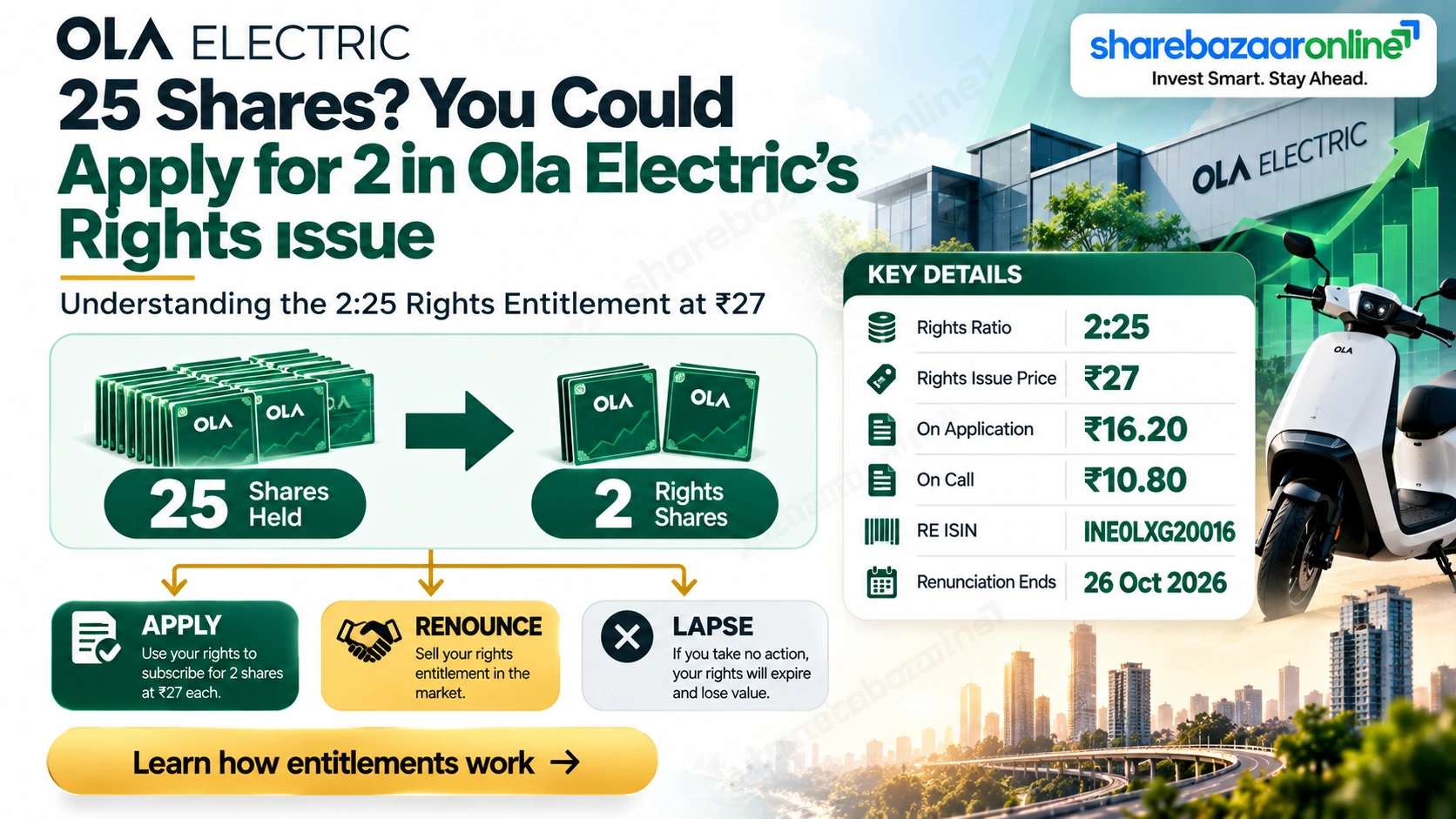
| Rights Entitlement Ratio | 2 rights shares for every 25 shares held |
| Issue Price | ₹27 per share (₹16.20 on application · ₹10.80 on call) |
| Face Value | ₹10 per share |
| Premium | ₹17 per share |
| Record Date | 13 October 2026 |
| Issue Opening Date | 22 October 2026 |
| Issue Closing Date | 30 October 2026 |
| RE Trading / On-Market Renunciation Ends | 26 October 2026 |
| Total Issue Size | Up to ₹999.74 crore (37,02,72,665 shares) |
| Issue Purpose | Debt repayment/pre-payment, organic growth, general corporate purposes |
| Registrar | Not disclosed in the board intimation — to be verified from the Letter of Offer |
| Lead Manager | Not disclosed in the board intimation — to be verified from the Letter of Offer |
| Promoter Participation | Promoter/founder Bhavish Aggarwal reported to have participated fully |
| Announcement / Board Meeting | 7 October 2026 (initial approval 28 September 2026) |
| Listing Status | Already listed; in-principle listing approvals received from NSE & BSE |
About Ola Electric
Ola Electric Mobility Limited is a Bengaluru-headquartered pure-play electric vehicle manufacturer, incorporated in February 2017 and listed on the exchanges in August 2024 after an IPO priced at ₹76 per share. The company is best known for its electric scooter range and operates a large integrated manufacturing complex, the Ola Future Factory, in Tamil Nadu.
The business has expanded beyond scooters into motorcycles and an in-house battery cell programme, pursuing a vertical-integration strategy across vehicles, powertrains and cells. Revenue is driven primarily by electric two-wheeler sales, supplemented by services and, prospectively, cell manufacturing. After a hyper-growth phase, Ola Electric has publicly shifted toward a more measured, margin-focused strategy amid intensifying competition from legacy two-wheeler makers and new EV entrants. Recent developments include a June 2026 qualified institutional placement of about ₹780 crore and this October 2026 rights issue.
Ola Electric Rights Issue Explained
A rights issue lets a listed company raise fresh capital by offering new shares to its existing shareholders in proportion to their current holding, usually at a price below the prevailing market price. In the Ola Electric rights issue, eligible shareholders on the record date of 13 October 2026 received a Rights Entitlement (RE) of 2 new shares for every 25 shares held, priced at ₹27 per share.
These are partly paid-up shares: ₹16.20 (60%) is payable on application and the remaining ₹10.80 (40%) on a first-and-final call expected on or before 31 October 2027. Shareholders had three choices — apply for their entitlement (in full or part), renounce (sell or transfer) the RE to someone else during the renunciation window, or let the entitlement lapse. An investor does not receive shares automatically; shares are allotted only against a valid application and payment. The RE for this issue traded under ISIN INE0LXG20016.
Important Dates for Ola Electric Rights Issue
| Event | Date |
|---|---|
| Initial board approval | 28 September 2026 |
| Board meeting approving terms / announcement | 7 October 2026 |
| Record Date | 13 October 2026 |
| Ex-Date (derived, T+1 convention) | On or about 10 October 2026 — derived, to be verified |
| Issue Opening Date | 22 October 2026 |
| Last date for on-market renunciation (RE trading closes) | 26 October 2026 |
| Last date for off-market renunciation | Such that REs are credited to renouncees on or before the closing date — to be verified from LOF |
| Issue Closing Date | 30 October 2026 |
| Allotment Date | Not disclosed by the company |
| Credit / listing of rights shares | Not disclosed by the company |
The ex-date is a derived estimate based on the T+1 convention and has not been separately disclosed in the board intimation. The board retains the right to extend the issue period by up to 30 days from the opening date.
Ola Electric Rights Issue Timeline
The 13 October 2026 record date fixed which shareholders were eligible to receive Rights Entitlements. From the 22 October opening, eligible holders could apply via ASBA, while the RE could be bought or sold on the exchange until on-market renunciation closed on 26 October. Off-market renunciation had to be completed so that REs reached the renouncee's demat account before the 30 October closing date.
Subscription ran from 22 to 30 October 2026. Press reports indicate the issue was fully subscribed on 28 October, two days before close. After closing, the company moves to finalising the basis of allotment, crediting the partly paid-up shares, and their listing — dates for these steps have not been disclosed in the board intimation and should be confirmed from subsequent exchange filings and the Letter of Offer.
Rights Issue Structure of Ola Electric
Price and payment
Issue price is ₹27 per share, comprising face value ₹10 and premium ₹17. It is partly paid: ₹16.20 on application (face ₹6 + premium ₹10.20, = 60%) and ₹10.80 on first-and-final call (face ₹4 + premium ₹6.80, = 40%), with the call expected on or before 31 October 2027.
Premium per share = ₹27 − ₹10 = ₹17.
Size and dilution
Up to 37,02,72,665 new shares for up to ₹999.74 crore (assuming full subscription and payment of call monies).
Shares outstanding rise from 4,62,84,08,313 to 4,99,86,80,978. New shares equal about 7.4% of post-issue capital (37,02,72,665 ÷ 4,99,86,80,978) — a derived figure.
Entitlement check
At 2 shares for every 25 held, 4,62,84,08,313 × (2 ÷ 25) = 37,02,72,665 shares — matching the disclosed issue size exactly.
Why Is Ola Electric Raising Capital Through a Rights Issue?
Per company disclosures reported in the press, the proceeds are earmarked for three stated objects:
- Repayment or pre-payment of certain outstanding borrowings, including related interest and pre-payment penalties.
- Organic growth initiatives to fund the business.
- General corporate purposes.
The emphasis on debt reduction is notable given the company reported a shift to a net-debt position in FY26. The rights issue follows a roughly ₹780 crore qualified institutional placement completed in June 2026, indicating a sequence of capital-raising steps. The precise rupee allocation across each object is set out in the Letter of Offer and should be read there for exact amounts.
Promoter Participation in Ola Electric Rights Issue
Promoter and promoter-group holding stood at roughly 32.9%–33% around the announcement, with founder Bhavish Aggarwal holding about 26.5% directly (a derived split from recent shareholding disclosures that varies slightly by source and date). The company had earlier indicated that Aggarwal pledged a 4.32% stake specifically to fund his subscription to the rights issue, and that no shares were being sold in doing so.
Press reports indicate Aggarwal participated fully in the issue. Full promoter participation signals commitment and helps limit the dilution of promoter ownership, but the exact post-issue promoter percentage depends on the final basis of allotment, including any unsubscribed or renounced portions. Post-issue promoter holding is therefore not confirmed until allotment and is labelled to be verified.
Ola Electric Financial Performance Overview
| Metric (consolidated) | FY25 | FY26 |
|---|---|---|
| Revenue from operations | ~₹4,514 cr | ~₹2,250–2,460 cr (source range) |
| Net loss | ~₹2,276 cr | ~₹1,833 cr |
| Net debt (year-end) | Net cash (figure disputed across sources) | ~₹934 cr net debt |
| EPS | Negative (loss-making) | Negative (loss-making) |
| Return on equity (FY25) | Approximately −63.6% (aggregator estimate) | |
Revenue fell sharply in FY26 as the company prioritised margins over volume, though the net loss narrowed year on year. In Q1 FY26 (Apr–Jun 2025), revenue was ₹828 crore with a net loss of ₹428 crore, and the auto segment was reported to have turned EBITDA-positive in June 2025. Figures above are drawn from company results and financial aggregators; exact audited numbers should be taken from the FY26 annual report and the Letter of Offer.
In-Depth Financial Analysis of Ola Electric
The financial profile frames the rationale for the rights issue. A roughly 50% revenue decline in FY26 alongside continued, though narrowing, losses points to a business still absorbing cash while it rebuilds volumes and margins. The shift from a net-cash position a year earlier to an estimated ~₹934 crore net debt by March 2026 is consistent with the stated objective of using rights proceeds for debt repayment and pre-payment.
Management commentary around Q1 FY26 highlighted improving auto gross margins, expected PLI benefits and a target of EBITDA-positive auto operations. These are company expectations rather than realised full-year outcomes, and FY26 revenue came in well below the ₹4,200–4,700 crore range management had guided at the start of the year — a gap investors may wish to weigh. The analysis here separates reported results (facts) from guidance and editorial interpretation.
Balance Sheet Strength of Ola Electric
Ola Electric entered FY26 with a cushion of cash from its IPO and subsequent raises, but the year saw that cushion erode as losses and investment continued, moving the company to a modest net-debt position by March 2026 (estimated around ₹934 crore). Total debt at FY26-end is estimated at roughly ₹2,476 crore by one aggregator. The June 2026 QIP (~₹780 crore) and this rights issue (up to ~₹999.74 crore) are both aimed at strengthening the balance sheet and funding operations.
Because audited, line-by-line balance-sheet detail for FY26 is best taken from the annual report and the Letter of Offer, specific asset, liability and net-worth figures are not reproduced here where sources diverge. Investors should treat net-cash/net-debt figures that conflict across aggregators with caution and rely on primary filings.
Cash Flow Position of Ola Electric
As a company still reporting net losses, Ola Electric has been consuming cash at the operating and investing levels while funding itself through equity and debt raises. Management has stated that the auto business turned EBITDA-positive in June 2025 and guided toward the auto segment generating operating cash flow later in FY26, with the cell business targeted to be free-cash-flow positive at a 5 GWh scale by end-FY27.
These are forward-looking company statements, not confirmed annual cash-flow outcomes. Accounting profit and cash flow are distinct; a narrowing net loss does not by itself establish positive free cash flow. Detailed operating, investing and financing cash-flow figures should be read from the audited FY26 cash-flow statement and the Letter of Offer.
Shareholding Pattern of Ola Electric Before and After the Rights Issue
| Category | Approx. holding (around announcement) |
|---|---|
| Promoter & promoter group | ~32.9%–33% (Bhavish Aggarwal ~26.5% direct) |
| Foreign Institutional Investors (FII) | ~4% |
| Domestic Institutional Investors (DII) | ~3.7%–5.5% (varies by source/date) |
| Public / retail & others | ~46%–49% |
Pre-issue shares outstanding: 4,62,84,08,313; post-issue (full subscription): 4,99,86,80,978. In a rights issue, shareholders who fully subscribe their entitlement broadly retain their ownership proportion; those who do not subscribe or renounce see their stake diluted. Exact post-issue category percentages are determined by the final allotment and are not disclosed in the board intimation. The figures above are the most recent available and differ slightly across aggregators.
Industry Analysis: Where Does Ola Electric Stand?
India's electric two-wheeler market has grown rapidly on the back of policy support, falling battery costs and rising fuel prices, but it has also become intensely competitive. Ola Electric was an early category leader, yet legacy two-wheeler manufacturers and newer EV players have expanded aggressively, pressuring market share and pricing. The sector is sensitive to subsidy frameworks, PLI incentives, charging infrastructure and consumer financing.
Ola Electric positions itself as a vertically integrated player spanning vehicles, powertrains and battery cells — a strategy that can lower long-run costs but requires heavy upfront capital. Industry demand trends, regulatory changes and competitive intensity are the principal external variables affecting the company. Specific market-size figures are not asserted here without a verified source.
Competitive Position of Ola Electric
Ola Electric's competitive edge rests on its brand recognition, large installed manufacturing capacity, vertical integration and an expanding product range across scooters and motorcycles. Its in-house cell programme, if executed to scale, could differentiate cost structure over time.
Against this, the company faces well-capitalised competitors with established dealer and service networks, and it has itself pivoted toward a dealer-led sales model. Operational challenges have included service-network scaling and demand normalisation after the early hyper-growth phase. Direct peer financial comparisons are meaningful only across comparable periods and business models, and should be made with that caveat. Claims of outright market leadership are avoided here absent current, verified share data.
Key Growth Drivers for Ola Electric
- Margin expansion: company guidance points to higher auto gross margins aided by PLI benefits and vertical integration.
- Product expansion: motorcycle ramp-up and new scooter variants broaden the addressable market.
- Battery cell programme: in-house cells targeted to reach meaningful scale, potentially improving cost structure.
- Balance-sheet repair: debt repayment from rights proceeds can lower interest costs.
- Distribution shift: a move toward a dealer-led model aimed at wider reach.
Several of these are company expectations or strategic initiatives rather than realised results, and are labelled as such. Their contribution depends on execution and market conditions.
Risk Factors Associated with Ola Electric Rights Issue
- Continued losses: the company remained loss-making through FY26, and a return to profit is not assured.
- Revenue contraction: FY26 revenue fell sharply year on year, and fell short of management's own guidance.
- Leverage: a shift to a net-debt position increases financial risk if cash generation lags.
- Partly paid structure: investors owe the ₹10.80 call later; failure to pay can affect their holding.
- Dilution: shareholders who do not subscribe see ownership diluted.
- Competition and demand: intense competition and policy/subsidy dependence.
- Execution: cell programme, motorcycle ramp-up and margin targets carry execution risk.
The complete, legally framed risk factors are set out in the Letter of Offer and should be read in full.
Opportunities Emerging from Ola Electric Rights Issue
Based on the stated use of proceeds, the rights issue could support several potential outcomes: a lower debt burden and reduced interest outgo from repayment and pre-payment; funding for organic growth initiatives; and greater financial flexibility to pursue margin and product goals. For eligible shareholders, the ₹27 price represented a discount to the market price around the announcement, offering an opportunity to add at a lower entry cost while maintaining ownership.
These are potential opportunities contingent on execution and market conditions — not guaranteed outcomes. The degree to which proceeds translate into improved financials will be visible only in future results.
Advantages of Ola Electric Rights Issue
Discounted entry: ₹27 was about 25.6% below the ~₹36.30 reference market price on the announcement date — relevant for eligible shareholders, though market prices move.
Maintain ownership: subscribing one's full entitlement helps avoid dilution.
Staggered payment: the partly paid structure spreads the cost (₹16.20 now, ₹10.80 later).
Balance-sheet support: proceeds earmarked partly for debt repayment may reduce interest costs.
Promoter alignment: reported full promoter participation signals commitment.
Growth capital: funding for organic initiatives and operations.
Each advantage applies to specific situations and none guarantees a positive return. The discount is to a past reference price and does not predict future value.
Disadvantages and Risks of Ola Electric Rights Issue
Dilution: non-participating shareholders see their stake reduced.
Capital-loss risk: the shares remain volatile and loss-making at the company level.
Future call obligation: the ₹10.80 call must be paid later.
Use-of-proceeds risk: benefits depend on effective deployment of funds.
Increased share supply: more shares outstanding can weigh on per-share metrics.
Execution and sector risk: competition, demand and policy dependence persist.
These describe possible effects, not certainties. Shareholders should evaluate them against primary disclosures and their own circumstances.
Should Existing Shareholders Participate in the Ola Electric Rights Issue?
This is an educational framework, not a recommendation. Factors eligible shareholders may weigh include: the ₹27 price versus the prevailing market price (and the fact that the discount is measured against a past reference date); the company's fundamentals and ongoing losses; the stated use of funds and whether debt reduction and growth plans are credible; the net-debt position; the competitive landscape; the dilution impact of not participating; the choice to apply, renounce or lapse the entitlement; and each investor's own financial situation, risk tolerance and objectives.
No single factor is decisive, and the appropriate choice differs by investor. ShareBazaar Online does not advise whether to apply or abstain.
Investor Insights on Ola Electric Rights Issue
Reading the disclosed terms together: a ₹999.74 crore raise at a discounted ₹27, partly paid, with stated debt-repayment and growth objectives, reported full promoter participation and a reported full subscription by 28 October, suggests the company secured the capital it sought. The available evidence establishes the issue's size, pricing, timeline and that demand covered the offer. It does not establish future profitability, the precise post-issue shareholding, allotment timing, or that proceeds will achieve their intended outcomes.
The clearest signals are the balance-sheet intent (debt reduction) and promoter commitment; the clearest open questions are the pace of margin and volume recovery and the exact deployment of funds, both of which will only be visible in subsequent results and filings.
Analyst Perspective on Ola Electric
On a neutral, fact-based reading: the strategic rationale for the raise — reducing leverage and funding growth after a year of lower revenue and continuing (though narrower) losses — is internally consistent with the company's disclosed financial trajectory. Pricing at a discount with a partly paid structure is a common design to encourage participation and ease the cash outlay for shareholders. Reported full promoter participation and full subscription are supportive data points.
Key unanswered questions remain: whether auto margins and volumes recover durably, how quickly net debt is brought down, and the exact allotment and listing timeline. This is an educational assessment; it is not a brokerage rating, price target or buy/sell call, and ShareBazaar Online has not issued any investment recommendation.
Conclusion: Ola Electric Rights Issue Review
Ola Electric's October 2026 rights issue raised up to ₹999.74 crore by offering 37,02,72,665 partly paid shares at ₹27 (₹16.20 on application, ₹10.80 on call) in a 2:25 ratio, on a 13 October record date, with subscription from 22 to 30 October. The price was about 25.6% below the ~₹36.30 reference market price on the announcement date. Proceeds are earmarked for debt repayment/pre-payment, organic growth and general corporate purposes. Founder Bhavish Aggarwal reportedly participated fully, and the issue was reported fully subscribed on 28 October. The company remained loss-making in FY26 on sharply lower revenue, with a modest net-debt position — context that underlines the balance-sheet intent behind the raise. Allotment and listing dates, registrar and lead-manager details are to be confirmed from the Letter of Offer and subsequent filings. This review is educational and not investment advice.