
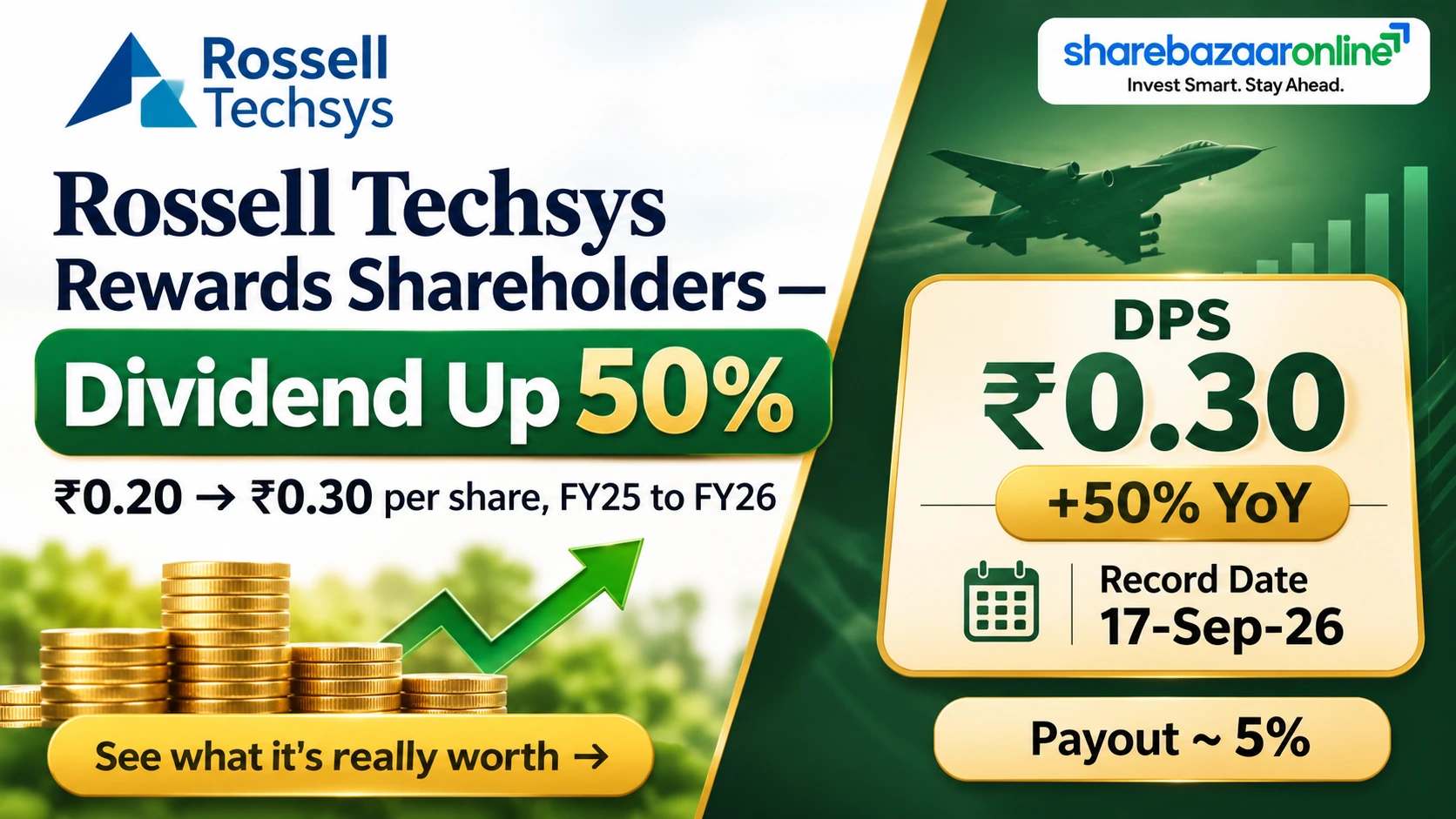
Dividend Snapshot – Rossell Techsys Limited
Rossell Techsys Limited (NSE: ROSSTECH, BSE: 544294) declared a final dividend of ₹0.30 per equity share for FY2025-26 — a payout equal to 15% on the ₹2 face value. The board fixed 17 September 2026 as the record date. For retail investors scanning the dividend, the striking fact is the gap between that eye-catching 15% figure and the real market yield: at a market price near ₹1,564, the actual Rossell Techsys dividend yield works out to roughly 0.02%. This report breaks down the dividend per share, dividend history, payout ratio, cash flow and dividend sustainability so you can read past the headline percentage.
Dividend Per Share
₹0.30
Final dividend · 15% of ₹2 face value
Real Dividend Yield
~0.02%
At market price near ₹1,564
Record Date
17 Sep 2026
Eligibility cut-off (now passed)
Total Dividend Outflow
~₹1.13 Cr
On ~3.77 crore shares
Company Overview – Rossell Techsys Limited
Rossell Techsys Limited is a Bengaluru-based aerospace and defence engineering company. It builds electrical wire harnesses, interconnect systems, panel products and test solutions for military aerospace and defence platforms, and operates in a single business segment. The company was carved out of Rossell India Limited under a Scheme of Arrangement and listed on the exchanges in FY24; it has a wholly owned US subsidiary, Rossell Techsys Inc. Its registered office is in Kolkata, with the corporate base at the Hi-Tech Defence and Aerospace Park, Devanahalli, Bengaluru. As a relatively young listed entity in a fast-growing defence-manufacturing theme, Rossell Techsys has scaled revenue sharply — and its FY2025-26 dividend is only its second payout as a standalone listed company.
Rossell Techsys Limited Financial Analysis
On the reported numbers, FY2025-26 was a strong growth year. Consolidated revenue rose to ₹485.1 crore with net profit of ₹21.89 crore and EPS of ₹5.81. Q1 FY27 (quarter ended 30 June 2026) continued the momentum, with standalone revenue from operations of ₹154.71 crore, up about 78% year-on-year, and quarterly profit of ₹6.98 crore. The catch sits below the profit line: profitability is thin relative to the balance sheet, with ROE around 6% and ROCE around 8% on Screener.in data. In short, the top line is expanding quickly, but the returns the business earns on its capital remain modest for now.
Consolidated PAT (FY26)
₹21.89 Cr
EPS ₹5.81 · Standalone PAT ₹20.74 Cr
Returns (Screener.in)
ROE ~6% · ROCE ~8%
Modest versus high valuation multiples
Rossell Techsys Limited Dividend History Table
| Financial Year | Type | Dividend / Share | % on Face Value | Record Date |
|---|---|---|---|---|
| FY2025-26 | Final | ₹0.30 | 15% | 17 Sep 2026 |
| FY2024-25 | Final | ₹0.20 | 10% | 17 Sep 2025 |
Dividend history for Rossell Techsys Limited begins in FY2024-25, its first full year as a separately listed entity. Source: exchange disclosures and public dividend records.
Expert Commentary on Rossell Techsys Limited Dividend
The honest read on this dividend is that it is a symbolic shareholder gesture, not an income event. The ₹0.30 per share is comfortably covered by earnings — it absorbs only about 5% of profit — yet it sits on a stock priced for aggressive growth, so the real dividend yield is around 0.02%. More importantly, Rossell Techsys is in a cash-consuming growth phase: it reported negative operating cash flow in FY26 and carries sizeable working-capital debt. A dividend this small is affordable, but it is being paid by a business that is currently funding its expansion through borrowings rather than internally generated cash. Investors drawn in by the “15%” label should weigh that the payout is a token, while the growth and leverage story is what actually matters here.
Rossell Techsys Limited Dividend & Future Outlook
Rossell Techsys has, on disclosed information, lifted its dividend from ₹0.20 to ₹0.30 per share — a 50% increase year-on-year, signalling a willingness to share some surplus with shareholders as profits grow. However, the company has not disclosed any formal dividend policy or future payout commitment, so investors should not assume a rising-dividend path. Separately, the company intimated a board meeting to consider a preferential allotment of equity shares — a capital-raising route that fits a growth-and-leverage profile. The practical outlook: the dividend is likely to stay a modest token for the foreseeable future, with capital directed toward funding order-book execution, working capital and capacity rather than larger distributions. Any change would depend on the business turning cash-generative.
Rossell Techsys Limited Dividend Announcement Summary
At its board meeting held on 28 July 2026, the board of Rossell Techsys Limited approved a final dividend of ₹0.30 per equity share (face value ₹2) for the financial year 2025-26, under Regulation 43 of the SEBI (LODR) Regulations, 2015. Being a final dividend, it is subject to shareholder approval at the Annual General Meeting. The same board meeting approved the unaudited Q1 FY27 results, appointed MMAK & Co as internal auditor for FY2026-27, fixed the Fourth AGM for 24 September 2026 (via video conferencing), and set the dividend record date as 17 September 2026. The company did not separately disclose a specific dividend payment date in this intimation.
Rossell Techsys Limited Key Dates Timeline
Announcement Date
28 July 2026
Board meeting outcome
Ex-Dividend Date
17 September 2026
Per public records (record date = ex-date)
Record Date
17 September 2026
Eligibility cut-off (disclosed)
AGM Date
24 September 2026
Dividend subject to AGM approval
Payment Date
Not Disclosed by Company
Typically credited within 30 days of AGM
Rossell Techsys Limited Dividend Yield Analysis
This is where the “15% dividend” headline misleads most. That 15% is calculated on the ₹2 face value, not on what you actually pay for the share. The real dividend yield — dividend per share divided by market price — tells the true story. At the price near the announcement (around ₹1,148) the yield was about 0.026%; at the more recent price near ₹1,564, it is about 0.019%. Either way, the headline 15% is roughly 570 times larger than the real yield an investor earns. For context, a plain fixed deposit yields several hundred times more income. The takeaway: the Rossell Techsys dividend is not a yield play — it is a token on a high-priced growth stock.
Headline “Dividend %”
15%
On ₹2 face value only
Real Market Yield
~0.02%
Dividend ÷ market price
Rossell Techsys Limited Dividend History Analysis
With only two payouts on record (₹0.20 in FY2024-25 and ₹0.30 in FY2025-26), Rossell Techsys Limited is best classified as an emerging / early-stage payer rather than a consistent dividend compounder. There have been no special dividends, no interim dividends, no dividend cuts and no suspensions — simply too short a history to judge consistency. The one clear signal is direction: the dividend per share has grown 50% in a single year. That is encouraging, but a two-year track record on a newly demerged company cannot be extrapolated into a reliable income stream. Investors should treat the growth in dividend as a positive sentiment indicator, not as evidence of an established, defensible payout policy.
Rossell Techsys Limited Financial Performance Analysis
Operating leverage is working in the company’s favour on the income statement. In Q1 FY27, standalone revenue from operations rose to ₹154.71 crore from ₹86.99 crore a year earlier (about +78%), while quarterly profit climbed to ₹6.98 crore from ₹2.98 crore (+134%) — profits growing faster than revenue, a sign of improving scale economics. Full-year FY26 consolidated profit was ₹21.89 crore. The pressure point is finance cost: standalone interest expense was ₹9.78 crore in Q1 FY27 alone, reflecting the company’s heavy working-capital borrowing. Strong revenue and profit growth are real, but a meaningful slice of operating gains is being consumed by interest on debt — a structural feature investors should keep front of mind.
Rossell Techsys Limited Cash Flow Analysis
Reported profit is an opinion; cash is a fact — and here the two diverge sharply. Despite a positive FY26 profit of ₹21.89 crore, Rossell Techsys reported negative operating cash flow of about ₹37 crore and negative free cash flow of about ₹28 crore (Screener.in / public data). The gap is driven by a stretched working-capital cycle typical of defence-manufacturing order execution, where inventory and receivables tie up cash well ahead of collections. The company bridged this with financing inflows of roughly ₹59 crore — largely borrowing. The implication for the dividend is direct: the ₹1.13 crore payout is not funded by internally generated cash; it is effectively supported by external financing. The amount is tiny, but the funding source is a genuine red flag.
Operating Cash Flow (FY26)
~–₹37 Cr
Negative, despite positive PAT
Free Cash Flow (FY26)
~–₹28 Cr
Dividend not covered by FCF
Rossell Techsys Limited Balance Sheet Strength
The balance sheet is the counterweight to the growth story. As on 30 June 2026, the company disclosed total borrowings of ₹441.87 crore (working-capital facilities), with nil default. Against a consolidated net worth of roughly ₹155 crore, that implies a debt-to-equity ratio near 2.8x — high leverage for a company of this size. Cash and equivalents are thin relative to that debt. In other words, Rossell Techsys is a leveraged growth business: it is deploying borrowed capital to fund a rapidly expanding, working-capital-intensive order book. The dividend is trivially small against both net worth (under 1%) and debt, so it does not threaten solvency — but the leverage itself is a core risk factor that overshadows the payout.
Rossell Techsys Limited Dividend Sustainability Analysis
Judged on a four-test scorecard, the picture is mixed. Earnings coverage is excellent — EPS of ₹5.81 covers the ₹0.30 dividend about 19 times, and the payout ratio is only ~5%. But operating-cash-flow and free-cash-flow coverage both fail, because both are negative. Liquidity coverage is weak given thin cash against ₹441.87 crore of debt. The verdict: Conditionally Sustainable. The dividend is so small (₹1.13 crore) that the company can keep paying it almost regardless of cash flow. But it is sustainable only in the narrow sense that the amount is negligible — not because the business is generating the cash to fund it. A larger, income-grade dividend would not be sustainable on the current cash profile.
Sustainability Verdict: Conditionally Sustainable
Earnings coverage strong (~19x); OCF & FCF coverage negative; small absolute size keeps it payable.
Rossell Techsys Limited Peer Comparison
| Company (Aerospace & Defence) | Dividend Yield | P/E (TTM) |
|---|---|---|
| Rossell Techsys Ltd | ~0.02% | ~269x |
| Hindustan Aeronautics (HAL) | Higher yield | ~34x |
| Bharat Electronics (BEL) | Higher yield | ~48x |
| Data Patterns / Astra Micro | Low | ~84–96x |
Against larger, cash-rich defence peers such as HAL and BEL — which pay far more meaningful yields and generate strong operating cash — Rossell Techsys stands out for its near-zero yield, extreme valuation (P/E ~269x) and negative cash flow. It is a small, early-stage, leveraged growth name rather than a dividend-paying blue-chip. Source: Screener.in, fyers.in peer data.
Rossell Techsys Limited Promoter Impact Analysis
Of the total ₹1.13 crore dividend, promoters receive the largest share. The more significant governance signal, however, sits in the shareholding pattern: promoter holding fell from 74.80% (June 2026) to 69.90% (September 2026) — a drop of about 4.9 percentage points around the dividend and record-date window, including disclosed market disposals. At the September holding, promoter dividend income is roughly ₹0.79 crore, with non-promoter (public and institutional) shareholders receiving about ₹0.34 crore. Meanwhile, institutional interest rose — mutual funds moved from 0% to about 5% and total institutional holding from ~2.5% to ~6.8% in the September quarter. For minority investors, the key point is not the tiny dividend but the promoter stake reduction, which deserves attention.
Rossell Techsys Limited Dividend Taxation Analysis
Since the abolition of the Dividend Distribution Tax regime, dividends are taxed in the hands of the shareholder at their applicable income-tax slab rate. The company deducts TDS at 10% under Section 194 (now Section 393(1) of the Income-tax Act, 2025, effective 1 April 2026) only where the total dividend to a resident shareholder exceeds ₹10,000 in a financial year; for non-residents, TDS applies under Section 195 (typically 20% plus surcharge and cess, subject to treaty relief). Form 15G/15H have been replaced by Form 121 from 1 April 2026 for eligible self-declarations.
Worked Example — 1,000 shares, 30% slab
- • Gross dividend = 1,000 × ₹0.30 = ₹300
- • TDS: ₹300 is below the ₹10,000 threshold → no TDS deducted
- • Tax at 30% slab = ₹90 (payable via return)
- • Net dividend in hand = ₹210
- • Post-tax yield at market price ~₹1,564 = ~0.013%
Illustrative only; not tax advice. Consult a qualified tax professional for your situation.
Rossell Techsys Limited Key Risks
- • Negative cash flow: FY26 operating and free cash flow were both negative; the business currently consumes cash despite reporting profits.
- • High leverage: ₹441.87 crore of borrowings against ~₹155 crore net worth (D/E ~2.8x) and rising interest cost (₹9.78 crore in Q1 FY27).
- • Extreme valuation: P/E around 269x and P/B near 38x leave little room for execution disappointment.
- • Promoter stake reduction: promoter holding fell from 74.80% to 69.90% in the September 2026 quarter.
- • Customer / demerger dependency: auditors noted certain customer agreements are still being transferred into the company’s own name post-demerger, with supplies routed via the demerged entity until amended.
- • Potential equity dilution: a board meeting was intimated to consider a preferential allotment of equity shares.
Rossell Techsys Limited — What To Monitor
- • Operating cash flow trend: whether the working-capital cycle shortens and OCF turns positive in coming quarters.
- • Debt trajectory: whether borrowings and interest cost stabilise or keep rising as the order book grows.
- • Preferential allotment outcome: size, pricing and dilution impact of any equity raise.
- • Promoter holding: whether the stake stabilises or declines further after the September 2026 reduction.
- • Margin durability: whether the strong revenue and profit growth sustains operating leverage without margin erosion.
- • Customer contract migration: completion of the transfer of customer agreements into the company’s own name post-demerger.
Conclusion — Reading the Rossell Techsys Limited Dividend
The Rossell Techsys Limited final dividend of ₹0.30 per share reads impressively as “15%”, but on the price investors actually pay it is a real yield of about 0.02% — a token, not an income stream. It is comfortably covered by earnings (payout ~5%, cover ~19x), yet the company reported negative operating and free cash flow in FY26 and carries ₹441.87 crore of debt, so even this tiny payout is effectively funded through borrowings rather than internal cash. The real story for shareholders is the high-growth, high-leverage, richly valued profile — alongside a notable promoter stake reduction. The positives (rapid revenue and profit growth, rising dividend, defence-sector tailwind) and the negatives (cash burn, leverage, valuation, dilution risk) are laid out above for you to weigh for yourself.
Frequently Asked Questions
What dividend has Rossell Techsys Limited announced for FY2025-26?
What is the Rossell Techsys dividend yield?
What is the record date for the Rossell Techsys dividend?
What is the ex-dividend date for Rossell Techsys shares?
When will the Rossell Techsys dividend be paid?
Who was eligible to receive the Rossell Techsys dividend?
How is the Rossell Techsys dividend taxed?
Is the Rossell Techsys dividend sustainable?
What is the Rossell Techsys dividend history?
What is the Rossell Techsys dividend payout ratio?
What should investors monitor about Rossell Techsys?
Why is the real yield so much lower than the 15% dividend?
Disclaimer
This article is for informational and educational purposes only and is based on publicly available and officially disclosed information, including exchange filings and third-party financial data sources (Screener.in, fyers.in, exchange records). It does not constitute investment, legal or tax advice, nor a recommendation to buy, sell or hold any security. ShareBazaar Online is not a SEBI-registered investment adviser. Figures sourced from outside the company filing are estimates and may be revised; market price, yield and shareholding data change over time. Dividend, taxation and regulatory details are subject to statutory approvals and amendments. Investors should verify all information independently and consult a qualified financial or tax professional before making any decision. Investments in securities are subject to market risks.