
Dividend Snapshot – Integrated Personnel Services Limited
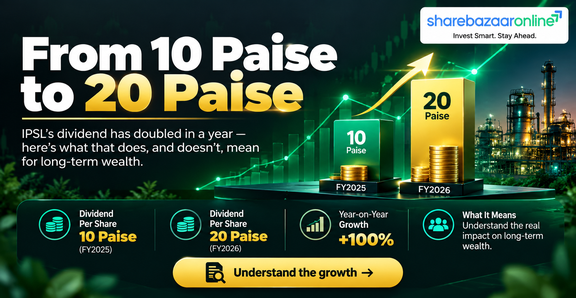
Integrated Personnel Services Limited (NSE: IPSL) has declared a Final Dividend of 20 paise per equity share for FY2025–26, described in the filing as 2% on the face value of ₹10. That “2%” headline is calculated on face value, not market price. On the market price of roughly ₹215, the real dividend yield is just 0.09% — about 21.5 times smaller than the face-value number suggests. The payout is the company’s second dividend ever, doubling last year’s maiden 10 paise. The total cash leaving the company is only about ₹0.20 crore — a symbolic reward rather than a meaningful income stream.
Dividend Per Share
₹0.20
Final, FY2025–26 (2% on ₹10 face value)
Real Dividend Yield (on CMP ~₹215)
0.09%
Not 2% — the 2% is on face value
Record Date
11 Sep 2026
Entitlement cut-off (now passed)
Total Dividend Outflow
~₹0.20 Cr
On ~1.02 crore shares
Company Overview – Integrated Personnel Services Limited
Integrated Personnel Services Limited (IPSL), incorporated in 2004 and headquartered in Mumbai, is a human-resource solutions company offering flexi-staffing, executive search, recruitment process outsourcing and payroll & compliance management across IT and non-IT sectors. It is a small, NSE EMERGE SME-platform listed company (symbol IPSL), with a shareholder-approved process underway to migrate to the NSE and BSE main boards. In FY2025 (consolidated) it reported revenue of about ₹316 crore and net profit near ₹7 crore, giving a thin net margin typical of staffing businesses. Operating margins hover around 4%, with earnings driven by volume rather than pricing power. In May 2026 it completed an acquisition (ICTPL), expanding its share base. The stock carries a market capitalisation of roughly ₹220 crore.
Integrated Personnel Services Limited Financial Analysis
IPSL’s consolidated financials show healthy top-line momentum: revenue grew from ₹198 Cr (FY23) to ₹246 Cr (FY24) to ₹316 Cr (FY25), a roughly 28.5% jump in FY25. Net profit rose from about ₹5 Cr to ₹7 Cr (+40%) over the same year, with EPS near ₹8.2. Return ratios are moderate — ROE and ROCE both around 15%. The weak spot sits below the profit line: despite rising reported profits, operating cash flow has been negative in the two most recent years, and borrowings have climbed. For a staffing firm this reflects heavy working-capital needs (receivables fund client payrolls), but it is the single most important lens for judging dividend capacity.
Revenue FY25 (Consolidated)
₹316 Cr
Net Profit FY25
~₹7 Cr
ROE / ROCE
~15% / ~15%
Operating Margin
~4%
Integrated Personnel Services Limited Dividend History
IPSL’s dividend record is short — it began paying only in FY2024–25. The table below shows the full disclosed history.
| Financial Year | Dividend Type | Dividend Per Share | % on Face Value | Record/Ex Date |
|---|---|---|---|---|
| FY2025–26 | Final | ₹0.20 | 2% | 11 Sep 2026 |
| FY2024–25 | Final (maiden) | ₹0.10 | 1% | 23 Sep 2025 |
| FY2020 to FY2024 | None | ₹0.00 | — | — |
Dividend amounts and dates per NSE corporate filings and market dividend records. Pre-FY25 years: no dividend declared.
Expert Commentary on Integrated Personnel Services Limited Dividend
The honest read on this dividend is that it is a signal, not an income source. Doubling the payout from 10 to 20 paise sounds like 100% growth, but in rupee terms it is a move from a near-nothing cheque to a slightly-larger near-nothing cheque — roughly ₹0.20 crore across all shareholders. What makes the gesture notable is the context: IPSL distributes cash while its operating cash flow is negative and borrowings are rising. For a young, SME-listed company migrating to the main board, a token dividend can serve a reputational purpose — demonstrating a shareholder-return culture to prospective main-board investors. Readers should treat the 2% label with care; the real yield is about 0.09%, which is immaterial to total returns. The investment case, if any, rests on earnings growth, not on this dividend.
Integrated Personnel Services Limited Dividend Outlook
The company has not disclosed any formal dividend policy or future payout guidance, so any forward view is an inference from the pattern, not a company commitment. Two data points exist: a maiden 10 paise for FY25 and 20 paise for FY26. If the trend of token-but-rising dividends continues, future payouts are likely to stay small relative to the share price — the business reinvests heavily in working capital to fund growth. A proposed migration from the SME platform to the NSE/BSE main boards is underway and may change the investor base and disclosure cadence. Whether dividends scale up will depend on the company converting reported profit into actual operating cash — the current gap is the main constraint. Future corporate actions are not disclosed and should not be assumed.
Integrated Personnel Services Limited Dividend Announcement Summary
The Board of Directors, at its meeting on 24 August 2026, recommended a Final Dividend of 20 paise (2%) per equity share of ₹10 face value for the financial year ended 31 March 2026, subject to shareholder approval at the 23rd Annual General Meeting. A corrigendum filed on 9 September 2026 clarified the exact wording of the Board resolution; the dividend amount itself was unchanged. Under SEBI (LODR) Regulation 42, the company fixed Friday, 11 September 2026 as the record date to determine shareholders entitled to the dividend. Payment, subject to tax deduction at source, follows AGM approval. As a recommended final dividend, it required shareholder ratification before becoming payable.
Integrated Personnel Services Limited Key Dates Timeline
Board Meeting / Announcement
24 August 2026
Corrigendum Filed
9 September 2026
Ex-Dividend Date
11 September 2026
Inferred alongside record date (T+1 settlement); confirm against NSE circular
Record Date
11 September 2026
AGM (Approval)
23rd AGM
Exact date Not Disclosed by Company in this filing
Payment Date
Post-AGM
Specific date Not Disclosed by Company in this filing
Integrated Personnel Services Limited Dividend Yield Analysis
This is where the headline misleads most. The filing calls the dividend 2% — but that is 2% of the ₹10 face value, equal to just 20 paise. Investors buy at the market price (~₹215), not face value. The dividend yield that actually matters is:
Face-Value “Yield” (headline)
2.00%
Misleading — based on ₹10, not market price
Real Yield (on CMP ~₹215)
0.09%
₹0.20 ÷ ₹215
At the announcement-date price of about ₹216, the yield was essentially identical at 0.09%. In plain terms: the face-value number overstates the real cash return by roughly 21.5 times. A ₹1 lakh investment earns about ₹93 in dividend for the year.
Integrated Personnel Services Limited Dividend History Analysis
With only two payouts on record, IPSL is best classified as an Irregular / Early-stage Payer rather than a consistent dividend company. For FY2020 through FY2024 the dividend payout ratio was 0% — the firm retained all earnings to fund growth and working capital. The maiden dividend arrived in FY2025 (10 paise) and was doubled to 20 paise in FY2026. There have been no special dividends, no dividend cuts and no suspensions, simply because there was no prior history to cut from. The trajectory is rising but from a near-zero base. Investors seeking dependable dividend income should note that two years of token payouts do not yet establish a reliable pattern, and there is no disclosed policy guaranteeing continuation.
Integrated Personnel Services Limited Financial Performance Analysis
Operating leverage tells a mixed story. In FY2025, revenue grew ~28.5% (₹246 Cr to ₹316 Cr) and PAT grew faster at ~40% (₹5 Cr to ₹7 Cr), which is positive. However, EBITDA grew more slowly at ~18% (₹11 Cr to ₹13 Cr), meaning operating margin actually compressed to about 4%. The faster PAT growth was helped by a very low effective tax rate — a point external data sources flag as a watch item, since it may not persist. In a staffing business, margins are structurally thin because labour pass-through costs dominate revenue. The quality takeaway: growth is real, but profitability is fragile and partly tax-aided, so headline PAT growth should not be read as margin strength.
Integrated Personnel Services Limited Cash Flow Analysis
Reported profit is an opinion; cash is a fact — and here the two diverge sharply. Despite positive PAT, IPSL’s operating cash flow was negative in both FY2024 (~₹-2 Cr) and FY2025 (~₹-6 Cr). Free cash flow was therefore also negative. The cause is working capital: debtor days run around 87 days, so as revenue grows, more cash is locked into receivables that fund associates’ payrolls before clients pay. The practical implication for this dividend is important — the payout is not being funded from current operating cash. With negative OCF and rising borrowings, the ~₹0.20 crore distribution is effectively supported by financing (debt/equity raised), not by cash the business generated. The amount is tiny, so it is affordable, but the funding source is a genuine quality flag.
Integrated Personnel Services Limited Balance Sheet Strength
The balance sheet is modest and carries debt. Reserves stood near ₹48 Cr (Mar 2025) on equity capital of about ₹9 Cr, since expanded to roughly ₹10.2 Cr after the May 2026 share allotment. Borrowings rose to around ₹35 Cr (Mar 2025) and higher by Sep 2025 (~₹46 Cr), giving a debt-to-equity near 0.7–0.8x — meaningful for a company this size. Cash and investments are small, consistent with a working-capital-intensive model. Book value per share is roughly ₹70–80. The key balance-sheet tension: debt is climbing at the same time dividends have started, which is an unusual combination and worth monitoring as the dividend scales.
Integrated Personnel Services Limited Dividend Sustainability
Running the four-test scorecard on this ₹0.20 crore payout:
Earnings Coverage
Pass (41x)
EPS ₹8.2 vs DPS ₹0.20; payout only ~3% of PAT
Operating Cash Flow Coverage
Fail
OCF negative in FY24 and FY25
Free Cash Flow Coverage
Fail
FCF negative
Liquidity / Size Coverage
Pass
Amount tiny vs reserves of ~₹48 Cr
Verdict: Moderately Sustainable. The dividend is trivially small versus earnings and reserves, so affordability is not in question. But it fails both cash-flow tests — it is paid despite the business not generating positive operating cash. Sustainability at this token level is fine; scaling the dividend meaningfully would require fixing the cash-conversion gap.
Integrated Personnel Services Limited Peer Comparison
Among listed Indian staffing peers, dividend behaviour splits sharply. IPSL’s token yield sits between the non-payers and the sector’s dividend leader.
| Company | Approx. Dividend Yield | Dividend Payout | Profile |
|---|---|---|---|
| IPSL | ~0.09% | ~3% | Small-cap SME, early payer |
| Quess Corp | ~2.6–4.4% | High (40%+) | Sector dividend leader |
| SIS Limited | ~0% | 0% | No dividend |
| TeamLease | ~0% | 0% | No dividend |
Peer yields and payout ratios sourced from public market data (Screener.in, exchange filings); figures move with price.
Integrated Personnel Services Limited Promoter Impact Analysis
The promoter group held about 64.42% of IPSL as of the June 2026 shareholding pattern (down from 67.12% at March 2026, reflecting dilution from the May 2026 acquisition-linked allotment). Of the roughly ₹0.20 crore total dividend, the promoter group receives approximately ₹13.2 lakh, while all public and minority shareholders together receive about ₹7.3 lakh. Because the amounts are small, the distribution impact is modest for everyone. For minority investors, the practical benefit is negligible in cash terms — the dividend functions as a governance signal rather than a payout that moves the needle. There is no evidence of the dividend being structured to disproportionately favour promoters; it is proportionate to holdings, as all equity dividends are.
Integrated Personnel Services Limited Dividend Taxation Analysis
Since FY2020–21, dividends in India are taxed in the hands of shareholders at their applicable income-tax slab rate (the company no longer pays Dividend Distribution Tax). TDS applies at 10% only if a resident shareholder’s total dividend from a company exceeds ₹10,000 in a financial year; below that threshold, no TDS is deducted. Given IPSL’s 20 paise dividend, a retail holder would need over 50,000 shares to cross the TDS threshold from this payout.
Worked Example — 1,000 shares, 30% tax slab
Gross dividend: 1,000 × ₹0.20 = ₹200
TDS: ₹0 (below ₹10,000 threshold)
Tax at 30% slab: ₹60
Net in hand: ₹140
Effective post-tax yield (on CMP ~₹215): ~0.065%
General information only, not tax advice. Tax treatment depends on individual circumstances; consult a qualified advisor.
Integrated Personnel Services Limited Key Risks
- Negative operating cash flow: profits are not converting to cash; receivables around 87 days tie up working capital as the business grows.
- Rising debt: borrowings have increased to roughly ₹35–46 Cr, giving debt-to-equity near 0.7–0.8x — the dividend is paid while leverage climbs.
- Thin, compressing margins: operating margin around 4% leaves little buffer; staffing is a low-margin, competition-heavy business.
- Low tax rate benefit: faster PAT growth is partly tax-aided; a normalised tax rate would reduce reported profit.
- SME-scale liquidity: low trading volumes and a 52-week range of roughly ₹172–₹385 indicate high price volatility.
- Immaterial dividend: at ~0.09% real yield, the dividend offers no meaningful income cushion against price swings.
What To Monitor in Integrated Personnel Services Limited
- Operating cash flow trend: whether OCF turns positive — the single most important signal for genuine dividend capacity.
- Debtor days: any improvement from ~87 days would free up cash and ease borrowing needs.
- Debt trajectory: whether borrowings stabilise or keep rising as revenue grows.
- Main-board migration: progress on the proposed move from NSE EMERGE SME to the NSE/BSE main boards, which could shift the investor base.
- Effective tax rate: whether the low tax rate normalises, which would compress reported PAT.
- Dividend policy: any formal payout policy or guidance the company may disclose in future.
Should You Consider Integrated Personnel Services Limited for Dividend Income? — Conclusion
As a dividend play, IPSL does not qualify. The “2%” headline is a face-value figure; the real yield is about 0.09%, and the total payout is roughly ₹0.20 crore. The positives are a growing top line (revenue up ~28.5% in FY25), a rising — if tiny — dividend (doubled to 20 paise), and comfortable earnings coverage. The negatives are material: negative operating and free cash flow, rising debt, thin margins and a tax-aided profit line. The dividend is best understood as a governance signal ahead of a possible main-board migration, not an income source. Investors interested in IPSL should evaluate it on growth and cash-conversion improvement, weighing the positives against the risks and monitoring points above, and reach their own decision.
Frequently Asked Questions About Integrated Personnel Services Limited Dividend
What dividend has Integrated Personnel Services Limited announced?
What is the dividend yield on IPSL?
What is the record date for the IPSL dividend?
What is the ex-date for the IPSL dividend?
When will the IPSL dividend be paid?
Who was eligible for the IPSL dividend?
How is the IPSL dividend taxed?
Is the IPSL dividend sustainable?
What is IPSL’s dividend history?
What should investors monitor in IPSL?
How much is IPSL’s total dividend outflow?
Why does IPSL pay such a small dividend?
Disclaimer
This article is for informational and educational purposes only and does not constitute investment, financial, legal or tax advice. ShareBazaar Online is not a SEBI-registered investment adviser. It is not a recommendation to buy, sell or hold any security. Dividend figures, dates and financial data are based on publicly available company filings and third-party market sources believed to be reliable but not independently guaranteed; figures such as market price, yield and shareholding change over time and should be verified against official NSE/BSE filings and the company’s disclosures before any decision. Tax treatment depends on individual circumstances. Investments in securities are subject to market risks; please consult a qualified professional and read all related documents carefully before investing.