
Dividend Snapshot – Emerald Tyre Manufacturers Limited
Company Details
| Company | Emerald Tyre Manufacturers Limited |
| NSE Symbol | ETML (NSE Emerge) |
| ISIN | INE0RHD01013 |
| Face Value | ₹10 |
| Market Cap | ~₹157.79 Cr |
Dividend Details
| Dividend Type | Final Dividend |
| Dividend Per Share | ₹1.00 |
| Dividend % | 10% (on FV ₹10) |
| Financial Year | FY2025-26 |
| Dividend Yield | ~1.23% |
Key Dates
Announcement
27 Aug 2026
Ex-Date
16 Sep 2026*
Record Date
17 Sep 2026
AGM Date
24 Sep 2026
*Ex-date inferred as T-1 trading day before record date under T+1 settlement. Not officially confirmed by the company.
Editorial Note: The headline "10% dividend" sounds attractive — but that percentage is calculated on the ₹10 face value, not the market price. At a CMP of ~₹81, the actual dividend yield is only ~1.23%. Investors should always evaluate dividend yield based on the current market price, not face value.
Emerald Tyre Manufacturers Limited – Company Overview
Emerald Tyre Manufacturers Limited (formerly Emerald Resilient Tyre Manufacturers Private Limited) is a Chennai-based micro-cap tyre manufacturer listed on the NSE Emerge (SME) platform. The company manufactures automotive tyres at its facility in Tamil Nadu and caters primarily to the domestic replacement market. ETML operates under the leadership of CMD Mr. Chandhrasekharan Thirupathi Venkatachalam, who is also the promoter. The company reported consolidated revenue of ₹218.16 Cr in FY2025-26, reflecting a 9.37% year-on-year growth. With a market capitalisation of approximately ₹157.79 Cr and total shares outstanding of 1.948 Cr, ETML remains a small-scale player in India's competitive tyre industry dominated by Apollo Tyres, MRF, CEAT, and JK Tyre. Promoters hold approximately 50.36% of the company, with zero institutional holding reported.
Emerald Tyre Manufacturers Limited – Financial Analysis
Profitability Metrics (FY2026 Consolidated)
| Revenue | ₹218.16 Cr (+9.37% YoY) |
| EBITDA | ₹28.83 Cr |
| EBITDA Margin | 13.22% |
| PAT | ₹10.33 Cr (-0.96% YoY) |
| EPS | ₹5.30 |
| ROE | ~8.6% |
| ROCE | ~10.2% |
Balance Sheet Highlights
| Total Debt | ₹135.70 Cr |
| Debt-to-Equity | 1.13x |
| Cash & Investments | ₹10.55 Cr |
| Net Debt | ₹125.15 Cr |
| Interest Coverage | 2.01x |
| Shares Outstanding | 1.948 Cr |
ETML's revenue grew 9.37% in FY2026 but PAT declined marginally by 0.96%, indicating operating leverage pressure. Higher interest costs (₹14.33 Cr) and depreciation absorbed most of the revenue gains. The debt-to-equity ratio at 1.13x is elevated for a company of this scale, and interest coverage at just 2.01x leaves limited financial flexibility. While ROE of ~8.6% is modest, the company remains profitable and continues its dividend track record.
Emerald Tyre Manufacturers Limited – Dividend History
| Financial Year | Dividend Type | DPS (₹) | Dividend % |
|---|---|---|---|
| FY2025-26 | Final | 1.00 | 10% |
| FY2024-25 | Final | 1.00 | 10% |
| FY2023-24 | Final | 1.00 | 10% |
| FY2022-23 | Final | 1.00 | 10% |
| FY2021-22 | — | Nil | — |
| FY2020-21 | — | Nil | — |
| FY2019-20 | — | Nil | — |
Source: BSE filings, Screener.in. Earlier years data sourced from exchange filings.
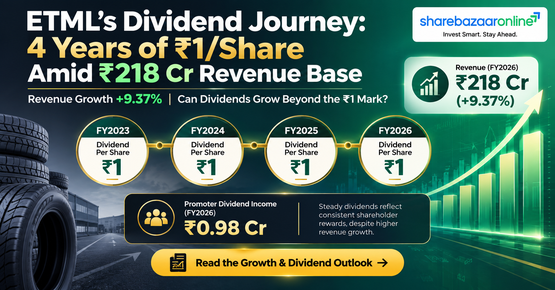
Classification: Cyclical Payer. ETML paid no dividends during FY2019-20 to FY2021-22, likely due to the pandemic-era stress on the tyre sector. Dividends resumed from FY2022-23 at a consistent ₹1/share (10% on face value) and have been maintained for four consecutive years. The flat DPS despite revenue growth suggests management prioritises capital preservation. Investors should note the dividend was suspended for three years, making ETML a cyclical rather than consistent dividend payer.
Emerald Tyre Manufacturers Limited – Expert Commentary
ETML's ₹1/share final dividend for FY2026 continues the company's post-pandemic dividend restoration that began in FY2023. The 18.86% payout ratio is conservative, retaining over 80% of earnings for business needs — a reasonable approach for a leveraged micro-cap manufacturer. However, the negative free cash flow (-₹30.43 Cr) is concerning: the company is funding both its capex programme and dividends while carrying ₹135.70 Cr in debt. The ₹1.95 Cr dividend outflow is small relative to revenue but should be viewed against the company's thin cash reserves of just ₹10.55 Cr. Management appears to be signalling confidence in future cash flows, but minority shareholders should watch whether debt continues rising alongside dividend payouts.
Emerald Tyre Manufacturers Limited – Future Outlook
ETML's dividend sustainability hinges on its ability to convert revenue growth into positive free cash flow. The company's FY2026 capex of ₹51 Cr (implied from the OCF-FCF gap) signals capacity expansion, which could drive future revenue and profits. If this investment translates into improved margins and cash generation in FY2027-28, the ₹1/share dividend should remain sustainable. However, with debt-to-equity at 1.13x and interest costs consuming a significant share of EBITDA, any downturn in tyre demand or raw material price spikes could pressure the company to suspend dividends again — as it did during FY2020-22. The domestic tyre replacement market is growing, which provides a tailwind, but ETML's micro-cap scale and SME listing limit its pricing power and access to capital.
Emerald Tyre Manufacturers Limited – Dividend Announcement Summary
The Board of Directors of Emerald Tyre Manufacturers Limited recommended a final dividend of ₹1.00 per equity share (10% on face value of ₹10) for the financial year ended March 31, 2026. The dividend recommendation was made at the board meeting held on May 25, 2026 and announced to the exchanges on August 27, 2026 alongside the notice of the 24th Annual General Meeting. The AGM was scheduled for September 24, 2026 via video conferencing, where shareholder approval was sought. The record date for determining eligible shareholders was fixed as September 17, 2026, with book closure from September 18–24, 2026. The total dividend outflow for FY2026 is approximately ₹1.95 Cr on 1.948 Cr outstanding equity shares.
Emerald Tyre Manufacturers Limited – Key Dates Timeline
Board Recommendation
25 May 2026
Dividend recommended
Exchange Announcement
27 Aug 2026
AGM notice filed
Ex-Dividend Date
16 Sep 2026*
Inferred (T-1)
Record Date
17 Sep 2026
Eligibility cutoff
Book Closure
18–24 Sep 2026
Register closed
AGM Approval
24 Sep 2026
24th AGM via VC
*Ex-date is inferred as one trading day before the record date under India's T+1 settlement cycle. Payment date is not disclosed by the company.
Emerald Tyre Manufacturers Limited – Dividend Yield Analysis
Yield Computation
| DPS | ₹1.00 |
| CMP on Announcement Date (27 Aug) | ~₹82.00 |
| Announcement Date Yield | 1.22% |
| Latest CMP | ~₹81.00 |
| Current Yield | 1.23% |
Yield Reality Check
The "10% dividend" headline refers to face value (₹10), not market price. At a CMP of ~₹81, the real dividend yield is only 1.23% — below bank fixed deposit rates of 6–7% and below the tyre sector average yield. The yield is not elevated due to a falling share price; ETML's stock has been relatively range-bound. The low yield is simply a function of a small ₹1 DPS against a ₹81 market price. This is a token dividend, not an income-generating one. Investors seeking meaningful dividend income should compare this yield against alternatives.
Emerald Tyre Manufacturers Limited – Dividend History Analysis
Over the last seven financial years, ETML paid dividends in only four years (FY2023 to FY2026), with no payout during FY2020–FY2022. The DPS has remained flat at ₹1.00/share across all four paying years, reflecting a zero growth trajectory. This pattern classifies ETML as a cyclical payer — dividends are paid when conditions allow, but there is no visible commitment to progressive increases. No special dividends or interim dividends have been declared. The three-year suspension during COVID/post-COVID confirms that dividends are discretionary and can be cut when the business is under pressure. Investors should not rely on ETML for consistent or growing dividend income.
Emerald Tyre Manufacturers Limited – Financial Performance Analysis
Operating Leverage Assessment
Revenue grew 9.37% in FY2026, but PAT declined by 0.96% — a classic case of negative operating leverage. The gap indicates that cost growth outpaced revenue growth. Interest expenses of ₹14.33 Cr on ₹135.70 Cr of debt consumed a significant portion of operating profit. Depreciation at ₹8.05 Cr added further pressure. EBITDA of ₹28.83 Cr translates to a 13.22% margin, which is acceptable for a small-scale tyre manufacturer but below larger peers like Apollo Tyres (~14-15%) and MRF (~16%). The revenue-to-profit disconnect signals that scale benefits are being offset by financing costs, suggesting the company's growth is being funded by debt rather than internal accruals.
Emerald Tyre Manufacturers Limited – Cash Flow Analysis
Cash Flow Metrics (FY2026)
| Operating Cash Flow | ₹20.57 Cr |
| Capex | ~₹51.00 Cr |
| Free Cash Flow | -₹30.43 Cr |
| PAT | ₹10.33 Cr |
| OCF / PAT Ratio | 1.99x |
| FCF Coverage of Dividend | Negative |
Dividend Funding Source
The OCF-to-PAT ratio of 1.99x is healthy — the company is generating real cash from operations, not just accounting profit. However, heavy capex of ~₹51 Cr resulted in negative free cash flow of -₹30.43 Cr. This means the ₹1.95 Cr dividend is not funded by free cash flow. The dividend is effectively being paid from borrowings or existing cash reserves. With cash reserves at only ₹10.55 Cr, the company's capacity to sustain dividends depends on capex moderating in future years and operating cash flows increasing.
Caution: Negative FCF combined with rising debt means the dividend is not self-funded. Investors should monitor whether FY2027 capex reduces and whether OCF improves to cover both capex and dividends.
Emerald Tyre Manufacturers Limited – Balance Sheet Strength
ETML's balance sheet carries ₹135.70 Cr in total debt against equity of ~₹120 Cr, producing a debt-to-equity ratio of 1.13x — elevated by industry standards. Net debt stands at ₹125.15 Cr after adjusting for ₹10.55 Cr in cash. The interest coverage ratio of 2.01x provides a thin buffer — in a stress scenario (raw material spike or demand slowdown), interest obligations could squeeze profits. Cash and investments of ₹10.55 Cr provide 5.41x coverage of the ₹1.95 Cr dividend outflow, indicating the current dividend is affordable from existing cash. However, the company's overall financial leverage limits its ability to increase dividends or absorb unexpected shocks without impacting shareholder returns.
Emerald Tyre Manufacturers Limited – Dividend Sustainability Analysis
Four-Test Sustainability Scorecard
| Test | Metric | Result | Verdict |
|---|---|---|---|
| Earnings Coverage | Payout Ratio 18.86% | EPS ₹5.30 vs DPS ₹1.00 | ✓ Pass |
| OCF Coverage | OCF ₹20.57 Cr | 10.55x dividend | ✓ Pass |
| FCF Coverage | FCF -₹30.43 Cr | Negative coverage | ✗ Fail |
| Liquidity Coverage | Cash ₹10.55 Cr | 5.41x dividend | ✓ Pass |
Overall Rating: Moderately Sustainable. Three of four tests pass. The ₹1/share dividend is well-covered by earnings and operating cash flows, but negative FCF means the dividend is technically unfunded after capex. Sustainability depends on capex normalisation in coming years.
Capital Allocation Assessment
The ₹1.95 Cr dividend outflow is modest against ₹218 Cr revenue. Management could have alternatively used this cash to reduce debt by ₹1.95 Cr (saving ~₹0.28 Cr in annual interest at 14% cost of borrowing) or retained it as additional working capital buffer. Given the company's leverage, prioritising debt reduction over dividends could be more value-accretive for shareholders. However, the token dividend signals management confidence and maintains shareholder engagement — particularly important for an SME-listed micro-cap company.
Emerald Tyre Manufacturers Limited – Peer Comparison
| Company | Dividend Yield | Payout Ratio | ROE | D/E |
|---|---|---|---|---|
| ETML | 1.23% | 18.86% | ~8.6% | 1.13x |
| Apollo Tyres | ~0.7% | ~12% | ~14% | ~0.3x |
| CEAT | ~0.8% | ~15% | ~12% | ~0.4x |
| JK Tyre | ~1.2% | ~10% | ~18% | ~0.6x |
| MRF | ~0.1% | ~3% | ~15% | ~0.1x |
Source: Screener.in, StockAnalysis. Peer data approximate based on latest available reports.
ETML's 1.23% yield is comparable to JK Tyre's ~1.2% and higher than Apollo Tyres and CEAT. However, ETML's debt-to-equity of 1.13x is significantly higher than all listed peers, whose leverage typically ranges from 0.1x to 0.6x. ETML's ROE at ~8.6% trails all major tyre companies. The higher yield is partly a function of ETML's lower market capitalisation and stock price, not superior cash distribution. Investors should weigh the yield premium against the substantially higher financial risk and lower return on equity compared to established players.
Emerald Tyre Manufacturers Limited – Promoter Impact Analysis
Promoter Dividend Benefit
| Promoter Holding | 50.36% |
| Total Dividend Outflow | ₹1.95 Cr |
| Promoter Dividend Income | ~₹0.98 Cr |
| Minority Share of Dividend | ~₹0.97 Cr |
Distribution Analysis
With promoter holding at 50.36%, the promoter group (led by CMD Mr. Chandhrasekharan) receives approximately ₹0.98 Cr of the ₹1.95 Cr total dividend — roughly half of the outflow. Given zero institutional holding (FII and DII both nil), the remaining ~₹0.97 Cr flows entirely to retail and non-institutional shareholders. The near-equal split between promoters and public shareholders is proportionate to their holdings. However, investors should note that with no institutional oversight, corporate governance scrutiny relies primarily on regulatory compliance and auditor observations.
Emerald Tyre Manufacturers Limited – Dividend Taxation Analysis
Indian Dividend Tax Rules
Under current Indian tax law, dividends are taxed as "Income from Other Sources" in the hands of the shareholder at their applicable income tax slab rate. The company deducts TDS at 10% if total dividend from a company exceeds ₹5,000 in a financial year. No TDS is deducted if the investor submits Form 15G/15H (for income below taxable threshold). Shareholders can claim a deduction under Section 57 for interest expense up to 20% of dividend income if borrowings were used to acquire shares.
Tax Worked Example — ETML Dividend FY2026
| Shares Held | 1,000 shares |
| DPS | ₹1.00 |
| Gross Dividend | ₹1,000 |
| Tax Slab (assumed) | 30% |
| Income Tax (30%) | ₹300 |
| Health & Education Cess (4%) | ₹12 |
| Total Tax | ₹312 |
| Net Dividend (Post-Tax) | ₹688 |
| Effective Post-Tax Yield | 0.85% |
Note: TDS at 10% would be deducted if total dividend from ETML exceeds ₹5,000 in FY. TDS is adjustable against final tax liability while filing ITR. Surcharge may apply for higher income brackets.
Emerald Tyre Manufacturers Limited – Key Risks
Negative Free Cash Flow: FCF of -₹30.43 Cr means the dividend is funded through borrowings or cash drawdown, not from organic cash generation. Continued negative FCF could force a dividend suspension.
High Leverage: Debt-to-equity at 1.13x with interest coverage of just 2.01x leaves minimal room for error. A sustained downturn in demand or spike in interest rates could make both debt servicing and dividends unsustainable simultaneously.
Raw Material Risk: Natural rubber and crude oil derivatives are key inputs. Price spikes in these commodities directly compress ETML's margins, as a micro-cap lacks the pricing power of larger peers to pass costs through quickly.
SME Liquidity Risk: ETML is listed on the NSE Emerge (SME) platform with very low trading volumes. Investors may face significant difficulty exiting positions, and the stock is susceptible to sharp price movements on small volumes.
Zero Institutional Holding: No FII or DII participation means limited external scrutiny of management decisions and corporate governance. Institutional investors typically bring governance accountability that is absent here.
Competitive Pressure: The Indian tyre market is dominated by well-capitalised players (MRF, Apollo, CEAT, JK Tyre) with strong brand recall, distribution networks, and economies of scale that ETML cannot match.
Concentration Risk: ETML's operations are concentrated in a single manufacturing facility in Tamil Nadu, exposing it to regional disruptions (floods, labour issues, power supply) without backup capacity.
Emerald Tyre Manufacturers Limited – What To Monitor
FY2027 Free Cash Flow: Whether capex normalises and FCF turns positive. This is the single most important factor for dividend sustainability.
Debt Trajectory: Whether total debt reduces from ₹135.70 Cr or continues rising. Declining debt would signal improving financial health and sustainable dividends.
EBITDA Margin Trend: Whether margins expand from the current 13.22% as the capex investment translates into higher volumes and better operating leverage.
Promoter Holding Changes: Any dilution or pledging of the 50.36% promoter stake could signal financial stress or weakening commitment.
Mainboard Migration: Whether ETML progresses towards mainboard listing from NSE Emerge, which would improve liquidity, institutional interest, and governance standards.
Raw Material Costs: Natural rubber and crude oil price movements directly impact tyre manufacturing margins and ETML's ability to maintain profitability.
Quarterly Revenue Growth: Whether the 9.37% revenue growth accelerates or decelerates, signalling the trajectory of the capacity expansion programme.
Emerald Tyre Manufacturers Limited – Conclusion
Emerald Tyre Manufacturers Limited's ₹1/share final dividend for FY2026 continues the company's four-year post-pandemic payout streak, but the investment case requires careful evaluation. The 1.23% yield is modest and well below fixed deposit rates. The 18.86% payout ratio is conservative, but the negative free cash flow (-₹30.43 Cr) and rising debt (D/E 1.13x) raise sustainability questions. The company's strengths include healthy operating cash flow (₹20.57 Cr), moderate payout ratio, and four-year dividend consistency. The weaknesses include micro-cap liquidity constraints, zero institutional backing, heavy leverage, and dependence on capex returns materialising. Investors should evaluate ETML's dividend as a token distribution from a small growth-stage manufacturer rather than a reliable income source. The face-value headline of "10% dividend" masks a sub-1% post-tax effective yield.
Frequently Asked Questions About Emerald Tyre Manufacturers Limited Dividend
What dividend has Emerald Tyre Manufacturers Limited announced for FY2026?
What is the dividend yield of ETML stock?
What is the record date for ETML's FY2026 dividend?
What was the ex-dividend date for ETML?
When will ETML's dividend be paid?
Who was eligible for ETML's FY2026 dividend?
How is ETML's dividend taxed in India?
Is ETML's dividend sustainable?
What is ETML's dividend history over the last 7 years?
What should investors monitor about ETML going forward?
How does ETML's dividend compare with other tyre companies?
What does "10% dividend" actually mean for ETML shareholders?
Disclaimer
This article is published by ShareBazaar Online for educational and informational purposes only. It does not constitute investment advice, a stock recommendation, or a solicitation to buy, sell, or hold any security. The information presented here is based on publicly available data from BSE/NSE filings, company annual reports, Screener.in, StockAnalysis.com, and other public sources. While every effort has been made to ensure accuracy, ShareBazaar Online does not guarantee the completeness or reliability of any data, computation, or analysis presented. Financial data, calculations, and peer comparisons may contain approximations. Keyword search volume data referenced in this article's SEO package could not be independently verified through Google Keyword Planner, Ahrefs, or Semrush API tools and is marked "Not Independently Verified" (NIV) where applicable. Investors should conduct their own due diligence and consult a SEBI-registered financial advisor before making any investment decisions. Past dividend payments do not guarantee future dividends. Equity investments carry market risk. ShareBazaar Online, its authors, and affiliates do not hold any position in the securities discussed and have no financial relationship with the company. All brand names, logos, and trademarks referenced belong to their respective owners.