
Dividend Snapshot – M.K. Exim (India) Limited
Company Identification
| Company | M.K. Exim (India) Limited |
| NSE Symbol | MKEXIM |
| BSE Code | 538890 |
| ISIN | INE227F01010 |
| Sector | Integrated Textiles / Consumer Discretionary |
Dividend Details
| Dividend Type | Final Dividend (FY2025–26) |
| Dividend Per Share | ₹0.60 |
| Dividend % (on FV ₹10) | 6% |
| Current Dividend Yield | 0.88% |
| Total Outflow | ₹2.42 Crore |
⚠️ Face Value Illusion: The headline “6% dividend” is calculated on a face value of ₹10. At the current market price of ₹68.10, the actual dividend yield is just 0.88% — a 6.8x gap between the headline and reality. Investors paying market price receive ₹0.60 on a ₹68.10 investment.
M.K. Exim (India) Limited – Company Overview
M.K. Exim (India) Limited is a small-cap integrated textiles company engaged in the manufacturing, trading, and export of textile products. Headquartered in India, the company operates across the textile value chain, dealing in fabrics, yarns, and finished textile goods. With a market capitalisation of approximately ₹275 Crore and a share price of ₹68.10, the company trades at a P/E ratio of 14.6x. The company completed a 3:2 stock split in January 2024, reducing the face value implication but expanding the share base to 4.036 Crore shares. Despite its small size, MK Exim has delivered a net profit margin of approximately 19.5% in FY26, indicating efficient operations relative to its scale.
M.K. Exim (India) Limited – Financial Analysis
Profitability Metrics
| Revenue (FY26) | ₹97 Crore |
| PAT (FY26) | ₹19 Crore |
| EPS (FY26) | ₹4.65 |
| Net Margin | ~19.6% |
| ROE | 16.0% |
| ROCE | 15.7% |
Growth Metrics
| Revenue CAGR (FY22–26) | 9.7% |
| PAT CAGR (FY22–26) | 20.5% |
| Revenue YoY (FY26) | -10.2% |
| PAT YoY (FY26) | +18.8% |
| P/E Ratio | 14.6x |
Operating Leverage Signal: Revenue declined 10.2% in FY26, yet PAT grew 18.8%. This suggests improved margins, likely from better product mix, lower raw material costs, or reduced operating expenses. However, this divergence warrants scrutiny — margin expansion during revenue contraction is not always sustainable.
M.K. Exim (India) Limited – Dividend History
Historical DPS restated under Ind AS 33 for 3:2 stock split (January 2024). Pre-split DPS divided by 1.5.
| Financial Year | Type | DPS (₹) | Note |
|---|---|---|---|
| FY2016 | Final | 0.11 | Restated (pre-split: ₹0.17) |
| FY2017–FY2023 | — | Nil | No dividend declared for 7 years |
| FY2024 | Final | 0.50 | Post-split, resumed after 7-year gap |
| FY2025 | — | Nil | No dividend despite ₹16 Cr PAT |
| FY2026 | Final | 0.60 | Current dividend (+20% vs FY24) |
Classification: Irregular Payer. M.K. Exim has paid dividends only 3 times in the last decade — FY2016, FY2024, and FY2026 — with a 7-year gap between 2016 and 2024, and a skip year in FY2025 despite posting profits. This pattern makes dividend income unreliable for income-focused portfolios.
Expert Commentary – M.K. Exim (India) Limited Dividend
M.K. Exim’s ₹0.60 per share final dividend represents a modest 12.7% payout ratio against FY26 consolidated PAT of ₹19 Crore. The company is clearly prioritising capital retention over distribution — retaining nearly 87% of earnings. For a small-cap textile exporter, this is not unusual; the business requires working capital to manage inventory cycles and trade receivables. The interesting signal is the revenue-profit divergence: revenue fell 10.2% while profits rose 18.8%. This suggests either a deliberate shift toward higher-margin products or a one-time cost benefit that may not recur. The 7-year dividend gap (FY2016–FY2024) and the FY2025 skip year confirm that management views dividends as discretionary, not a commitment. Investors should treat any dividend from MK Exim as a bonus, not a reliable income stream.
M.K. Exim (India) Limited – Future Outlook
The near-term outlook for MK Exim carries mixed signals. While the company’s PAT CAGR of 20.5% over four years and healthy ROE of 16% demonstrate earnings power, the revenue decline of 10.2% in FY26 raises questions about demand sustainability. The sharp working capital deterioration — cash conversion cycle ballooning from 213 to 400 days — suggests either deliberate inventory build-up ahead of expected orders or softening demand leading to stock accumulation. Textile exports face headwinds from global trade uncertainties and currency fluctuations. If the company can maintain its improved margins while stabilising revenue, a similar or slightly higher dividend in FY27 is plausible. However, given the irregular dividend history and small-cap nature, future dividends remain entirely at management’s discretion.
M.K. Exim (India) Limited Dividend Announcement Summary
M.K. Exim (India) Limited announced a final dividend of ₹0.60 per share (6% on face value of ₹10) for the financial year 2025–26. The dividend was approved at the company’s Annual General Meeting held in late August 2026. This is the company’s second consecutive dividend after resuming payouts in FY2024 following a 7-year hiatus. The total dividend outflow stands at approximately ₹2.42 Crore, representing a conservative 12.7% of consolidated net profit. The record date was set for 18 September 2026. As this date has already passed, only shareholders who held shares on the record date were eligible for this dividend.
M.K. Exim (India) Limited – Key Dates Timeline
Announcement Date
~28 August 2026 (AGM)
Ex-Date (Inferred)
17 September 2026
Record Date
18 September 2026
Payment Date
Not Disclosed by Company
Ex-date inferred as record date minus 1 trading day under T+1 settlement. Payment date not disclosed in company filings.
M.K. Exim (India) Limited Dividend Yield Analysis
Yield Metrics
| Dividend Per Share | ₹0.60 |
| Current CMP | ₹68.10 |
| Current Yield | 0.88% |
| Announcement CMP (est.) | ₹64.50 |
| Announcement Yield | 0.93% |
Yield Reality Check
At 0.88%, the dividend yield sits well below the 1-year bank fixed deposit rate (~7%) and even below most savings account rates. The headline “6% dividend” is misleading for market purchasers. The yield is driven by a modest ₹0.60 payout rather than a depressed share price — the stock has appreciated, making the yield optically low. This is not a yield trap; rather, MK Exim is fundamentally a growth play where dividends are incidental, not the investment thesis.
M.K. Exim (India) Limited – Dividend History Analysis
M.K. Exim’s dividend track record is sparse. Over the past decade, the company has paid dividends in only 3 financial years: FY2016 (₹0.11 restated), FY2024 (₹0.50), and FY2026 (₹0.60). The 7-year gap between FY2016 and FY2024 — despite the company being profitable in several of those years — signals that management treats dividends as entirely discretionary. The FY2025 skip, when the company posted ₹16 Crore PAT, reinforces this pattern. The positive signal is the 20% increase from ₹0.50 (FY24) to ₹0.60 (FY26), suggesting an emerging — if inconsistent — willingness to share profits. Classification remains Irregular Payer until the company establishes at least 3–4 consecutive years of dividends.
M.K. Exim (India) Limited – Financial Performance Analysis
| Metric | FY22 | FY23 | FY24 | FY25 | FY26 |
|---|---|---|---|---|---|
| Revenue (₹ Cr) | 67 | 87 | 111 | 108 | 97 |
| PAT (₹ Cr) | 9 | 13 | 21 | 16 | 19 |
| EPS (₹) | — | 3.20 | 5.31 | 3.89 | 4.65 |
| Net Margin (%) | 13.4% | 14.9% | 18.9% | 14.8% | 19.6% |
Source: Screener.in (Consolidated). Revenue peaked in FY24 at ₹111 Crore and has since declined. However, net margins expanded to a five-year high of 19.6% in FY26, supporting profit growth despite the top-line contraction.
M.K. Exim (India) Limited – Cash Flow Analysis
FY26 Cash Flow (₹ Crore)
| Operating Cash Flow | ₹7 Cr |
| Capital Expenditure | ₹3 Cr |
| Free Cash Flow | ₹4 Cr |
| Dividend Outflow | ₹2.42 Cr |
Cash Quality Assessment
OCF of ₹7 Crore against PAT of ₹19 Crore is a red flag. The OCF/PAT ratio of just 37% indicates that a significant portion of reported profits is stuck in working capital. The cash conversion cycle jumped from 213 to 400 days and inventory days ballooned from 149 to 328 days. While the dividend of ₹2.42 Crore is technically covered by FCF (1.7x), the deteriorating cash generation quality requires close monitoring.
⚠️ Forensic Flag: Cash conversion cycle doubled (213 → 400 days). Inventory days more than doubled (149 → 328 days). Reported profits significantly exceed cash generated. This could indicate inventory build-up ahead of orders, or potential demand weakness leading to stock accumulation.
M.K. Exim (India) Limited – Balance Sheet Strength
Balance Sheet Snapshot (₹ Cr)
| Shareholders’ Equity | ₹119 Cr |
| Borrowings | ₹2 Cr |
| Total Assets | ₹126 Cr |
| Cash & Equivalents | ₹5 Cr |
| Net Cash Position | ₹3 Cr (Net Cash) |
Strength Assessment
M.K. Exim operates with a near-zero leverage balance sheet. Borrowings of ₹2 Crore against equity of ₹119 Crore translates to a debt-to-equity ratio of just 0.02x. The company is in a net cash position of ₹3 Crore. This provides ample room for the ₹2.42 Crore dividend payout. The balance sheet is not strained by this distribution, and the company retains significant reserves for operations and growth.
M.K. Exim (India) Limited – Dividend Sustainability Analysis
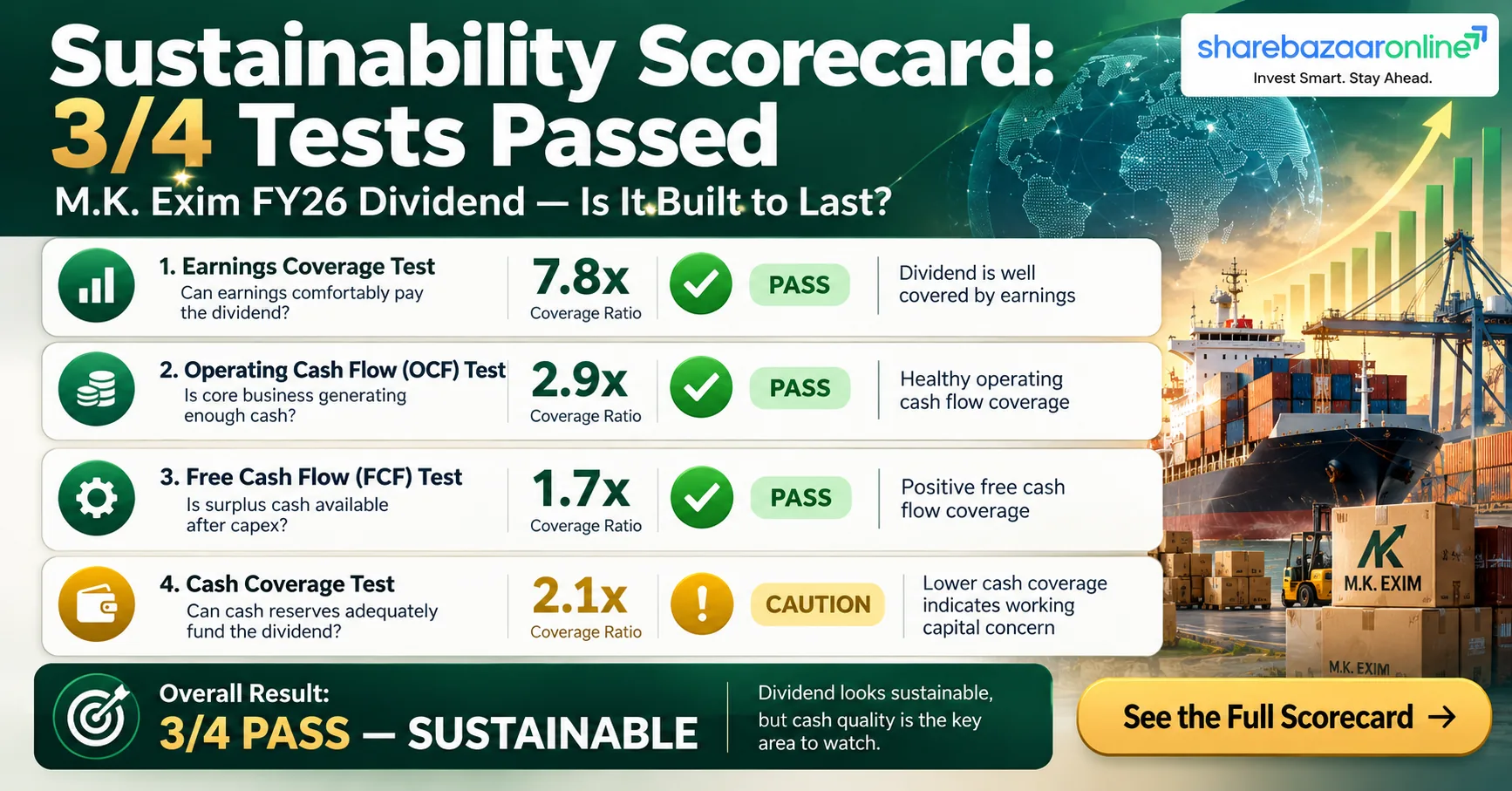
Four-Test Sustainability Scorecard
PAT ₹19 Cr vs Dividend ₹2.42 Cr — comfortably covered
OCF ₹7 Cr vs Dividend ₹2.42 Cr — passes threshold
FCF ₹4 Cr vs Dividend ₹2.42 Cr — adequately covered
Cash ₹5 Cr vs Dividend ₹2.42 Cr — below 3x threshold
Result: 3/4 Tests Passed — Dividend Classified as Sustainable
The dividend is affordable from earnings and cash flow. However, the modest cash buffer and deteriorating working capital cycle suggest that future sustainability depends on the company converting its accrual profits into actual cash.
M.K. Exim (India) Limited – Peer Comparison
| Company | Mkt Cap (₹ Cr) | Div. Yield | P/E | ROE |
|---|---|---|---|---|
| M.K. Exim (India) | 275 | 0.88% | 14.6x | 16.0% |
| K.P.R. Mill | 36,846 | 0.6% | 40.4x | 16.5% |
| Vardhman Textiles | 15,365 | 0.95% | 18.1x | 8.2% |
| Trident Ltd | 11,461 | 2.22% | 29.0x | 8.4% |
| Sanathan Textiles | 4,349 | 0.0% | 71.6x | 3.3% |
Source: Value Research Online. MK Exim trades at the lowest P/E (14.6x) among peers and delivers the highest ROE (16%). Its yield of 0.88% is below Trident (2.22%) and Vardhman (0.95%) but above K.P.R. Mill (0.6%). The company’s significantly smaller scale (₹275 Cr vs peers at ₹4,000–37,000 Cr) implies higher business risk but also greater room for growth.
M.K. Exim (India) Limited – Promoter Impact Analysis
Shareholding Pattern
| Promoter Holding | 43.97% |
| FII Holding | 0.05% |
| DII Holding | Not Separately Reported |
| Public Holding | 55.99% |
Promoter Dividend Benefit
With 43.97% holding, promoters receive approximately ₹1.06 Crore from the total ₹2.42 Crore dividend outflow. The remaining ₹1.36 Crore flows to public and institutional shareholders. Notably, FII interest is negligible at 0.05%, and the absence of significant DII holding means the stock lacks institutional anchoring. The below-50% promoter holding is notable for a small-cap — a promoter stake reduction below the current level could signal risk.
M.K. Exim (India) Limited – Dividend Taxation Analysis
Indian Dividend Tax Rules
Since April 2020, dividends are taxable in the hands of shareholders at their applicable income tax slab rate. Companies deduct TDS at 10% if total dividend income exceeds ₹5,000 in a financial year. Health and education cess of 4% applies on the tax. Surcharge applies for incomes above ₹50 Lakh. Dividend income is added to total taxable income — there is no separate concessional rate.
Worked Example: 1,000 Shares @ 30% Slab
| Gross Dividend (1,000 × ₹0.60) | ₹600 |
| Tax @ 30% + 4% Cess | ₹187 |
| Net Dividend Received | ₹413 |
| Effective Post-Tax Yield | 0.61% |
| TDS Applicable? | No (₹600 < ₹5,000 threshold) |
Tax Impact: For investors in the highest tax bracket, the effective post-tax yield drops to just 0.61%. Even for investors in the 5% slab, the yield post-tax is only ~0.84%. At these levels, the dividend income is negligible in absolute terms — a ₹1 Lakh investment (approximately 1,469 shares) would generate only ₹881 gross dividend annually.
M.K. Exim (India) Limited – Key Risks
1. Working Capital Deterioration: Cash conversion cycle doubled from 213 to 400 days in FY26. Inventory days jumped from 149 to 328. This is the single biggest concern and could signal unsold stock accumulation.
2. Revenue Contraction: Revenue declined 10.2% in FY26 to ₹97 Crore from ₹108 Crore. If this trend continues, current margin expansion may reverse.
3. Small-Cap Liquidity Risk: At ₹275 Crore market cap with negligible institutional ownership (FII 0.05%), the stock is thinly traded. Large exit orders could significantly impact price.
4. Irregular Dividend Track Record: Only 3 dividends in 10 years with a 7-year gap. No formal dividend policy exists. Future payouts are unpredictable.
5. Textile Sector Cyclicality: The textile export industry faces currency volatility, trade policy changes, and raw material price fluctuations. Global demand slowdowns directly impact order flows.
6. Promoter Holding Below 50%: At 43.97%, promoter holding provides limited cushion against hostile actions or market pressure. Any further dilution or stake sale would be a negative signal.
7. Cash Quality Mismatch: PAT of ₹19 Crore versus OCF of ₹7 Crore means only 37% of profits are converting to cash. Sustained divergence could indicate aggressive revenue recognition.
M.K. Exim (India) Limited – What To Monitor
1. Working Capital Normalisation: Watch inventory days and cash conversion cycle in Q1/Q2 FY27 results. A return toward 200–250 day CCC would signal recovery; further expansion would confirm demand weakness.
2. Revenue Trend Reversal: Q1 FY27 revenue data will confirm whether the FY26 decline was temporary (destocking) or structural (market share loss).
3. OCF/PAT Convergence: The 37% conversion ratio must improve. Look for OCF approaching 60–80% of PAT in coming quarters to validate profit quality.
4. Promoter Shareholding Changes: Any reduction from the current 43.97% level would be a significant negative signal. Monitor SAST disclosures and quarterly shareholding patterns.
5. Margin Sustainability: The 19.6% net margin in FY26 is the highest in 5 years. Track whether this is maintained or reverts toward the historical 14–15% range.
6. Institutional Interest: Any fresh FII or DII buying would provide validation of the business model and improve liquidity. Currently, institutional ownership is practically zero.
7. Dividend Policy Formalisation: A stated dividend policy would signal management commitment to regular payouts. Its absence keeps the classification at Irregular Payer.
M.K. Exim (India) Limited – Conclusion
M.K. Exim’s ₹0.60 per share final dividend for FY26 delivers a headline 6% on face value but translates to a real yield of just 0.88% at current market price. The dividend is technically sustainable — passing 3 of 4 coverage tests — but the company’s irregular payout history (3 dividends in 10 years) and sharp working capital deterioration (CCC doubling to 400 days) demand caution. Positively, the balance sheet is nearly debt-free, ROE at 16% is the strongest among textile peers, and the payout ratio of 12.7% leaves ample room for reinvestment. However, revenue contraction, weak cash conversion, and negligible institutional ownership are meaningful concerns. This is not a dividend income stock — investors evaluating MK Exim should focus on its capital appreciation potential and treat any dividend as a modest bonus.
Frequently Asked Questions – M.K. Exim (India) Limited Dividend
What dividend has M.K. Exim (India) Limited announced for FY2026?
What is the dividend yield of M.K. Exim (India) Limited?
What is the record date for M.K. Exim dividend FY2026?
What is the ex-dividend date for M.K. Exim (India) Limited?
When will M.K. Exim dividend be paid?
Who was eligible for the M.K. Exim FY2026 dividend?
How is M.K. Exim dividend taxed in India?
Is M.K. Exim’s dividend sustainable?
What is M.K. Exim (India) Limited’s dividend history?
What should investors monitor after M.K. Exim’s dividend?
What is the face value illusion in M.K. Exim’s dividend?
Why did M.K. Exim skip dividend in FY2025 despite being profitable?
Disclaimer
This article is published by ShareBazaar Online for informational and educational purposes only. ShareBazaar Online is not a SEBI-registered investment advisor, research analyst, or portfolio manager. The content presented here does not constitute investment advice, a recommendation to buy, sell, or hold any security, or a solicitation to invest. All financial data, calculations, and analysis are based on publicly available sources including company filings, stock exchange data, and third-party financial platforms. While every effort has been made to ensure accuracy, ShareBazaar Online does not guarantee the completeness or correctness of the information. Investors should conduct their own due diligence and consult a qualified financial advisor before making any investment decisions. Past dividend performance does not guarantee future payouts. Dividend payments are subject to company profitability, board approval, and regulatory requirements. Market investments are subject to risks including loss of principal. Keyword metrics marked “NIV” (Not Independently Verified) require re-verification through Google Keyword Planner or equivalent tools before use in marketing decisions.