
Yogi Limited Company Overview
Yogi Limited (BSE: 511702, NSE: YOGI, ISIN: INE290E01011) was incorporated in December 1992 as Parsharti Investment Limited, an investment company. It changed its business to real estate and was renamed Yogi Limited on 16 June 2022. Its work now covers real estate development, construction contracting, infrastructure and slum rehabilitation (SRA) projects in Mumbai.
Market cap: ₹725 Cr
CMP: ₹161 (25 Sep 2026)
Face value: ₹10
Trading on NSE started in August 2026. Before that the stock traded only on BSE. Some screeners still group it with NBFCs because of its past, so their peer lists can be misleading.
Source: Screener.in, BSE filings, BlinkX company profile.
Yogi Limited Financial Analysis at a Glance
ROE (FY26): 16.7%
ROCE (FY26): 12.8%
3-year average ROE: 8.3%
P/E (TTM EPS ₹3.04): ~53x
Book value per share: ₹32.2
Price-to-book: ~5.0x
The 16.7% ROE comes from one year. FY26 was the first full year after the business change began producing revenue. The three-year average of 8.3% is a fairer guide. At about 5x book value, the market is valuing Yogi Limited on a return profile that has only a year of history. Screener also flags that the company may be capitalising interest cost. If so, this would lift reported profit relative to cash, so it should be checked in the annual report notes.
Source: Screener.in consolidated data, CMP ₹161 as of 25 Sep 2026; P/E and P/B computed by ShareBazaar Online.
Yogi Limited Dividend History Table (10 Years)
| Financial Year | Dividend/Share | % of FV | Payout |
|---|---|---|---|
| FY2025-26 | ₹0.25 (Final) | 2.5% | ~5.3% |
| FY2024-25 | Nil | – | 0% |
| FY2023-24 | Nil | – | 0% |
| FY2022-23 | Nil | – | 0% |
| FY2021-22 | Nil | – | – |
| FY2020-21 | Nil | – | 0% |
| FY2019-20 | Nil | – | 0% |
| FY2018-19 | Nil | – | 0% |
| FY2017-18 | Nil | – | 0% |
| FY2016-17 | Nil | – | 0% |
Before FY23 the company was an investment firm with almost no revenue. FY26 is the first payout since it moved into real estate and construction.
Source: Screener.in standalone dividend payout history; FY26 payout computed on consolidated PAT.
Expert Commentary on the Yogi Limited Dividend
ShareBazaar Online Research Desk View
This maiden dividend signals intent more than capacity. The payout of about ₹1.13 Cr is small against FY26 profit of ₹21.2 Cr. But it came in a year when consolidated operating cash flow was –₹192 Cr and borrowings rose from ₹24 Cr to ₹253 Cr.
In plain terms, the company paid cash out while borrowing heavily to fund working capital. The timing lines up with the stock's new NSE listing, when a first dividend helps build credibility with a wider base of investors. What matters now is whether the ₹0.25 becomes a recurring payment backed by operating cash, not just by reported profit.
Yogi Limited Future Outlook
Supportive Signals
On 24 Sep 2026 the company disclosed two domestic purchase orders worth ₹50.63 Cr, to be executed in about 15 days. Promoters raised their stake by 1.59 points in the June 2026 quarter.
Headwinds
In Q1 FY27 revenue fell 46% year-on-year and the company posted a net loss of ₹1.62 Cr. Quarterly interest cost rose to ₹4.46 Cr from ₹0.08 Cr a year earlier.
Whether FY27 brings another dividend depends on converting receivables to cash and getting back to profit. We do not make earnings forecasts.
Source: BSE announcements; Screener.in quarterly results.
Dividend Snapshot – Yogi Limited
Dividend per share: ₹0.25
Dividend %: 2.5% of ₹10 face value
Type: Final (maiden)
Financial year: FY2025-26
Dividend yield: 0.155% (CMP ₹161)
Record date: 19 Sep 2026
Ex-date: 18 Sep 2026 (inferred)
Payment date: Not Disclosed by Company (statutory deadline: on or before 26 Oct 2026)
Estimated outflow: ~₹1.13 Cr
Payout ratio: ~5.3% of FY26 consolidated PAT
Identifiers: BSE 511702 | NSE YOGI | ISIN INE290E01011 | Maiden dividend in company history on record
Outflow, yield and payout computed by ShareBazaar Online. Ex-date inferred from T+1 settlement; confirm against the BSE/NSE corporate action circular.
Yogi Limited Dividend Announcement Summary
At its 15 May 2026 meeting, which also approved the FY26 audited results, the board recommended a maiden final dividend of ₹0.25 per share (2.5% of face value). The dividend required shareholder approval at the 34th AGM on 26 September 2026. The record date was notified to BSE on 4 September 2026.
Share Count Triangulation
The company has not disclosed the total dividend outflow. We checked the share count three ways: equity capital ₹43 Cr ÷ ₹10 = 4.30 Cr shares (Mar 2026); PAT ÷ EPS = 4.34 Cr (weighted average); market cap ÷ CMP = 4.50 Cr (current). The higher current count matches the warrant-conversion share allotments of April 2026. Using 4.50 Cr shares gives an outflow of about ₹1.13 Cr.
Yogi Limited Dividend Record Date and Ex-Date Timeline
- 15 May 2026 (Fri): Board recommends ₹0.25 final dividend
- 4 Sep 2026: Record date notified to BSE
- 17 Sep 2026 (Thu): Last day to buy and still qualify (inferred)
- 18 Sep 2026 (Fri): Ex-dividend date (inferred)
- 19 Sep 2026 (Sat): Record date
- 26 Sep 2026 (Sat): 34th AGM held
- By 26 Oct 2026: Statutory deadline for payment (30 days from declaration)
Because the record date fell on a Saturday, a purchase on Friday 18 September would have settled on Monday 21 September, after the record date. Shareholders who owned the stock at the close on 17 September were eligible.
Yogi Limited Dividend Yield Analysis
The Face-Value Illusion
Headlines call this a "2.5% dividend". That percentage is measured against the ₹10 face value, not the market price. At the current price of ₹161 the actual yield is 0.155%, about 16 times lower than the headline figure.
Announcement-day yield: 0.152% (close ₹164.50 on 15 May 2026)
Current yield: 0.155% (₹161)
Why the yield is low: The payout is small and the stock trades at about 53x earnings. A falling price is not the reason: the stock is down only about 4% over one year.
Source: Torus Digital (15 May 2026 close), Screener.in (current price, 1-year return).
Yogi Limited Dividend History Analysis
FY26 is the first dividend in at least ten years. With a single data point there is no consistency, growth trend or cut history to assess yet. We classify Yogi Limited as an Irregular Payer until a second consecutive dividend is paid.
Equity Dilution Changes the Per-Share Picture
There were no bonus issues or splits, so no Ind AS 33 restatement is needed. However, equity share capital grew from ₹8 Cr (FY23) to ₹43 Cr (FY26), about 5.4x, through share issuances and warrant conversions. Per-share figures from before FY25 are therefore not comparable with today's.
Yogi Limited Financial Performance Analysis
| ₹ Cr (Consolidated) | FY25 | FY26 | TTM (Jun 26) |
|---|---|---|---|
| Revenue | 111 | 439 | 398 |
| Net Profit | ~1.5 | 21.2 | 13.2 |
| Interest | 0.1 | 6 | 10 |
FY26 revenue grew 296%, but the operating margin was thin at about 5.7%, which leaves little buffer. Now operating leverage is working against the company. Q1 FY27 revenue fell to ₹48.6 Cr while interest cost stayed high, pushing the quarter to a loss. TTM profit is 38% below FY26. Other income was only about ₹3 Cr in FY26, so one-off gains did not drive the profit jump.
Source: Screener.in consolidated P&L; margin computed as financing profit ÷ revenue.
Yogi Limited Cash Flow Analysis
Red flag: Consolidated operating cash flow was –₹192 Cr in FY26 while reported profit was +₹21.2 Cr. The gap is about 9x profit, in the wrong direction.
OCF trend: –₹24 Cr (FY24) → –₹72 Cr (FY25) → –₹192 Cr (FY26)
Financing inflow FY26: +₹228 Cr
Standalone OCF FY26: –₹111 Cr
Receivables: 282 debtor days, which implies roughly ₹340 Cr owed to the company against ₹439 Cr of revenue (derived figure; verify in the annual report).
How the dividend is funded: Operating cash was negative, so the payout was effectively paid from borrowed money, not from cash earned in the year.
Yogi Limited Balance Sheet Strength
| ₹ Cr (Consolidated) | FY24 | FY25 | FY26 |
|---|---|---|---|
| Net worth | 56 | 113 | 139 |
| Borrowings | 18 | 24 | 253 |
| Total assets | 74 | 489 | 712 |
Debt-to-equity rose to 1.82x. Standalone borrowings are ₹181 Cr, so about ₹72 Cr sits in subsidiaries. Cash and bank balance: Not Disclosed by Company in the data we reviewed. Consolidated investments are only ₹2 Cr. Other liabilities of ₹320 Cr likely include customer advances, which is common in real estate, but this needs to be verified. Total assets grew 9.6x in two years, from ₹74 Cr to ₹712 Cr.
Source: Screener.in consolidated and standalone balance sheets.
Yogi Limited Dividend Sustainability Analysis
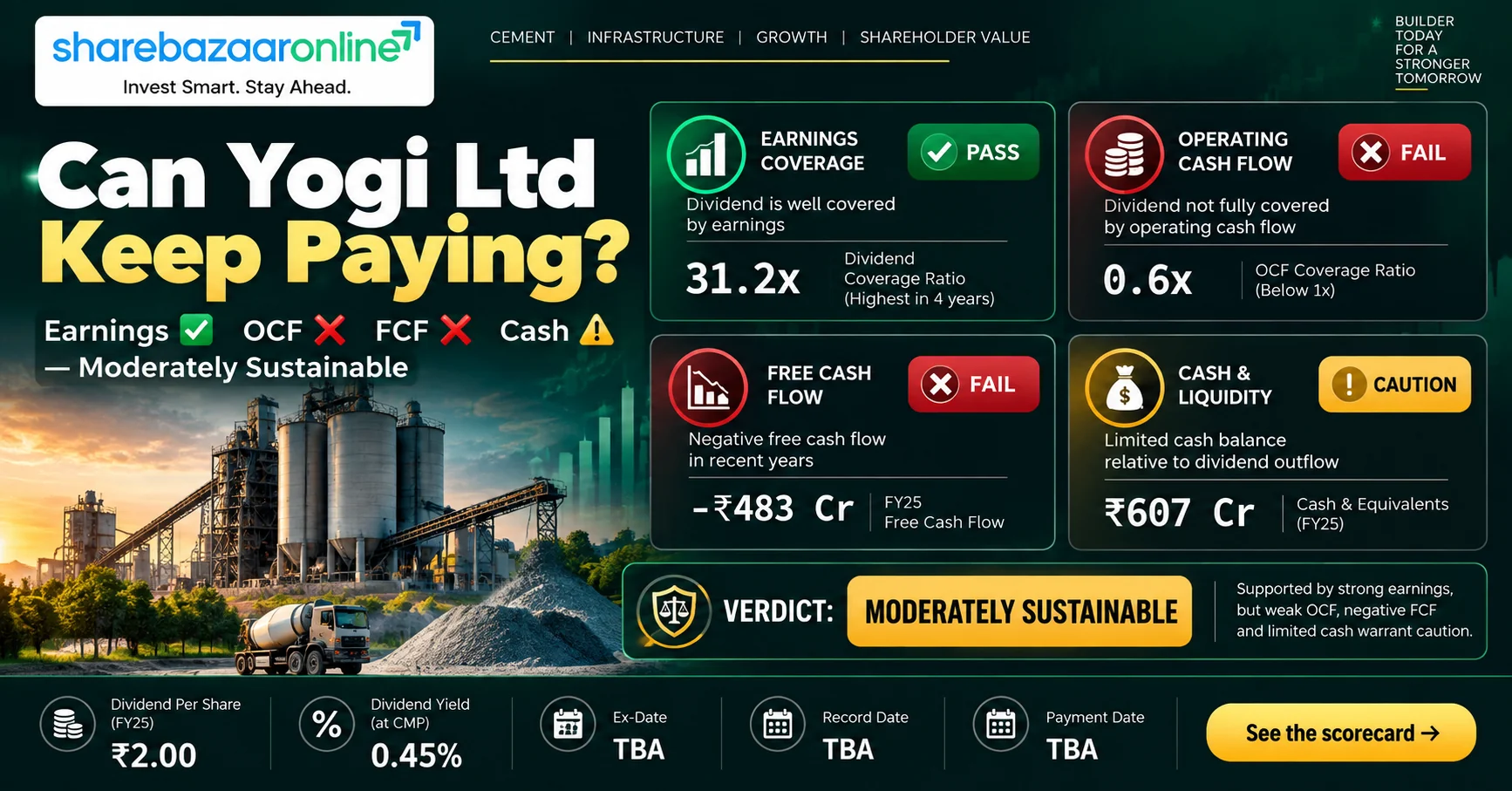
Earnings coverage: 19.5x FY26 EPS; 12.2x TTM — Pass
OCF coverage: –170x — Fail
FCF coverage: –170x — Fail
Cash coverage: Not Disclosed by Company — Caution
Verdict: Moderately Sustainable. The amount is small enough to keep paying: ₹1.13 Cr is 0.45% of borrowings, or about 1.4 months of TTM interest cost. But it is not funded by operating cash. Keeping the money instead would have cut debt by less than 0.5%, and a buyback at this size would make no difference. Operating cash flow has to turn positive before the dividend can be called sustainable.
Yogi Limited Peer Comparison
| Company | Yield | Payout | ROE | ROCE | OCF FY26 |
|---|---|---|---|---|---|
| Yogi Limited | 0.16% | 5% | 16.7% | 12.8% | –₹192 Cr |
| Ajmera Realty | 0.83% | 13% | 11.5% | 14.3% | +₹69 Cr |
| Arihant Superstructures | 0.10% | 2% | 13.7% | 10.6% | –₹71 Cr |
Yogi Limited has the highest ROE of the three but the weakest cash conversion. Ajmera is the only peer that funds its dividend from positive operating cash flow. Arihant also paid ₹0.25 on a ₹10 face value, and shows the same face-value illusion: a "2.5%" headline against a real yield of 0.10%.
Source: Screener.in consolidated data, prices as of 25 Sep 2026.
Yogi Limited Promoter Impact Analysis
Promoter holding: 62.68% (Jun 2026)
Promoter dividend income: ~₹0.71 Cr
Public holding: 37.31%
Minority dividend income: ~₹0.42 Cr
Promoter holding rose from 49.66% (Sep 2023) to 62.68%, a gain of 13 percentage points, during the same period as the warrant-conversion allotments. Filings show no FII or DII holding. With about 2,845 shareholders on record, most of each rupee paid out goes to the promoter group. Promoters receive about ₹1.68 for every ₹1 paid to public shareholders. The amounts on both sides are too small to matter much financially.
Source: Screener.in shareholding pattern; dividend split computed by ShareBazaar Online.
Yogi Limited Dividend Taxation Analysis
Dividends are taxed at the investor's income-tax slab rate. Under Section 393(1) of the Income-tax Act, 2025, the company deducts 10% TDS when a resident's dividend from one company exceeds ₹10,000 in a financial year. The rate is 20% if no PAN is on record. Form 121 replaces Forms 15G/15H. For NRIs the rate is 20% plus surcharge and cess, or the lower DTAA rate. For Yogi Limited, TDS applies only to holdings above 40,000 shares.
Example: 1,000 shares × ₹10
Gross: ₹10,000
Tax (30% + 4% cess): ₹3,120
Net: ₹6,880
Effective yield at ₹161: 6.21% gross → 4.27% net
Actual: 1,000 Yogi shares
Gross: ₹250
Tax: ₹78
Net: ₹172
Net yield: 0.107%
Key Risks for Yogi Limited Shareholders
- Cash burn: Operating cash flow has been negative for three straight years, reaching –₹192 Cr in FY26.
- Debt jump: Borrowings rose about 10.5x in one year, and quarterly interest is now ₹4.46 Cr.
- Receivables: 282 debtor days tie up most of the year's revenue in unpaid bills.
- Earnings reversal: Q1 FY27 ended in a loss, with revenue down 46% year-on-year.
- Short track record: The real estate business has been operating only since FY23.
- Valuation: The stock trades at about 5x book value and about 53x TTM earnings.
- Liquidity: Daily trading volumes are thin, although the new NSE listing may help.
What to Monitor at Yogi Limited
- Q2 FY27 results: whether the company returns to profit after the June-quarter loss.
- H1 FY27 cash flow: whether operating cash flow turns positive.
- Borrowings: any further increase beyond ₹253 Cr, and how quarterly interest trends.
- Collections: whether debtor days fall from 282.
- Order execution: whether the ₹50.63 Cr orders are converted into revenue on schedule.
- Dividend credit: payment confirmation by the 26 Oct 2026 statutory deadline.
- NSE liquidity: whether daily traded volumes improve after the August 2026 NSE listing.
- Shareholding: changes in promoter holding and any new warrant allotments.
Yogi Limited Dividend: Conclusion
Positives
This is the first dividend in over a decade. It is covered 19.5x by FY26 earnings, and the FY26 ROE of 16.7% leads its peers.
Negatives
The real yield is 0.155%, not 2.5%. Operating cash flow is –₹192 Cr, debt is up 10.5x, and Q1 FY27 was loss-making.
The Yogi Limited dividend of ₹0.25 is a signal of intent, not a source of income. Whether it is worth anything depends on management turning a profitable income statement into cash. Investors should watch operating cash flow and debt more closely than the dividend itself.
Frequently Asked Questions About Yogi Limited Dividend
What dividend has Yogi Limited announced for FY26?
What is the Yogi Limited dividend yield?
What was the Yogi Limited dividend record date?
What was the Yogi Limited ex-dividend date?
When will the Yogi Limited dividend be paid?
Who is eligible for the Yogi Limited dividend?
How is the Yogi Limited dividend taxed?
Is the Yogi Limited dividend sustainable?
What is the dividend history of Yogi Limited?
What should Yogi Limited investors monitor?
How much does the Yogi Limited dividend cost the company?
Why does Yogi Limited appear under NBFC on some platforms?
Yogi Limited Dividend Article Disclaimer
This article on the Yogi Limited dividend is for educational and informational purposes only. It is not investment advice or a recommendation to buy, sell or hold any security. ShareBazaar Online is not registered with SEBI as an investment adviser or research analyst. Figures come from company filings and third-party sources believed to be reliable; where stated, some are derived or inferred by ShareBazaar Online. Readers should check dates and amounts against official BSE/NSE disclosures and consult a SEBI-registered adviser before making any investment decision. Tax information is general and may not apply to your individual circumstances.