
Company Overview – Foods and Inns Limited
Incorporated in 1967, Foods and Inns Limited (NSE: FOODSIN, BSE: 507552, ISIN: INE976E01023) is one of India's largest processors and exporters of mango pulp, fruit concentrates, spray-dried fruit and vegetable powders, frozen foods and spices. It is a USDA- and FDA-certified agri-processing company with plants in Maharashtra and other states. For FY26, Foods and Inns Limited reported consolidated revenue of ₹868 crore and net profit of ₹28 crore. The business is seasonal and raw-material driven, with product pricing described by management as a "pass-through" of crop costs. The stock trades near ₹53–54, down roughly 42% over the past year, giving a market capitalisation of about ₹394 crore (Source: Screener.in, NSE, Sept 2026).
Financial Analysis – Foods and Inns Limited
Earnings Snapshot (Consolidated)
FY26 was a weak year for Foods and Inns Limited. Revenue fell 12.5% to ₹868 cr (FY25: ₹992 cr), operating profit dropped 16.7% to ₹100 cr, and net profit slid 33% to ₹28 cr from ₹42 cr. EPS declined to ₹3.77. Management attributed the fall to a ~25% drop in average realisations as cheaper 2025-crop inventory was sold (Source: company results, Screener.in).
Return & Valuation Ratios
ROE is a modest 5.0% and ROCE 8.85%, both below the cost of capital and pressured by high debt. The stock trades at a P/E of about 16x but only 0.70x book value (book value ₹77). Interest coverage is weak, a recurring flag for Foods and Inns Limited given borrowings of ₹432 cr against reserves of ₹558 cr.
Foods and Inns Limited Dividend History
The table below shows the annual dividend record of Foods and Inns Limited (face value Re 1). Note that a 2:1 bonus issue in 2019 and a face-value split materially changed the per-share base, so pre-2020 figures are not directly comparable (Source: exchange records, TipRanks).
| Financial Year (paid) | Dividend Per Share | Dividend % (on Re 1 FV) | Type |
|---|---|---|---|
| FY26 (current) | ₹0.30 | 30% | Final |
| FY25 | ₹0.30 | 30% | Final |
| FY24 | ₹0.30 | 30% | Final |
| FY23 | ₹0.50 | 50% | Final |
| FY22 | ₹0.25 | 25% | Final |
| FY21 | ₹0.20 | 20% | Final |
| FY20 | ₹0.20 | 20% | Final |
Foods and Inns Limited is best classified as a cyclical / token payer: it pays consistently but in small amounts, with the FY23 ₹0.50 being a one-off high. The dividend has held flat at ₹0.30 for three straight years even as profits fell.
Expert Commentary – Foods and Inns Limited
The single most important thing retail investors should understand about the Foods and Inns Limited dividend is that "30%" does not mean a 30% return. The 30% is calculated on the Re 1 face value, so it equals just ₹0.30 per share. Against the market price of ~₹53, the real cash yield is only 0.56%. The total payout of about ₹2.22 crore is immaterial to a company earning ₹28 crore and carrying ₹432 crore of debt. In our view this is a symbolic dividend that signals continuity rather than a meaningful income stream, and the headline percentage is the most misunderstood number in the announcement.
Foods and Inns Limited Dividend Outlook
The forward outlook for the Foods and Inns Limited dividend is stable but modest. With a payout of under 8% of profit and earnings coverage above 12x, the company can comfortably sustain ₹0.30 even in a weak year. However, growth in the dividend is unlikely while ROE stays near 5% and debt remains elevated; retained earnings are needed for the spray-drying and pectin capacity expansion management has flagged. Investors tracking Foods and Inns Limited should treat the dividend as a consistency signal, not a rising-income play. A recovery in realisations in FY27 would matter far more to total returns than any change in the token payout (Source: Q1 FY27 concall, company filings).
Dividend Snapshot – Foods and Inns Limited
Dividend Announcement Summary – Foods and Inns Limited
The Board of Foods and Inns Limited, at its meeting on 29 May 2026, recommended a final dividend of ₹0.30 per equity share (30% on face value of Re 1) for FY2025–26, subject to shareholder approval at the 54th Annual General Meeting. The company subsequently filed a book-closure intimation confirming that the Register of Members will remain closed from 21 to 28 September 2026 for the AGM and dividend distribution. The dividend is payable to shareholders on record as of the record date, 21 September 2026. The payout is unchanged from the previous two years despite a sharp fall in FY26 earnings (Source: BSE/NSE filings, company book-closure notice dated 11 Aug 2026).
Key Dates Timeline – Foods and Inns Limited Dividend
| Event | Date | Status |
|---|---|---|
| Board Announcement | 29 May 2026 | Confirmed |
| Ex-Dividend Date | 19 Sept 2026 (inferred) | Inferred – verify vs exchange circular |
| Record Date / Book Closure Start | 21 Sept 2026 | Confirmed |
| Book Closure End | 28 Sept 2026 | Confirmed |
| AGM (approval) | 28 Sept 2026 | Confirmed |
| Payment Date | Not Disclosed by Company (after AGM) | Pending |
The company uses the book-closure method rather than a stand-alone record date. Under India's T+1 settlement, the ex-date is inferred as one trading day before book closure begins; this should be confirmed against the official NSE/BSE corporate-action circular.
Foods and Inns Limited Dividend Yield
This is the most important reality check for the Foods and Inns Limited dividend. The headline "30%" is calculated on the Re 1 face value, not the market price:
Face-Value "Yield" (headline)
30%
Misleading – based on Re 1
Real Cash Yield @ ₹53
0.56%
₹0.30 ÷ ₹53 market price
At the announcement-date price (~₹55), the yield was 0.55%. Even that thin yield only exists because the share price has fallen ~42% in a year — a classic case where a "higher" yield reflects a weak stock, not a generous dividend.
Financial Performance Analysis – Foods and Inns Limited
Operating leverage worked against Foods and Inns Limited in FY26. Revenue fell 12.5%, but profit fell far faster — a sign of margin and interest pressure:
Revenue
-12.5%
₹992cr → ₹868cr
Operating Profit
-16.7%
₹120cr → ₹100cr
Net Profit
-33%
₹42cr → ₹28cr
The gap between a 12.5% revenue fall and a 33% profit fall is driven by lower realisations (pricing is a raw-material pass-through), a high fixed interest burden of ~₹47 cr, and rising depreciation from capacity additions.
Cash Flow Analysis – Foods and Inns Limited
Reported profit fell, but cash flow surged — a divergence standard coverage misses. FY26 operating cash flow jumped to ₹132 cr from just ₹15 cr, and free cash flow turned strongly positive at +₹94 cr (from -₹41 cr).
The forensic point: this cash did not come from earnings — PAT actually fell 33%. It came from a working-capital swing and stretched payables (days payable rose to 168). Inventory days remained very high at 442. The tiny ₹2.22 cr dividend is therefore funded many times over by current cash generation, but investors should note the cash improvement is inventory/working-capital driven and may not repeat once the crop cycle normalises.
Balance Sheet Strength – Foods and Inns Limited
The balance sheet is the main constraint on Foods and Inns Limited. Gross borrowings stand at ₹432 crore against reserves of ₹558 crore — a debt-to-reserves ratio of 0.77x. Interest cost of ~₹47 cr consumes a large share of operating profit, and interest coverage is low, a standing red flag. Investments on the balance sheet are minimal (₹4 cr). While the ₹2.22 cr dividend is trivial next to this debt, the key question for shareholders is whether the company should be distributing cash at all versus accelerating debt reduction. The low ROE of 5% reflects how leverage is diluting equity returns.
Foods and Inns Limited Dividend Sustainability
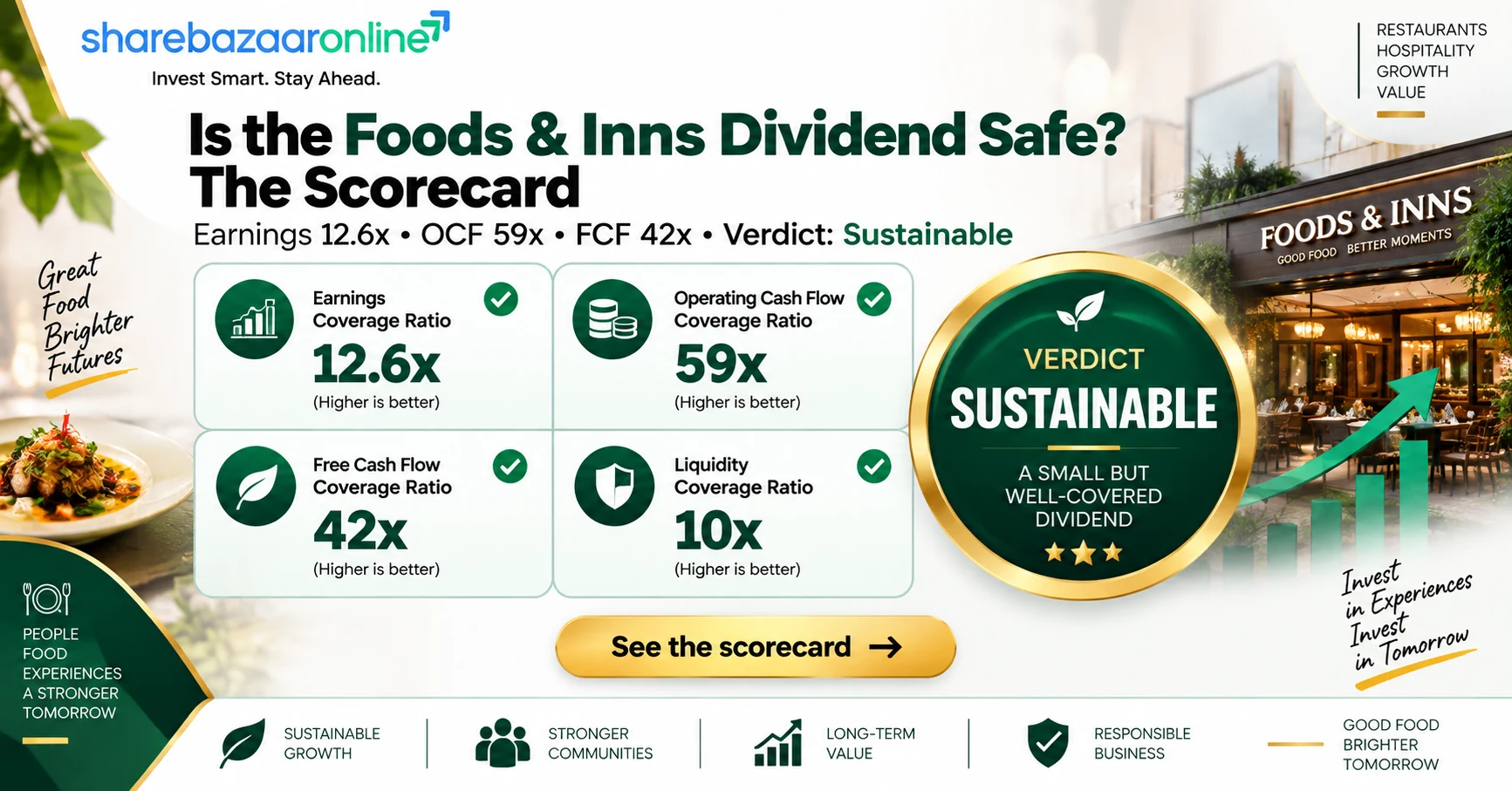
Earnings Coverage
12.6x — Pass
OCF Coverage
59x — Pass
FCF Coverage
42x — Pass
Liquidity Coverage
~10x — Pass
Verdict: Sustainable. Because the payout is only 7.9% of profit and outflow is a token ₹2.22 cr, all four sustainability tests pass comfortably even in a down year. The risk is not affordability — it is that the dividend is too small to matter for income, and future growth in it is capped by weak ROE and high debt.
Peer Comparison – Foods and Inns Limited
| Metric | Foods and Inns Ltd | Packaged-Food Peers (typical) |
|---|---|---|
| Dividend Yield | 0.56% | ~1.0% (Food industry avg) |
| Payout Ratio | 7.9% | 25–50% |
| ROE | 5.0% | 12–20% |
| ROCE | 8.85% | 15%+ |
Against branded FMCG-food peers, Foods and Inns Limited scores below industry average on yield, payout, ROE and ROCE. That is expected: it is a low-margin, capital-intensive agri-processor and exporter, not a branded consumer company. Investors should benchmark it against agri/ingredient processors rather than branded FMCG names (Source: Screener.in, Simplywall.st).
Promoter Impact Analysis – Foods and Inns Limited
Promoter holding in Foods and Inns Limited is low at 25.39% and has fallen from over 45% a few years ago. On the ₹2.22 cr total dividend, the split is:
Promoter Dividend Income (25.39%)
~₹0.56 cr
Public Dividend Income (73.48%)
~₹1.63 cr
Because promoter holding is low, most of the dividend actually flows to public shareholders — unusual versus promoter-heavy companies where dividends are a promoter-enrichment tool. The token size means the dividend is not a material cash-extraction route for anyone.
Taxation Analysis – Foods and Inns Limited Dividend
Since FY21, dividends in India are taxed in the hands of the shareholder at their income-tax slab rate. Companies deduct TDS at 10% under Section 194 only if total dividend paid to a resident exceeds ₹5,000 in a financial year. Worked example for Foods and Inns Limited:
For most retail holders the ₹300 gross falls well under the ₹5,000 TDS threshold, so no tax is withheld at source — but it still must be declared and taxed at slab.
Key Risks – Foods and Inns Limited
- High debt & weak interest coverage: ₹432 cr borrowings with low coverage make earnings vulnerable to rate and margin shifts.
- Realisation/pricing risk: pricing is a raw-material pass-through, so falling crop costs directly compress revenue, as seen in the 12.5% FY26 decline.
- Very high inventory (442 days): large working-capital lock-up exposes the company to crop-price and obsolescence risk.
- Low ROE (5%): returns are below cost of capital, limiting value creation and dividend growth.
- Falling promoter holding (25.4%): down from 45%+, which some investors read as reduced promoter conviction.
- Cyclical/seasonal earnings: heavy dependence on the mango and fruit crop cycle causes volatile quarterly profits.
What To Monitor – Foods and Inns Limited
- Realisations & revenue recovery in FY27 as the new crop cycle and pricing normalise.
- Debt reduction trajectory — whether borrowings fall from the ₹432 cr level and interest coverage improves.
- Inventory days — a fall from 442 days would confirm the FY26 cash surge is being converted, not just deferred.
- Capacity ramp-up — spray-drying (120 MTPA) and new pectin production reaching commercial scale.
- Frozen-food segment growth, cited by management as growing ~30% CAGR.
- Dividend consistency — whether ₹0.30 is maintained, raised, or cut in FY27.
Should You Consider Foods and Inns Limited for Dividend Income?
In conclusion, the Foods and Inns Limited FY26 dividend of ₹0.30 per share (30% on Re 1) is a consistent but symbolic payout. The real yield of 0.56% and payout of 7.9% mean this is not a dividend-income stock. Positives: the dividend is highly sustainable (12.6x earnings cover), FCF turned positive, and most of it flows to public shareholders. Negatives: earnings fell 33%, debt is high, ROE is just 5%, and inventory is stretched. The dividend is best read as a signal of management's intent to keep rewarding shareholders through a weak cycle, rather than a source of meaningful income. We present the facts, positives and risks — the decision rests with you.
Frequently Asked Questions About Foods and Inns Limited Dividend
What dividend has Foods and Inns Limited announced for FY26?
What is the real dividend yield of Foods and Inns Limited?
What is the record date for the Foods and Inns Limited dividend?
What is the ex-dividend date?
When will the Foods and Inns Limited dividend be paid?
Who is eligible for the dividend?
How is the Foods and Inns Limited dividend taxed?
Is the Foods and Inns Limited dividend sustainable?
What is the dividend history of Foods and Inns Limited?
Why did profit fall but cash flow rise in FY26?
What should investors monitor in Foods and Inns Limited?
What is the total dividend outflow of Foods and Inns Limited?
Disclaimer
This article on the Foods and Inns Limited dividend is for informational and educational purposes only and does not constitute investment, financial or tax advice. ShareBazaar Online is not a SEBI-registered investment adviser. No content here should be read as a recommendation to buy, sell or hold any security. Figures are compiled from company filings, exchange disclosures and third-party sources (BSE, NSE, Screener.in, TipRanks) believed reliable but not independently guaranteed; some dates (e.g. ex-date) are inferred and must be verified against official exchange circulars. Investments in securities are subject to market risks. Please read all scheme-related documents and consult a qualified financial adviser before investing.