
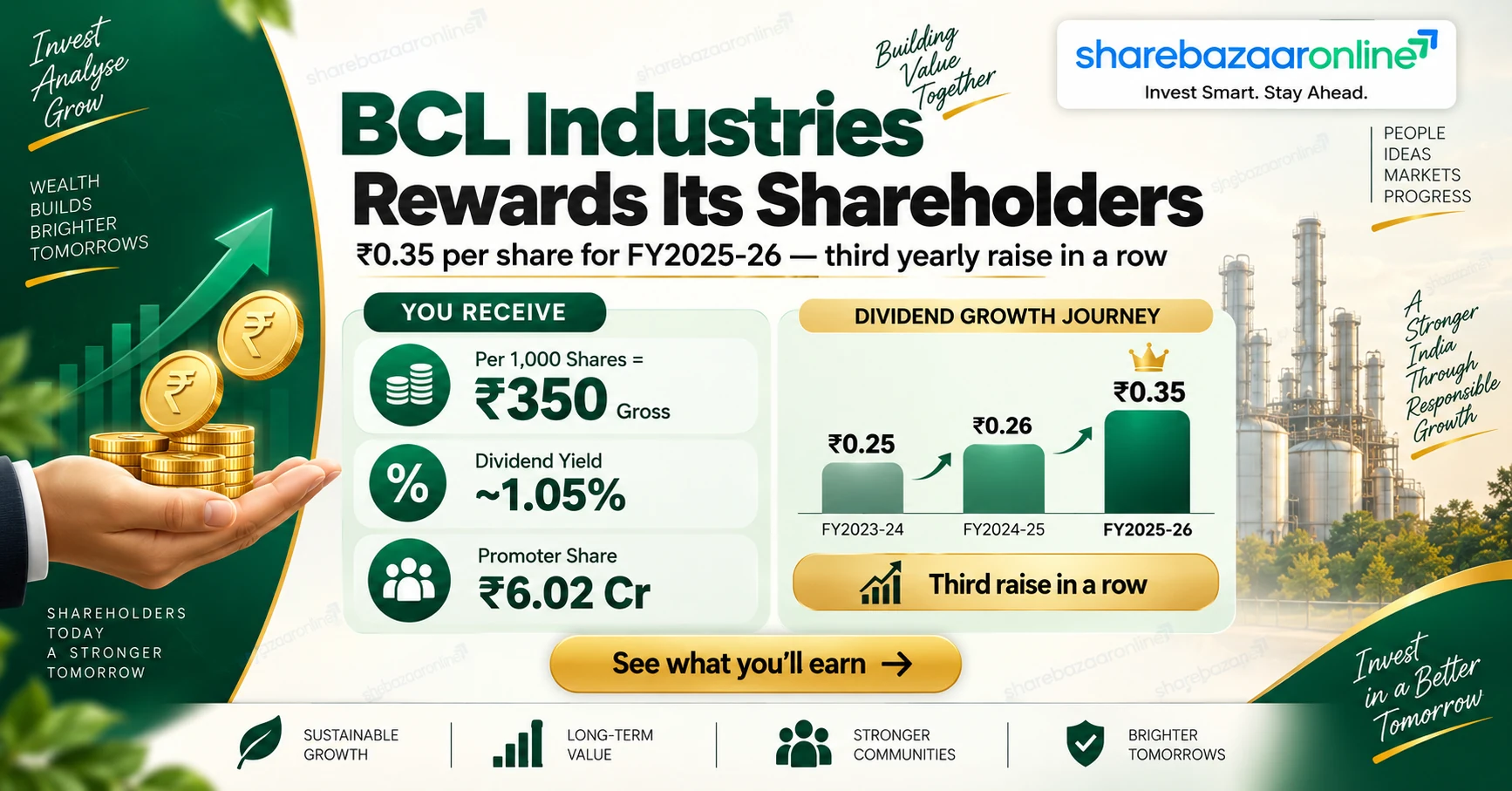
BCL Industries Limited Dividend 2026 – Final Dividend of ₹0.35 Per Share
BCL Industries Limited (NSE: BCLIND | BSE: 524332) has declared a final dividend of ₹0.35 per equity share for the financial year 2025-26, and its Board has fixed 18 September 2026 as the record date. This BCL Industries dividend analysis breaks down the payout, the BCL Industries dividend yield, its dividend history, sustainability, cash flows, promoter impact and the tax you actually pay — so you can judge the BCL Industries dividend 2026 for yourself instead of just reading the headline.
Company Overview – BCL Industries Limited
BCL Industries Limited is a Bathinda (Punjab) based, diversified agro-processing company and part of the Mittal Group, incorporated in 1976. It operates across three verticals: Distillery (grain-based ethanol, ENA and IMIL), Edible Oil & Refinery, and Real Estate. It is one of India's larger grain-based ethanol producers, with distillery units at Bathinda and, through subsidiary Svaksha Distillery, at Kharagpur (West Bengal).
For FY2025-26, BCL Industries reported consolidated revenue of ₹2,791.66 crore and consolidated net profit of ₹126.44 crore. The distillery segment is the primary profit engine, while the lower-margin edible-oil trading business drives volume. The company recently commissioned an additional 150 KLPD grain-based distillery at Bathinda and closed its legacy Oil & Vanaspati unit.
Dividend Snapshot – BCL Industries Limited
Dividend Per Share
₹0.35
Final Dividend (35% on ₹1 face value)
Dividend Yield
~1.05%
On CMP of ₹33.20 (22 Sep 2026)
Record Date
18 Sep 2026
Ex-date aligns under T+1 settlement
Financial Year
FY 2025-26
Recommended on 25 May 2026
Total Dividend Outflow
~₹10.33 Cr
On 29.52 crore shares
Payout Ratio
~9%
Consolidated FY26 (12.6% standalone)
ISIN: INE412G01024 | NSE: BCLIND | BSE: 524332 | Face Value: ₹1 | AGM: 25 Sep 2026 (VC/OAVM). Payment date: Not Disclosed by Company in the filing (payable after AGM approval).
BCL Industries Limited Dividend Announcement Summary
The BCL Industries dividend for FY2025-26 is a final dividend of ₹0.35 per share, first recommended by the Board on 25 May 2026 alongside the audited FY26 results and subject to shareholder approval at the 50th AGM. In its Board meeting of 12 August 2026, the company approved Q1 FY2026-27 results and fixed 18 September 2026 as the record date for the dividend, confirming entitlement dates for investors.
At ₹0.35, this is a 35% increase in the per-share dividend versus ₹0.26 last year — the third straight year of dividend growth (₹0.25 → ₹0.26 → ₹0.35). The total cash going out is a modest ~₹10.33 crore, comfortably small relative to FY26 profit, which shapes the sustainability picture discussed below.
BCL Industries Limited Key Dates Timeline
| Event | Date |
|---|---|
| Dividend Recommended by Board | 25 May 2026 |
| Record Date Fixed (Board Meeting) | 12 August 2026 |
| Record Date | 18 September 2026 |
| Ex-Dividend Date (under T+1) | 18 September 2026 |
| 50th Annual General Meeting | 25 September 2026 |
| Payment Date | Not Disclosed by Company |
To be eligible for the BCL Industries dividend, shares must be held as of the record date of 18 September 2026. Buying on or after the ex-date does not entitle you to this payout.
BCL Industries Limited Dividend Yield Analysis
At the current market price of ₹33.20 (NSE, 22 Sep 2026), the ₹0.35 dividend gives a yield of about 1.05%. Against the announcement-period price of roughly ₹35 (late May 2026), the yield was near 1.00%. Either way, BCL Industries is not a high-yield stock — the yield sits below the ~2.5% consumer-defensive sector average.
Yield reality check: BCL's yield looks higher than premium distillery peers only because the stock trades cheaply (P/E ~8.4, P/B ~1.05), not because the company is generous — its payout ratio is a low ~9%. The stock is also down ~23% over the past year, which mechanically lifts the yield. This is a low-valuation yield, not a large-dividend yield.
BCL Industries Limited Dividend History
| Financial Year | Dividend / Share (₹1 FV) | Payout Ratio |
|---|---|---|
| FY2025-26 | ₹0.35 (Final) | ~9% |
| FY2024-25 | ₹0.26 | 8% |
| FY2023-24 | ₹0.25 | 8% |
| FY2022-23 | ₹0.50 | 18% |
| FY2021-22 | ₹0.50 (incl. interim) | 14% |
| FY2020-21 | ₹0.50 | 29% |
| FY2019-20 | Nil | 0% |
| FY2018-19 | ₹0.12 | 5% |
| FY2017-18 | Nil | 0% |
| FY2016-17 | ₹0.10 | 14% |
Source: exchange filings and Screener/TipRanks dividend records.
Dividend History Analysis: BCL Industries is best described as a cyclical / irregular payer that has become a steady low payer recently. It skipped dividends in FY18 and FY20 and cut sharply from ₹0.50 to ₹0.25 between FY23 and FY24. However, it has now paid for five straight years (FY22–FY26) and grown per-share dividends for three consecutive years. The payout ratio has stayed conservative at 8–9%, meaning most profit is retained for capacity expansion.
BCL Industries Limited Financial Performance Analysis
FY2025-26 (Consolidated): Revenue was flat at ₹2,791.66 crore (−0.8%), but net profit rose 22% to ₹126.44 crore and operating profit grew ~18% to ₹242 crore, lifting OPM from 7% to 9%. This is positive operating leverage — profit growing far faster than sales, driven by richer distillery mix and lower finance cost, even as low-margin oil trading shrank.
Q1 FY2026-27: Consolidated revenue fell ~24% to ₹623.42 crore (edible-oil/segment closure effect), yet net profit still rose ~6% to ₹35.52 crore, again showing margin-led resilience. Standalone FY26 net profit was ₹81.97 crore (EPS ₹2.78); consolidated EPS was ₹3.90. ROE stands at ~13.4% and ROCE at ~13.9%.
BCL Industries Limited Cash Flow Analysis
Reported profits are opinions; cash is fact — and here FY26 was a major positive turn. Consolidated operating cash flow jumped to ₹325 crore from just ₹63 crore in FY25, a CFO-to-operating-profit conversion of ~149%, helped by a sharp reduction in working capital (cash cycle down to ~49 days, inventory days from 73 to 47).
Crucially, free cash flow turned strongly positive at ~₹193 crore in FY26, after several years of negative FCF (FY23 −₹228 cr, FY24 −₹98 cr, FY25 −₹71 cr) caused by heavy distillery capex. This means the ₹10.33 crore dividend is now funded from genuine surplus cash, not borrowings — a meaningful improvement in dividend quality versus prior years.
BCL Industries Limited Balance Sheet Strength
At end-FY26, BCL Industries had a net worth of ~₹910 crore (book value ₹30.8/share) against total borrowings of ~₹569 crore, giving a debt-to-equity of ~0.63. Debt rose modestly by ~₹33 crore year-on-year as the company completed capacity expansion, and Screener flags that the company may be capitalising some interest cost — worth watching.
The balance sheet is manageable but leveraged: this is a capital-intensive distillery business, so debt is structurally present. The ₹10.33 crore dividend is trivial against the ₹910 crore net worth, but the company is clearly prioritising debt-funded growth and retention over large distributions — consistent with the low 8–9% payout.
BCL Industries Limited Dividend Sustainability Analysis
EPS / DPS Coverage
11.1×
Consolidated (7.9× standalone)
Free Cash Flow Coverage
18.7×
FY26 FCF ₹193 Cr ÷ ₹10.33 Cr
On coverage alone, this dividend is highly secure: earnings cover it 11 times over and FY26 free cash flow covers it nearly 19 times. The low payout leaves ample buffer even in a weaker year. The only caution is that FCF has been positive for just one year; the business is capex-heavy and cyclical (ethanol pricing, feedstock costs). Overall rating: Sustainable, with the caveat that the comfort rests on FY26's newly-positive cash generation continuing.
BCL Industries Limited Peer Comparison
| Company | Div Yield | P/E | P/B |
|---|---|---|---|
| BCL Industries | ~1.05% | ~8.4 | ~1.05 |
| Globus Spirits | ~0.29% | ~35 | ~2.6 |
| Radico Khaitan | ~0.21% | ~70 | ~12 |
| Associated Alcohols | Low | ~18 | ~2.7 |
| G M Breweries | Moderate | ~14 | ~2.3 |
Among grain-based distillery/ethanol peers, BCL offers the highest headline dividend yield but at the lowest valuation. Globus Spirits — its closest grain-ENA peer — yields just ~0.29%, and Radico Khaitan ~0.21%. BCL's cheaper multiple reflects its commodity edible-oil mix, lower ROE (~13%) and thinner margins versus premium IMFL names. The takeaway: BCL's yield edge comes from valuation, not superior shareholder returns.
BCL Industries Limited Promoter Impact Analysis
Promoters (the Mittal family) hold 58.23% of BCL Industries (as of June 2026), so about ₹6.02 crore of the ₹10.33 crore dividend flows to promoters. FIIs hold just 0.24% and DIIs ~0.01%, leaving the public with ~40.6% (about ₹4.2 crore of the payout). Institutional interest is minimal, which is typical for a small-cap agro stock.
Two points for minority investors: promoter holding has edged down ~3% over three years, and a small portion of promoter shares (~4%) is pledged. The dividend is small enough that it is not a material promoter cash-extraction tool; the low payout suggests the family is prioritising reinvestment over dividends.
BCL Industries Limited Dividend Taxation Analysis
Since FY2020-21, dividends in India are taxable in the hands of the investor at their income-tax slab rate. The company deducts TDS at 10% under Section 194 if your total dividend from that company in a year exceeds ₹5,000 (20% without PAN). The TDS is adjusted against your final tax liability.
Worked example (30% slab): An investor holding 1,000 shares receiving ₹10/share earns a gross dividend of ₹10,000. TDS at 10% = ₹1,000 is withheld. Total tax at 30% + 4% cess (31.2%) = ₹3,120. Net dividend in hand = ₹6,880, an effective post-tax retention of ~68.8%.
For BCL's actual ₹0.35/share: 1,000 shares = ₹350 gross — below the ₹5,000 TDS threshold, so no TDS; at a 30% slab the tax is ~₹109, leaving ~₹241 net.
Expert Commentary on BCL Industries Limited
The most important signal in this cycle is not the dividend itself but the cash-flow turnaround behind it. For three years BCL burned cash funding distillery expansion; in FY26 that capex phase eased and free cash flow swung to +₹193 crore. A ₹0.35 dividend costing ₹10.33 crore is a rounding error against that — the raised payout is really the board signalling confidence that the heavy-build phase is over.
The offsetting reality is a fire at the 200 KLPD ethanol plant in June 2026 that halted operations, plus falling revenue and ~₹569 crore of debt. BCL is a growth-and-capacity story with a token dividend, not an income stock. Investors chasing yield elsewhere will find richer, safer payers.
BCL Industries Limited Dividend Outlook
With the major distillery capex behind it and free cash flow now positive, BCL Industries has the headroom to keep growing its small dividend if profitability holds — the per-share payout has already risen three years running. The newly commissioned 150 KLPD Bathinda unit and full utilisation of existing distillery capacity should support cash generation.
However, the outlook hinges on ethanol allocations and pricing, feedstock (grain) costs, and recovery from the June 2026 plant fire. Given the conservative 8–9% payout policy, investors should expect modest, gradually rising dividends rather than a step-change. Capital appreciation, not dividend income, will remain the primary return driver for BCL Industries.
Key Risks for BCL Industries Limited Investors
- Ethanol plant fire (June 2026): A fire shut the 200 KLPD ethanol plant; recovery depends on insurance claims and restart timelines.
- Policy dependence: Earnings are highly sensitive to government ethanol-blending allocations and procurement pricing by OMCs.
- Feedstock & margin volatility: Grain and broken-rice prices directly swing distillery margins; the oil segment is thin-margin and commodity-linked.
- Leverage: ~₹569 crore of debt (D/E ~0.63) in a capital-intensive business; possible interest capitalisation flagged by data providers.
- Revenue contraction: Both FY26 and Q1 FY27 saw double-digit revenue decline; profit was held up by margins, which may not repeat.
What To Monitor in BCL Industries Limited
- Free cash flow durability: Whether FY26's +₹193 crore FCF sustains, or reverts to negative with fresh capex.
- Ethanol allocations: FY27 OMC ethanol volumes and realisations, and blending-policy changes.
- Fire recovery & insurance: Restart of the 200 KLPD ethanol plant and settlement of the insurance claim.
- Debt trajectory: Whether borrowings fall now that expansion is largely complete.
- Distillery utilisation: Ramp-up of the new 150 KLPD Bathinda unit and Svaksha Distillery (now wholly owned).
Should You Consider BCL Industries Limited for Dividend Income?
The BCL Industries FY2025-26 dividend of ₹0.35 per share is well-covered, growing, and — for the first time — funded by genuine free cash flow rather than debt. On sustainability metrics (11× earnings cover, ~19× FCF cover, low ~9% payout), it scores well. That is the positive case.
The negative case is equally clear: a ~1% yield is small, the payout is deliberately kept low to fund expansion, and the business carries real risks — leverage, a recent plant fire, policy dependence and shrinking revenue. In short, BCL Industries is a capacity-growth story that pays a token, rising dividend, not a yield play. Weigh the positives, negatives, risks and monitoring points above against your own objectives before deciding.
Frequently Asked Questions About BCL Industries Limited Dividend
What dividend has BCL Industries announced for FY2025-26?
What is the BCL Industries dividend yield?
What is the record date for the BCL Industries dividend?
What is the ex-dividend date for BCL Industries?
When will the BCL Industries dividend be paid?
Who is eligible for the BCL Industries dividend?
How is the BCL Industries dividend taxed?
Is the BCL Industries dividend sustainable?
What is the BCL Industries dividend history?
How much is the total BCL Industries dividend outflow?
What should investors monitor in BCL Industries?
Is BCL Industries a good dividend stock?
Disclaimer
This BCL Industries Limited dividend analysis is for informational and educational purposes only and does not constitute investment advice or a recommendation to buy, sell or hold any security. Figures are sourced from company exchange filings and publicly available data (including Screener, exchange announcements and market data providers) and may contain errors or become outdated; market prices and yields change continuously. Certain items marked "Not Disclosed by Company" were unavailable in the source filing. Please verify all figures independently and consult a SEBI-registered investment adviser before making any investment decision. ShareBazaar Online and the author accept no liability for any loss arising from the use of this content.