
DCW Limited Final Dividend 2026: ₹0.20 Per Share Declared for FY2025-26 — Record Date, Yield & Sustainability Analysis
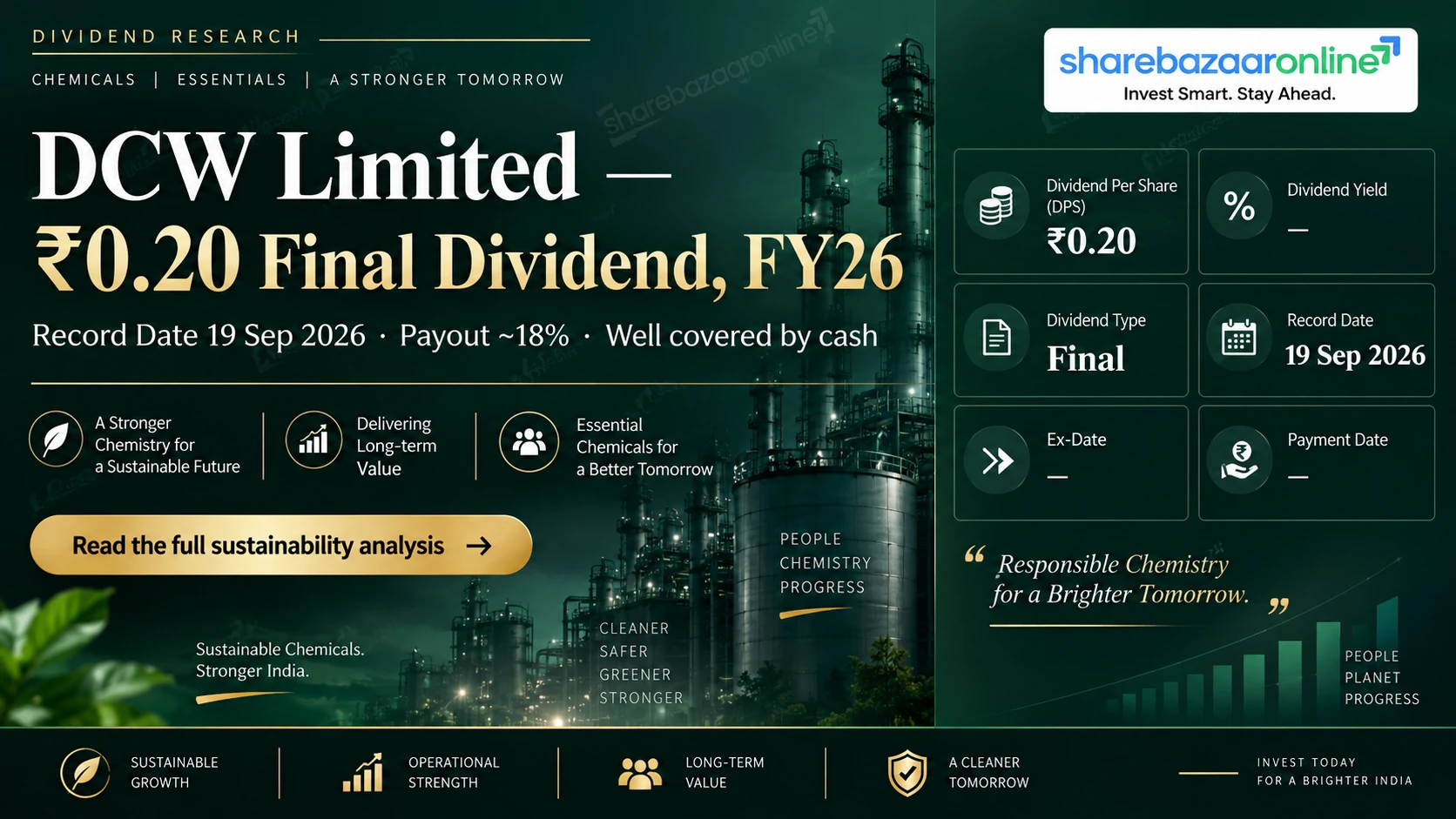
DCW Limited has declared a final dividend of ₹0.20 per equity share (10% on face value of ₹2) for the financial year ended 31 March 2026. The dividend carries a record date of 19 September 2026 and will be paid after the company's 87th Annual General Meeting on 26 September 2026, subject to shareholder approval. Combined with the ₹0.10 interim already paid, DCW Limited's total FY2025-26 payout reaches ₹0.30 per share. This analysis breaks down the DCW Limited dividend yield, payout ratio, cash coverage, dividend history and sustainability so you can judge the reward for yourself.
Company Overview – DCW Limited
DCW Limited (BSE: 500117, NSE: DCW), formerly Dhrangadhra Chemical Works, is one of India's oldest chemical manufacturers, tracing its roots to India's first soda ash factory taken over in 1939. The company operates across three segments — Chlor-Alkali, Soda Ash and PVC — from plants at Dhrangadhra (Gujarat) and Sahupuram (Tamil Nadu). Basic chemicals (Soda Ash, Caustic Soda, PVC) formed roughly 71% of FY26 revenue, with specialty products such as Synthetic Iron Oxide Pigment (SIOP), Synthetic Rutile and C-PVC making up the rest. Classified as a small-cap stock with a market capitalisation near ₹1,300 crore, DCW Limited is now steering toward higher-value specialty grades.
DCW Limited Financial Analysis (FY2025-26)
For FY2025-26, DCW Limited reported revenue from operations of ₹2,143.59 crore, up 7.16% from ₹2,000.34 crore in FY25. Net profit rose sharply to ₹48.17 crore from ₹30.07 crore — a jump of roughly 60% — lifting reported EPS to ₹1.63. The recovery continued into Q1 FY27, where net profit reportedly climbed 304% year-on-year to ₹34.5 crore. Note that DCW Limited reports on a standalone basis; management stated consolidated results were not required, as its 28.96% stake in Kaze Renewables is not treated as an associate. Profitability is recovering off a low base, so the trend matters more than any single quarter.
DCW Limited Dividend History Table
| Financial Year | Dividend Per Share (₹) | Dividend % | Type |
|---|---|---|---|
| FY2025-26 | 0.30 | 15% | Interim ₹0.10 + Final ₹0.20 |
| FY2024-25 | 0.10 | 5% | Final |
| FY2023-24 | 0.10 | 5% | Final |
| FY2022-23 | 0.50 | 25% | Interim ₹0.20 + Final ₹0.30 |
| FY2021-22 | 0.40 | 20% | Final (payout resumed) |
| FY2015-16 to FY2020-21 | Nil | 0% | Dividend suspended |
| FY2013-14 | 0.36 | 18% | Final |
| FY2012-13 | 0.36 | 18% | Final |
Source: Exchange filings and dividend trackers (TipRanks, Investing.com). Figures rounded to face value ₹2. Minor variation exists across third-party trackers for FY24.
Expert Commentary on DCW Limited Dividend
The DCW Limited dividend is best read as a signalling gesture, not an income play. At ₹0.20 final (₹0.30 for the full year), the payout absorbs only about 18% of FY26 earnings, leaving ample room for reinvestment into the ₹250 crore SIOP and C-PVC expansions. The more telling story is the balance sheet: management is guiding to net-debt-free status by FY27 and a ₹300 crore steady-state EBITDA. A small, well-covered dividend alongside deleveraging suggests capital discipline. The caution flag is margin quality — C-PVC realisations fell over 20%, and returns (ROE ~3.4%) remain thin versus DCW Limited's own FY23 peak of ~19%. Reward is modest but affordable.
DCW Limited Dividend Outlook & Future View
DCW Limited's forward dividend capacity hinges on three levers: completing deleveraging, specialty margin recovery, and volume ramp from new C-PVC (capacity taken to 50,000 t) and SIOP capacity (rising to 45,000 TPA by Q4 FY28). If the ₹300 crore steady-state EBITDA target is met and the company turns net-debt-free by FY27, the payout ratio could rise from the current ~18% without straining cash. However, DCW Limited is a cyclical chemicals producer exposed to soda ash and PVC import pressure; earnings — and therefore dividends — can swing with global pricing. Investors should expect a modest, variable dividend rather than steady, growing income in the near term.
Dividend Snapshot – DCW Limited
Dividend Per Share
₹0.20
Final dividend (10% on FV ₹2)
Dividend Yield
~0.44%
On CMP ≈ ₹45 (final only); ~0.67% on full-year ₹0.30
Record Date
19 Sep 2026
Ex-date: 18 Sep 2026
Payment
After 26 Sep 2026
Subject to 87th AGM approval
DCW Limited Dividend Announcement Summary
On 5 May 2026, the Board of Directors of DCW Limited recommended a final dividend of ₹0.20 per equity share (10%) of face value ₹2 for FY2025-26, subject to shareholder approval at the 87th AGM. Via its 4 September 2026 intimation under Regulation 42, the company fixed the record date as 19 September 2026 and a book closure from 20–26 September 2026. The dividend, if declared by members at the AGM on 26 September 2026 (held via video conferencing), will be paid thereafter, subject to TDS. Together with the ₹0.10 interim declared on 10 February 2026, DCW Limited's total FY2025-26 dividend is ₹0.30 per share. The registrar is Bigshare Services Private Limited.
DCW Limited Key Dividend Dates Timeline
| Event | Date |
|---|---|
| Board Recommendation | 5 May 2026 |
| Ex-Dividend Date | 18 September 2026 |
| Record Date | 19 September 2026 |
| Book Closure | 20–26 September 2026 |
| 87th AGM | 26 September 2026 |
| Payment Date | After 26 September 2026 |
DCW Limited Dividend Yield Analysis
At a market price of roughly ₹45 (late August 2026), the DCW Limited final dividend of ₹0.20 offers a yield of about 0.44%; on the full FY26 payout of ₹0.30, the yield is around 0.67%. Measured against the ~₹48 price when the dividend was recommended in May 2026, the announcement-date yield was ~0.42%. This sits below the chemicals sector average of ~0.7-0.8%. Importantly, DCW Limited's yield is low because the dividend is small relative to price — not because the share price has spiked. In fact the stock is down ~32% over the past year, which has actually supported the yield rather than depressed it. This is a capital-preservation-and-growth stock, not a high-yield income stock.
DCW Limited Dividend History Analysis
DCW Limited is best classified as an irregular / cyclical dividend payer. The company paid a steady 18% (₹0.36) through FY10–FY14, then suspended dividends entirely for roughly six years (FY16–FY21) during a debt- and capex-heavy phase. Payouts resumed in FY22 at ₹0.40, peaked at ₹0.50 in FY23, dipped to ₹0.10 in FY24 and FY25, and have now recovered to ₹0.30 in FY26. The takeaway for income investors is clear: DCW Limited's dividend track record shows meaningful gaps and volatility, tied closely to the chemical cycle and the balance sheet. Consistency and predictable growth — the hallmarks of a reliable dividend stock — are not features of this history.
DCW Limited Financial Performance Analysis
Examining operating leverage tells a nuanced story. In FY26, DCW Limited grew revenue ~7% while net profit rose ~60% and EBITDA increased ~11% — profit outgrew sales because of a low prior-year base, a 7.5% cut in finance costs, better fixed-cost absorption and solar power substitution. However, management flagged a genuine tension: specialty EBITDA fell and margins compressed as C-PVC realisations dropped over 20%, even as basic chemicals recovered. The EBITDA margin is around 10-11% — thin for the asset-heavy nature of the business. So while headline profit growth looks strong, it is partly a base effect and cost-driven, not broad-based pricing power. Watch whether specialty margins stabilise.
DCW Limited Cash Flow & Dividend Funding Analysis
The most important sustainability question is whether the dividend is funded from real cash. DCW Limited's total FY26 dividend outflow is only about ₹8.86 crore (final ₹0.20 ≈ ₹5.90 crore), against net profit of ₹48.17 crore. That is a very small claim on the business, and external analysis pegs the cash payout ratio near 5% — meaning the dividend is comfortably covered by cash flows, not borrowings or asset sales. With net-debt-to-EBITDA falling to roughly 1.0x (from 1.47x) and the company reducing debt, the dividend is being paid alongside deleveraging rather than at its expense. Detailed free-cash-flow figures are Not Disclosed by Company in summary form, but the coverage math is reassuring.
DCW Limited Balance Sheet Strength
DCW Limited's balance sheet is improving but not yet robust. Debt-to-equity has come down to about 0.41, and net-debt-to-EBITDA sits near 1.0x, with management targeting net-debt-free by FY27. The clear weak spot is a low interest coverage ratio of ~1.55x, meaning operating profit only modestly exceeds interest costs — leaving limited cushion if earnings dip. The current ratio of ~1.08 indicates tight but adequate short-term liquidity. Promoter pledge stands at about 3.83% of holding, which is low. Overall, the direction of travel — lower leverage, falling finance costs — supports the modest dividend, but the thin interest cover is the number to keep watching.
DCW Limited Dividend Sustainability Analysis
Weighing the evidence — a low 18% earnings payout, ~5% cash payout, dividend coverage of about 5.4x on the full-year payout (8.1x on the final alone), falling debt and recovering profit — the current DCW Limited dividend looks affordable and sustainable at its present small size. The caveat is consistency: this is a cyclical business with a history of dividend suspensions, and returns (ROE ~3.4%) are still recovering. So while the ₹0.20 final dividend is not at risk of straining the company, investors should not assume it will grow steadily.
Sustainability rating: Moderately Sustainable
DCW Limited Peer Comparison
| Company | Approx. Dividend Yield | Payout Ratio |
|---|---|---|
| DCW Limited | ~0.44% (final) / ~0.67% (FY26) | ~12–18% |
| DCM Shriram | ~0.6% | ~23% |
| GHCL | ~2%+ | Higher payer |
| Tata Chemicals | ~1.4% | Moderate |
| Chemicals sector avg | ~0.7–0.8% | — |
DCW Limited's dividend yield trails most soda-ash and chlor-alkali peers and the sector average. Peers such as GHCL and Tata Chemicals reward shareholders more generously, reflecting stronger, steadier cash generation. DCW Limited's lower payout is consistent with a company still prioritising deleveraging and expansion. Peer figures are indicative and should be verified against the latest data.
DCW Limited Promoter Impact Analysis
Promoters hold about 45.43% of DCW Limited (FIIs ~6.7%, DIIs ~0.02%, public ~47.83%). Applying the promoter stake to the total FY26 dividend outflow of ₹8.86 crore, the promoter group receives roughly ₹4.0 crore in dividend income (about ₹2.7 crore from the final dividend alone). The remaining ~₹4.9 crore accrues to public and institutional shareholders. Because the payout is proportional to shareholding, minority investors are treated equally per share. The recent amalgamation of promoter entities (Dhrangadhra Trading and Sahu Brothers), effective 4 February 2026, streamlined the promoter structure into direct holdings but did not alter the pro-rata nature of the dividend. There is no evidence the dividend disproportionately benefits promoters.
DCW Limited Dividend Taxation Analysis
Since April 2020, dividends in India are taxable in the hands of the investor at their applicable income-tax slab rate. The company deducts TDS at 10% under Section 194 only if total dividend paid to a resident shareholder exceeds ₹5,000 in a financial year (₹10,000 from FY25-26 onwards under recent changes). PAN must be updated to avoid higher TDS.
Worked example (DCW Limited final dividend ₹0.20/share):
- Investor holds 1,000 shares → Gross dividend = 1,000 × ₹0.20 = ₹200
- Below the TDS threshold, so no TDS is deducted
- At a 30% slab, tax payable = ₹60 → Net dividend ≈ ₹140
- Effective post-tax yield on ₹45 price ≈ 0.31%
- For a large holder (e.g., 30,000 shares → ₹6,000 gross), 10% TDS of ₹600 would apply, adjustable against final tax.
Key Risks for DCW Limited Dividend Investors
- Cyclicality & dividend gaps: DCW Limited suspended dividends for ~6 years (FY16–FY21); payouts remain irregular and tied to the chemical cycle.
- Margin compression: C-PVC realisations fell over 20% and specialty EBITDA declined, pressuring profitability.
- Import competition: Soda ash imports (US, Turkey, Russia) and PVC dumping from China are under DGTR investigation; adverse outcomes could hurt pricing.
- Thin interest coverage: At ~1.55x, operating profit only modestly exceeds interest costs, limiting cushion.
- Low returns: ROE (~3.4%) and ROCE (~7%) are well below the company's FY23 peaks, signalling weak capital efficiency.
What To Monitor in DCW Limited Going Forward
- Deleveraging progress: Whether DCW Limited achieves its net-debt-free target by FY27 and lifts interest coverage.
- Specialty margin recovery: Stabilisation of C-PVC and SIOP realisations and specialty-segment EBITDA.
- EBITDA trajectory: Progress toward the ₹300 crore steady-state EBITDA guidance.
- Capacity ramp-up: Commissioning and utilisation of the ₹250 crore SIOP and new C-PVC capacity.
- Trade remedy outcomes: DGTR decisions on soda ash safeguards and PVC anti-dumping, which affect domestic pricing.
Should You Consider DCW Limited for Dividend Income? — Conclusion
DCW Limited's ₹0.20 final dividend (₹0.30 for FY26) is small, affordable and well-covered, paid while the company deleverages and reinvests in specialty capacity. The positives are a low payout ratio, strong cash coverage, falling debt and recovering profit. The negatives are a sub-0.7% yield, an irregular dividend history with multi-year suspensions, thin interest coverage and weak returns in a cyclical, import-pressured industry. In short, DCW Limited is a turnaround/growth chemicals stock that happens to pay a token dividend — not a dependable income generator. Weigh the positives, negatives, risks and monitoring points above against your own objectives before deciding.
Frequently Asked Questions
What dividend has DCW Limited announced for FY2025-26?
What is the DCW Limited dividend yield?
What is the record date for the DCW Limited dividend?
What is the ex-dividend date for DCW Limited?
When will DCW Limited pay the dividend?
Who is eligible for the DCW Limited dividend?
How is the DCW Limited dividend taxed?
Is the DCW Limited dividend sustainable?
What is the DCW Limited dividend history?
What should DCW Limited investors monitor?
What was DCW Limited's FY26 profit and EPS?
How much promoter holding does DCW Limited have?
Disclaimer
This article is for informational and educational purposes only and does not constitute investment advice or a recommendation to buy, sell or hold any security. DCW Limited dividend details are based on company filings; market price, yield and ratio figures are drawn from publicly available third-party sources as of late August/September 2026 and may change. Computed figures (yield, payout, coverage, outflow) are estimates based on stated inputs. Investors should verify all data from official exchange filings and consult a SEBI-registered financial advisor before making any investment decision. ShareBazaar Online is not liable for any loss arising from the use of this information.