
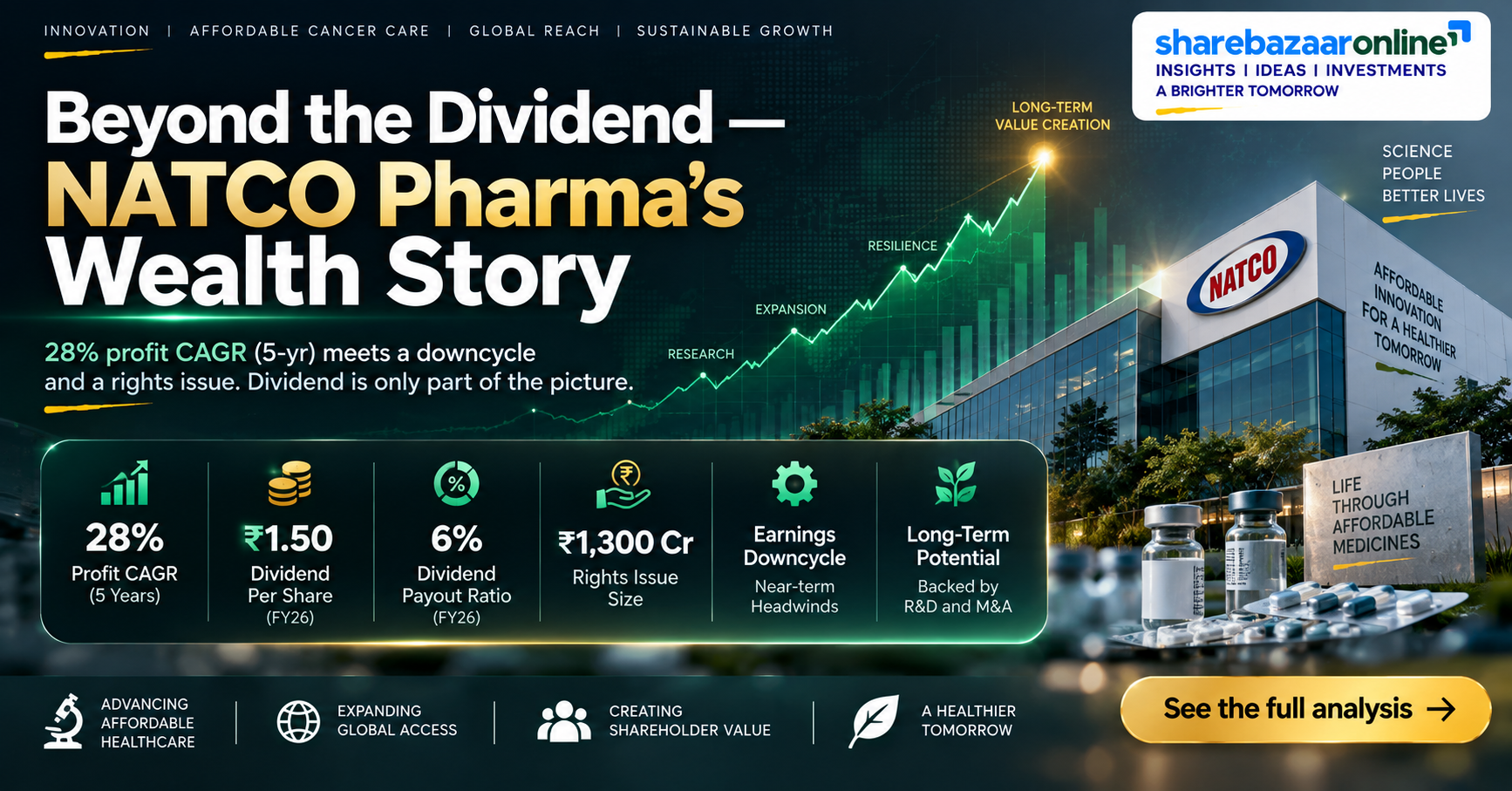
Dividend Snapshot
NATCO Pharma Limited (NSE: NATCOPHARM, BSE: 524816) declared an interim dividend of ₹1.50 per share for the financial year 2026-27. On the ₹2 face value of each share, this is styled as a 75% dividend — but on the actual traded price, the real cash yield is far smaller, which is the first thing every investor should understand before the headline number misleads.
Dividend Per Share
₹1.50
Interim dividend for FY 2026-27 (75% on ₹2 face value)
Real Dividend Yield
~0.18%
On CMP of ₹819 (15 Sep 2026) — not 75%
Dividend Type
Interim
Declared at the 14 Aug 2026 board meeting
Estimated Dividend Outflow
~₹27 Cr
On ~17.9 crore shares outstanding
Record Date
20 August 2026
Thursday (as fixed by the company)
Payment Started
26 August 2026
Payment of the interim dividend commenced from this date
Dividend Announcement Summary
On 14 August 2026, the Board of Directors of NATCO Pharma declared an interim dividend of ₹1.50 per equity share (75% of the ₹2 face value) for FY 2026-27. The company fixed Thursday, 20 August 2026 as the record date to identify eligible shareholders, and payment of the dividend began from 26 August 2026.
The declaration was made on the same day the company reported its Q1 FY27 (quarter ended June 2026) results and hosted its earnings call. This timing matters: the interim dividend was announced against a backdrop of a sharp year-on-year decline in quarterly revenue and profit, and only weeks before the board separately approved a rights issue of up to ₹1,300 crore (draft letter filed 9 September 2026). In other words, NATCO chose to return a small amount of cash to shareholders even as it prepared to raise a much larger amount from those same shareholders — a capital-allocation tension we examine later in this analysis.
Note on the headline "75%": A percentage dividend is always calculated on face value, not market price. ₹1.50 on a ₹2 face value is 75%. But for an investor buying the share at roughly ₹819, the cash return from this dividend is only about 0.18%. Aggregator sites that headline "75% dividend" without this context overstate the real income by hundreds of times.
Key Dates Timeline
Announcement / Board Meeting
14 August 2026
Interim dividend declared with Q1 FY27 results
Record Date
20 August 2026 (Thursday)
Shareholders on the register on this date were eligible
Ex-Dividend Date
20 August 2026 (inferred)
Under India's T+1 settlement, the ex-date typically coincides with the record date; the company circular stated the record date only
Payment Date
From 26 August 2026
Dividend payout to eligible shareholders commenced
All of these dates have now passed. Eligibility for this particular interim dividend was determined by holdings as of the 20 August 2026 record date; investors buying the share after the ex-date did not receive this specific payout.
Dividend Yield Analysis
This is where the "75%" headline collapses. Dividend yield measures the cash you receive against the price you actually pay for the share. It is calculated as (Dividend Per Share ÷ Market Price) × 100.
Yield on Latest Price
~0.18%
₹1.50 ÷ ₹819 (CMP, 15 Sep 2026)
Yield on Announcement-Day Price
~0.17%
₹1.50 ÷ ~₹900 (approx. price around 14 Aug 2026)
Reality check: The 75% figure is the dividend as a percentage of the ₹2 face value. The real yield of about 0.18% is what a buyer at today's price earns in cash from this interim payout. Even on a full-year basis, NATCO's trailing dividend yield sits in the 0.6%–0.7% range — below the roughly 0.8% average yield for the Indian pharmaceuticals sector (Simply Wall St). NATCO is not, and has never marketed itself as, a high-yield income stock. It is a growth-and-reserves company that pays a token dividend.
Why the yield looks even thinner now: Part of the reason the trailing yield has ticked up recently is not a bigger dividend — it is a falling share price. The stock is down from a 52-week high of ₹1,227 to around ₹819, roughly a third off its peak. A higher yield born of a falling price is a warning sign to read carefully, not a reward.
Dividend History Analysis
NATCO has paid dividends consistently for over a decade, but the amounts are modest and the payout ratio has fallen sharply in recent years. Here is the recent picture (per share, face value ₹2):
| Ex / Record Date | Amount (₹) | Type |
|---|---|---|
| 20 Aug 2026 | 1.50 | Interim (FY27) |
| Feb 2026 | 1.50 | Interim (FY26) |
| Nov 2025 | 1.50 | Interim (FY26) |
| 19 Aug 2025 | 2.00 | Interim (FY26) |
| Feb 2025 | 1.50 | Interim (FY25) |
| Nov 2024 | 1.50 | Interim (FY25) |
| Aug 2024 | 3.00 | Interim (FY25) |
| Aug 2023 | 7.00 | Large interim (FY24) |
| FY23 (multiple) | ~5.50 | Interims (FY23) |
Source: TipRanks / aggregator dividend records, cross-checked with Screener.in payout ratios. Amounts across aggregators occasionally differ; figures are indicative.
The forensic finding aggregators miss: At the August slot, this year's interim was cut from ₹2.00 (August 2025) to ₹1.50 (August 2026) — a 25% reduction in the same-period payout. Most wire and aggregator write-ups simply report "₹1.50 interim, 75%" without flagging that this is a lower amount than the comparable dividend a year earlier.
Payout ratio trend (consolidated, per Screener.in): The dividend payout ratio has compressed from 48% in FY22 to just 6% in FY25 and 6% in FY26. NATCO is retaining almost all of its profit. Classification: Consistent but modest (low-payout) payer — regular in frequency, but deliberately small relative to earnings, with a visible reduction at the latest August payout.
Financial Performance Analysis
The dividend cut cannot be read in isolation from the profit-and-loss statement. NATCO's earnings are in a visible downcycle (all figures consolidated, ₹ crore, per Screener.in):
Revenue (Full Year)
FY26: ₹4,078 Cr
FY25: ₹4,430 Cr → down ~7.9%
Net Profit (Full Year)
FY26: ₹1,418 Cr
FY25: ₹1,883 Cr → down ~24.7%
Q1 FY27 Revenue
₹735 Cr
Q1 FY26: ₹1,329 Cr → down ~44.7%
Q1 FY27 Net Profit
₹206 Cr
Q1 FY26: ₹480 Cr → down ~57.1%
Operating leverage worked in reverse. As revenue fell, margins fell faster: quarterly operating margin (OPM) dropped from about 43% in Q1 FY26 to roughly 25% in Q1 FY27. When a high-margin, low-competition product line normalises, profit falls much more steeply than sales — exactly what is showing up here.
The core reason: NATCO's profits over FY24–FY25 were inflated by a limited-competition window on generic lenalidomide (a generic of Revlimid) in the US. As that exclusivity window fades and pricing normalises, the extraordinary margins compress. The FY24 OPM of 44% and FY25 OPM of 50% were the peak; the return toward the mid-30s (FY26 OPM ~36%) and lower quarterly readings reflects that normalisation. This is a structural earnings reset, not a one-quarter blip, and it is the backdrop against which the ₹1.50 interim should be read.
Longer-term context: Despite the current downcycle, NATCO has still compounded net profit at roughly 28% CAGR over five years and 25% over ten years (Screener.in). The business is not weak — but investors should not extrapolate the peak-exclusivity earnings of FY24–FY25 forward.
Cash Flow Analysis
Reported profit is an accounting opinion; cash is the fact that funds a dividend. On the cash-flow test, NATCO looks strong (consolidated, ₹ crore, per Screener.in):
Operating Cash Flow (FY26)
₹1,768 Cr
FY25: ₹1,697 Cr — cash generation held up even as profit fell
Free Cash Flow (FY26)
₹1,379 Cr
FY25: ₹1,300 Cr
Cash conversion is excellent. NATCO's operating cash flow was about 148% of operating profit in FY26 (CFO/OP), meaning it converted more than 100% of reported operating profit into actual cash — a healthy sign that profits are backed by real receipts, not just accruals or receivables build-up.
How the dividend is funded: The full interim outflow of about ₹27 crore is funded comfortably from current-year free cash flow — FY26 FCF of ₹1,379 crore covers this payout roughly 51 times over. There is no reliance on borrowings, asset sales, or reserves to pay this dividend. The dividend is tiny precisely because the company is choosing to retain almost all of that cash for growth, M&A and its planned demerger, rather than because it cannot afford more.
Balance Sheet Strength
Reserves (FY26)
₹9,185 Cr
Up from ₹7,571 Cr in FY25
Investments (FY26)
₹3,127 Cr
Jumped from ₹474 Cr — reflects the Adcock Ingram stake and other investments
Borrowings (FY26)
₹714 Cr
Up from ₹279 Cr in FY25 — still low, but more than doubled
Book Value / Return Ratios
₹515 / share
ROE ~17.1%, ROCE ~17.4% (FY26)
Screener.in flags NATCO as "almost debt-free." Even after borrowings rose to ₹714 crore, that is modest against ₹9,185 crore of reserves and ₹1,379 crore of annual free cash flow. The balance sheet can easily sustain the current dividend many times over. The nuance to watch: borrowings more than doubled and investments surged, showing the company is deploying capital into acquisitions and stakes (Adcock Ingram, eGenesis) rather than into larger shareholder payouts — and it is simultaneously seeking fresh equity via a rights issue.
Dividend Sustainability Analysis
We test sustainability across four independent coverage measures for the ~₹27 crore interim outflow:
1. Earnings Coverage
~42.6x
TTM EPS ₹63.89 ÷ DPS ₹1.50. Even on the weak Q1 FY27 EPS of ₹11.53, coverage is ~7.7x
2. Operating Cash Flow Coverage
~66x
FY26 OCF ₹1,768 Cr ÷ ~₹27 Cr outflow
3. Free Cash Flow Coverage
~51x
FY26 FCF ₹1,379 Cr ÷ ~₹27 Cr outflow
4. Liquidity / Investments Coverage
~116x
FY26 investments ₹3,127 Cr ÷ ~₹27 Cr outflow
Verdict: Sustainable. On pure affordability, this dividend is never in question — it is covered dozens of times over by earnings, cash flow and reserves. The real issue is not whether NATCO can pay but how little it chooses to pay. With a 6% payout ratio and profits many multiples of the outflow, the constraint on this dividend is management's capital-allocation preference, not the balance sheet. Investors seeking rising income should note that even a "sustainable" dividend can be a deliberately small one.
Peer Comparison
| Company | Approx. Dividend Yield | Notes |
|---|---|---|
| NATCO Pharma | ~0.6%–0.7% | Low payout (~6%); regular but modest |
| Alembic Pharma | ~1.22% | Highest yield in this peer set |
| Ajanta Pharma | ~1.0%–1.1% | Payout ~33–36% |
| Torrent Pharma | ~0.99% | Consistent payer |
| Alkem Labs | ~0.81% | Above sector average |
| Divi's Labs | Low (premium valuation) | Payout ~50%, but rich P/E keeps yield low |
| Ipca Labs | ~0.28% | Among the lowest in the set |
Yields are indicative, sourced from Wisesheets / Simply Wall St / aggregator data and vary with price. Pharmaceuticals-sector average yield is ~0.8% (Simply Wall St).
Takeaway: NATCO's yield sits at the lower end of its peer group and below the sector average. On return ratios, NATCO's ROE (~17%) and ROCE (~17%) are respectable but no longer at the peak levels of its lenalidomide window. The comparison confirms that NATCO is priced and managed as a growth/R&D pharma, not a dividend-income name — investors comparing it to higher-yielding peers should expect a smaller and less predictable payout.
Promoter Impact Analysis
Promoter Holding (Jun 2026)
49.41%
Estimated promoter share of dividend: ~₹13.3 Cr
Public Holding (Jun 2026)
27.97%
Estimated public share of dividend: ~₹7.5 Cr
Of the ~₹27 crore total interim outflow, the promoter group receives roughly ₹13.3 crore (49.41%), with the balance split across FIIs (~17%), DIIs (~5.6%) and public shareholders (~28%). Because the payout is small and the promoter stake is just under half, this dividend does not meaningfully skew value toward insiders — both promoter and minority shareholders receive the same ₹1.50 per share. The more relevant point for minority investors is the opposite: with a low payout and a pending rights issue, minority shareholders who do not subscribe to the rights could see their stake diluted, while the token dividend does little to offset that. Note also the steady, gradual decline in promoter holding (from ~49.7% to 49.41% over the past two years).
Taxation Analysis
Since the abolition of the Dividend Distribution Tax (FY 2020-21), dividends are fully taxable in the shareholder's hands at their applicable income-tax slab rate. There is no separate flat rate and no exemption specific to dividend income for resident individuals.
TDS Threshold (Section 194)
₹10,000 per company / year
Raised from ₹5,000 by Budget 2025, effective 1 April 2025 (FY 2025-26)
TDS Rate
10% (with PAN)
20% without PAN; non-residents ~20% under Section 195, subject to DTAA
Worked example (protocol illustration — 30% slab):
Investor owns 1,000 shares of a company paying ₹10 per share.
• Gross dividend = 1,000 × ₹10 = ₹10,000
• TDS at 10% (dividend exactly meets the threshold; applies once it exceeds ₹10,000) — on ₹10,001+ a 10% deduction would apply
• Tax at 30% slab = ₹3,000
• Net in hand after tax = ₹7,000
• Effective yield depends on the purchase price of the shares.
NATCO-specific example (this ₹1.50 interim, 30% slab):
Investor owns 1,000 NATCO shares.
• Gross dividend = 1,000 × ₹1.50 = ₹1,500
• TDS = Nil (well below the ₹10,000 per-company threshold)
• Tax at 30% slab = ₹450
• Net in hand = ₹1,050
Investors in lower slabs pay proportionately less; those below the taxable limit can submit Form 15G/15H to avoid TDS. This is general information, not tax advice.
Key Risks
- Lenalidomide earnings cliff: A large share of the FY24–FY25 profit surge came from limited-competition generic lenalidomide in the US. As that window closes and pricing normalises, profit is resetting lower — Q1 FY27 PAT already fell ~57% year-on-year.
- Rights-issue dilution: The board approved a rights issue of up to ₹1,300 crore (draft filed 9 September 2026). Shareholders who do not subscribe face dilution of their ownership and per-share metrics.
- USFDA / regulatory risk: NATCO's Parawada formulations facility received a USFDA Form 483 with four observations after an August 2026 inspection. Any escalation could affect US supply and approvals for a company heavily dependent on the US market.
- Low and falling payout: With a ~6% payout ratio and the August interim cut from ₹2.00 to ₹1.50, income-focused investors face an unpredictable and shrinking dividend, not a growing one.
- Concentration and lumpiness: NATCO's earnings are lumpy and product-launch driven; a few key US filings and para-IV opportunities can swing quarterly results dramatically, as the Q1 numbers show.
- Execution risk on restructuring: The proposed Natco Crop Health (agro) demerger and the Adcock Ingram stake increase add integration and execution risk, and could change the future dividend profile.
What To Monitor
- Rights issue terms: Watch the final rights-issue price, ratio, record date and use of proceeds — these will materially affect per-share value and future capital returns.
- Quarterly margin recovery: Track whether operating margin stabilises above the ~25% seen in Q1 FY27, and whether new US launches replace fading lenalidomide economics.
- USFDA resolution: Monitor the outcome of the Parawada Form 483 and any subsequent inspection classifications across NATCO's US-facing plants.
- Adcock Ingram and eGenesis: Watch how the increased Adcock stake (35.75% → 49%) and new investments contribute to consolidated earnings and cash flow.
- Agro demerger progress: Follow the Natco Crop Health demerger scheme and how the post-demerger structure treats dividends.
- Dividend policy signals: Watch whether the payout ratio stays near 6% or the company re-rates its distribution policy after the rights issue and restructuring settle.
Conclusion
NATCO Pharma's FY27 interim dividend of ₹1.50 per share reads as a big "75%" number but delivers a real cash yield of only about 0.18% at the current price. It is comfortably affordable — covered dozens of times over by earnings, free cash flow and reserves — but it is also smaller than last year's August payout of ₹2.00, and it sits on a payout ratio of just 6%.
The more important context is what surrounds the dividend: a Q1 FY27 earnings collapse (revenue down ~45%, profit down ~57%) as the lenalidomide window normalises, a planned rights issue of up to ₹1,300 crore, an agro-business demerger, and active deployment of capital into acquisitions. NATCO is choosing to retain cash and raise more rather than lift its payout — a defensible growth strategy, but one that makes this a poor fit for investors chasing dividend income.
Positives: strong cash conversion, near-debt-free balance sheet, deep reserves, long-term profit compounding, and a fully affordable dividend. Negatives: tiny and reduced payout, earnings downcycle, rights-issue dilution, regulatory overhang, and lumpy US-dependent profits. We present the evidence; the decision is yours.
Frequently Asked Questions
What dividend has NATCO Pharma announced?
What is the real dividend yield on NATCO Pharma?
What was the record date for the NATCO Pharma dividend?
What was the ex-dividend date?
When was the NATCO Pharma dividend paid?
Who was eligible for this dividend?
How is this dividend taxed?
Is the NATCO Pharma dividend sustainable?
Did NATCO Pharma cut its dividend?
What is NATCO Pharma's dividend history?
Why did NATCO Pharma's profit fall so sharply?
Why is NATCO paying a dividend and running a rights issue at the same time?
What should investors monitor after this dividend?
Disclaimer
This article is for informational and educational purposes only and does not constitute investment, financial, tax or legal advice, nor a recommendation to buy, sell or hold any security. ShareBazaar Online is not a SEBI-registered investment adviser. Dividend figures, dates and the ₹1.50 per share interim are taken from NATCO Pharma's official record-date intimation dated 14 August 2026. Financial data, market prices, ratios, dividend history, shareholding and peer figures are sourced from third-party providers including Screener.in, TipRanks, Simply Wall St, Wisesheets and exchange filings, and are indicative and subject to revision. The announcement-day share price and some historical figures are approximate. Computed ratios (yields, coverage, outflow) are our own estimates based on these inputs. Markets carry risk; the value of investments can go down as well as up. Please verify all figures independently and consult a qualified, registered financial adviser before making any investment decision.