
Dividend Snapshot
AVG Logistics Limited (NSE: AVG | BSE: 543910 | ISIN: INE680Z01018) has recommended a Final Dividend of ₹1.20 per equity share for the financial year ended 31 March 2026. On a face value of ₹10, that headline works out to a 12% dividend — but at the current market price of about ₹180, the money actually landing in a shareholder's account is a yield of only 0.67%. That gap between the "12%" headline and the real cash return is the single most important number to understand here.
The Headline vs The Reality
Dividend on face value: 12% (₹1.20 on ₹10)
Real dividend yield (on ₹180 CMP): 0.67%
Dividend type: Final Dividend (annual)
For FY: 2025–26
Money Involved
Estimated total payout: approx. ₹2.24 crore
Payout ratio (reported PAT): about 8.6%
Payout ratio (core, one-time stripped out): about 22%
Record date: 18 September 2026
Dividend Announcement Summary
At its board meeting on 14 August 2026, the Board of Directors of AVG Logistics recommended a final dividend of ₹1.20 per equity share of ₹10 face value for FY2025–26. As with every final dividend, the payment is subject to shareholder approval at the company's 17th Annual General Meeting, scheduled for Friday, 25 September 2026.
The same board meeting was unusually busy. Alongside the dividend, the board also cleared an increase in authorised share capital from ₹21 crore to ₹25 crore, an Employee Stock Option Scheme (ESOS 2026) covering up to 9,50,000 options, and two board-level appointments. In other words, the dividend is a small piece of a wider capital-and-governance agenda — a point worth keeping in mind when judging how much conviction sits behind the payout itself.
One layer of context matters a lot here: just weeks earlier, in June 2026, AVG raised roughly ₹52.93 crore from shareholders through a Rights Issue at ₹145 per share. So the same shareholders who put fresh money into the company in June are, a quarter later, being offered a token ₹1.20 back. We unpack this tension in the Capital Allocation and Sustainability sections below.
Key Dates Timeline
Announcement Date
14 August 2026 — Board recommended the dividend.
Record Date
18 September 2026 — the date on which shareholders on the register are eligible for the dividend.
Ex-Dividend Date
18 September 2026 (expected) — under India's T+1 settlement the ex-date and record date generally fall on the same day. To be confirmed against the official NSE/BSE corporate-action circular.
AGM & Payment
AGM: 25 September 2026. Payment must follow within 30 days of approval — so on or before roughly 24 October 2026. AVG has historically paid in late October. Exact payment date: Not yet officially confirmed by the company.
Dividend Yield Analysis
This is where retail investors are most often misled. A "12% dividend" sounds enormous. It is not. That 12% is calculated on the ₹10 face value of the share — an accounting reference number, not what you pay to own the stock. The number that matters is the yield on the market price you actually invest.
The Yield Maths
Face-value "headline": ₹1.20 ÷ ₹10 = 12%
Yield at current price (₹180): ₹1.20 ÷ ₹180 = 0.67%
Yield at approx. announcement-date price (₹175): about 0.69% (announcement-day close approximate; not independently verified to the tick)
What 0.67% Actually Means
A ₹1,00,000 investment in AVG at ₹180 fetches roughly ₹667 in gross dividend a year — before any tax. A basic bank savings account or liquid fund pays multiples of that. AVG is clearly not a dividend-income stock; any investment case has to rest on business growth, not the payout.
Dividend History Analysis
AVG Logistics is a relatively new dividend payer. The company paid nothing for the first several years after listing and only began distributing from FY2022–23. Since then it has paid every year — but the amount has flatlined at ₹1.20 for three straight years.
| Financial Year | Dividend / Share | On Face Value | Payout Ratio |
|---|---|---|---|
| FY2021–22 and earlier | Nil | — | 0% |
| FY2022–23 | ₹1.00 | 10% | approx. 15% |
| FY2023–24 | ₹1.20 | 12% | approx. 5% |
| FY2024–25 | ₹1.20 | 12% | approx. 8% |
| FY2025–26 (current) | ₹1.20 | 12% | approx. 8.6% |
Classification: Consistent but Flat Payer
Four consecutive years of dividends is a genuine tick in AVG's favour — there have been no cuts or suspensions. But there is no growth: the dividend has been frozen at ₹1.20 since FY2023–24 even as reported profit rose. The payout ratio has stayed in single digits, telling you management wants to keep the vast majority of earnings inside the business for expansion. Treat this as a symbolic, habit-forming dividend, not an income stream that will compound.
Financial Performance Analysis
Here lies the most important forensic finding in this entire dividend. AVG's FY2025–26 headline profit looks solid — consolidated PAT of ₹26.17 crore on revenue of ₹557.41 crore. But a large slice of that profit did not come from moving trucks.
The One-Time Gain That Flattered FY26
FY26 consolidated profit before tax was ₹34.46 crore. Of that, ₹21.19 crore was a one-off, non-cash gain on reversal of a lease (the Indian Railways Yesvantpur route contract was terminated). That single item is roughly 61.5% of pre-tax profit.
Strip it out and core operating PBT was closer to ₹13.3 crore. The reported number nearly doubled the underlying reality.
Operating Leverage: Revenue Flat, Margins Squeezed
Consolidated revenue barely moved — from ₹551 crore (FY25) to ₹556–557 crore (FY26), roughly flat. Operating margins slipped: the standalone operating-profit margin fell from around 16–17% to under 15%, and the March 2026 quarter alone saw margins collapse to about 8.4%. Rising interest costs (₹31 crore) and depreciation (₹46 crore) continue to eat into a thin operating base.
Latest Quarter (Q1 FY2026–27)
For the quarter ended June 2026, consolidated PAT was ₹6.46 crore on revenue of ₹132.48 crore — up roughly 30% year-on-year, but down sharply versus the March quarter (which carried the one-time gain). The trailing-twelve-month profit trend is negative once the lease gain rolls off. This is the operational backdrop against which the dividend is being paid.
Cash Flow Analysis
Reported profit is an opinion; cash is fact. So how does AVG's cash picture actually look, and is the dividend funded by real cash?
The Good: Operating Cash Is Real
Standalone operating cash flow for FY26 was around ₹49 crore — comfortably positive and higher than reported profit, which is reassuring (it means earnings are converting to cash). Against a dividend outflow of just ₹2.24 crore, operating cash covers the payout roughly 22 times over. On this test alone, the dividend is trivially affordable.
The Catch: Free Cash Flow Is Negative
After heavy investing (roughly ₹74 crore of outflow, largely capex and expansion), free cash flow for FY26 was negative — about −₹24 crore. The company is spending more than it generates. The gap was plugged by financing — including the June 2026 rights issue. So the dividend is funded out of operating cash, but the overall cash cushion depends on raising external money, not on surplus free cash.
Receivables Watch
Debtor days have crept up steadily — from around 105 days (FY23) to 154 days (FY26). Money is increasingly tied up in receivables even as revenue growth stalls, which is a drag on future cash generation and a classic pressure point for an asset-heavy logistics operator.
Balance Sheet Strength
Debt Position
Borrowings stood at around ₹218 crore (standalone, FY26) against reserves of about ₹256 crore. Interest cost of roughly ₹31 crore is heavy relative to a modest operating base — Screener flags AVG for a low interest-coverage ratio. This is a leveraged, capital-intensive business, not a debt-light cash machine.
Equity & Liquidity
The June 2026 rights issue lifted paid-up capital and added a fresh ₹52.93 crore of equity, of which about ₹16 crore was still unutilised (held in bank deposits) at quarter-end. Book value is around ₹145 per share. Net cash flow for the year was near zero — liquidity is adequate for a ₹2.24 crore dividend but not abundant.
Return Ratios: Weak
This is the balance-sheet weak spot. ROE is just 3.80% and ROCE 9.20% (latest year) — both well below the quality end of the logistics sector. A company earning single-digit returns on capital while carrying meaningful debt has limited room to grow the dividend generously without first fixing profitability.
Dividend Sustainability Analysis
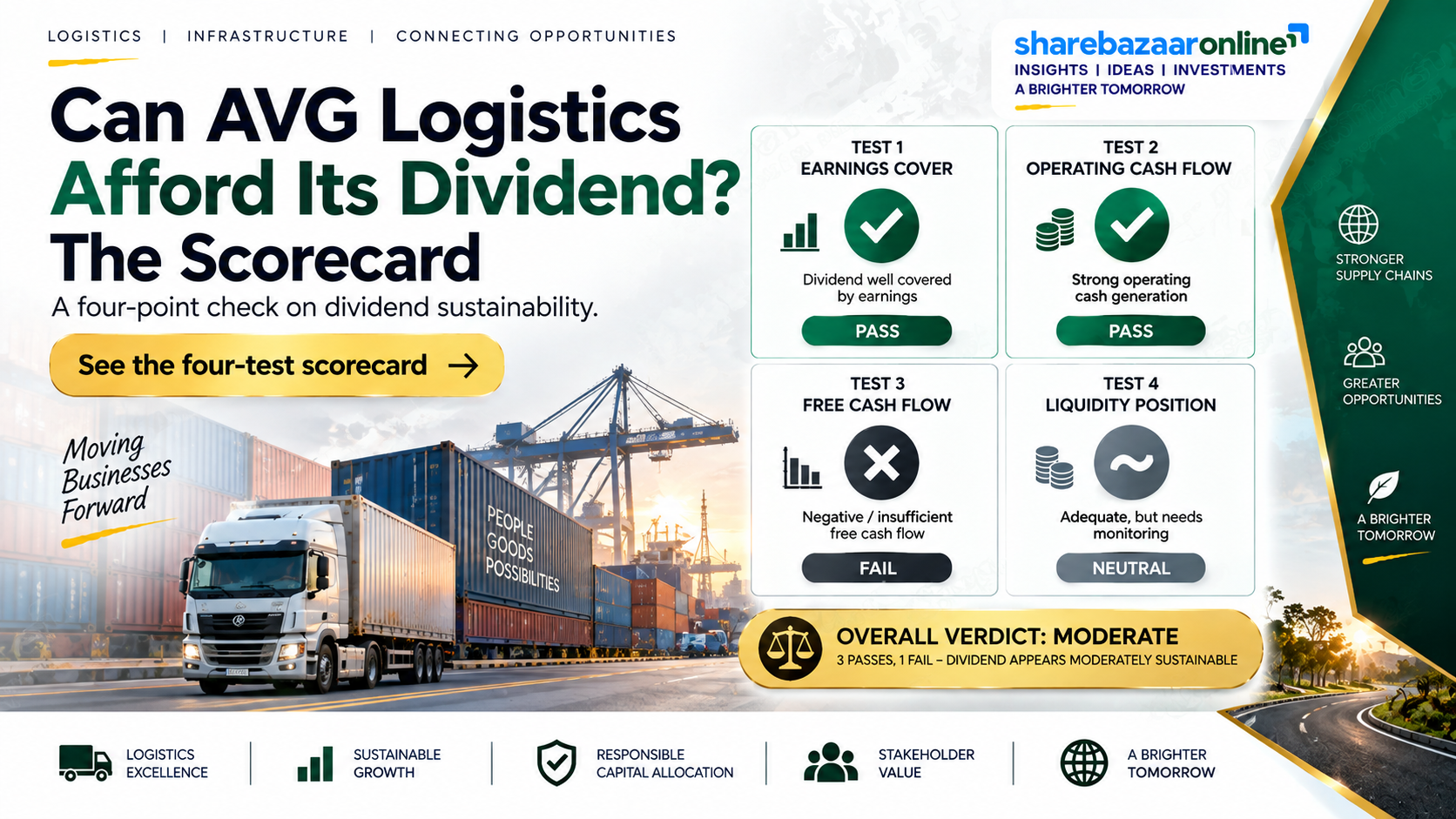
We run every dividend through a four-test scorecard: earnings coverage, operating-cash coverage, free-cash-flow coverage, and liquidity. Here is how AVG scores.
Test 1 — Earnings Coverage: PASS
Reported EPS of about ₹17.4 covers the ₹1.20 dividend roughly 14 times. Even stripping out the one-time lease gain, core earnings cover it about 4.5 times. Comfortable.
Test 2 — Operating Cash: PASS
₹49 crore of operating cash against a ₹2.24 crore payout is roughly 22x cover. No stress at all on this measure.
Test 3 — Free Cash Flow: FAIL
FY26 free cash flow was negative (about −₹24 crore). The dividend is not covered by surplus free cash — the company is in a capex-and-fundraise phase.
Test 4 — Liquidity: ADEQUATE
Post-rights liquidity easily absorbs ₹2.24 crore, but the cushion leans on the equity just raised rather than on internally generated surplus.
Verdict: Moderately Sustainable
Because the dividend is so tiny (₹2.24 crore) and operating cash so much larger, there is little near-term risk of a cut. But the label is "Moderately Sustainable," not "Sustainable": the payout survives on the sheer smallness of the cheque, not on a business throwing off free cash. If profitability stays weak and capex stays high, the dividend will most likely stay frozen at ₹1.20 rather than grow.
Peer Comparison
| Company | Dividend Yield | ROE | Notes |
|---|---|---|---|
| AVG Logistics | 0.67% | 3.80% | Small-cap; leveraged; flat dividend |
| VRL Logistics | approx. 1.68% | approx. 20.7% | Sector quality anchor |
| Transport Corp of India (TCI) | approx. 1.11% | approx. 17.8% | Near debt-free |
| Blue Dart Express | approx. 0.49% | approx. 15.8% | Premium express, DHL-backed |
| Mahindra Logistics | approx. 0.61% | low | Turnaround phase |
| Delhivery | 0.00% | approx. 1.8% | No dividend; growth-focused |
Peer figures are drawn from third-party market data (Screener, Univest, MarketsMojo) and are approximate as of mid-2026. The read-through is clear: AVG's yield sits at the low end of the pack, and its ROE is a fraction of quality operators like VRL and TCI. Investors who want dividend-plus-quality in logistics have historically looked to VRL or TCI; AVG is neither the highest yielder nor the highest-return name in its own sector.
Promoter Impact Analysis
Who Gets The Cash
Promoters held about 41.23% of AVG as of June 2026. On a ₹2.24 crore payout, their share of the dividend is roughly ₹92.6 lakh. Non-promoter shareholders (public, FIIs at 5.62%, DIIs at 16.89%) collectively receive the remaining ₹1.32 crore. Given the small size, no group is being meaningfully enriched by this dividend — it is symbolic across the board.
Two Red Flags Worth Naming
First, promoter holding dropped from 51.20% to 41.23% in the June 2026 quarter — a near-10-point fall, largely because the promoter did not fully absorb the rights issue while DIIs stepped in. Second, and more serious, about 66.7% of the promoters' remaining stake is pledged. A high pledge level is a governance and balance-sheet caution flag that dwarfs anything positive in a ₹1.20 dividend.
Taxation Analysis
Since April 2020, dividends in India are taxed in the hands of the investor, not the company. There is no separate Dividend Distribution Tax any more. The key rules:
• The entire dividend is added to your income and taxed at your applicable slab rate (0%, 5%, 20%, 30% plus surcharge and cess).
• The company deducts TDS at 10% under Section 194 if your total dividend from that company in a financial year exceeds ₹10,000 (this threshold was raised from ₹5,000 with effect from FY2025–26). Submit Form 15G/15H if eligible to avoid TDS.
• TDS is only an advance; the final liability is settled at your slab when you file returns.
Worked Example (10,000 shares, 30% slab investor)
Gross dividend: 10,000 × ₹1.20 = ₹12,000
TDS at 10% (because > ₹10,000): ₹1,200 deducted at source — you receive ₹10,800 upfront.
Total tax at 30% slab: ₹3,600
Net dividend in hand after full tax: ₹8,400
Effective post-tax yield (on ₹18,00,000 invested at ₹180): about 0.47%. For a 30%-slab investor, the real, after-tax cash return is under half a percent — a stark illustration of why the "12%" headline is meaningless.
Key Risks
1. Earnings quality. About 61% of FY26 pre-tax profit came from a one-time lease-reversal gain. As that rolls off, reported profit is set to fall sharply, and the trailing-twelve-month profit trend is already negative.
2. High promoter pledge. Roughly two-thirds of the promoter stake is pledged — a material governance and financial-stress signal.
3. Weak returns and leverage. ROE of 3.80% with roughly ₹218 crore of borrowings and low interest coverage leaves little margin for error if freight demand softens.
4. Negative free cash flow. Heavy capex means the company consumes cash and depends on external fundraising — a ₹52.93 crore rights issue was needed in June 2026.
5. Stretched receivables. Debtor days at 154 (up from 105 in FY23) tie up working capital and raise the risk of bad debts in a competitive, fragmented logistics market.
What To Monitor
1. Core operating profit in coming quarters, excluding one-time items — is the underlying trucking-and-warehousing business actually growing?
2. Promoter pledge level in each quarterly shareholding filing — any rise is a warning; a reduction is a positive.
3. Free cash flow turning positive — the marker of when the current capex cycle starts paying back.
4. Debtor days — whether receivables stabilise or keep climbing.
5. Rights-issue proceeds deployment and ROCE — whether the fresh ₹52.93 crore lifts returns, and whether the dividend is ever raised above ₹1.20.
Conclusion
AVG Logistics' ₹1.20 final dividend for FY2025–26 is best understood as a gesture of continuity, not a return of wealth. The "12%" headline collapses to a real yield of about 0.67%, and to roughly 0.47% after tax for a top-slab investor.
The positives: four straight years of dividends with no cuts, easy earnings and operating-cash coverage, and a payout so small it carries almost no risk of being withdrawn.
The negatives: more than half of FY26 profit was a one-off lease gain; free cash flow is negative; ROE is a weak 3.80%; roughly two-thirds of the promoter stake is pledged; and the company had to raise ₹52.93 crore from shareholders in June just before offering ₹2.24 crore back. Paying a dividend and running a rights issue in the same quarter is a capital-allocation contradiction worth thinking about.
For anyone screening AVG on the "12% dividend" tag, the honest takeaway is that this is a growth-and-turnaround story with governance flags — not a dividend-income holding. We present the facts; the decision is yours.
Frequently Asked Questions
What dividend has AVG Logistics announced for FY2025–26?
What is the real dividend yield of AVG Logistics?
What is the record date for the AVG Logistics dividend?
What is the ex-dividend date?
When will the AVG Logistics dividend be paid?
Who is eligible to receive the dividend?
How is the AVG Logistics dividend taxed?
Is the AVG Logistics dividend sustainable?
What is AVG Logistics' dividend history?
Why did AVG's reported FY26 profit look strong?
Why did AVG pay a dividend right after a rights issue?
How does AVG's dividend compare with logistics peers?
What should AVG Logistics investors monitor going forward?
Disclaimer
This article is for informational and educational purposes only and does not constitute investment advice, a recommendation, or an offer to buy or sell any security. ShareBazaar Online is not a SEBI-registered investment adviser. Figures are drawn from AVG Logistics' stock-exchange filings and third-party financial data sources (including Screener.in and public market data providers); some market prices and peer metrics are approximate and were not independently verified to the tick. Dividend payment remains subject to shareholder approval at the AGM and to any changes the company may notify. Tax treatment depends on your individual circumstances. Please verify all figures with official NSE/BSE disclosures and consult a qualified financial adviser before making any investment decision. Investments in securities are subject to market risks.