
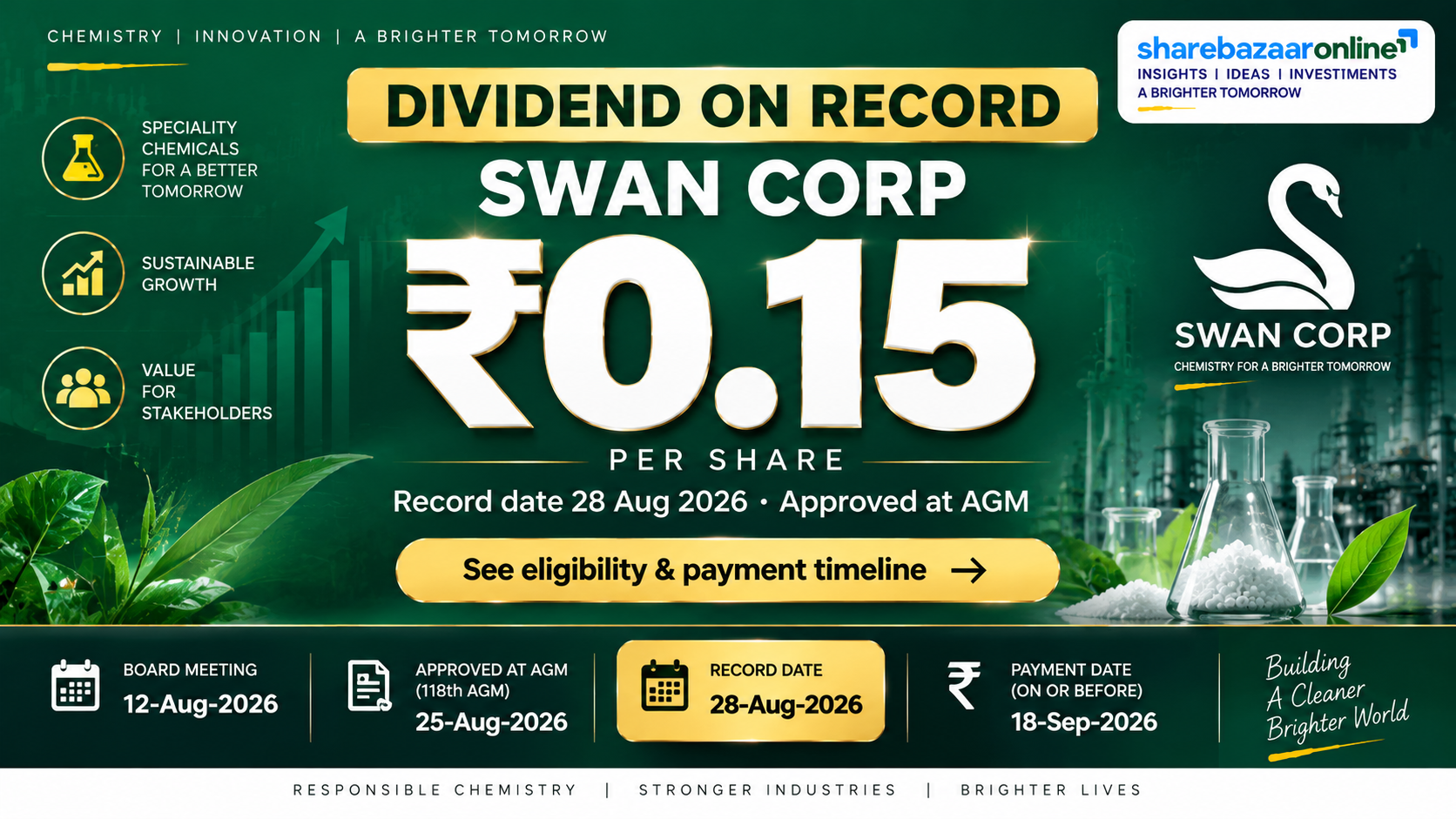
Dividend Snapshot
Swan Corp Limited (formerly Swan Energy Limited), NSE: SWANCORP, BSE: 503310, ISIN INE665A01038, has paid a final dividend of ₹0.15 per equity share for FY 2025-26. Because the face value of the share is only ₹1, the company can describe this as a headline “15% dividend”. On the actual market price, the real cash yield works out to roughly 0.05% — a gap every retail investor should understand before reading the headline.
Dividend Per Share
₹0.15
Final dividend, FY 2025-26 (15% on ₹1 face value)
Real Dividend Yield
~0.05%
On market price of about ₹291 per share
Record Date
28 Aug 2026
Book closure 29 Aug – 04 Sep 2026
Total Dividend Outflow
~₹4.7 Cr
On about 31.3 crore shares
One-line takeaway: A tiny, symbolic payout from a diversified group whose consolidated core operations actually ran at an operating loss in FY26, with reported profit propped up almost entirely by non-operating “other income”.
Dividend Announcement Summary
On Friday, 29 May 2026, the Board of Directors of Swan Corp Limited recommended a final dividend of Re. 0.15 (Fifteen Paise) per equity share of ₹1 each, fully paid up (15%), for the financial year 2025-26. The recommendation was made under Regulations 30(6) and 43(1) of the SEBI (LODR) Regulations, 2015, and was subject to shareholder approval at the Annual General Meeting.
What was announced
- Dividend type: Final dividend
- Amount: ₹0.15 per share (15% on ₹1 face value)
- Financial year: FY 2025-26
- Announcement date: 29 May 2026
Approval status
- The dividend was placed for approval at the 118th AGM held on 04 September 2026.
- As per exchange filings, shareholders approved the ₹0.15 dividend and other resolutions at that AGM.
- Signed by Saptarshi Ganguly, Company Secretary & Compliance Officer.
Context on the name: Swan Energy Limited was renamed Swan Corp Limited with effect from July 2025. The company traces its origins to Swan Mills Limited, incorporated in 1909. It is today a diversified group spanning textiles, an LNG (FSRU) terminal, real estate, chemical distribution and, more recently, shipbuilding and defence.
Key Dates Timeline
Announcement Date
29 May 2026
Record Date
28 Aug 2026
Ex-Date
28 Aug 2026
Under T+1 settlement, ex-date aligns with the record date
Book Closure
29 Aug – 04 Sep 2026
AGM Date
04 Sep 2026
Dividend approved by shareholders
Payment Date
Not Disclosed by Company
Under the Companies Act, a declared dividend must be paid within 30 days of declaration — i.e., broadly by early October 2026
Because the record date of 28 August 2026 has already passed, eligibility is now settled: investors who held shares as of that date were eligible to receive this dividend. Buyers after the ex-date were not.
Dividend Yield Analysis
The face-value illusion
The company’s filing describes the dividend as 15%. That percentage is calculated on the ₹1 face value, not on the market price. This is the single most misunderstood number in Indian dividend reporting. The real question for a shareholder is: how much cash do I get for every rupee I actually invested?
Headline vs reality
- Headline rate on face value: 15%
- Real yield at market price (~₹291): ~0.05%
- Real yield at announcement price (~₹320, estimated): ~0.05%
The headline number is roughly 290 times larger than the real cash yield an investor earns.
Why the yield looks so thin
Swan Corp trades at a high multiple relative to a very small absolute payout. A ₹0.15 dividend against a share price near ₹291 simply cannot produce a meaningful yield. Swan Corp is not, and has never really been, a yield stock — its dividend is symbolic rather than a source of income.
Market price of about ₹291 is the NSE close as reported on 15 September 2026 (cited from Screener.in). The announcement-date price of ~₹320 is an estimate and is not independently confirmed.
Dividend History Analysis
Swan Corp has historically been an irregular and negligible dividend payer. For most of the past decade the consolidated dividend payout ratio has been either near zero or distorted by loss-making years. The company only re-established a small, steady payout in the last two financial years.
| Financial Year | Dividend / Share | Rate on FV ₹1 | Consolidated Payout |
|---|---|---|---|
| FY 2025-26 | ₹0.15 | 15% | ~2% |
| FY 2024-25 | ₹0.10 | 10% | ~0% |
| FY 2023-24 | Nominal / Nil | — | ~1% |
| FY 2019-20 to FY 2022-23 | Largely Nil | — | Loss / negligible |
Per-share and payout history sourced from Screener.in (consolidated). Older years reflect several loss-making periods where payout ratios are not meaningful.
Trend read
- Absolute dividend rose from ₹0.10 to ₹0.15 year-on-year — a 50% increase, but off a tiny base.
- No special dividends, no bonus-adjusted distortions in the recent record.
- Payout ratio remains among the lowest in the market.
Classification
On the available record, Swan Corp is best described as an irregular / token payer. The recent two-year run of small dividends signals intent to maintain a distribution habit, but the amounts are not material to total shareholder return.
Financial Performance Analysis
Consolidated FY26 vs FY25
| Metric (₹ Cr, consolidated) | FY 2025-26 | FY 2024-25 | Change |
|---|---|---|---|
| Revenue | 4,371 | 4,938 | -11.5% |
| Operating Profit | -204 | -141 | Worsened |
| Other Income | 774 | 1,944 | -60.2% |
| Profit Before Tax | 365 | 1,470 | -75.2% |
| Net Profit (PAT) | 271 | 874 | -69.0% |
| EPS (₹) | 8.75 | 24.10 | -63.7% |
Source: Screener.in (consolidated) and company results filing dated 29 May 2026.
The most important line: operating leverage in reverse
Revenue fell 11.5%, but the far bigger issue is that consolidated operating profit was negative (-₹204 Cr). The core businesses did not make an operating profit at all. The reported PAT of ₹271 Cr exists only because of ₹774 Cr of “other income” (non-operating items such as gains, treasury and exceptional entries). Strip out other income and the group would show a large pre-tax loss of roughly -₹409 Cr. This is a serious earnings-quality flag and the central fact behind this year’s profit decline: the collapse in other income (down 60%), not just weaker sales.
Standalone vs consolidated — the part most reports miss
The dividend is declared by the parent (standalone) entity, and standalone actually improved: standalone revenue rose to ₹216 Cr (from ₹135 Cr) and standalone PAT rose to ₹27.6 Cr (from ₹9.05 Cr). So while the consolidated group looks weak, the entity that legally pays the dividend had a better year. This matters for judging affordability, which we return to in the sustainability section.
Cash Flow Analysis
Reported profit is an accounting opinion; cash is fact. Here the two diverge sharply. Despite a reported consolidated PAT of ₹271 Cr, the group’s operating cash flow was negative.
| Cash Flow (₹ Cr, consolidated) | FY 2025-26 | FY 2024-25 |
|---|---|---|
| Operating Cash Flow (OCF) | -14 | -529 |
| Free Cash Flow (FCF) | -221 | 1,311 |
Source: Screener.in cash-flow statement (consolidated). FY25 positive FCF was driven by investing inflows / asset monetisation, not core operations.
Profit vs cash
A positive PAT of ₹271 Cr sitting alongside negative operating cash flow confirms that the reported profit is not being converted into cash. High debtor days of 188 (up from 100) point to working capital tied up in receivables.
How is the dividend funded?
Because FY26 operating cash flow and free cash flow were both negative, the ₹4.7 Cr dividend is not funded from current operating cash generation. It is paid out of accumulated reserves and the balance-sheet liquidity of the parent. The saving grace is that the amount is trivially small relative to the company’s size.
Balance Sheet Strength
Net Worth (Mar 2026)
~₹7,536 Cr
Book Value / Share
~₹240
Borrowings (Mar 2026)
~₹2,130 Cr
Down from ~₹2,823 Cr (FY25) and ~₹3,449 Cr (FY24)
Investments
~₹833 Cr
The positives
- Gross borrowings have been reduced steadily over three years.
- A large net worth of ~₹7,536 Cr and a substantial capital-work-in-progress base (~₹3,997 Cr) tied to the LNG terminal.
- The dividend outflow (₹4.7 Cr) is a rounding error against reserves.
The watch-outs
- ROCE is negative (~-0.6% to -1.6%) and ROE is negative (~-4.5%) — capital is not currently earning a return.
- Screener flags that the company might be capitalising interest cost, which can flatter reported profit.
- Large receivables (188 debtor days) and heavy CWIP mean much of the balance sheet is not yet cash-generative.
Dividend Sustainability Analysis
Four-test scorecard
| Test | Reading | Verdict |
|---|---|---|
| Earnings coverage | Consolidated EPS ₹8.75 covers DPS ₹0.15 ~58x; standalone EPS ~₹0.88 covers it ~5.9x | Pass (on paper) |
| Operating cash flow coverage | FY26 OCF -₹14 Cr — cannot fund the dividend from operations | Fail |
| Free cash flow coverage | FY26 FCF -₹221 Cr — negative | Fail |
| Liquidity / balance-sheet coverage | Investments alone cover the outflow ~177x; net worth ~₹7,536 Cr | Pass |
Verdict: Conditionally Sustainable
The ₹4.7 Cr dividend is so small that affordability is not in doubt — reserves and investments dwarf it many times over, and standalone profit alone (₹27.6 Cr) covers it comfortably. However, it is not backed by operating cash generation: both consolidated OCF and FCF are negative. The right way to read this payout is as a token, reserve-funded distribution, easily maintained at its current size but not a signal of strong underlying cash flows.
Peer Comparison
Swan Corp is a diversified conglomerate (textiles, LNG, real estate, chemicals distribution, shipbuilding) rather than a clean single-sector business, so any peer set is imperfect. On dividend characteristics, the comparison is straightforward: Swan Corp sits at the very bottom of the yield and payout spectrum, and unlike typical dividend payers it currently has negative returns on capital.
| Attribute | Swan Corp | Typical dividend-paying peer |
|---|---|---|
| Dividend yield | ~0.05% | ~1% to 3% |
| Payout ratio (consolidated) | ~2% | ~20% to 40% |
| ROE | ~-4.5% | Positive, often 12%+ |
| ROCE | ~-1% | Positive |
Peer bands are indicative industry ranges for established dividend payers, shown for context; Swan Corp’s figures are from Screener.in (consolidated).
The takeaway: investors who own Swan Corp are clearly not owning it for dividend income. The thesis, if any, rests on the group’s asset value (LNG terminal, real estate, shipbuilding/defence) rather than distributions.
Promoter Impact Analysis
Who receives the dividend
- Promoter holding: 53.96%
- FIIs: ~10.4% | DIIs: ~12.9% | Public: ~22.8%
- Promoter share of the ₹4.7 Cr outflow: ~₹2.5 Cr
Distribution impact
Because the payout is tiny, the promoter’s dividend cheque of ~₹2.5 Cr is immaterial to both the promoter and to minority shareholders. There is no evidence of the dividend being used as a promoter cash-extraction tool here — the amount is simply too small.
The more relevant promoter signals
- Promoter holding has fallen by roughly 10 percentage points over three years (from ~64% to ~54%).
- Screener data indicates promoters have pledged around 39.6% of their holding, and encumbrance-related disclosures were filed in September 2026.
For this company, promoter pledging and the fall in promoter stake are far more important governance signals than the dividend itself.
Taxation Analysis
How dividends are taxed in India (FY 2025-26)
- Dividends are fully taxable in the investor’s hands at their income-tax slab rate (Dividend Distribution Tax was abolished from FY 2020-21).
- TDS under Section 194: 10% is deducted only if total dividend from a single company exceeds ₹10,000 in a financial year (threshold raised from ₹5,000 with effect from 1 April 2025). Without a valid PAN, TDS is 20%.
- NRIs: TDS is generally 20% under Section 195, subject to DTAA relief with Form 10F and a Tax Residency Certificate.
- Report gross dividend under “Income from Other Sources”; TDS is a credit, not a final tax.
Worked example (1,000 shares)
| Item | Value |
|---|---|
| Shares held | 1,000 |
| Dividend per share | ₹0.15 |
| Gross dividend | ₹150 |
| TDS (below ₹10,000 threshold) | ₹0 |
| Tax at 30% slab + 4% cess | ₹46.80 |
| Net dividend after tax | ₹103.20 |
| Net effective yield (on ~₹291/share cost) | ~0.036% |
Even before tax the yield is negligible; after a 30% slab it becomes almost invisible. This underlines that Swan Corp’s dividend has no real income value to a taxable investor.
Key Risks
- Earnings quality: Consolidated operating profit is negative; reported PAT of ₹271 Cr depends almost entirely on ₹774 Cr of other income. If other income normalises, headline profit could turn to a loss.
- Negative cash conversion: Operating cash flow (-₹14 Cr) and free cash flow (-₹221 Cr) are both negative, with high debtor days of 188.
- Negative returns on capital: ROE ~-4.5% and ROCE ~-1% show capital is not currently generating returns.
- Promoter pledging: A large share of promoter holding is reported as pledged (~39.6%), and promoter stake has declined ~10 percentage points over three years.
- Execution risk on large projects: Heavy capital-work-in-progress (LNG terminal, shipbuilding/defence) means value depends on projects being completed and monetised on time.
- Share-price weakness: The stock is down roughly 37% over the past year, reflecting the market’s concern about the operating picture.
What To Monitor
- Return of operating profit: Watch whether quarterly operating profit turns positive so that profit no longer depends on other income.
- Operating cash flow: A shift from negative to positive OCF would be the single most important sign of improving quality.
- Debtor days and working capital: Track whether the 188-day debtor position eases.
- Promoter pledge levels: Any rise or reduction in promoter encumbrance and any further change in promoter holding.
- LNG terminal and shipbuilding/defence progress: Commissioning timelines and cash generation from these large assets.
- Debt trajectory: Whether the multi-year reduction in borrowings continues alongside project spending.
Conclusion
Swan Corp’s FY26 final dividend of ₹0.15 per share is a headline “15%” that translates into a real yield of about 0.05% — a textbook example of the face-value illusion. The payout is easily affordable given the group’s reserves and standalone profit, so it is conditionally sustainable at its current token size. But it should not distract from the more important story in the numbers.
That story is one of weak earnings quality: consolidated operations ran at an operating loss, reported profit was rescued by non-operating other income, and both operating and free cash flow were negative. Returns on capital are negative, and governance signals like promoter pledging deserve attention.
Positives: low, affordable payout; falling gross debt; large asset base and standalone improvement. Negatives: negative operating profit and cash flow, negative ROE/ROCE, promoter pledging, and a sharply lower share price. We present these facts so readers can weigh them for themselves.
Frequently Asked Questions
What dividend has Swan Corp announced for FY 2025-26?
What is the real dividend yield on Swan Corp shares?
What was the record date for the Swan Corp dividend?
What is the ex-date for this dividend?
When will the Swan Corp dividend be paid?
Who was eligible to receive the Swan Corp dividend?
How is the Swan Corp dividend taxed?
Is the Swan Corp dividend sustainable?
What is Swan Corp’s dividend history?
Why did Swan Corp’s profit fall so sharply in FY26?
What is the difference between Swan Corp’s standalone and consolidated results?
Was Swan Energy renamed Swan Corp?
What should investors monitor going forward?
Disclaimer
This article is for educational and informational purposes only and does not constitute investment, financial, legal or tax advice, nor a recommendation to buy, sell or hold any security. ShareBazaar Online is not a SEBI-registered investment adviser. Figures are drawn from the company’s exchange filing dated 29 May 2026 and third-party sources including Screener.in; some market figures are estimates and are marked as such. Keyword and search-volume data could not be independently verified in this edition and must be re-run on the desk before publication. Financial data can contain errors or become outdated, and market conditions change. Readers should verify all figures independently and consult a SEBI-registered financial adviser before making any investment decision. Investments in securities are subject to market risks.