
Dividend Snapshot
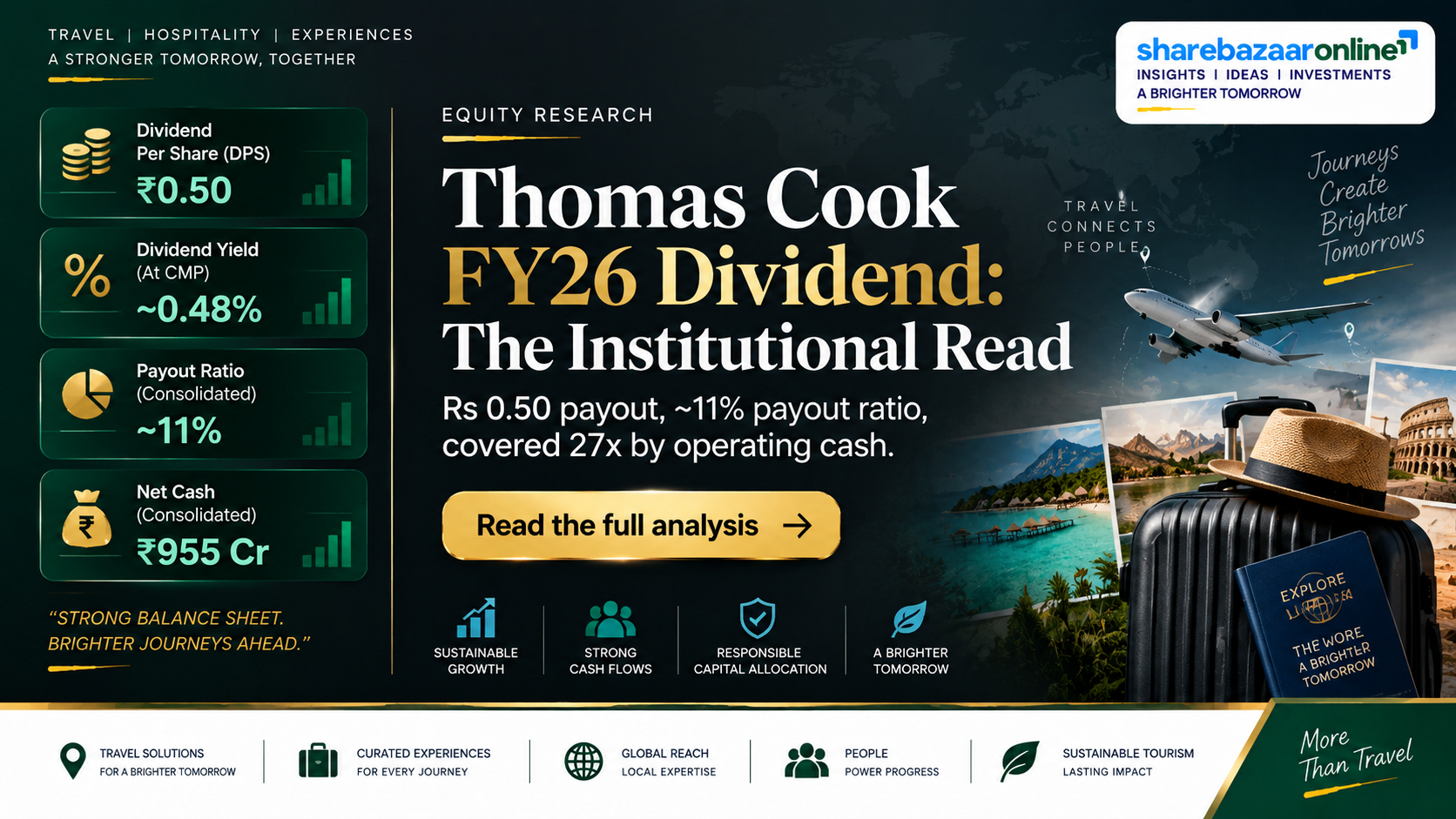
Dividend Per Share
Rs 0.50
Final dividend, FY 2025-26 (50% of Re 1 face value)
Dividend Yield (at CMP ~Rs 105)
~0.48%
Modest despite the eye-catching 50% headline
Record Date
27 Aug 2026
Ex-date also 27 Aug 2026 (T+1 settlement)
Total Dividend Outflow
Rs 23.52 Cr
On 47.04 crore equity shares (gross)
The face-value illusion: "50% dividend" sounds large, but it is 50% of a Re 1 face value — just Rs 0.50 in cash. Against a market price of about Rs 105, that is a yield of roughly 0.48%. Thomas Cook is not a high-yield income stock; the dividend is a small, symbolic return of cash on top of a business the market values chiefly for growth and restructuring optionality.
Dividend Announcement Summary
At its board meeting on 12 May 2026, the Board of Directors of Thomas Cook (India) Limited recommended a final dividend of Rs 0.50 (fifty paise) per equity share of face value Re 1 each for the financial year ended 31 March 2026, aggregating to a gross outflow of Rs 235.2 million (Rs 23.52 crore). The recommendation was placed for shareholder approval and was approved at the 49th Annual General Meeting held on 10 September 2026.
What was declared
- Type: Final Dividend (single annual dividend)
- Amount: Rs 0.50 per share (50% of face value)
- For: financial year 2025-26
- Board approval at 18:30 hrs on 12 May 2026
Company identifiers
- NSE Symbol: THOMASCOOK
- BSE Code: 500413
- ISIN: INE332A01027
- CIN: L63040MH1978PLC020717
Context: This Rs 0.50 payout continues a rebuilding trend after Thomas Cook resumed dividends post-COVID — Rs 0.40 (FY2022-23), Rs 0.40 (FY2023-24), Rs 0.45 (FY2024-25) and now Rs 0.50 (FY2025-26), an 11% step-up over last year's dividend.
Key Dates Timeline
| Event | Date | Notes |
|---|---|---|
| Board Meeting / Announcement | 12 May 2026 | Dividend recommended by the Board |
| Record Date | 27 Aug 2026 | Shareholders on the register are entitled |
| Ex-Dividend Date | 27 Aug 2026 | Same as record date under T+1 settlement |
| AGM (Shareholder Approval) | 10 Sep 2026 | 49th AGM approved the dividend |
| Payment Date | On/before 9 Oct 2026 | Within statutory 30 days of AGM approval |
Because the record date of 27 August 2026 has already passed, eligibility for this dividend is now fixed. Investors who held the shares before the ex-date were entitled; the credit follows the AGM approval. In FY2024-25, the company paid within roughly a week of its AGM, so payment for FY2025-26 is expected around the same window after the 10 September 2026 AGM.
Dividend Yield Analysis
Yield at Current Market Price
~0.48% (CMP ~Rs 105)
Rs 0.50 / Rs 105 × 100
Yield at Announcement Price
~0.52% (~Rs 97, May 2026)
Rs 0.50 / ~Rs 97 × 100
Reality check: why the yield looks the way it does
The dividend is up 11% year-on-year, so the low yield is not the result of a dividend cut. It is simply a small absolute payout. Notably, Thomas Cook's share price has fallen roughly 40% over the past year (52-week range about Rs 86 to Rs 181). A falling price mechanically raises yield, yet the yield here is still under 0.5% — confirming this is a growth/restructuring stock, not an income stock. The dividend is a modest cash sweetener, not the investment thesis.
Dividend History Analysis
| Financial Year | Dividend Per Share | Remark |
|---|---|---|
| FY2025-26 | Rs 0.50 | Final (approved Sep 2026) |
| FY2024-25 | Rs 0.45 | Final |
| FY2023-24 | Rs 0.40 | Final |
| FY2022-23 | Rs 0.40 | Dividend resumed |
| FY2021-22 | Nil | COVID impact |
| FY2020-21 | Nil | COVID impact |
| FY2019-20 | Nil | COVID onset / loss year |
| FY2018-19 | Rs 0.38 | Final |
| FY2017-18 | Rs 0.38 | Final |
| FY2016-17 | Rs 0.38 | Final |
Sources: exchange filings and dividend databases (TipRanks, Screener.in). Amounts are per share on Re 1 face value.
Classification: Interrupted (Re-established) Payer
Thomas Cook was a steady Rs 0.38 payer before the pandemic, then suspended dividends for three years (FY2019-20 to FY2021-22) as travel collapsed. It resumed in FY2022-23 and has since raised the dividend every year: Rs 0.40 to Rs 0.45 to Rs 0.50. That is a constructive, rising-dividend re-establishment — but the multi-year gap means it does not yet qualify as a "consistent, uninterrupted payer." The trend is positive; the track record still carries a COVID-era break.
Financial Performance Analysis
Consolidated FY2025-26 (year ended 31 Mar 2026)
- Revenue from operations: Rs 8,398 Cr (up 3.2% YoY)
- Profit before tax: Rs 326.8 Cr
- Net profit (owners): Rs 218.85 Cr (down 15.3% YoY)
- EPS (after exceptional): Rs 4.70 (vs Rs 5.46)
Operating leverage: revenue up, profit down
Revenue rose 3.2% but net profit fell about 15%. The squeeze is at the margin line: consolidated operating margin slipped to roughly 5% and Q4FY26 was hit hard — quarterly net profit dropped about 40% as Middle East airspace disruption, fuel and fare spikes and a compressed selling window pressured the travel business. This is a negative signal to flag: growth in the top line is not converting into bottom-line growth this year.
Standalone (the entity that actually pays the dividend) posted revenue of Rs 2,133.8 Cr and net profit of Rs 119.53 Cr for FY2025-26. Standalone other income includes Rs 19.9 Cr of dividends upstreamed from wholly-owned subsidiaries (TC Tours and TC Visa Services), which supports the parent's own distribution capacity. Return metrics are moderate: consolidated ROE ~9.2% and ROCE ~14.9%.
Cash Flow Analysis
Operating Cash Flow (Consol)
Rs 643.0 Cr
vs net profit of Rs 218.85 Cr — OCF is ~2.9x profit
Free Cash Flow (OCF – Capex)
Rs 517 Cr
Capex Rs 126 Cr; FCF comfortably positive
Cash is fact — and the cash here is strong
Reported profit fell, but operating cash flow of Rs 643 Cr comfortably exceeded net profit, driven partly by a large increase in trade payables (a normal feature of the forex/travel float model). After capex of about Rs 126 Cr, free cash flow was roughly Rs 517 Cr. The dividend of just Rs 23.52 Cr is a tiny fraction of this. The dividend is clearly funded from current cash generation, not from borrowings or asset sales — a healthy quality signal that stands in contrast to the weaker profit trend.
Balance Sheet Strength
Cash + Current Investments
Rs 1,231.9 Cr
Cash Rs 959.9 Cr + current investments Rs 272 Cr
Total Borrowings vs Net Position
Net cash ~Rs 955 Cr
Borrowings Rs 277 Cr against liquid assets Rs 1,232 Cr
On a consolidated basis Thomas Cook is effectively net-cash: liquid assets of about Rs 1,232 crore dwarf total borrowings of roughly Rs 277 crore, leaving an estimated net cash position of about Rs 955 crore. Consolidated net worth is around Rs 2,523 crore (book value ~Rs 54 per share). Debt is not rising to fund the dividend — borrowings are modest and the balance sheet carries ample liquidity to service a Rs 23.5 crore payout many times over.
Dividend Sustainability Analysis
Earnings Coverage (EPS / DPS)
9.4x
Operating Cash Flow Coverage
27.3x
Free Cash Flow Coverage
22.0x
Cash / Liquidity Coverage
52.4x
Verdict: Sustainable
On all four tests, the dividend passes comfortably. The consolidated payout ratio is only about 10.7% of net profit (standalone about 19.7%), so even the current soft-profit year covers it 9x over on earnings, 27x on operating cash and 52x on available cash. The small absolute size of the dividend is precisely what makes it Sustainable — the company retains the vast majority of its cash to fund growth and the pending restructuring. The main risk to future growth in the dividend is earnings, not affordability of the current amount.
Peer Comparison
| Company | Approx. Dividend Yield | Approx. Payout Ratio |
|---|---|---|
| Thomas Cook (India) | ~0.48% | ~11% (consolidated) |
| IRCTC | ~1.1% to 1.8% | ~48% to 62% |
| Easy Trip Planners (EaseMyTrip) | ~0% to 0.3% | Low / irregular |
| Travel & Leisure sector (median) | ~2.4% | Varies widely |
Peer figures are approximate, drawn from public databases (Equitymaster, GuruFocus, TipRanks, Screener.in) and change with price. Shown for context, not as investment guidance.
Against listed travel peers, Thomas Cook's yield is on the lower end and its payout ratio is conservative. IRCTC — a cash-rich, asset-light monopoly — returns a far larger share of profit (payout near 50-60%). Thomas Cook's low payout reflects a deliberate choice to conserve capital for its multi-segment growth (forex, travel, Sterling resorts, DEI imaging) and the pending demerger/consolidation scheme, rather than any inability to pay.
Promoter Impact Analysis
Promoter Holding
~64.8%
Fairfax Financial via Fairbridge Capital (Mauritius)
Estimated Promoter Dividend Income
~Rs 15.23 Cr
64.8% of the Rs 23.52 Cr outflow
Of the Rs 23.52 crore total dividend, roughly Rs 15.23 crore flows to the promoter group (Fairfax/Fairbridge) and about Rs 8.29 crore to public and institutional shareholders (FII ~6.2%, DII ~6.5% as of June 2026). Because the dividend is taxed in the promoter's hands too, and the payout ratio is low, this is a balanced, proportionate distribution rather than an aggressive cash extraction. Promoter holding actually rose ~0.94% in the latest quarter, indicating continued sponsor commitment.
Taxation Analysis
How dividends are taxed in India
Since April 2020, dividends are taxable in the hands of the shareholder at their applicable income-tax slab rate (the company no longer pays Dividend Distribution Tax). The company must deduct TDS at 10% under Section 194 if total dividend paid to a resident shareholder in a financial year exceeds Rs 10,000 (no TDS below that threshold if PAN is furnished; 20% if PAN is not available).
Worked example — investor holding 1,000 shares
- Gross dividend: 1,000 × Rs 0.50 = Rs 500
- TDS: Nil (Rs 500 is well below the Rs 10,000 Section 194 threshold)
- Tax at 30% slab: Rs 500 × 30% = Rs 150 (paid at time of filing return)
- Net dividend in hand: Rs 350
- Effective post-tax yield (at Rs 105): about 0.33%
For most retail holders the dividend is too small to trigger TDS, but it is still added to total income and taxed at the slab rate. A higher-slab investor keeps proportionately less. This reinforces that Thomas Cook's appeal is capital appreciation and restructuring value, not tax-efficient income.
Key Risks
- Earnings pressure: FY26 net profit fell ~15% and Q4 fell ~40%; margins are thin (operating margin ~4.4-5%), leaving little cushion if demand weakens.
- Geopolitical and travel-demand shocks: Middle East airspace disruption, fuel/fare spikes and event-driven cancellations directly hit the core travel and forex businesses.
- Restructuring execution risk: the composite scheme (demerger of the Sterling resorts business into SHRL, plus a face-value consolidation and reduction) is subject to statutory, NCLT and shareholder approvals — timing and terms could change.
- Low, discretionary dividend: with a payout of only ~11%, income-focused investors get little; the board has previously suspended dividends entirely (FY20-FY22) when conditions worsened.
- Segment weakness in imaging (DEI): the Digiphoto imaging segment swung to a loss in recent quarters, dragging on group profitability.
- New Labour Codes / cost inflation: past-service cost recognition already triggered an exceptional charge, and employee-cost inflation is squeezing margins.
What To Monitor
- Operating margin recovery: watch whether OPM climbs back above 5-6% as travel demand normalises after the FY26 shocks.
- Progress of the composite scheme: track NCLT/shareholder milestones, the 81:100 SHRL demerger ratio, the 4-into-1 share consolidation and the face-value reduction from Rs 4 to Rs 3.
- Forex and travel volumes: prepaid-card loads, digital penetration (reported ~23%) and corporate/MICE bookings as leading indicators of segment health.
- Dividend growth path: whether the Rs 0.38 to Rs 0.40 to Rs 0.45 to Rs 0.50 progression continues, signalling durable confidence.
- Sterling resorts and DEI imaging turnaround: occupancy/ARR at Sterling and a return to profit at DEI imaging.
- Free cash flow trend: whether OCF and FCF stay well above the dividend and capex, preserving the net-cash balance sheet.
Conclusion
Thomas Cook (India)'s Rs 0.50 final dividend for FY2025-26 is a small but rising and well-covered payout. The headline "50%" is a face-value artifact; the real yield is under 0.5%. On sustainability the picture is reassuring — a conservative ~11% consolidated payout, coverage of 9x on earnings, 27x on operating cash and 52x on liquid assets, and an effectively net-cash balance sheet (~Rs 955 crore). The dividend is funded from genuine cash generation, not debt.
The tension sits on the earnings side: profit fell about 15% in FY26 on margin pressure and travel-demand shocks, and a major restructuring scheme (Sterling demerger plus share consolidation and face-value reduction) is pending. For a shareholder, the dividend is a modest bonus; the real story is whether margins recover and the restructuring unlocks value. We present the positives, negatives, risks and monitoring factors above so readers can weigh the evidence themselves.
Frequently Asked Questions
What dividend has Thomas Cook (India) announced for FY 2025-26?
What is the Thomas Cook dividend yield?
What is the record date for the Thomas Cook dividend?
What is the ex-dividend date?
When will the Thomas Cook dividend be paid?
Who is eligible for the dividend?
How is the Thomas Cook dividend taxed?
Is the Thomas Cook dividend sustainable?
What is Thomas Cook's dividend history?
What should investors monitor going forward?
Why is the dividend called "50%" if it is only Rs 0.50?
How does this dividend compare with peers like IRCTC?
Does the pending demerger affect the dividend or my shares?
Disclaimer
This article is for informational and educational purposes only and does not constitute investment, financial, legal or tax advice, or any recommendation to buy, sell or hold Thomas Cook (India) Limited or any other security. Figures are drawn from the company's audited FY2025-26 results and board filing, and from third-party databases (Screener.in, TipRanks, Equitymaster, exchange disclosures); market prices are indicative and change continuously. ShareBazaar Online does not guarantee the accuracy or completeness of any figure. Securities markets are subject to risks; please verify all data from primary sources and consult a SEBI-registered financial advisor before making any investment decision.