
Dividend

JK Paper Dividend 2026 – ₹4/Share Final Dividend, Record Date 19 Aug

JK Paper Dividend 2026 – ₹4/Share Final Dividend, Record Date 19 Aug

Dividend Snapshot – JK Paper Limited

JK Paper Limited (NSE: JKPAPER | BSE: 532162 | ISIN: INE789E01012) has recommended a Final Dividend of ₹4.00 per equity share (40% on face value of ₹10) for the financial year ended 31 March 2026. The dividend was approved by the Board on 18 May 2026 and is subject to shareholder approval at the ensuing Annual General Meeting (AGM). This is the headline point retail investors should notice first: the payout is 20% lower than the ₹5.00 per share JK Paper paid for FY2024-25, even though the company's revenue actually grew during the year.

At a Glance

  • Dividend Per Share₹4.00
  • Dividend Percentage40%
  • Face Value₹10
  • Dividend TypeFinal Dividend
  • Financial YearFY2025-26
  • Total Outflow₹72.53 Crore

Key Ratios

  • Dividend Yield (latest)~0.96%
  • Yield on Announcement~1.08%
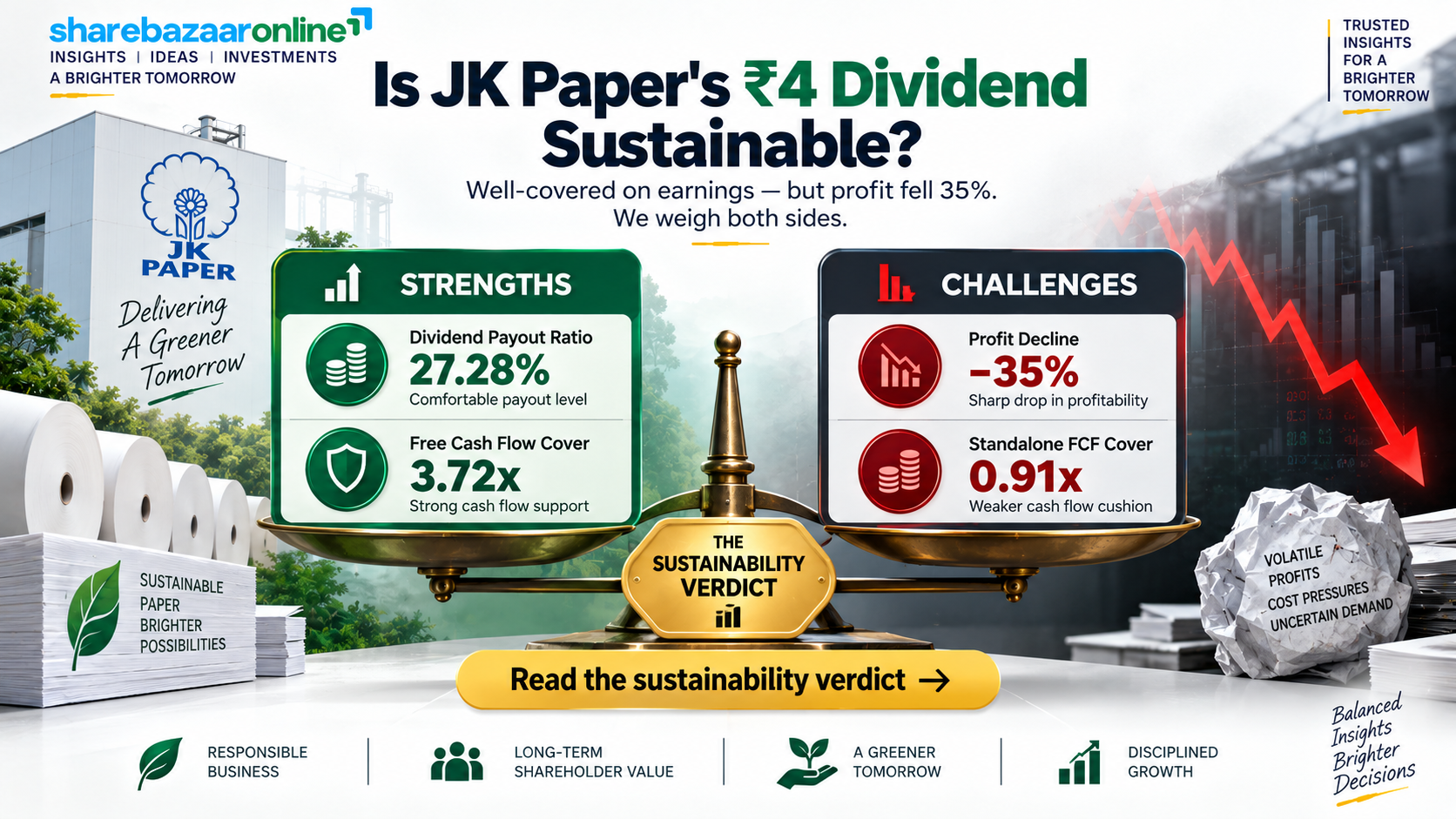
  • Payout Ratio (Consolidated)27.28%
  • Dividend Coverage3.67x
  • FCF Coverage (Consolidated)3.72x
  • YoY Change in Dividend-20%

Market-price-based ratios use externally sourced share prices (NSE/BSE via public market data providers); all per-share and outflow figures are from JK Paper Limited's audited filing dated 18 May 2026.

JK Paper Limited Dividend Announcement Summary

At its Board Meeting held on Monday, 18 May 2026 (which began at 2:15 PM and concluded at 5:45 PM), the Board of Directors of JK Paper Limited approved the audited standalone and consolidated financial results for the quarter and year ended 31 March 2026, and recommended a final dividend of ₹4.00 per equity share (40%) on 18,13,18,771 equity shares of ₹10 each.

Per the company's disclosure, the total dividend amounts to ₹72.53 Crore on the equity share capital. The dividend, "if declared by the Members of the Company at the ensuing Annual General Meeting (AGM), will be credited/dispatched, subject to deduction of applicable tax at source, within 30 days of the conclusion of said AGM." In other words, this is a recommended final dividend that still requires shareholder approval before it becomes payable.

The auditors, Lodha & Co LLP, issued an unmodified (clean) opinion on both the standalone and consolidated results. Management noted that "higher volume with improved operational efficiencies" supported quarterly performance, but flagged that "the sharp depreciation of the Indian Rupee against the Euro has adversely impacted the Net Profit for FY 2025-26."

JK Paper Limited Dividend Record Date, Ex-Date and Key Timeline

Announcement Date

18 May 2026

Board meeting; results & dividend recommended

Record Date

19 Aug 2026

Shareholders on record are eligible

Ex-Dividend Date

19 Aug 2026

Buy before this date to qualify

Payment Date

02 Oct 2026

Within 30 days of AGM (AGM: 02 Sep 2026)

Announcement date and total outflow are from the company filing. Record date, ex-date, AGM date and payment date are sourced from exchange corporate-action disclosures and public market-data providers. Dates are subject to AGM approval and any subsequent company intimation.

JK Paper Limited Dividend Yield Analysis

Dividend yield tells you how much cash return a shareholder earns relative to the share price. For JK Paper Limited, the ₹4.00 dividend translates into:

Yield on announcement-period price (~₹371)

~1.08%

Yield on latest price (~₹415)

~0.96%

Yield reality check: JK Paper's yield sits at roughly 1% — modest for an Indian paper stock. Importantly, the yield is lower than last year not because the price surged, but because the dividend itself was cut from ₹5.00 to ₹4.00. A falling dividend on a broadly rising share price mechanically compresses the yield. This is not a "high-yield distress" situation, nor a special one-time payout inflating the number — it is a normal-but-reduced annual dividend from a business whose FY26 earnings fell. Investors chasing yield alone will find JK Paper unremarkable; the more useful question is whether the payout is sustainable, which we examine below.

JK Paper Limited Dividend History and Payment Track Record

The table below shows JK Paper Limited's dividend track record by ex-date, based on exchange and public corporate-action records. Figures are per share on face value of ₹10.

Ex-DateDividend / ShareType
19 Aug 2026₹4.00Final
18 Aug 2025₹5.00Final
20 Aug 2024₹5.00Final
16 Feb 2024₹3.50Interim
18 Aug 2023₹4.00Final
17 Feb 2023₹4.00Interim
23 Aug 2022₹5.50Final
12 Aug 2021₹4.00Final
05 Mar 2020₹4.00Interim
13 Aug 2019₹3.50Final
08 Aug 2018₹2.50Final

Source: public exchange corporate-action records / dividend databases. Presented by ex-date to avoid mis-attribution across financial years.

What the record shows

JK Paper has paid a dividend every year since at least FY2018, making it a consistent payer. However, the amount is cyclical, not steadily growing — it rose to ₹5.50 (2022), varied through the ₹8-9 combined-payout years, then settled at ₹5.00 and now ₹4.00.

Classification

Consistent but Cyclical Payer. The dividend tracks the paper cycle: it expands when margins are strong and is trimmed when earnings weaken (as in FY26). There is no multi-year suspension in the recent record, but there is no reliable year-on-year growth either.

JK Paper Limited Financial Performance and Dividend vs Profit Growth

This is where the FY26 story becomes clear. On a consolidated basis, JK Paper Limited grew its top line but saw profits fall sharply — a classic case of operating leverage working in reverse.

Metric (Consolidated, ₹ Cr)FY2025-26FY2024-25*Change
Revenue from Operations (net)7,076.036,662.49+6.21%
EBITDA984.111,026.31-4.11%
EBITDA Margin13.91%15.40%-149 bps
Profit Before Tax364.48516.96-29.50%
Net Profit (Owners of Parent)265.84408.79-34.97%
EPS (Basic, ₹)14.6622.55-34.99%

*FY2024-25 figures are restated by the company to give effect to a Composite Scheme of Arrangement (NCLT order effective 15 March 2026). All figures from JK Paper Limited's audited consolidated results.

Why did profit fall while revenue rose? (Operating Leverage Analysis)

Revenue grew +6.21%, yet net profit fell ~35%. The gap is explained by cost lines rising faster than sales:

  • Cost of materials consumed rose +7.19% (₹4,436.53 Cr vs ₹4,138.83 Cr), outpacing revenue and lifting raw-material intensity to 62.7% of sales.
  • Employee benefits expense jumped +11.52% (₹696.44 Cr vs ₹624.48 Cr).
  • Finance costs surged +26.79% (₹225.34 Cr vs ₹177.73 Cr) — the single sharpest increase, reflecting higher borrowings.
  • Depreciation & amortisation rose +13.66% (₹376.93 Cr vs ₹331.62 Cr) as capex-heavy assets came on stream.
  • A ₹17.36 Cr exceptional item (incremental retiral obligations under the four new Labour Codes) further dented PBT.
  • Management explicitly cited sharp INR depreciation against the Euro as an adverse hit to net profit.

In short, JK Paper Limited sold more but earned less — margin compression, higher interest, higher depreciation and currency effects combined to shrink the bottom line. That is the direct reason the dividend was reduced.

JK Paper Limited Cash Flow Analysis

Reported profit is an accounting opinion; cash is fact. Here the news is more reassuring than the profit line suggests.

Operating Cash Flow vs Profit

Consolidated Operating Cash Flow rose to ₹772.84 Cr (FY25: ₹643.38 Cr) — up ~20% — even as net profit fell. OCF of ₹772.84 Cr comfortably exceeds net profit of ₹271.87 Cr, showing that the earnings decline was driven heavily by non-cash items (depreciation ₹376.93 Cr) and currency effects, not by cash leakage. This is a positive quality-of-earnings signal.

Free Cash Flow

Consolidated capex (PP&E + intangibles) was heavy at ₹503.28 Cr. Free Cash Flow = OCF − capex = ₹269.56 Cr. The ₹72.53 Cr dividend is therefore covered 3.72x by consolidated FCF. On a standalone basis, however, capex of ₹452.24 Cr against OCF of ₹518.23 Cr leaves standalone FCF of just ₹65.99 Cr — only 0.91x the dividend, because the standalone entity is funding the new BCTMP plant.

How is the dividend funded?

On a consolidated basis, the dividend is funded out of current operating cash flow and free cash flow — not by selling assets. However, note that working capital absorbed cash (inventories rose ₹66.68 Cr) and the group simultaneously raised net borrowings during the year (proceeds of long-term borrowings ₹422.09 Cr; net short-term borrowings +₹373.77 Cr). So while operations generate enough to cover the dividend, the group is paying dividends and expanding debt at the same time to fund its capex programme — a point worth monitoring.

JK Paper Limited Balance Sheet Strength

  • Cash & Cash Equivalents (Consol)₹157.29 Cr
  • Total Financing Liabilities (LT+ST, incl leases)₹2,577.52 Cr
  •   — Long Term₹1,980.13 Cr
  •   — Short Term₹597.39 Cr
  • Net Debt (approx, incl leases)₹2,420.23 Cr
  • Owners' Equity (Consol)₹5,520.53 Cr
  • Book Value / Share~₹304
  • Debt-to-Equity (incl leases)~0.47x
  • ROE (external)~4.8%
  • ROCE (external)~7.4%

JK Paper Limited runs a moderately leveraged balance sheet: debt-to-equity of roughly 0.47x is manageable, and cash of ₹157.29 Cr provides a buffer. The concern is the direction: finance costs jumped ~27% in FY26 and net borrowings expanded to fund capex, while return ratios are depressed — ROE around 4.8% and ROCE around 7.4% are well below the company's own history, reflecting the weak-margin year.

Cash, equity and borrowing figures from JK Paper Limited's audited consolidated filing (financing-liabilities note includes lease liabilities). ROE/ROCE and book value per share are externally sourced (Screener.in) and rounded; they may differ slightly from filing-derived figures due to methodology.

JK Paper Limited Dividend Sustainability Assessment

Supports the dividend

  • Low payout ratio of 27.28% (consolidated) — plenty of retained earnings.
  • 3.67x earnings coverage and 3.72x consolidated FCF coverage.
  • Operating cash flow rose ~20% to ₹772.84 Cr.
  • Cash buffer of ₹157.29 Cr; D/E a moderate ~0.47x.

Pressures on the dividend

  • Dividend already cut 20% (₹5.00 → ₹4.00).
  • Net profit down ~35%; margins compressed.
  • Standalone FCF covers the dividend only 0.91x amid heavy capex.
  • Debt and finance costs rising alongside the payout.

Verdict: Sustainable, but reduced

On coverage and consolidated cash-flow metrics, the ₹4.00 dividend is comfortably Sustainable — it is well within earnings and consolidated free cash flow. The nuance is that management chose to reduce the payout rather than stretch it, which is prudent given the ~35% profit fall, the capex cycle and rising debt. The dividend is safe at the new, lower level; its future growth depends on a margin recovery in FY2026-27.

JK Paper Limited Peer Comparison

How does JK Paper Limited compare with other listed Indian paper companies on dividend and returns? Externally sourced, approximate figures:

CompanyDiv. YieldPayoutROEROCE
JK Paper~1.0%~27%~4.8%~7.4%
West Coast Paper~1.7%~8%higherhigher
Andhra Paper~0.8%low~4.6%—
Seshasayee Paper~modestlow——

On yield, JK Paper Limited (~1.0%) sits below West Coast Paper (~1.7%) and roughly in line with Andhra Paper. Its payout ratio (~27%) is higher than West Coast's ~8%, meaning JK Paper distributes a larger slice of a smaller FY26 profit. Sector return ratios are generally in single digits currently, reflecting an industry-wide margin squeeze from cheap imports and weak realisations. JK Paper's edge is scale, backward integration (pulp/energy) and packaging-board diversification rather than a superior dividend.

Peer figures are approximate, externally sourced (Screener.in, Simply Wall St, ScanX) and as-of varying recent dates; treat as directional, not precise. West Coast Paper's per-share ratios reflect a ₹2 face value.

JK Paper Limited Promoter Impact Analysis

Promoters (the H.S. Singhania group) held approximately 52.94% of JK Paper Limited as of the June 2026 shareholding pattern. Applying that to the ₹72.53 Cr total outflow:

Promoter Dividend Income (~52.94%)

₹38.40 Cr

Public / Institutional Shareholders (~47.06%)

₹34.13 Cr

Roughly ₹38.40 Cr of the dividend flows to promoters and ₹34.13 Cr to public and institutional shareholders (FIIs ~11.4%, DIIs ~6.1%, retail/public the remainder). Because promoter ownership is just over half, the majority of the cash leaves for the promoter group — but the split is far less skewed than in tightly held companies. The dividend cut affects promoters and minority holders proportionally; there is no structural feature that advantages one class over the other in this payout.

Shareholding percentages are externally sourced (latest available quarter) and may be revised in subsequent filings.

JK Paper Limited Dividend Taxation Explained

Since April 2020, dividends in India are taxed in the hands of the shareholder at their applicable income-tax slab rate (the old Dividend Distribution Tax was abolished). Key rules:

  • Dividend is added to "Income from Other Sources" and taxed at your slab rate.
  • TDS under Section 194: the company deducts 10% TDS if total dividend paid to a resident shareholder in the financial year exceeds ₹5,000 (20% if PAN is not furnished).
  • TDS is adjustable against your final tax liability when you file your return.
  • Non-resident shareholders face different TDS rates (typically 20% plus surcharge/cess, subject to treaty relief).

Worked Example (illustrative)

Assume an investor owns 1,000 shares, dividend ₹10 per share, and is in the 30% tax slab:

  • Gross Dividend = 1,000 × ₹10 = ₹10,000
  • TDS @10% (exceeds ₹5,000) = ₹1,000 deducted at source
  • Tax @30% slab = ₹3,000 (the ₹1,000 TDS is credited against this)
  • Net in-hand after full tax = ₹7,000
  • Effective post-tax yield falls to roughly 70% of the headline yield for a 30%-slab investor

For JK Paper's actual ₹4 dividend: 1,000 shares = ₹4,000 gross. As this is below ₹5,000, no TDS would be deducted (assuming PAN on record and no other JK Paper dividend that year); a 30%-slab investor would still owe ₹1,200 as tax, leaving ₹2,800 net.

This is a general illustration, not tax advice. Rules, thresholds and surcharge/cess vary by investor status and year. Consult a qualified tax professional.

Key Risks for JK Paper Limited Dividend Investors

  • Margin cyclicality & import pressure: Paper is a cyclical, capital-intensive business. Cheap imports and weak net sales realisation compressed FY26 EBITDA margin to 13.91% from 15.40%. Further margin erosion would pressure future dividends.
  • Currency risk: Management explicitly blamed sharp INR depreciation against the Euro for hurting FY26 net profit. Continued rupee weakness against key import currencies raises input costs.
  • Rising finance costs & debt: Finance costs jumped +26.79% and net borrowings expanded to fund capex. If earnings stay soft while debt rises, the payout has less headroom.
  • Capex execution: The new BCTMP pulp plant (commercial production expected Q1 FY2026-27) is absorbing heavy capex (~₹503 Cr consolidated). Delays or weak returns on this investment could strain standalone free cash flow, which already covers the dividend just 0.91x.
  • Regulatory / cost shocks: The four new Labour Codes triggered a ₹17.36 Cr exceptional charge in FY26; further statutory or environmental compliance costs are a structural risk for the sector.
  • AGM approval & cyclical cuts: The dividend is a recommendation subject to AGM approval, and the company's history shows the payout is trimmed in weak years — there is no guarantee of a floor.

What to Monitor in JK Paper Limited Going Forward

  • EBITDA margin recovery: Watch whether the FY26 margin of 13.91% rebounds toward the mid-teens/20s in coming quarters — the key driver of any dividend restoration.
  • BCTMP plant ramp-up: Track commissioning and utilisation of the new pulp plant and whether backward integration lowers raw-material costs as intended.
  • Finance cost trajectory: Monitor quarterly finance costs and net debt — a peak-and-decline pattern would signal the capex cycle is turning into cash generation.
  • Realisations & import trends: Follow paper/board price realisations and the pace of low-cost imports, which drive sector margins.
  • Standalone free cash flow: Watch whether standalone FCF (only 0.91x the dividend in FY26) improves as capex tapers post-plant-commissioning.
  • Dividend trend: Note whether the next payout stabilises at ₹4 or resumes growth — the clearest signal of management's confidence in earnings.

Should You Consider JK Paper Limited for Dividend Income? — Conclusion

JK Paper Limited's FY2025-26 final dividend of ₹4.00 per share (40%) is a consistent-but-reduced payout from a business having a tough margin year. The positives are real: a low 27.28% payout ratio, 3.67x earnings coverage, 3.72x consolidated FCF coverage, operating cash flow up ~20% to ₹772.84 Cr, and a moderate ~0.47x debt-to-equity.

The negatives are equally real: the dividend was cut 20% because net profit fell ~35%, margins compressed, finance costs rose ~27%, and standalone free cash flow barely covers the payout amid a heavy capex cycle. The ~1% yield is modest.

For a dividend-focused reader, the takeaway is that JK Paper Limited offers a safe-but-small, cyclical dividend whose future direction is tied to margin recovery and the payoff from its new pulp capacity — not a high-yield income play. The data is laid out above; the decision is yours.

Frequently Asked Questions About JK Paper Limited Dividend

What dividend has JK Paper Limited announced for FY2025-26?
JK Paper Limited has recommended a final dividend of ₹4.00 per equity share (40%) on a face value of ₹10, for the financial year ended 31 March 2026. The total outflow is ₹72.53 Crore on 18,13,18,771 shares. It was announced at the Board Meeting on 18 May 2026 and is subject to AGM approval.
What is the JK Paper dividend yield?
The dividend yield is approximately 0.96% on the latest share price (~₹415) and about 1.08% on the price around the announcement (~₹371). Yield = dividend ÷ share price. The yield is modest and is lower than last year mainly because the dividend itself was cut from ₹5.00 to ₹4.00.
What is the record date for the JK Paper dividend?
The record date is 19 August 2026. Shareholders whose names appear in the company's records on this date are eligible to receive the dividend (subject to AGM approval).
What is the ex-dividend date for JK Paper?
The ex-dividend date is 19 August 2026. To be eligible for the dividend, you must buy JK Paper shares before the ex-date; if you buy on or after it, the seller receives the dividend.
When will the JK Paper dividend be paid?
The dividend is expected to be paid on or around 2 October 2026. Per the filing, it will be credited/dispatched within 30 days of the conclusion of the AGM (AGM scheduled around 2 September 2026), subject to shareholder approval and tax deduction at source.
Who is eligible for the JK Paper dividend?
Anyone holding JK Paper Limited shares in their demat account as of the record date (19 August 2026) is eligible. In practice, you must purchase the shares before the ex-date (19 August 2026) so that the trade settles and you are on the register by the record date.
How is the JK Paper dividend taxed?
Dividends are taxable in the shareholder's hands at their income-tax slab rate. The company deducts 10% TDS if your total JK Paper dividend in the year exceeds ₹5,000 (20% without PAN). For example, a 30%-slab investor holding 1,000 shares (₹4,000 gross) pays ₹1,200 tax, keeping ₹2,800 — and since ₹4,000 is below ₹5,000, no TDS would apply in that case.
Is the JK Paper dividend sustainable?
At the reduced ₹4.00 level, yes — it is well covered by earnings (3.67x), by a low payout ratio (27.28%) and by consolidated free cash flow (3.72x). The caution is that management cut the payout because FY26 profit fell ~35%, and standalone free cash flow covers it only 0.91x during the current capex cycle. Future growth in the dividend depends on a margin recovery.
What is JK Paper's dividend history?
JK Paper Limited has paid a dividend every year since at least FY2018. Recent per-share payouts include ₹5.00 (2025), ₹5.00 (2024 final) plus ₹3.50 (2024 interim), ₹4.00 + ₹4.00 (2023), ₹5.50 (2022) and ₹4.00 (2021). It is a consistent but cyclical payer — the amount rises in strong years and is trimmed in weak ones, such as the FY26 cut to ₹4.00.
Why did JK Paper cut its dividend when revenue grew?
Consolidated revenue rose 6.21%, but net profit fell ~35% because costs rose faster: materials +7.19%, employee costs +11.52%, finance costs +26.79%, depreciation +13.66%, plus a ₹17.36 Cr labour-code exceptional item and adverse INR/Euro currency movement. Lower profit led directly to a lower dividend.
What should investors monitor in JK Paper going forward?
Key items to track are the EBITDA margin recovery, the ramp-up of the new BCTMP pulp plant, the trajectory of finance costs and net debt, paper/board realisations versus imports, standalone free cash flow, and whether the next dividend stabilises at ₹4 or resumes growth.
How much of the JK Paper dividend goes to promoters?
With promoters holding about 52.94%, roughly ₹38.40 Crore of the ₹72.53 Crore payout flows to the promoter group, and about ₹34.13 Crore to public and institutional shareholders (FIIs ~11.4%, DIIs ~6.1%, and retail investors).

Disclaimer – JK Paper Limited Dividend Analysis

This article is for informational and educational purposes only and does not constitute investment, financial, legal or tax advice, nor a buy, sell or hold recommendation. Per-share, outflow and financial figures are drawn from JK Paper Limited's audited results filed on 18 May 2026; share prices, yields, shareholding, peer data and return ratios are externally sourced from public market-data providers and may change or be revised. The dividend is a Board recommendation subject to shareholder approval at the AGM. Investors should verify all figures independently and consult a SEBI-registered financial advisor and a qualified tax professional before making any investment decision. ShareBazaar Online and the author accept no liability for any loss arising from the use of this information.

Share this update
Back to Corporate Actions

Explore More Investment Opportunities

Discover IPOs, unlisted shares, and broker comparison tools curated for smart investors.