
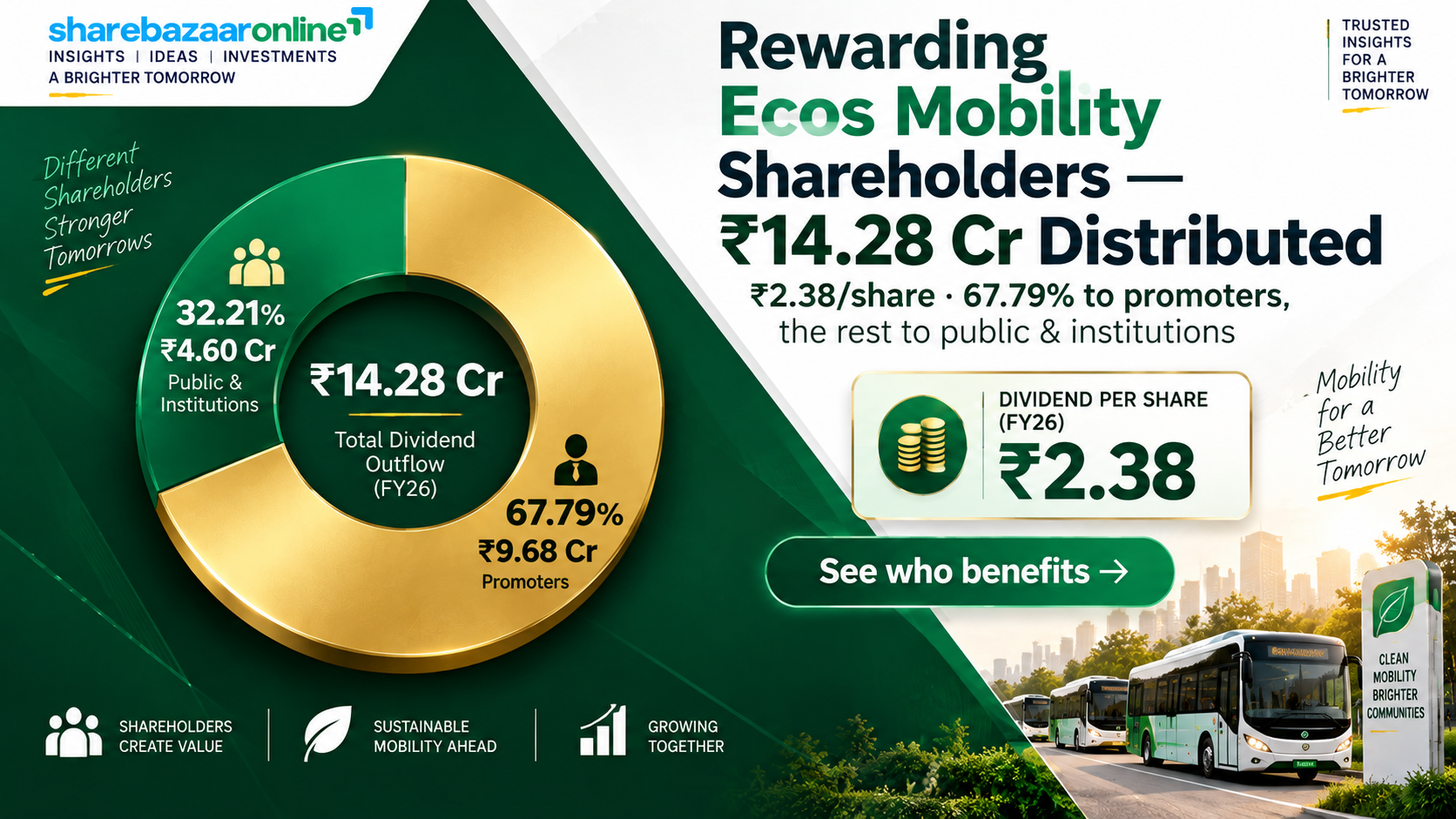
Dividend Snapshot – Ecos (India) Mobility & Hospitality Limited
Ecos (India) Mobility & Hospitality Limited (NSE: ECOSMOBLTY, BSE: 544239, ISIN: INE06HJ01020) has declared a final dividend of ₹2.38 per equity share for the financial year 2025–26, on a face value of ₹2 — a payout equal to 119% of face value. The dividend was recommended at the board meeting held on 6 July 2026 and is subject to shareholder approval at the 30th Annual General Meeting. This snapshot summarises the key numbers for the Ecos (India) Mobility & Hospitality Limited dividend before we analyse whether it is sustainable.
Dividend Per Share
₹2.38
Face value ₹2 · 119% of face value
Dividend Type
Final
FY 2025–26 · subject to AGM approval
Dividend Yield (latest CMP ₹106)
2.25%
1.83% at the announcement-date price (~₹130)
Total Dividend Outflow
~₹14.28 Cr
On ~6.00 crore shares
Dividend Payout Ratio
24.6%
Of FY26 consolidated PAT (~₹58 Cr)
Record Date
18 Aug 2026
Payment on 21 Oct 2026
The headline that matters: a "119% dividend" sounds large, but it is calculated on a ₹2 face value. In real terms, an investor earns about ₹2.38 for every share, which is a 2.25% yield at the current market price of ₹106. This is the face-value illusion every retail investor should look past.
Ecos (India) Mobility & Hospitality Limited Dividend Announcement Summary
The Board of Directors of Ecos (India) Mobility & Hospitality Limited met on 6 July 2026 and recommended a final dividend of ₹2.38 per equity share of face value ₹2 each for FY 2025–26. The recommendation is subject to the approval of members at the ensuing 30th Annual General Meeting. This is the company's second dividend since its September 2024 stock market listing.
What was announced
A final dividend of ₹2.38 per share (119% of the ₹2 face value), pending AGM ratification. Ecos declares one dividend per financial year, typically after its Q4 board meeting.
How it compares with last year
FY25 dividend was ₹2.40 per share. The FY26 dividend of ₹2.38 is a marginal reduction of ₹0.02 (−0.83%) — effectively flat, but notably not an increase despite higher revenue.
Company profile: Incorporated in 1996, Ecos (India) Mobility & Hospitality Limited is India's largest chauffeur-driven mobility provider, offering corporate car rentals (CCR) and employee transportation services (ETS). It runs an asset-light model with 20,000+ vehicles (over 90% vendor-owned) across 131 cities, serving 1,750+ organisations including 70+ Fortune 500 companies, and completed 5.23 million trips in FY26.
Ecos (India) Mobility & Hospitality Limited Key Dividend Dates
Announcement Date
6 July 2026
Board meeting — dividend recommended
Record Date
18 August 2026
Shareholders on the register were eligible
Ex-Dividend Date
18 August 2026
Aligned with record date under T+1 settlement (to be confirmed against the official NSE/BSE circular)
Payment Date
21 October 2026
Credited after AGM approval
Under India's T+1 settlement, an investor needed to hold Ecos (India) Mobility & Hospitality Limited shares before the ex-date to qualify. The record date of 18 August 2026 has already passed, so eligibility for this dividend is now closed; the dividend is scheduled for payment on 21 October 2026.
Ecos (India) Mobility & Hospitality Limited Dividend Yield Analysis
Dividend yield tells you the real cash return on the price you pay. For the Ecos (India) Mobility & Hospitality Limited dividend, the yield looks different depending on which price you use — and that difference is itself part of the story.
Yield at latest market price
₹2.38 ÷ ₹106 = 2.25%. The yield has risen mainly because the share price has fallen sharply over the past year, not because the dividend grew.
Yield at announcement price
₹2.38 ÷ ~₹130 = 1.83%. This reflects what a buyer around the July 2026 announcement window would have earned.
Yield reality check: Ecos's yield of 2.25% is "optically" higher than last year's, but this is a price-driven yield increase. The stock is down roughly 57–63% over one year (from a 52-week high of ~₹294–358 to ~₹106). A yield that rises because the price is collapsing is not the same as a yield that rises because the company is paying more. In fact, the dividend was cut marginally, from ₹2.40 to ₹2.38.
Ecos (India) Mobility & Hospitality Limited Dividend History
Ecos (India) Mobility & Hospitality Limited has a very short public dividend record because it listed only in September 2024. Before the IPO it operated as a closely held company with a tiny equity base and paid no dividends. The table below shows the complete dividend payment history since listing.
| Financial Year | Dividend Type | Dividend / Share | Face Value | Declared |
|---|---|---|---|---|
| FY 2025–26 | Final | ₹2.38 | ₹2 | 6 Jul 2026 |
| FY 2024–25 | Final | ₹2.40 | ₹2 | 19 May 2025 |
| FY 2019–20 to FY 2023–24 | — | Nil (pre-IPO) | — | — |
Consistency & trend
Two consecutive annual dividends since listing, with the amount essentially flat (₹2.40 → ₹2.38). No special dividends, no interim dividends, no suspensions on record.
Classification
Emerging / New Payer. With only two years of history, it is too early to call Ecos a "consistent" dividend payer. The marginal cut in year two, despite higher revenue, is worth watching.
Ecos (India) Mobility & Hospitality Limited Financial Performance
This is the most important section for understanding the Ecos (India) Mobility & Hospitality Limited dividend. The company is growing its top line strongly, but its profits are shrinking — a classic case of revenue growth without profit growth.
| Metric | FY24 | FY25 | FY26 |
|---|---|---|---|
| Revenue | 547 | 642 | 790 |
| Operating Profit | 90 | 93 | 94 |
| Operating Margin (OPM) | 16.5% | 14.5% | 11.9% |
| Net Profit (PAT) | 63 | 60 | 58 |
| EPS (₹) | 10.42 | 10.02 | 9.60 |
Operating leverage in reverse: In FY26, revenue grew +23.1% but operating profit grew only +1.1% and net profit fell −3.3%. In FY25, revenue rose +17.4% while PAT fell −4.8%. The operating margin has compressed from 16.5% to 11.9% in two years. The company is buying growth — adding leadership, technology and manpower, and expanding geographically (including the SIXT GSA tie-up) — at the cost of near-term profitability. Management has explicitly flagged deliberate investment and a Q4FY26 demand dip tied to West Asia disruption.
For a dividend investor, the key point is this: the dividend is being paid out of a shrinking profit pool, not a growing one. That does not make the dividend unaffordable today — coverage is still comfortable — but the direction of profits is the wrong way for future dividend growth.
Ecos (India) Mobility & Hospitality Limited Cash Flow Analysis
Reported profit is an opinion; cash is a fact. The good news for the Ecos (India) Mobility & Hospitality Limited dividend is that the business converts profit into cash well, and the dividend is comfortably funded from current operating cash flow — not from reserves, asset sales or borrowings.
| Metric | FY24 | FY25 | FY26 |
|---|---|---|---|
| Operating Cash Flow (OCF) | 67 | 75 | 68 |
| Free Cash Flow (FCF) | 48 | 45 | 35 |
| OCF / Operating Profit | 99% | 103% | 97% |
Is the dividend funded by cash?
Yes. The ~₹14.28 Cr dividend outflow is covered 4.76x by operating cash flow and 2.45x by free cash flow. The dividend is funded by current earnings and cash generation, not debt.
Cash quality
OCF has consistently tracked close to 100% of operating profit, confirming healthy earnings quality. Receivables (debtor days ~49) are stable and in line with revenue, with no build-up warning sign.
One nuance: FCF has declined from ₹48 Cr (FY24) to ₹35 Cr (FY26) as capex and investing activity rose. FCF still covers the dividend more than twice over, but the shrinking cushion is worth tracking alongside the margin compression noted above.
Ecos (India) Mobility & Hospitality Limited Balance Sheet Strength
The balance sheet is the strongest part of the Ecos (India) Mobility & Hospitality Limited dividend story. The company is almost debt-free and holds a healthy cash and investments buffer.
Borrowings (FY26)
~₹8 Cr
Down from ₹30 Cr in FY24 — effectively debt-free
Investments (FY26)
~₹107 Cr
Liquidity coverage of ~7.5x the dividend outflow
Reserves (FY26)
~₹253 Cr
Book value ~₹44/share
Return Ratios
ROCE 28% · ROE 20.5%
3-yr ROE ~27.6%, though trending down
The asset-light model (over 90% of vehicles vendor-owned) keeps capital intensity low, which is why Ecos can post high return ratios and stay near debt-free. Debt is not rising to fund the dividend — the opposite; borrowings have fallen every year. Return ratios remain healthy but are softening (ROE 20.5% in FY26 vs a 3-year average of ~27.6%) as margins compress.
Ecos (India) Mobility & Hospitality Limited Dividend Sustainability
We assess the sustainability of the Ecos (India) Mobility & Hospitality Limited dividend against four tests: earnings coverage, operating cash flow coverage, free cash flow coverage, and liquidity.
1. Earnings coverage
EPS ₹9.60 ÷ DPS ₹2.38 = 4.03x. Payout ratio just 24.6% of PAT. Very comfortable.
2. OCF coverage
Operating cash flow covers the dividend 4.76x. Strong.
3. FCF coverage
Free cash flow covers the dividend 2.45x. Adequate, though the cushion is narrowing.
4. Liquidity coverage
~₹107 Cr of investments vs a ~₹14.28 Cr outflow = 7.5x. Very strong.
Verdict: Sustainable (at the current level). The dividend passes all four tests with room to spare, on a low payout ratio, strong cash conversion and a near debt-free balance sheet. The caveat is growth, not affordability: with profits falling and margins compressing, the scope for the dividend to increase is limited unless profitability recovers. Ecos can keep paying ₹2.38; growing it meaningfully is a different question.
Ecos (India) Mobility & Hospitality Limited Peer Comparison
Ecos (India) Mobility & Hospitality Limited sits in the road transport / logistics services space. The table compares it with listed peers on the metrics that matter for dividend investors.
| Company | Dividend Yield | ROE | ROCE | Debt |
|---|---|---|---|---|
| Ecos (India) Mobility | ~2.25% | 20.5% | 28.0% | Almost debt-free |
| Transport Corp. of India (TCI) | ~1.14% | 17.8% | 15.2% | Low |
| VRL Logistics | ~1.7% | Moderate | Moderate | Debt roughly equal to equity |
Where Ecos stands out
Higher return ratios (ROCE 28%) and a near debt-free balance sheet vs leveraged logistics peers. Its yield of ~2.25% is above TCI's ~1.14%, but that gap is partly because Ecos's share price has fallen so hard.
Where peers differ
VRL Logistics runs a much higher payout ratio (~70%+) and is more of a dividend-first story; Ecos retains most of its earnings (payout ~25%) to fund expansion. TCI is a larger, more diversified logistics play with lower yield.
Peer figures are drawn from public market data sources and are approximate; investors should verify current numbers before acting.
Ecos (India) Mobility & Hospitality Limited Promoter Impact
Promoters hold the majority of Ecos (India) Mobility & Hospitality Limited, so a large share of every dividend flows back to them. This is neither good nor bad in itself, but retail investors should understand who benefits.
Promoter Holding
67.79%
Stable over the past year
Promoter Dividend Income
~₹9.68 Cr
Of the ~₹14.28 Cr total outflow
Of the total ~₹14.28 Cr dividend, roughly ₹9.68 Cr goes to promoters and about ₹4.60 Cr to public and institutional shareholders. Note also the sharp fall in FII holding — from ~6.3% (Mar 2025) to ~1.0% (Jun 2026) — while DII holding has risen to ~12.6% and public holding to ~18.6%. Foreign investors have been exiting even as the dividend was maintained.
Ecos (India) Mobility & Hospitality Limited Dividend Taxation
Since the 2020 change in Indian tax law, dividends are taxed in the hands of the investor, not the company. Here is how the Ecos (India) Mobility & Hospitality Limited dividend is taxed.
How dividends are taxed
Dividend income is added to your total income and taxed at your applicable income-tax slab rate under "Income from Other Sources".
TDS rule
The company deducts TDS at 10% if your total dividend from Ecos exceeds ₹10,000 in a financial year (20% without a valid PAN). Below ₹10,000, no TDS is deducted.
Worked example — investor holding 1,000 shares (30% slab)
| Gross dividend (1,000 × ₹2.38) | ₹2,380 |
| TDS at 10% (gross is below the ₹10,000 threshold) | ₹0 |
| Tax at 30% slab | ₹714 |
| Net dividend in hand | ₹1,666 |
| Effective post-tax yield (at ₹106) | 1.57% |
A 30%-slab investor keeps about 70% of the gross dividend, cutting an already modest 2.25% yield to roughly 1.57% post-tax. Investors in lower slabs keep more.
Key Risks – Ecos (India) Mobility & Hospitality Limited
1. Margin compression: Operating margin has fallen from 16.5% to 11.9% in two years. If this continues, profit — and eventually the dividend's growth potential — is at risk.
2. Falling profits despite rising revenue: PAT declined in both FY25 and FY26. Growth is not translating into shareholder profit.
3. Severe share-price de-rating: The stock is down ~57–63% over one year. The "higher" yield is a symptom of price weakness, not dividend strength.
4. Client concentration & corporate demand: Revenue depends on large corporate CCR/ETS contracts; a slowdown in corporate travel budgets (e.g. the flagged West Asia disruption) directly hits volumes.
5. FII exit: Foreign holding collapsed from ~6.3% to ~1.0% in a year, signalling weak institutional confidence.
6. Execution risk on expansion: Heavy investment in leadership, technology and global expansion (SIXT GSA) is compressing margins now with uncertain payoff timing.
What To Monitor – Ecos (India) Mobility & Hospitality Limited
1. Operating margin trend: Watch whether OPM stabilises above ~12% or keeps falling in upcoming quarters.
2. PAT recovery: Does net profit resume growth, or does the decline extend into FY27?
3. Free cash flow: FCF has fallen from ₹48 Cr to ₹35 Cr — track whether the dividend cushion keeps shrinking.
4. Payout policy: Whether management raises, holds or cuts the dividend at the next declaration — a second cut would be a signal.
5. Return on expansion: Whether the SIXT GSA tie-up and global push start converting into revenue and margin, not just cost.
6. Institutional flows: Whether FII selling stabilises and DII/public support holds.
Should You Consider Ecos (India) Mobility & Hospitality Limited for Dividend Income?
The Ecos (India) Mobility & Hospitality Limited dividend of ₹2.38 per share is affordable and well-covered, but it is a modest-yield, flat-to-declining payout from a company whose profits are currently going the wrong way. The picture is genuinely mixed, and investors should weigh both sides.
Positives
Low payout (24.6%), strong coverage (4x earnings, 4.76x OCF), near debt-free balance sheet, ~₹107 Cr liquidity, high ROCE (28%), and an asset-light, cash-generative model. The dividend is comfortably sustainable at current levels.
Negatives
Marginal dividend cut (₹2.40 → ₹2.38), falling profits despite rising revenue, sharp margin compression, a ~60% one-year price fall, FII exodus, and only a modest 2.25% yield (1.57% post-tax at the top slab).
In short: Ecos is a growth-oriented company that pays a small, safe dividend, not a high-yield income stock. The dividend is a bonus, not the reason to own it. Investors should decide based on their own view of whether the company's profitability and growth investments will pay off.
Frequently Asked Questions About Ecos (India) Mobility & Hospitality Limited Dividend
What dividend has Ecos (India) Mobility & Hospitality Limited announced?
What is the dividend yield of Ecos (India) Mobility & Hospitality Limited?
What is the record date for the Ecos (India) Mobility & Hospitality Limited dividend?
What is the ex-dividend date?
When will the Ecos dividend be paid?
Who was eligible to receive this dividend?
How is the Ecos dividend taxed?
Is the Ecos dividend sustainable?
What is the dividend history of Ecos (India) Mobility & Hospitality Limited?
What should investors monitor going forward?
Why did the Ecos dividend fall from ₹2.40 to ₹2.38?
How much of the dividend goes to promoters?
Disclaimer – Ecos (India) Mobility & Hospitality Limited
This article is for informational and educational purposes only and does not constitute investment, financial, legal or tax advice, nor a recommendation to buy, sell or hold any security. Figures are compiled from company filings and publicly available sources (including Screener.in, NSE/BSE disclosures and market data providers) and may contain errors or become outdated; several ratios are computed estimates. Ecos (India) Mobility & Hospitality Limited share prices, the exact ex-date and dividend details should be independently verified against official NSE/BSE corporate-action circulars and company announcements before acting. Investments in securities are subject to market risks. Please consult a SEBI-registered investment adviser and read all related documents carefully before investing. ShareBazaar Online and the author accept no liability for any loss arising from the use of this information.