
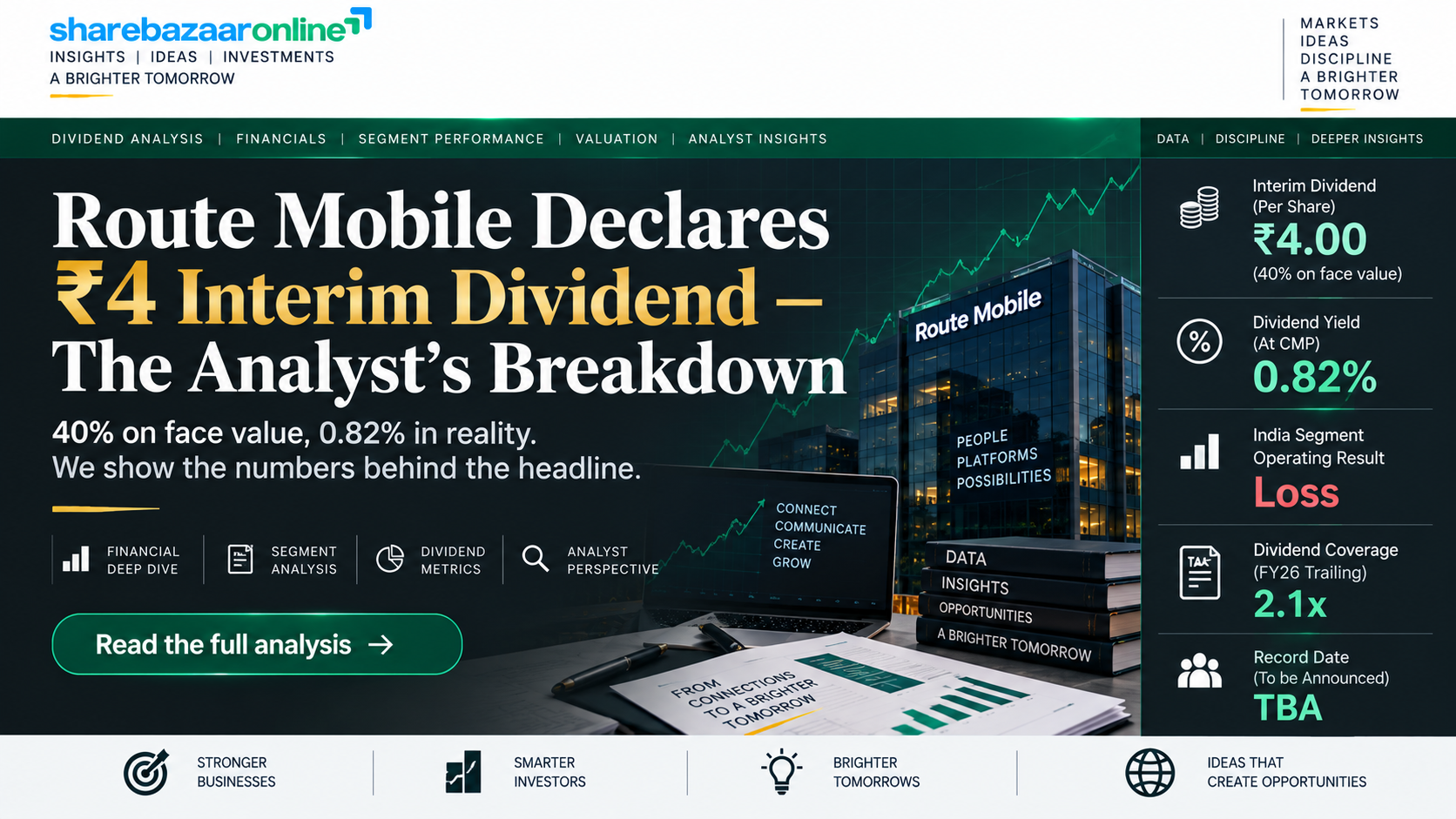
Dividend Snapshot
Route Mobile Limited (NSE: ROUTE | BSE: 543228) has declared a First Interim Dividend of ₹4 per equity share for FY2026–27, announced alongside its Q1 results on 23 July 2026. On the ₹10 face value this is a headline 40% dividend — but on the market price it is a far smaller number, which is the first thing every shareholder should understand.
Dividend per share: ₹4.00
Dividend rate (on face value): 40% of ₹10
Real yield at CMP ₹488: 0.82% (this interim)
Dividend type: First Interim, FY2026–27
Record date: 29 July 2026 (passed)
Ex-date: 29 July 2026 (T+1 regime)
Payment: on/before 13 Aug 2026
Total outflow: ≈ ₹25.2 crore
This is a post-event analysis: the record date has already passed, so this report is for informational and record-keeping purposes and not an eligibility guide. All financial figures are on a consolidated basis unless stated otherwise. Market price ₹488 as on 15 September 2026 (Screener.in).
Dividend Announcement Summary
At its board meeting on 23 July 2026 (which ran from 6:45 p.m. to 8:45 p.m. IST), the Board of Directors of Route Mobile recommended a first interim dividend of ₹4 per share (40% of the ₹10 face value) for the financial year 2026–27. The same meeting approved the unaudited Q1 FY27 results and fixed the 22nd Annual General Meeting for 2 September 2026.
Company: Route Mobile Limited
ISIN: INE450U01017
Face value: ₹10 per share
Shares outstanding: 6.30 crore
Business: Cloud communications (CPaaS)
Promoter: Proximus Group (74.85%)
AGM date: 2 September 2026
Auditor: Walker Chandiok & Co LLP
Route Mobile is a global Communications-Platform-as-a-Service (CPaaS) provider — it routes enterprise SMS, WhatsApp, voice, email and other business messages worldwide. It became part of Belgium’s Proximus Group in May 2024 and now sits inside “Proximus Global” alongside BICS and Telesign. The dividend, being interim, did not require separate AGM approval; the board can declare interim dividends on its own authority.
Key Dates Timeline
Announcement date:
23 July 2026 (board meeting)
Record date:
29 July 2026
Ex-dividend date:
29 July 2026 (aligned with record date under T+1 settlement)
Payment date:
On or before 13 August 2026 (within the 30-day statutory window)
Under India’s current T+1 settlement cycle, the ex-date and record date fall on the same day. Shareholders who held the stock at the close of the ex-date (29 July 2026) were entitled to the dividend. All these dates have passed as of this report.
Dividend Yield Analysis
This is where most retail coverage misleads. A “40% dividend” sounds enormous, but that 40% is calculated on the ₹10 face value, not on the price you actually pay. Here is the reality:
Headline rate on face value: 40%
Yield at announcement (≈₹585): 0.68%
Yield at CMP ₹488: 0.82%
Trailing 12-month dividend: ₹12 per share
Trailing yield at ₹488: ≈ 2.2–2.5%
Screener stated dividend yield: 2.22%
In plain terms: for this single ₹4 interim, a shareholder buying at ₹488 earns roughly 82 paise for every ₹100 invested — not “40%.” Across a full year, Route Mobile’s multiple payouts add up to a trailing yield of about 2.2%, which is roughly in line with a bank savings account and modest for an equity investment. The 40% figure is a regulatory convention, not a return.
The ≈₹585 announcement price is implied by the ₹3,684 crore market capitalisation reported on 23 July 2026 (Value Research); the share had fallen to ₹488 by mid-September 2026.
Dividend History Analysis
Route Mobile has been a consistent, frequent dividend payer since its 2020 IPO, distributing multiple times each year. The declaration record (by ex-date) is below.
| Ex / Record Date | Amount | Type |
|---|---|---|
| 29 Jul 2026 | ₹4.00 | First interim FY27 |
| 18 Aug 2026 | ₹2.00 | Final FY26 |
| 13 Feb 2026 | ₹3.00 | Interim FY26 |
| 10 Nov 2025 | ₹3.00 | Interim FY26 |
| 28 Aug 2025 | ₹2.00 | Interim FY26 |
| 23 Jul 2025 | ₹3.00 | Interim FY26 |
| FY2024–25 total | ₹9–11 | 3 payouts |
| FY2023–24 total | ₹11 | 4 payouts |
| FY2022–23 total | ₹11 | 3 payouts |
Pattern: Annual total has clustered near ₹11 for four straight years (FY23–FY26).
Classification: Consistent Payer — no cuts, no suspensions, no missed years.
Notable signal: The ₹4 first interim for FY27 is the largest first-interim in the company’s history (prior first interims were ₹2–₹3).
Read: Either an intent to lift the annual total, or front-loading of the FY27 payout.
Note: the ₹2 payout with ex-date 18 August 2026 was the final dividend for FY26 (approved at the 2 September 2026 AGM), not part of FY27. Historical amounts are on a declaration-date basis; the exact fiscal-year split of interim versus final can vary by source.
Financial Performance Analysis
The dividend arrives with a Q1 that looks fine at the top line but hides a sharp regional split and heavy margin pressure.
Q1 FY27 (consolidated)
Revenue: ₹1,151.51 cr (+9.58% YoY)
Net profit: ₹68.55 cr (+16.62% YoY)
EPS: ₹9.94
PBT: ₹91.47 cr (+19.5% YoY)
FY2025–26 (consolidated)
Revenue: ₹4,408.21 cr
Net profit: ₹256.94 cr
EPS: ₹37.94
Reported PBT: ₹353.04 cr
Forensic finding 1 — the India business slipped into a loss
The segment table in the filing shows Route Mobile’s India operations posted a ₹4.00 crore operating loss in Q1 FY27, versus a ₹19.58 crore profit a year earlier — a ₹23.6 crore swing. Every rupee of Q1 growth came from overseas, where segment result jumped 65% to ₹85.67 crore. The consolidated “+9.6% revenue” headline masks a domestic business that is currently loss-making at the operating level.
Forensic finding 2 — FY26 profit was understated by one-offs
FY26 net profit of ₹257 crore was dragged down by ₹135.87 crore of exceptional write-offs — a ₹107.96 crore write-off of an advance under a minimum-guaranteed SMS-volume agreement, plus a ₹27.91 crore vendor-advance write-off. Stripping these out, pre-exceptional PBT was ₹488.91 crore versus the reported ₹353.04 crore. The underlying operating business was materially stronger than the headline suggests — a nuance most wire coverage omits.
Forensic finding 3 — profit fell 40% sequentially
Against the immediately prior quarter (Q4 FY26), net profit dropped 40% from ₹114.43 crore to ₹68.55 crore and EPS fell from ₹17.35 to ₹9.94, even though revenue edged up 1.8%. The gap is explained by lower other income (₹11.06 cr vs ₹27.85 cr) and margin compression, not a one-time item.
Cash Flow Analysis
Reported profit is an opinion; cash is a fact. On this test, Route Mobile scores well — the dividend is funded by real cash, not borrowings or reserves.
FY26 operating cash flow: ₹581 cr
FY26 free cash flow: ₹555 cr
Cash conversion (CFO/OP): 131%
This interim outflow: ₹25.2 cr
FCF cover of this interim: 22×
CFO cover of this interim: 23×
In FY26, operating cash flow (₹581 cr) actually exceeded net profit (₹257 cr) — a healthy sign that earnings are backed by cash, and a recovery from FY24 when operating cash flow was negative ₹98 crore. The ₹25.2 crore interim payout is a rounding error against this cash generation. The dividend is clearly funded by current cash earnings, not by cash reserves, asset sales or debt.
One caveat retail investors should note: debtor days sit around 75 and working-capital days rose to about 40 in FY26, so a chunk of revenue is tied up in receivables — worth watching, though not yet a red flag given the strong FCF.
Balance Sheet Strength
The balance sheet is the strongest part of the story. Route Mobile has aggressively deleveraged.
Borrowings (FY26): ₹42 cr — down from ₹468 cr in FY25
Cash & bank (approx): ≈ ₹850 cr
Net cash position: ≈ ₹800+ cr
Net worth: ₹2,770 cr (Reserves ₹2,707 cr)
Book value: ₹440 per share
Status: “almost debt-free” (Screener)
Borrowings collapsed from ₹468 crore to ₹42 crore in a single year — a roughly ₹426 crore repayment. Combined with an estimated ₹850 crore cash pile (bolstered by earlier QIP proceeds of ₹867.5 crore and unutilised IPO money), Route Mobile is comfortably net cash. Against this, the entire FY26 dividend of ₹69 crore, let alone this ₹25 crore interim, is trivially affordable.
Cash figure is approximate, drawn from third-party aggregation of the FY26 balance sheet; exact cash and equivalents should be confirmed against the audited annual report.
Dividend Sustainability Analysis
Applying our four-test scorecard to the ₹4 interim (₹25.2 crore outflow):
1. Earnings coverage: Q1 EPS ₹9.94 covers the ₹4 interim 2.5× — comfortable.
2. FCF coverage: FY26 FCF covers it 22× — very strong.
3. Cash coverage: ≈₹850 cr cash covers it 34× — abundant liquidity.
4. Debt position: Net cash, borrowings just ₹42 cr — no debt-funded payout risk.
Verdict: Sustainable
On coverage, cash and balance-sheet tests, the dividend is clearly Sustainable. The full-year FY26 payout of ₹11 (a 29% payout ratio) is also comfortably financed — FY26 free cash flow covered it 8 times over. The one soft spot is earnings trend: with the India segment loss-making and margins compressing, the quantum of future dividends depends on whether the overseas engine keeps compensating. Capacity is not in doubt; direction of profit is the variable.
Peer Comparison
The closest listed Indian peer is Tanla Platforms, the other large domestic CPaaS player.
| Metric | Route Mobile | Tanla Platforms |
|---|---|---|
| Market cap | ₹3,071 cr | ₹6,600 cr |
| Dividend yield | ≈ 2.2% | ≈ 2.3–2.6% |
| Dividend payout | ≈ 23–29% | ≈ 31–51% |
| ROE | 12.6% | ≈ 25% (3-yr) |
| ROCE | 17.4% | higher |
| P/E | ≈ 9 (Screener) | ≈ 13 |
| Debt | Almost debt-free | Almost debt-free |
The two yield roughly the same (~2.2–2.6%), and both are almost debt-free. The differences: Tanla runs a higher payout ratio and roughly double the return on equity (25% vs 12.6%), while Route Mobile trades cheaper (lower P/E, near book value at about 1.1× P/B). For a dividend-focused reader, both offer a modest, similar yield; Tanla returns more of its profit as dividend, Route Mobile retains more but is valued more conservatively by the market.
Promoter Impact Analysis
Promoter (Proximus) holding: 74.85%
Promoter share of this payout: ≈ ₹18.86 cr
Public holding: 19.29%
Public share of this payout: ≈ ₹4.86 cr
Of the ₹25.2 crore total outflow, about ₹18.86 crore flows to promoter Proximus Group (74.85% stake) and roughly ₹4.86 crore to public shareholders (19.29%), with the balance to FIIs (2.40%) and DIIs (3.46%). This is normal for a company with a dominant strategic parent — the dividend is a legitimate, pro-rata channel for the Belgian parent to receive cash from its Indian-listed subsidiary. Minority shareholders receive the same ₹4 per share; the point to note is simply that the majority of the cash leaves for the promoter, which is a feature of the 74.85% ownership structure rather than a concern in itself.
Taxation Analysis
Since April 2020, dividends are taxable in the hands of the shareholder at their income-tax slab rate — there is no separate dividend distribution tax. Route Mobile deducts TDS before paying, in line with the Income-tax Act, 2025.
Taxable at: your income-tax slab rate
TDS threshold: nil TDS if total dividend from the company is under ₹10,000 in the year (resident, with PAN)
TDS rate: 10% above ₹10,000 (valid PAN)
No / unlinked PAN: 20% TDS
Worked example — 1,000 shares
Gross dividend: 1,000 × ₹4 = ₹4,000
TDS: nil (below ₹10,000 threshold, assuming this is the only dividend from the company)
Cash received: ₹4,000
Tax later (30% slab): ₹1,200 → net ₹2,800; effective yield ≈ 0.57% at ₹488
The key retail takeaway: dividend income is added to your total income and taxed at your slab. For someone in the 30% bracket, an already-thin 0.82% pre-tax yield becomes roughly 0.57% after tax. If your annual dividend from Route Mobile crosses ₹10,000, 10% TDS is withheld up front but the final liability still follows your slab.
Key Risks
1. India turned loss-making: the domestic segment swung to a ₹4 cr operating loss in Q1 FY27; if it doesn’t recover, group margins stay under pressure.
2. Wafer-thin margins: purchase of messaging services (₹911 cr) eats about 79% of Q1 revenue; operating margin is only ~9%, so small cost shifts hit profit hard.
3. Falling share price: the stock is down ~49% over one year and near multi-year lows — the “higher” trailing yield partly reflects price weakness, not dividend growth.
4. Currency & overseas concentration: most profit is overseas and exposed to foreign-exchange swings; net FX moves already flip between gain and loss year to year.
5. Receivables build-up: debtor days ~75 and working-capital days rising to ~40; slower collections could pressure future cash flow.
6. Recurring write-offs: FY26 carried ₹135.87 cr of exceptional advance write-offs — a reminder that vendor/volume commitments can turn into losses.
What To Monitor
1. India segment result: does it return to profit in H2 FY27, or stay a drag?
2. Operating margin: whether adjusted EBITDA margin holds above ~9% or slips further.
3. Proximus integration: revenue and cost synergies from BICS/Telesign under “Proximus Global,” plus the Heltar and other bolt-on acquisitions.
4. Full-year dividend total: whether the larger ₹4 first interim signals a higher FY27 payout than the ₹11 norm.
5. Cash conversion & receivables: whether OCF keeps exceeding profit and debtor days stabilise.
6. New-product revenue: traction in RCS, WhatsApp, AI and Network-API (Konera) offerings as legacy SMS commoditises.
Conclusion
Route Mobile’s ₹4 first interim dividend for FY2026–27 is its largest-ever first interim, and on affordability it is a non-event in the best sense — the company is net cash, generated ₹555 crore of free cash flow in FY26, and the ₹25 crore outflow is covered more than 20 times over. The dividend is unambiguously Sustainable.
Two truths sit behind the headline, though. First, the “40%” is on face value; the real cash yield is about 0.82% for this interim and roughly 2.2% on a trailing-year basis — modest, and flattered by a share price that has nearly halved in a year. Second, beneath a “+9.6% revenue” quarter, the India business slipped into an operating loss and FY26 profit was distorted by ₹136 crore of write-offs. The cash to pay dividends is not in question; the trajectory of the profits that ultimately fund them is the thing to watch.
Positives: consistent multi-year payer, net-cash balance sheet, strong FCF, cheap on P/E and P/B. Negatives: thin margins, loss-making India segment, price weakness, recurring write-offs. We present the evidence; the decision is yours.
Frequently Asked Questions
What dividend has Route Mobile announced?
What is the actual dividend yield on Route Mobile?
What was the record date for the Route Mobile dividend?
What was the ex-dividend date?
When was the dividend paid?
Who was eligible for the Route Mobile dividend?
How is the Route Mobile dividend taxed?
Is Route Mobile’s dividend sustainable?
What is Route Mobile’s dividend history?
Why did net profit fall despite higher revenue?
Who owns Route Mobile?
What should investors monitor going forward?
How does Route Mobile compare with Tanla Platforms on dividends?
Does the ₹4 interim mean a bigger dividend this year?
Disclaimer
This article is for informational and educational purposes only and does not constitute investment advice or a recommendation to buy, sell or hold any security. ShareBazaar Online is not a SEBI-registered investment adviser. Figures are sourced from Route Mobile’s regulatory filing dated 23 July 2026 and third-party data providers (Screener.in, StockAnalysis, Value Research, Equitymaster and others); some market-price and cash figures are approximate and should be verified against official company disclosures and the audited annual report. Computed ratios are our own analysis. Dividend, tax and market data are subject to change. Investing in equities carries risk, including loss of capital. Please consult a qualified, SEBI-registered financial adviser and read all official documents before making any investment decision.