
Dividend Snapshot
Rail Vikas Nigam Limited (RVNL), a Navratna Central Public Sector Enterprise under the Ministry of Railways, has declared a final dividend of ₹0.71 per equity share for the financial year 2025-26. On the ₹10 face value, that headline reads as a 7.1% dividend — but on RVNL's real market price of roughly ₹199 (NSE, 15 September 2026), the actual cash yield on the final dividend is only about 0.36%. This gap between the face-value percentage and the real market yield is the single most important thing a retail investor should understand before reading any further.
The Headline Numbers
- Final Dividend: ₹0.71 per share (7.1% of face value)
- Interim Dividend already paid in FY26: ₹1.00 per share
- Total FY26 Dividend: ₹1.71 per share
- Real yield on final dividend (CMP ₹199): ~0.36%
- Real yield on full-year FY26 payout: ~0.86%
- Face Value: ₹10
What Stands Out
- Final dividend cut ~59% vs last year's final (₹1.72 → ₹0.71)
- Consolidated net profit fell ~32% in FY26 to ₹871 crore
- FY26 operating cash flow was negative ₹1,889 crore
- Debtor days jumped from 33 to 96
- Total FY26 payout ratio: ~41% of consolidated profit
The record date of 18 August 2026 has already passed. This analysis is therefore a post-event review of the dividend's quality, sustainability and context — not an eligibility alert. Shareholders who held RVNL in their demat account as of the record date were entitled to the payout, which the company said would be credited within 30 days of the AGM held on 25 August 2026.
Dividend Announcement Summary
RVNL's Board of Directors recommended the ₹0.71 per share final dividend for FY2025-26 when it approved the audited results for the year ended 31 March 2026 (results released after market hours on 25 May 2026). In a separate regulatory intimation dated 28 July 2026, the company fixed the record date and confirmed the AGM schedule. The board's exact language: a final dividend of ₹0.71 per fully paid-up equity share of face value ₹10 each, subject to shareholder approval at the ensuing Annual General Meeting, to be paid within 30 days of declaration at the AGM.
Company Identity
- Company: Rail Vikas Nigam Limited
- NSE Symbol: RVNL
- BSE Code: 542649
- ISIN: INE415G01027
- CIN: L74999DL2003GOI118633
- Status: Navratna CPSE, Ministry of Railways
Dividend Structure
- Dividend Type: Final Dividend
- Dividend Per Share: ₹0.71
- Dividend Percentage: 7.1% (on face value)
- Financial Year: 2025-26
- AGM Approval: Required (obtained at AGM on 25 Aug 2026)
- Total FY26 Outflow (final): ~₹148 crore
Management context: Alongside the results, RVNL noted the formal closure of its Central Asian joint venture (Kyrgyzindustry-RVNL CJSC) and the incorporation of a new wholly-owned subsidiary in Andhra Pradesh. Management flagged nominal delays in receipts from certain projects such as Krishnapatnam Railway Company Limited (KRCL) but maintained that its long-term trajectory was intact. Rail infrastructure development remains its single core reportable segment.
Key Dates Timeline
| Event | Date | Note |
|---|---|---|
| Board Recommendation (with FY26 results) | 25-26 May 2026 | Final dividend proposed |
| Record-Date Intimation Filing | 28-07-2026 | Book closure & AGM notified |
| Book Closure | 19-08-2026 to 25-08-2026 | Both days inclusive |
| Ex-Dividend Date | 18-08-2026 | Same as record date under T+1 |
| Record Date | 18-08-2026 | Eligibility cut-off (passed) |
| Annual General Meeting | 25-08-2026 | Via video conferencing |
| Payment Date | Within 30 days of AGM (~by 24-09-2026) | Credited to eligible holders |
A note on the ex-date: Under India's T+1 settlement cycle, the ex-dividend date and the record date fall on the same trading day. RVNL's ex-date of 18 August 2026 is confirmed by exchange records showing the stock traded ex-dividend that week. Investors who bought on or after 18 August 2026 were not eligible for this final dividend.
Dividend Yield Analysis
This is where most aggregator coverage misleads readers. The "7.1% dividend" figure is calculated on the ₹10 face value, not on the price you actually pay in the market. Here is the same dividend measured against the prices that matter.
| Basis | Price / Reference | Yield |
|---|---|---|
| Face-value "headline" (final) | ₹10 face value | 7.1% |
| Real yield — final dividend | CMP ~₹199 | ~0.36% |
| Real yield — full FY26 payout (₹1.71) | CMP ~₹199 | ~0.86% |
| Yield at pre-results price | ~₹272 (pre 26 May) | ~0.26% (final) |
The Face-Value Illusion
A "7.1% dividend" sounds generous. In cash terms it is 71 paise on a share worth around ₹199. RVNL is a growth-and-capex story that the market prices at roughly 47 times earnings; it has never been a high-yield stock. Buying it for the dividend would be a category error.
Yield Reality Check
Part of the reason the trailing yield looks marginally better (~0.86%) than the raw final yield is simply that the share price has fallen roughly 50% from its 52-week high of ₹400.70. A rising yield here reflects a falling denominator, not a rising dividend.
Dividend History Analysis
| Financial Year | Total DPS | Payout Ratio |
|---|---|---|
| FY2025-26 | ₹1.71 (₹1.00 interim + ₹0.71 final) | ~41% |
| FY2024-25 | ₹1.72 (final) | ~28% |
| FY2023-24 | ₹2.11 (final) | ~28% |
| FY2022-23 | ~₹2.13 (interim + final) | ~33% |
| FY2021-22 | ~₹1.81 (interim + final) | ~34% |
| FY2020-21 | ~₹1.57 | ~33% |
| FY2019-20 | ~₹1.13 | ~31% |
Per-share figures for older years are derived from disclosed payout ratios and profit (interim/final splits vary by year). Source: company filings and Screener.in.
Consistency
RVNL has paid a dividend every year since listing in 2019, which makes it a consistent payer. There have been no suspensions. But consistency of frequency is not the same as consistency of amount — the rupee value has moved around with profits and payout policy.
The Overlooked Cut
Coverage that reports "total FY26 dividend broadly flat at ₹1.71 vs ₹1.72" hides the real move: the final component was cut ~59%, from ₹1.72 to ₹0.71. The total only held because RVNL front-loaded a ₹1.00 interim in February 2026. That is a meaningful shift in payout timing and profile.
Financial Performance Analysis
All figures below are consolidated unless stated. RVNL's headline story for FY26 is that revenue held broadly flat while profit fell sharply — a classic case of margin compression at an infrastructure execution company.
| Metric (Consolidated) | FY24 | FY25 | FY26 |
|---|---|---|---|
| Revenue (₹ cr) | 21,879 | 19,923 | 20,412 |
| Operating Profit (₹ cr) | 1,354 | 1,131 | 767 |
| Operating Margin (%) | 6% | 6% | 3.8% |
| Other Income (₹ cr) | 1,266 | 1,091 | 869 |
| Net Profit (₹ cr) | 1,551 | 1,278 | 871 |
| EPS (₹) | 7.44 | 6.13 | 4.20 |
Operating Leverage — In Reverse
Revenue rose ~2.5% in FY26, yet operating profit fell ~32% and the operating margin nearly halved from 6% to 3.8%. Costs rose faster than billings — higher material, employee and other execution costs squeezed a business that already runs on thin single-digit margins. This is negative operating leverage.
Quality of Earnings
A recurring feature at RVNL: other income (₹869 crore) exceeded operating profit (₹767 crore) in FY26. A large slice of pre-tax profit comes from treasury and interest income rather than core project execution. Investors should read the profit line knowing this cushion is doing heavy lifting.
Cash Flow Analysis
Reported profit is an accounting opinion; cash is a fact. This is the section aggregators skip — and for RVNL in FY26, it is the most important one.
| Cash Flow (Consolidated, ₹ cr) | FY24 | FY25 | FY26 |
|---|---|---|---|
| Operating Cash Flow (OCF) | 2,956 | 1,881 | -1,889 |
| Free Cash Flow (FCF) | 2,630 | 1,450 | -1,949 |
| Net Profit (for comparison) | 1,551 | 1,278 | 871 |
The Key Finding: A Profitable Year With Negative Operating Cash Flow
RVNL reported ₹871 crore of profit in FY26 but consumed ₹1,889 crore of cash from operations and posted free cash flow of negative ₹1,949 crore. In plain terms, the FY26 dividend was not funded by the cash the business generated this year — because the business generated none. It was funded from the balance sheet: accumulated cash, investments and the sovereign-backed liquidity RVNL carries.
Why Cash Turned Negative
The swing is driven largely by working capital, not by losses. Debtor days ballooned from 33 to 96 — receivables nearly tripled relative to sales. Money that would normally return as cash is stuck in project receivables (management specifically flagged delayed receipts from KRCL). If those receivables convert, OCF should normalise; if they don't, this is a warning light.
Receivables vs Revenue
Revenue barely grew, yet receivables surged — a divergence that usually signals slower collections or revenue recognised ahead of cash receipt. For an EPC company sharing revenue with the Ministry of Railways, collection timing can be lumpy, but a jump of this size deserves close monitoring in FY27 quarterly numbers.
Balance Sheet Strength
The balance sheet is what makes the negative-cash-flow year survivable. RVNL sits on a solid reserve base and manageable leverage, which is precisely why the dividend could still be paid out of the balance sheet.
Key Balance-Sheet Items (FY26)
- Net Worth: ~₹9,822 crore
- Book Value per Share: ~₹47
- Borrowings: ~₹4,818 crore
- Cash: ~₹968 crore
- Investments: ~₹2,645 crore
- Net Debt: ~₹3,850 crore
Leverage & Returns
- Debt-to-Equity: ~0.49x (comfortable)
- ROE (FY26): ~9.0% (down from ~16% three-year average)
- ROCE (FY26): ~10.8%
- Stock trades at: ~4.35x book value
The nuance: Borrowings have actually fallen year-on-year (from ₹5,419 crore to ₹4,818 crore), so the dividend was not funded by taking on fresh debt. However, returns are trending down — ROE has slid from the low-20s a few years ago to around 9% in FY26 — which is the real cost of the profit decline.
Dividend Sustainability Analysis
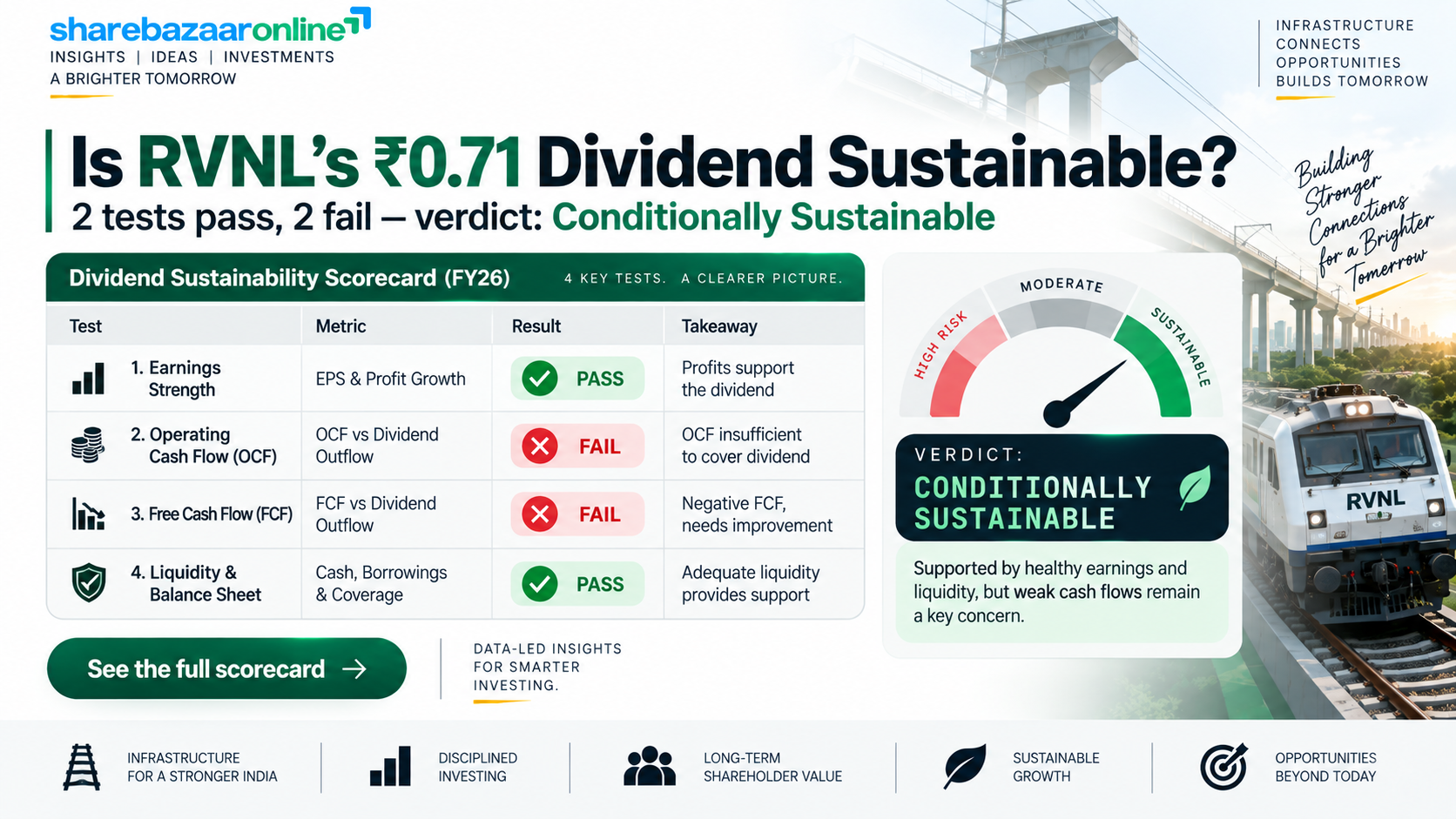
We assess sustainability on a four-test scorecard. RVNL passes the earnings and liquidity tests but fails both cash-flow tests for FY26 — a split verdict that turns on one variable: receivables.
| Test | Reading | Result |
|---|---|---|
| Earnings coverage | EPS ₹4.20 vs total DPS ₹1.71 = 2.46x | Pass |
| Operating cash flow coverage | OCF negative ₹1,889 cr | Fail |
| Free cash flow coverage | FCF negative ₹1,949 cr | Fail |
| Liquidity coverage | Cash covers outflow 2.7x; cash+investments ~10x | Pass |
Verdict: Conditionally Sustainable
The final dividend of ₹0.71 (total FY26 outflow ~₹357 crore) is small relative to RVNL's ₹9,822 crore net worth and its cash-plus-investment base, so the company can clearly afford it from the balance sheet. The payout ratio (~41%) is moderate. But calling it fully sustainable ignores that the business produced no operating cash in FY26. Our classification is therefore Conditionally Sustainable: sustainable so long as receivables (the KRCL-type project dues) convert to cash and OCF returns to positive territory in FY27. A second consecutive year of negative operating cash flow would move this to "Moderately Sustainable" at best.
Peer Comparison
| Railway PSU | Approx Yield | Payout | Character |
|---|---|---|---|
| RVNL | ~0.4% (final) / ~0.9% (TTM) | ~41% | EPC execution, thin margin |
| IRCON International | ~1.6% | ~34% | Diversified EPC |
| IRFC | ~1.5-2.1% | ~50% | Railway financier, high leverage |
| RailTel | ~0.6% | ~37% | Telecom infra |
| RITES | ~2% (higher) | Healthy | Asset-light consultancy, high ROE |
Peer yields and payouts are approximate, drawn from recent public data and move with price; RITES figures are indicative. Verify against latest exchange data before use.
Read-across: RVNL sits at the bottom of the railway-PSU dividend-yield table. Peers like IRCON, IRFC and RITES offer higher cash yields and, in the case of RITES, materially higher return ratios on an asset-light model. RVNL's appeal has always been execution scale and order-book visibility, not income — and FY26's margin and cash-flow slippage widens the gap versus peers on quality metrics.
Promoter Impact Analysis
Ownership
- Promoter (President of India): 72.84%
- FIIs: 2.41% (Jun 2026)
- DIIs: 6.60%
- Public & others: ~18.15%
Where the Dividend Goes
- Final dividend to Govt of India: ~₹108 crore
- Full-year FY26 to Govt of India: ~₹260 crore
- Final dividend to non-promoters: ~₹40 crore
The structural reality: Because the Government of India owns nearly three-quarters of RVNL, roughly 73 paise of every dividend rupee flows back to the promoter — the sovereign exchequer. For PSUs, dividends are partly a fiscal transfer mechanism to the government. Minority shareholders receive the same per-share rate, but the aggregate is dominated by the state's stake. It is also worth noting promoter holding has drifted down ~5 percentage points over three years (from ~78% to ~73%) as the government has trimmed its stake.
Taxation Analysis
Since the FY2020-21 change, dividends are taxed in the hands of the investor, not the company. There is no Dividend Distribution Tax anymore — instead the dividend is added to your total income and taxed at your slab rate.
The Rules in Brief
- Dividend taxed at your income-tax slab rate
- TDS at 10% deducted by the company if your total dividend from it exceeds ₹10,000 in a financial year (with PAN; 20% without PAN)
- TDS is not an extra tax — it is adjusted against your final liability
- NRIs face TDS at 20% (plus surcharge/cess), subject to treaty relief
Worked Example
Investor owns 1,000 RVNL shares, final dividend ₹0.71/share, tax slab 30%:
- Gross dividend: ₹710
- Tax at 30%: ₹213
- Net in hand: ₹497
- TDS: None (₹710 is below the ₹10,000 threshold)
On the full-year payout: the same 1,000 shares earned ₹1,710 across FY26 (₹1.71 total). At a 30% slab, that is ₹513 in tax and ₹1,197 net — an effective post-tax yield of well under 1% on a share around ₹199. The dividend is a modest top-up, not an income stream.
Key Risks
- Cash-flow risk: FY26 operating cash flow was negative ₹1,889 crore. If receivables do not convert, the mismatch between reported profit and cash could persist and pressure future distributions.
- Margin compression: Operating margin nearly halved to 3.8% in FY26. RVNL already operates on razor-thin single-digit margins, leaving little buffer against cost inflation.
- Earnings decline: Consolidated profit has fallen two years running (₹1,551 cr → ₹1,278 cr → ₹871 cr). Falling profit ultimately caps dividend capacity.
- Receivable concentration: A sharp rise in debtor days (33 to 96) and specific delayed receipts (KRCL) point to collection and counterparty timing risk.
- Valuation risk: At ~47x earnings and ~4.35x book, RVNL is priced as a growth stock; any further earnings disappointment carries de-rating risk, as the ~50% fall from its 52-week high already shows.
- Other-income dependence: Treasury/other income (₹869 cr) exceeded core operating profit in FY26; a fall in yields or investable surplus would hit the bottom line disproportionately.
What To Monitor
- FY27 operating cash flow: The single most important number. Watch whether OCF returns to positive as receivables are collected. Q1 FY27 profit already rose ~18% YoY — check whether cash follows.
- Debtor days trend: Track whether the 96-day figure reverses toward the historical 20-35 day range.
- Operating margin recovery: Look for OPM stabilising or recovering from 3.8% back toward the ~6% RVNL sustained through FY22-FY25.
- Order book and inflows: RVNL continues to win contracts (e.g. recent SJVN Buxar and East Coast Railway awards). Order-book growth underpins future revenue and, eventually, cash.
- Interim vs final dividend mix: Watch whether RVNL keeps front-loading interim dividends — a signal of how management is managing distribution timing against cash.
- Government stake actions: Any further OFS or stake dilution by the promoter can affect float, sentiment and the aggregate dividend flow to the exchequer.
Conclusion
RVNL's ₹0.71 final dividend for FY2025-26 is best understood as a small, balance-sheet-funded distribution from a company having a difficult year. The "7.1% dividend" headline is a face-value artefact; the real cash yield on the final dividend is around 0.36%, and even the full-year payout yields under 1%. Nobody owns RVNL for income.
Positives
- Unbroken dividend record since 2019
- Moderate ~41% payout, comfortably earnings-covered (2.46x)
- Strong balance sheet: net worth ~₹9,822 cr, D/E ~0.49x, borrowings falling
- Sovereign parent and large order book
Negatives
- Negative operating and free cash flow in FY26
- Final dividend cut ~59% year-on-year
- Profit down two years running; margins halved
- Debtor days tripled; earnings lean on other income
Bottom line: The dividend is affordable today because of RVNL's balance sheet, not because of the cash it earned this year. Sustainability hinges on receivables converting and cash flow normalising in FY27. We present the positives, negatives, risks and monitoring factors above so you can weigh them yourself.
Frequently Asked Questions
What dividend has RVNL announced for FY2025-26?
What is the real dividend yield on RVNL's final dividend?
What was the record date for the RVNL dividend?
What was the ex-dividend date?
When will the RVNL dividend be paid?
Who was eligible for the dividend?
How is the RVNL dividend taxed?
Is the RVNL dividend sustainable?
What is RVNL's dividend history?
Why did RVNL's profit fall in FY26?
How does RVNL's dividend compare with other railway PSUs?
How much of the dividend goes to the government?
What should investors monitor going forward?
Disclaimer
This article is for informational and educational purposes only and does not constitute investment advice, a recommendation, or an offer to buy or sell any security. ShareBazaar Online is not a SEBI-registered investment adviser. Figures are compiled from company filings, Screener.in, exchange data and public news sources as of September 2026; market prices, yields and peer data change continuously and should be independently verified. Computed ratios are estimates based on disclosed data. Dividend approval, record and payment dates are subject to company and regulatory processes. Tax treatment depends on individual circumstances — consult a qualified tax professional. Investments in securities are subject to market risks; please read all related documents carefully and consult a registered financial adviser before making any investment decision.