
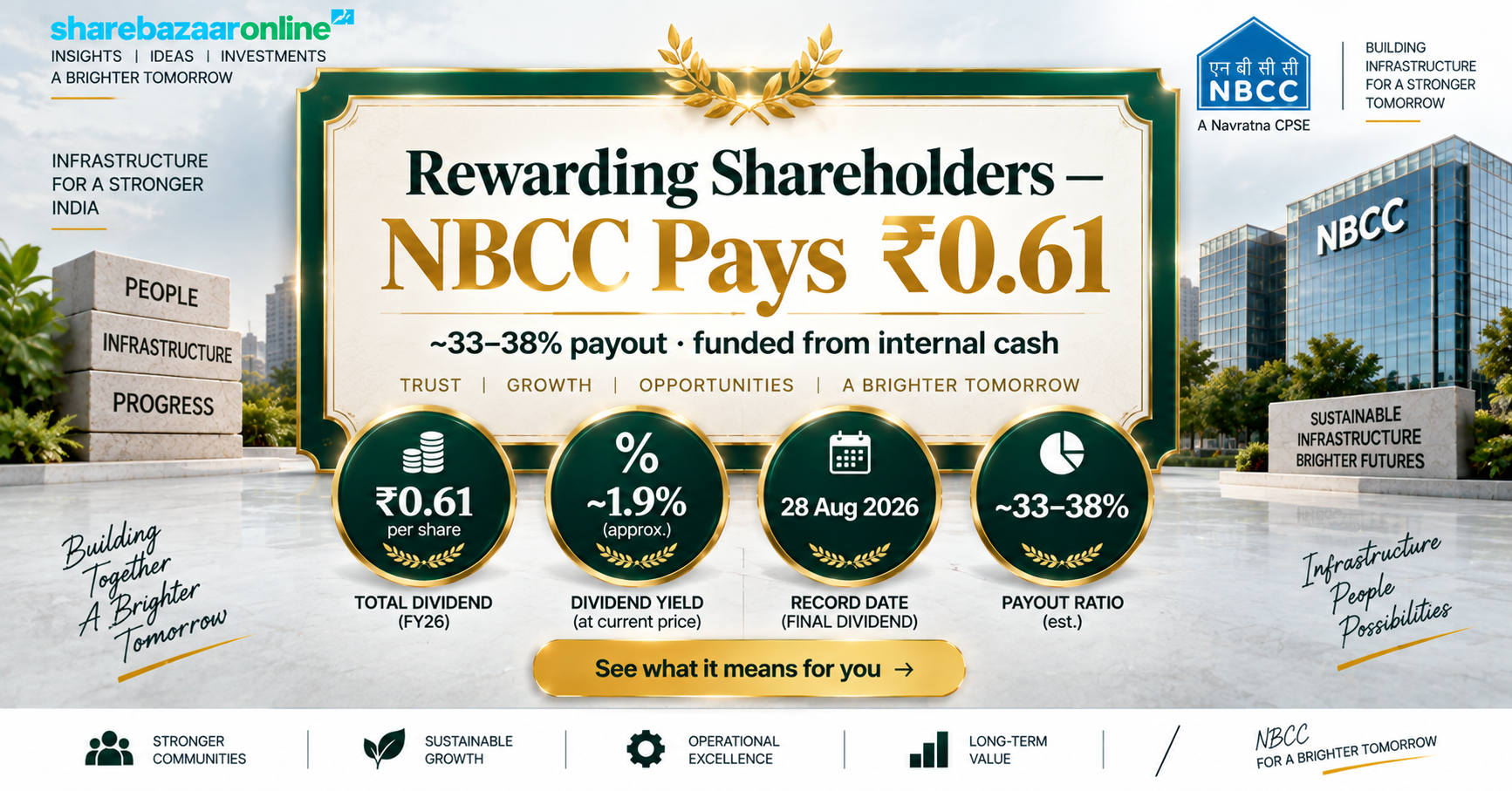
Dividend Snapshot
NBCC (India) Limited, a Navratna Central Public Sector Enterprise under the Ministry of Housing & Urban Affairs, has rewarded shareholders twice in a single board sitting on August 11, 2026. The Board declared a 1st interim dividend of ₹0.15 per share (15% of face value) for FY 2026‑27 and separately recommended a final dividend of ₹0.46 per share (46%) for FY 2025‑26. Together, shareholders on record stand to receive ₹0.61 per share across the two events.
Dividend Details
- Interim Dividend (FY27)₹0.15 (15%)
- Final Dividend (FY26)₹0.46 (46%)
- Combined Per Share₹0.61
- Face Value₹1.00
- Interim Record Date17 Aug 2026
Market Context
- CMP (10 Sep 2026)*₹83.90
- Combined Yield @ CMP~0.73%
- Trailing 12M Yield*~1.19%
- Promoter (Govt of India)61.75%
- Market Cap*~₹22,664 Cr
The one-line takeaway: The headline "15%" and "46%" figures are calculated on the ₹1 face value, not on the market price. In real cash-return terms, the combined ₹0.61 works out to a market-price yield of only about 0.73% at a CMP of ₹83.90 — a large gap that most wire reports never explain.
*CMP, market cap and trailing yield sourced from Screener.in / exchange data as of 10 September 2026. All yield figures are price‑dependent and require re‑verification against the live quote at the time of reading.
Dividend Announcement Summary
At its meeting on 11 August 2026 (12:30 p.m. to 3:00 p.m.), the NBCC Board approved the unaudited Q1 FY 2026‑27 results and took two distinct dividend decisions that belong to two different financial years:
Declared — Interim (FY 2026‑27)
₹0.15 per paid‑up equity share of ₹1 each. Being an interim dividend, it was declared by the Board and does not require separate shareholder approval. Record date fixed at 17 August 2026; payment within the timeline stipulated under the Companies Act, 2013.
Recommended — Final (FY 2025‑26)
₹0.46 per paid‑up equity share of ₹1 each. Being a final dividend, it is subject to shareholder approval at the 66th AGM on 11 September 2026. Record date fixed at 28 August 2026.
Other board decisions worth noting
- In‑principle approval to incorporate a wholly‑owned SPV for a Real Estate Investment Trust (REIT), subject to Ministry of Housing & Urban Affairs / DIPAM approval — a potential monetisation route for NBCC's real‑estate assets.
- The 66th AGM is scheduled for 11 September 2026 at 12:00 noon via VC/OAVM.
- A separate merger of subsidiary HSCC (India) Ltd into NBCC is in motion; DIPAM's no‑objection was received on 9 July 2026 and a joint first‑motion application was filed on 17 July 2026.
Key Dates Timeline
| Event | Interim (FY27) | Final (FY26) |
|---|---|---|
| Announcement | 11 Aug 2026 | 11 Aug 2026 |
| Record Date | 17 Aug 2026 | 28 Aug 2026 |
| Ex‑Date | Not Disclosed by Company | Not Disclosed by Company |
| AGM Approval | Not required (interim) | 11 Sep 2026 |
| Payment Date | Within Companies Act limit | Not Disclosed by Company |
Under Indian settlement rules, the ex‑date typically falls on the record date itself (T+1 regime). The company's filing states the record dates but does not explicitly disclose ex‑dates or the exact payment dates; these should be confirmed against the official NSE/BSE corporate‑action circular. For final dividends, the ₹0.46 remains conditional until ratified by shareholders at the AGM.
Dividend Yield Analysis
The face‑value yield illusion
A "15% dividend" sounds generous, but the percentage is applied to the ₹1 face value — so it equals just ₹0.15 in cash. The same logic applies to the "46%" final dividend, which is ₹0.46. What matters to a buyer at today's price is the market‑price yield, not the face‑value percentage.
Yield at CMP ₹83.90
- Interim ₹0.150.18%
- Final ₹0.460.55%
- Combined ₹0.610.73%
- Trailing 12‑month*~1.19%
Yield at announcement ₹93.80
- Combined ₹0.610.65%
- Face‑value "yield"61%
The "61%" face‑value figure is an accounting artefact, not a cash return. The real cash yield on the money you would pay for the share is below 1%.
Why the yield is low: NBCC trades at a rich valuation (a P/E of roughly 33x and about 7.5x book value). A high price in the denominator mathematically compresses the yield, even though the company maintains a healthy payout ratio near 33–38% of profit. This is a growth‑and‑order‑book stock that also pays a modest dividend — not a high‑yield income stock.
Dividend History Analysis
NBCC is a consistent dividend payer that has distributed dividends every year for over a decade, typically through a mix of interim and final payments. However, raw per‑share numbers across years are not directly comparable because of two corporate actions that changed the share base.
Corporate actions to adjust for
- 1:2 bonus issue (2017) plus a subsequent split from ₹2 to ₹1 face value.
- 1:2 bonus issue (2024) — equity capital rose from ₹180 Cr to ₹270 Cr, lifting the share count to 270 crore shares.
Per Ind AS 33, historical per‑share figures must be restated for these events before any year‑on‑year comparison.
Payout discipline
Rather than compare unadjusted per‑share amounts, the payout ratio tells a cleaner story. NBCC has held a dividend payout of roughly 26% to 41% of profit across the last decade — a stable, board‑driven policy typical of a government enterprise.
Bonus‑adjusted effective dividend per share (computed)
| Financial Year | Payout % | EPS (restated, ₹) | Effective DPS (₹) |
|---|---|---|---|
| FY2021‑22 | 40% | 0.83 | ~0.33 |
| FY2022‑23 | 36% | 0.99 | ~0.36 |
| FY2023‑24 | 28% | 1.49 | ~0.42 |
| FY2024‑25 | 33% | 2.00 | ~0.66 |
| FY2025‑26 | 38% | 2.67 | ~1.01 |
Effective DPS = payout% × restated consolidated EPS (Screener.in, bonus‑adjusted). These are computed approximations on the current 270‑crore share base and may differ from as‑declared amounts due to interim/final timing. Individual as‑declared amounts are Not Independently Verified pending a desk cross‑check against exchange records.
Trend read: On a restated basis, the effective payout has grown alongside earnings — from about ₹0.33 (FY22) to roughly ₹1.01 (FY26). This is a rising, earnings‑linked dividend, not a fixed one. Classification: Consistent Payer.
Financial Performance Analysis
FY2025‑26 (Consolidated)
- Revenue₹12,889 Cr
- Net Profit (total)₹742 Cr
- PAT (owners)₹720 Cr
- EPS₹2.67
- Operating margin~4.8%
Q1 FY2026‑27 (Consolidated)
- Revenue₹2,260 Cr
- Net Profit₹158 Cr
- EPS (quarter)₹0.57
- Other Income (Q1)₹61 Cr
Operating leverage — the thin‑margin reality
NBCC's core Project Management Consultancy (PMC) model is asset‑light but low‑margin. Operating profit margins sit around 4.8–7% because most contract value is passed through to sub‑contractors, with NBCC earning a management fee (for example, a 5.5% PMC fee on the recent NHPC MoU). Consolidated revenue grew from ₹10,407 Cr (FY24) to ₹12,044 Cr (FY25) to ₹12,889 Cr (FY26), while profit rose from ₹414 Cr to ₹557 Cr to ₹742 Cr — profit has grown faster than revenue, aided partly by higher other income.
Earnings quality flag
FY26 profit includes other income of about ₹376–388 Cr (largely treasury/interest income on cash floats), a meaningful slice of pre‑tax profit. Investors should separate this from core PMC operating profit. Note also that the standalone Q1 results carry several Emphasis of Matter items from the auditor — stuck real‑estate projects (Kochi, Faridabad, Naya Raipur), the NBCC Green View (Gurugram) reconstruction, and litigation — which do not modify the audit conclusion but do sit as overhangs.
Cash Flow Analysis
Reported profit is an accounting opinion; cash is the fact that funds a dividend. Here NBCC's record is volatile but recently positive.
| Consolidated (₹ Cr) | FY23 | FY24 | FY25 | FY26 |
|---|---|---|---|---|
| Operating Cash Flow | -374 | -6 | 661 | 439 |
| Free Cash Flow | -385 | -50 | 342 | 402 |
| Net Profit | 278 | 414 | 557 | 742 |
What the numbers say
- In FY23 and FY24, operating cash flow was negative even though the company was profitable — a classic working‑capital gap where profits were locked in receivables, not cash.
- Debtor days rose from 113 to 144 in the latest year, signalling that collections are lengthening again — a metric to watch closely.
- Positively, FY25 and FY26 both generated healthy free cash flow (₹342 Cr and ₹402 Cr), comfortably above the near‑term dividend outflow.
Funding source: The combined ₹0.61 dividend costs roughly ₹164.7 Cr. Against FY26 free cash flow of ₹402 Cr and operating cash flow of ₹439 Cr, the dividend is funded out of current cash generation — not borrowings (the company is virtually debt‑free) and not asset sales.
Balance Sheet Strength
Key metrics (FY26, Consolidated)
- Equity Capital₹270 Cr
- Reserves₹2,747 Cr
- Borrowings~₹0 (debt‑free)
- Book Value / Share~₹11.2
- Net DebtNet cash positive
Return ratios
- ROE (FY26)~20.4%
- ROCE (FY26)~29%
- 5‑yr avg ROE~22%
- Exact cash balanceNIV*
NBCC's balance sheet is a genuine strength: near‑zero debt, strong return ratios, and a large cash float arising from client advances (its "Other Liabilities" of about ₹13,290 Cr are largely project‑linked advances, not borrowings). A negative working‑capital cycle historically let the company operate on other people's cash. This gives ample headroom to service a modest dividend without financial stress.
*The precise consolidated cash & bank balance is Not Independently Verified here and should be confirmed from the FY26 annual report; a large share of current assets/liabilities relates to project advances.
Dividend Sustainability Analysis
| Test | Metric | Coverage | Verdict |
|---|---|---|---|
| Earnings | PAT ₹742 Cr vs ₹164.7 Cr | 4.5x | Strong |
| Operating Cash | OCF ₹439 Cr | 2.7x | Adequate |
| Free Cash Flow | FCF ₹402 Cr | 2.4x | Adequate |
| Liquidity / Debt | Net cash, debt‑free | High | Strong |
Verdict: Sustainable
On all four tests, the combined ₹0.61 dividend (about ₹164.7 Cr) is comfortably covered. Earnings cover it 4.5 times over, free cash flow 2.4 times, and the debt‑free balance sheet removes any financing risk. The one caveat is cash‑flow volatility: two of the last four years saw negative operating cash flow, so coverage should be re‑checked each year rather than assumed. Overall classification: Sustainable, with the payout policy tracking earnings.
Peer Comparison
| Company | Div Yield* | Payout* | ROE* |
|---|---|---|---|
| NBCC (India) | ~1.2% | ~38% | ~20% |
| Engineers India | ~2.0–2.4% | ~32% | High |
| RITES | ~3.8% | ~85–91% | Moderate |
| Ircon Intl. | ~1.5–2% | ~45% | Moderate |
| NCC Ltd | ~1.1–1.5% | ~17% | ~13–15% |
*Approximate, from Screener.in / exchange data around Aug–Sep 2026; peers span PSU construction & engineering‑consultancy names. Not Independently Verified — desk re‑run required.
Where NBCC sits: Among PSU peers, NBCC is a low‑yield, growth‑valued name. Pure consultancy PSUs like RITES (yield ~3.8%, payout ~85%+) and Engineers India (~2%+) return far more of their profit as dividends. NBCC's superior ROE/ROCE and strong order book are what the market is paying up for — but income‑focused investors get a thinner cash yield here than from the higher‑payout consultancy PSUs.
Promoter Impact Analysis
Shareholding (Jun 2026)
- Promoter (Govt of India)61.75%
- DIIs11.28%
- FIIs4.77%
- Public & Others22.20%
Dividend flow (combined ₹0.61)
- Total outflow~₹164.7 Cr
- To Govt of India~₹101.7 Cr
- To public/institutions~₹63.0 Cr
Because the Government of India owns 61.75%, the majority of every rupee distributed flows back to the exchequer — roughly ₹101.7 Cr of the combined ₹164.7 Cr. For a public‑sector enterprise, dividends double as a fiscal transfer to the government. Minority (public) shareholders receive the remaining ~₹63 Cr on a pro‑rata, equal‑per‑share basis — the same ₹0.61 per share as the promoter, so there is no differential treatment.
Taxation Analysis
How dividends are taxed in India
Since the abolition of the Dividend Distribution Tax (FY2020‑21), dividends are taxable in the hands of the investor at their applicable income‑tax slab rate, under "Income from Other Sources". The company deducts TDS at 10% if a resident shareholder's total dividend from that company in a financial year exceeds ₹10,000 (10% only where PAN is valid; 20% otherwise). NRIs face 20% TDS (subject to DTAA).
Worked example (generic template)
Investor holds 1,000 shares, dividend ₹10/share, 30% slab:
- Gross dividend₹10,000
- TDS @10%₹0 (at threshold)
- Tax @30%₹3,000
- Net in hand₹7,000
Realistic NBCC example
1,000 NBCC shares, combined ₹0.61/share, 30% slab:
- Gross dividend₹610
- TDS₹0 (below ₹10,000)
- Tax @30%₹183
- Net in hand₹427
Tax outcomes depend on individual circumstances. This is general information, not tax advice — consult a qualified tax professional.
Key Risks
- Cash‑flow volatility & rising receivables: Operating cash flow was negative in FY23 and FY24; debtor days have climbed from 113 to 144. Government‑client payment cycles can stretch, straining cash conversion even when profits look healthy.
- Real‑estate & legal overhangs: Multiple auditor Emphasis‑of‑Matter items — stuck projects (Kochi, Faridabad, Naya Raipur), the NBCC Green View, Gurugram structural‑defect reconstruction, and a ₹750 Cr recovery suit with 18 pending litigations — carry contingent liabilities (~₹63.9 Cr quantifiable claims disclosed).
- Thin operating margins: Core PMC margins of ~5% leave little cushion; profit growth leans partly on other (treasury) income of ~₹376–388 Cr.
- Governance gaps: The auditor notes the Board lacked the requisite number of Independent Directors (including an Independent Woman Director) and non‑compliant Audit/NRC committee composition during the quarter.
- Valuation risk to yield: At ~33x earnings and ~7.5x book, the dividend yield is structurally low; the stock is down roughly 20% over the past year, and further de‑rating is possible.
What To Monitor
- Operating cash flow & debtor days each quarter — the single most important sustainability signal for this stock.
- Order‑book conversion: New MoUs (NHPC, RIICO, HUDCO) and order wins are large; watch how quickly they translate into billed revenue and collections.
- REIT SPV progress: The approved REIT special‑purpose vehicle could unlock real‑estate value and reshape cash flows — track MoHUA/DIPAM approvals.
- HSCC merger: Integration of the wholly‑owned subsidiary and its effect on consolidated earnings and cash.
- Resolution of stuck projects & litigation (Green View Gurugram, Kochi EC, DVAT demand) that could crystallise into cash outflows.
- Governance remediation — appointment of required independent directors and committee compliance.
Conclusion
NBCC's twin dividend announcement — a ₹0.15 interim for FY27 and a ₹0.46 final for FY26 — is comfortably affordable. The combined ₹164.7 Cr outflow is covered 4.5x by profit and about 2.4x by free cash flow, funded from internal accruals on a debt‑free, cash‑rich balance sheet with ~20% ROE.
Positives
- Debt‑free, cash‑rich, high ROE/ROCE
- Consistent, earnings‑linked payout (~33–38%)
- Strong order book & new MoUs; REIT optionality
- Healthy FCF in FY25 and FY26
Negatives
- Low cash yield (~0.7–1.2%) at a rich valuation
- Volatile operating cash flow; rising debtor days
- Real‑estate/legal overhangs & governance gaps
- Thin core margins; reliance on other income
In short: NBCC is a growth‑oriented PSU that also pays a modest, sustainable dividend — not an income stock. The dividend is a bonus on top of the equity thesis, not the reason to own it. Investors should weigh the positives against the negatives and decide for themselves.
Frequently Asked Questions
What dividend has NBCC announced in August 2026?
What is the NBCC dividend yield?
What is the record date for the NBCC dividend?
What is the ex‑date for the NBCC dividend?
When will the NBCC dividend be paid?
Who is eligible for the NBCC dividend?
How is the NBCC dividend taxed?
Is the NBCC dividend sustainable?
What is NBCC's dividend history?
Why is NBCC's dividend yield so low despite a "46%" dividend?
What should investors monitor going forward?
How much of the NBCC dividend goes to the Government of India?
Disclaimer
This article is for informational and educational purposes only and does not constitute investment, financial, legal or tax advice, nor any buy/sell/hold recommendation. ShareBazaar Online is not a SEBI‑registered investment adviser. Dividend figures, dates and financial data are drawn from NBCC's exchange filing dated 11 August 2026 and third‑party sources (Screener.in, exchange data, dividend aggregators) believed reliable but not independently guaranteed; some figures are marked "Not Independently Verified (NIV)" or "Not Disclosed by Company". All yield and price‑dependent figures require re‑verification against the live market quote. Final dividends remain subject to shareholder approval at the AGM. Please consult a SEBI‑registered adviser and a qualified tax professional before making any investment decision. Past performance and past dividends are not indicative of future results.