
Dividend Snapshot
Gillette India Limited (NSE: GILLETTE, BSE: 507815) has recommended a final dividend of ₹60 per equity share on a face value of ₹10 for the financial year ended 31 March 2026. On face value this reads as a headline 600% dividend — but on the live market price the real cash yield on this final payout is only about 0.80%. This is the single most important number a reader should carry away, and we explain the gap in detail below.
Final Dividend Per Share
₹60
Face value ₹10 • 600% on face value
Real Yield on Final Dividend
~0.80%
On CMP ₹7,480 (9 Sep 2026)
Total FY26 Dividend
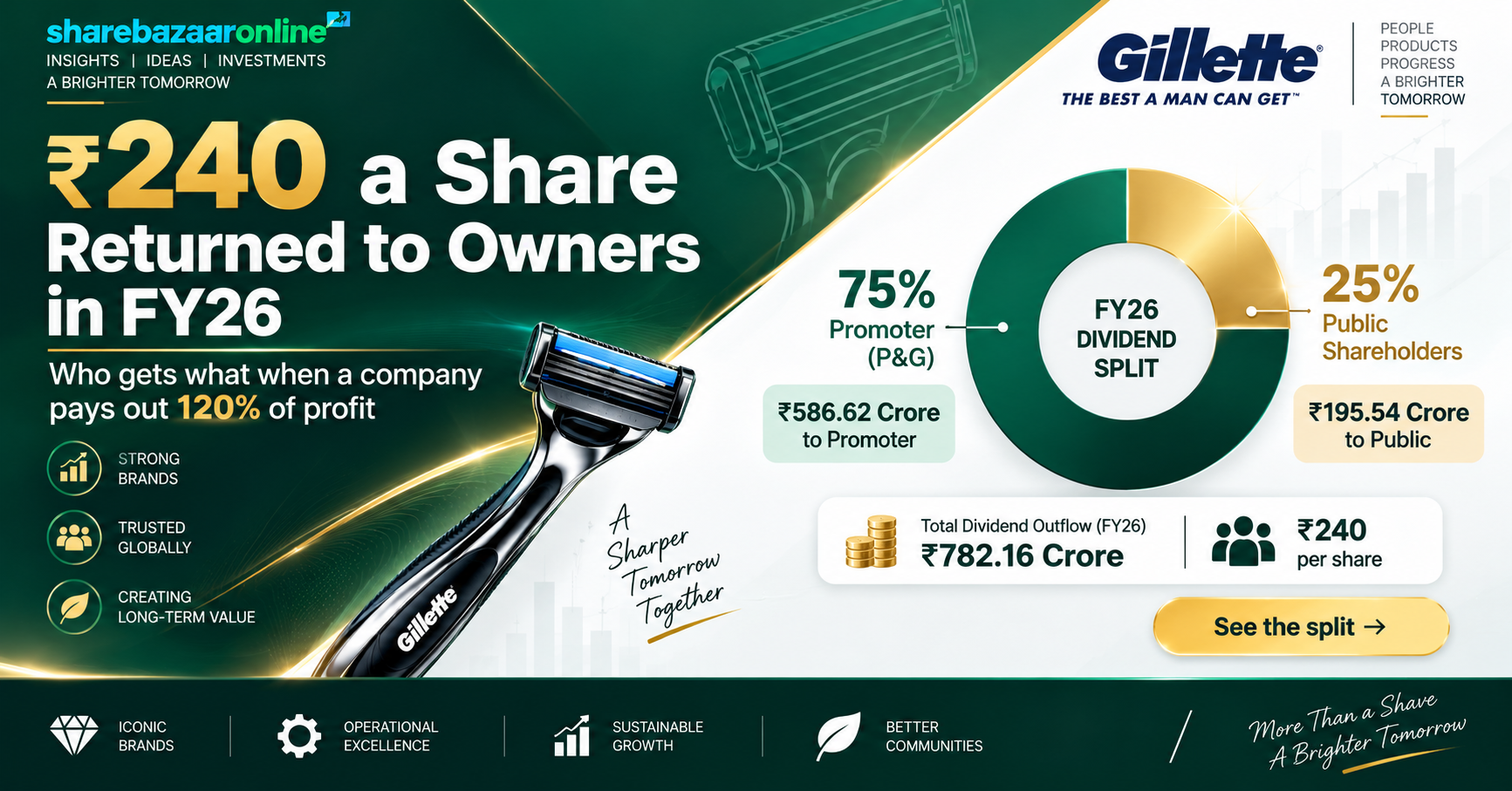
₹240
₹120 interim + ₹60 special + ₹60 final
Total FY26 Yield
~3.21%
Full ₹240 on current price
Our forensic take: The ₹60 final dividend is easily affordable in isolation — it is covered 3.35 times by earnings and 2.88 times by free cash flow. The more revealing story is the full-year ₹240 payout, which works out to roughly 119.5% of FY26 net profit. Gillette paid out more than it earned this year, drawing down cash reserves — a pattern its 90%+ return on capital and debt-free balance sheet allow, but one worth understanding before the "600%" headline is taken at face value.
Dividend Announcement Summary
At its board meeting held on 27 May 2026, the Board of Directors of Gillette India, a subsidiary of the global consumer-goods group Procter & Gamble (P&G), recommended a final dividend of ₹60 per equity share for FY2025-26. The recommendation accompanied the audited annual results and was placed before shareholders at the company’s 42nd Annual General Meeting.
What was announced
A final dividend of ₹60 per share (600% on the ₹10 face value), aggregating to a stated outflow of ₹195.51 crore as disclosed by the company. Our own computation, using a triangulated share count of 3.259 crore shares, gives ₹195.54 crore — a match within rounding.
Approval status
The final dividend was approved by members at the 42nd AGM held on 31 August 2026, per the company’s AGM voting disclosure. It is therefore confirmed rather than pending, and moves to payment within the statutory window.
Context that headlines usually omit: This ₹60 final is the second tranche of FY26. Earlier, on 29 January 2026, the Board declared an interim dividend of ₹180 per share — which itself included a one-time special dividend of ₹60 — paid on 25 February 2026. Adding the ₹60 final takes the total FY2025-26 distribution to ₹240 per share.
Key Dates Timeline
Announcement Date
27 May 2026
Record Date
24 August 2026
Ex-Dividend Date
24 August 2026
Payment Date
On or before 18 September 2026
Under India’s T+1 settlement, the ex-date and record date fall on the same trading day. Both the record date and ex-date of 24 August 2026 have already passed, so eligibility for this final dividend is now closed — investors buying the share today do not qualify for the ₹60. The company stated the dividend will be paid on or before 18 September 2026, following AGM approval on 31 August 2026. Investors should still confirm the ex-date against the official NSE/BSE corporate-action circular.
Dividend Yield Analysis
"Yield" is the only figure that tells you what the dividend is worth in cash terms. The 600% headline is calculated on the ₹10 face value — an accounting reference, not a market price. The number that matters is the dividend divided by the price you actually pay.
Yield on the ₹60 final dividend
At the current price of ₹7,480 (9 Sep 2026 close), the ₹60 final gives a real yield of just 0.80%. At the announcement-day level near ₹8,293 (27 May 2026, intraday), it was about 0.72%.
Yield on the full FY26 payout
The complete ₹240 for the year yields about 3.21% on today’s price. Data services often quote a trailing yield near 2.41%, which reflects the ₹180 regular distribution and strips out the one-time ₹60 special.
Yield reality check — why the trailing yield looks generous
A chunk of that ~3.2% trailing yield is a falling-price effect, not a rising-dividend effect. Gillette’s share price is down roughly 27% over the past year and is trading close to its 52-week low of about ₹7,160. When the denominator (price) drops, yield mechanically rises even if the payout is flat. Part of the yield is also the one-time ₹60 special dividend that will not necessarily repeat. Both factors flatter the headline yield.
Dividend History Analysis
| Financial Year | Dividend Per Share | Dividend Payout Ratio | Notes |
|---|---|---|---|
| FY26 (12M, Mar-26) | ₹240 | 120% | ₹120 interim + ₹60 special + ₹60 final |
| FY25 (9M stub, Mar-25) | ₹112 | 87% | ₹65 + ₹47; nine-month transition period |
| FY24 (12M, Jun-24) | ~₹130 | 103% | Per-share figure derived from payout × EPS |
| FY23 (12M, Jun-23) | ~₹85 | 78% | Derived |
| FY22 (12M, Jun-22) | ~₹69 | 78% | Derived |
| FY21 (12M, Jun-21) | ~₹119 | 125% | Included a special component |
| FY17 (12M, Jun-17) | ~₹164 | 211% | ₹154 special interim distributed May 2017 |
Payout ratios are sourced from public financial databases and cross-checked against the audited results. Per-share figures for FY26, FY25 and FY17 are confirmed from filings/news; figures marked "derived" are back-calculated from payout ratio × EPS and should be verified against the company’s dividend register before publication.
Classification — Consistent but lumpy payer. Gillette has paid a dividend every year, which qualifies it as a consistent payer. However, the payout is uneven year to year: it swings from around 33% in some years to over 200% in others, driven by periodic special dividends (FY17, FY21 and the FY26 special). The July-June to April-March financial-year change also created a nine-month FY25 stub, which distorts any simple year-on-year per-share comparison. Read the payout ratio, not the raw per-share number, to judge the trend.
Financial Performance Analysis
Revenue from Operations (FY26)
₹3,099.53 crore
Net Profit / PAT (FY26)
₹654.31 crore
Earnings Per Share (FY26)
₹200.80
Operating Margin (FY26)
~30%
The comparability trap — why "up 39%" is misleading
FY26 revenue of ₹3,099.53 crore looks like a 38.7% jump over FY25’s ₹2,234.84 crore. It is not a fair comparison. FY25 was a nine-month transition period (July 2024 to March 2025) created when Gillette shifted its financial-year end from June to March. Comparing a 12-month year with a 9-month stub overstates growth. Put both on the same footing:
- Annualising the 9-month FY25, revenue growth is a modest ~4%.
- On the same annualised basis, net profit growth is a healthier ~17.5%.
- The cleanest read is the March-2026 quarter, where net profit rose 21.3% year-on-year to ₹192.51 crore — a true like-for-like quarter.
Operating leverage — margins doing the heavy lifting
Profit is growing faster than revenue because margins are expanding. Operating margin improved to roughly 30% in FY26 from about 27% in the FY25 stub and 24% two years earlier, helped by productivity savings and a favourable product mix in the higher-margin Grooming segment. This is quality profit growth — earned on the operating line, not manufactured by one-off items.
Cash Flow Analysis
Reported profit is an opinion shaped by accounting choices; cash is fact. Here Gillette scores well — and reveals the one genuine stretch in its dividend policy.
Operating Cash Flow (FY26)
₹606.64 crore
Against PAT of ₹654.31 crore
Free Cash Flow (FY26)
₹563.36 crore
OCF minus capex of ₹43.28 crore
Dividend Actually Paid (FY26)
₹739.68 crore
= 122% of operating cash flow
Cash & Bank Balance
₹269.26 crore
Down from ₹415.45 crore a year earlier
Cash conversion is strong; the payout is the stretch
Operating cash flow of ₹606.64 crore converts about 93% of reported profit into cash — a high-quality figure with no red flag between profit and cash. Capex is light at ₹43.28 crore, so free cash flow is a robust ₹563.36 crore. The stretch is on the payout side: cash dividends paid during FY26 (₹739.68 crore, which includes the large February interim) came to 122% of operating cash flow. The shortfall was met by drawing down cash, which fell from ₹415.45 crore to ₹269.26 crore.
How is this dividend funded? The ₹60 final by itself is comfortably funded from current earnings and free cash flow. But the full-year ₹240 distribution was funded partly from cash reserves, not entirely from the year’s own cash generation — largely because of the one-time ₹60 special dividend. Importantly, none of it was funded by borrowing: Gillette remains debt-free.
Balance Sheet Strength
Total Borrowings
Nil — Debt-free
Total Equity (Net Worth)
₹948.43 crore
Return on Equity (FY26)
~66.5%
Return on Capital Employed (FY26)
~90.7%
Gillette runs an asset-light, debt-free balance sheet. A return on capital employed near 90% and return on equity around 66% are exceptional — they mean the business generates very high profit per rupee of capital tied up, which is precisely why it can sustain a high dividend payout without borrowing. The trade-off of paying out so aggressively is a relatively modest cash cushion (₹269.26 crore) for a company of this quality; the reserve is deliberately kept lean because surplus cash is returned to shareholders rather than hoarded.
Dividend Sustainability Analysis
| Coverage Test | ₹60 Final Only | Full FY26 ₹240 | Read |
|---|---|---|---|
| Earnings coverage (EPS ÷ DPS) | 3.35x | 0.84x | Final: strong • Total: above earnings |
| Operating cash flow coverage | 3.10x | 0.78x | Final: strong • Total: below 1x |
| Free cash flow coverage | 2.88x | 0.72x | Final: strong • Total: below 1x |
| Cash & bank coverage | 1.38x | 0.34x | Final: adequate • Total: needs earnings |
Verdict on the ₹60 final dividend
Sustainable. It passes all four coverage tests with a wide margin — earned several times over by both profit and free cash flow.
Verdict on the full ₹240 payout
Moderately sustainable. At ~120% of earnings it exceeds a single year’s profit and cash generation, sustained by reserves and the special dividend. The recurring ~₹180 base is more repeatable than the ₹240 total.
Composite verdict: The dividend is well supported by an exceptional, debt-free, high-return business. The base distribution is sustainable from operations; the ₹240 headline is elevated by a non-recurring special dividend and a draw on cash, so investors should anchor expectations to the recurring level rather than assume ₹240 repeats every year.
Peer Comparison
| Company | Dividend Yield | Payout Ratio (FY26) | ROE | Debt |
|---|---|---|---|---|
| Gillette India | ~2.4% (regular) / ~3.2% (incl. special) | ~120% (89.7% ex-special) | ~66.5% | Debt-free |
| P&G Hygiene & Health Care | — | ~91.5% | ~89% (3-yr) | Debt-free |
| Colgate-Palmolive (India) | ~2.1–2.3% | ~96–119% | ~81% | Debt-free |
| Hindustan Unilever | — | ~62% | — | Debt-free |
| Marico | — | — | ~37.6% | — |
Cells marked "—" are intentionally left blank where a figure could not be independently verified at the time of writing, rather than filled with estimates. Peer figures are drawn from public databases and vary by source and date; re-verify before publication.
Gillette sits inside a cluster of high-payout, high-return, debt-free FMCG names. Its closest mirror is sister P&G company P&G Hygiene & Health Care, which coincidentally also declared a ₹60 final for FY26 (total ₹255, no special this cycle) on a similarly high payout. Against oral-care rival Colgate, Gillette’s return on equity is comparable and its payout discipline similar. Versus the broader market leader Hindustan Unilever, Gillette pays out a far larger share of profit — a hallmark of the tightly-held P&G subsidiaries, which retain little and distribute heavily.
Promoter Impact Analysis
Promoter Holding (P&G group)
75.00%
Promoter Share of ₹60 Final
₹146.66 crore
Promoter Share of FY26 ₹240 Total
₹586.62 crore
Public / Non-Promoter Share (FY26)
₹195.54 crore
With the P&G group holding 75%, three out of every four rupees of dividend flows to the promoter. Of the ₹60 final, roughly ₹146.66 crore goes to P&G; of the full FY26 ₹240, about ₹586.62 crore. This is neither hidden nor improper — it is the arithmetic of a 75%-owned subsidiary — but it explains the company’s generous, cash-heavy payout policy: high dividends are an efficient way for a global parent to repatriate profit from a debt-free, cash-generative Indian arm. Minority shareholders benefit proportionally (about ₹195.54 crore across FY26), and the interests are aligned in the sense that the parent has every incentive to keep the cash-return engine running.
Taxation Analysis
Since April 2020, dividends in India are taxed in the hands of the shareholder, not the company. The dividend is added to your total income and taxed at your applicable income-tax slab rate. If a company’s total dividend to you in a financial year exceeds ₹5,000, the company deducts TDS at 10% (Section 194) before paying; a valid PAN is required, else TDS is higher. The TDS is not an extra cost — it is adjusted against your final tax liability when you file your return.
Worked example — standard template
An investor owns 1,000 shares of a company paying ₹10 per share, and is in the 30% tax slab:
- Gross dividend: 1,000 × ₹10 = ₹10,000
- TDS deducted at 10% (as it exceeds ₹5,000): ₹1,000 — you receive ₹9,000 in your bank
- Total tax at 30% slab: ₹3,000 (the ₹1,000 TDS is credited against this)
- Net dividend after tax: ₹7,000 — an effective 70% of the gross for a top-slab investor
Applied to Gillette’s ₹60 final dividend
An investor holding 100 Gillette shares in the 30% slab receives a gross final dividend of ₹6,000. Because it crosses ₹5,000, ₹600 TDS is deducted at source. The full tax at 30% is ₹1,800, leaving a net of ₹4,200 in hand. A shareholder in a lower slab pays less; one below the taxable threshold can claim a refund of the TDS (or file Form 15G/15H where eligible).
Key Risks
- Special-dividend dependence: The ₹240 FY26 headline includes a one-time ₹60 special. Investors extrapolating ₹240 as a run-rate risk disappointment; the repeatable base is closer to ₹180.
- Payout above earnings: A ~120% total payout means the company distributed more than it earned in FY26, funded by drawing cash down from ₹415 crore to ₹269 crore. Sustained over-distribution would erode the reserve cushion.
- Price weakness: The stock is down roughly 27% in a year and near its 52-week low. Part of the attractive-looking yield is a falling-price effect, and a rich P/E near 37x leaves limited valuation support if growth slows.
- Concentrated demand base: Grooming is the dominant segment; any slowdown in razor/blade volumes or weak urban FMCG demand hits both profit and the cash pool that funds dividends.
- Input-cost and margin risk: Current ~30% margins are near record highs. Raw-material inflation or heavier advertising/promotion spend to defend share could compress margins and, in turn, dividend capacity.
- Related-party and parent dependence: As a 75%-owned P&G subsidiary, royalty/input pricing and strategy are influenced by the parent; minority holders have limited say over payout policy.
What To Monitor
- Recurring vs special split in FY27: Watch whether the next interim/final excludes a special component — that reveals the true underlying payout the business can fund from operations.
- Operating cash flow trend: Track whether OCF grows back above the annual dividend so payouts are funded by the year’s own cash rather than reserves.
- Grooming segment volume growth: The core razor/blade business drives the whole model; monitor volume and premiumisation (Venus, electric shaving) commentary each quarter.
- Operating margin durability: Confirm the ~30% margin holds against input costs and rising advertising & sales-promotion spend.
- Cash balance rebuild: Watch whether the ₹269 crore cash pool stabilises or keeps shrinking under the payout policy.
- Rural vs urban demand mix: FMCG recovery is uneven; shifts in rural demand and distribution reach are leading indicators for revenue.
Conclusion
Gillette India’s ₹60 final dividend for FY2025-26 is a small, well-covered cash return dressed in a large "600%" headline. On the price investors actually pay, the final dividend yields about 0.80%, and the full-year ₹240 distribution about 3.21% — the latter flattered by a one-time special dividend and a share price near its 52-week low.
Positives
Debt-free, ROCE ~91% and ROE ~66%, 93% cash conversion, a consistent dividend record, and a final payout covered several times over by earnings and free cash flow.
Negatives / Watch-outs
Full-year payout above 100% of profit funded by cash draw-down, dependence on a non-recurring special dividend, a rich ~37x P/E, and a weak one-year price trend.
The positives, negatives, risks and monitoring points are laid out above so readers can weigh them for themselves. This analysis does not offer any buy, sell or hold recommendation.
Frequently Asked Questions
What dividend has Gillette India announced for FY2025-26?
What is the Gillette India dividend yield?
What is the record date for the Gillette India final dividend?
What is the ex-date for the dividend?
When will the Gillette India dividend be paid?
Who is eligible for the dividend?
How is the Gillette India dividend taxed?
Is the Gillette India dividend sustainable?
What is Gillette India’s dividend history?
Why is the dividend "600%" but the yield under 1%?
How much of the dividend goes to the promoter?
What should investors monitor going forward?
Does Gillette India carry any debt to fund its dividends?
Disclaimer
This article is for informational and educational purposes only and does not constitute investment, financial, legal or tax advice, nor any recommendation to buy, sell or hold any security. ShareBazaar Online is not a SEBI-registered investment adviser or research analyst. Figures are drawn from the company’s regulatory filing dated 27 May 2026 and from publicly available financial data sources; market prices, yields and ratios are price-dependent and change constantly, and some figures are estimated or derived and should be independently verified. Dividend approval, record date, ex-date and payment dates should be confirmed against official NSE/BSE and company disclosures. Investors must do their own research and consult a qualified, registered financial adviser and tax professional before making any decision. ShareBazaar Online accepts no liability for any loss arising from the use of this information.