
Dividend Snapshot
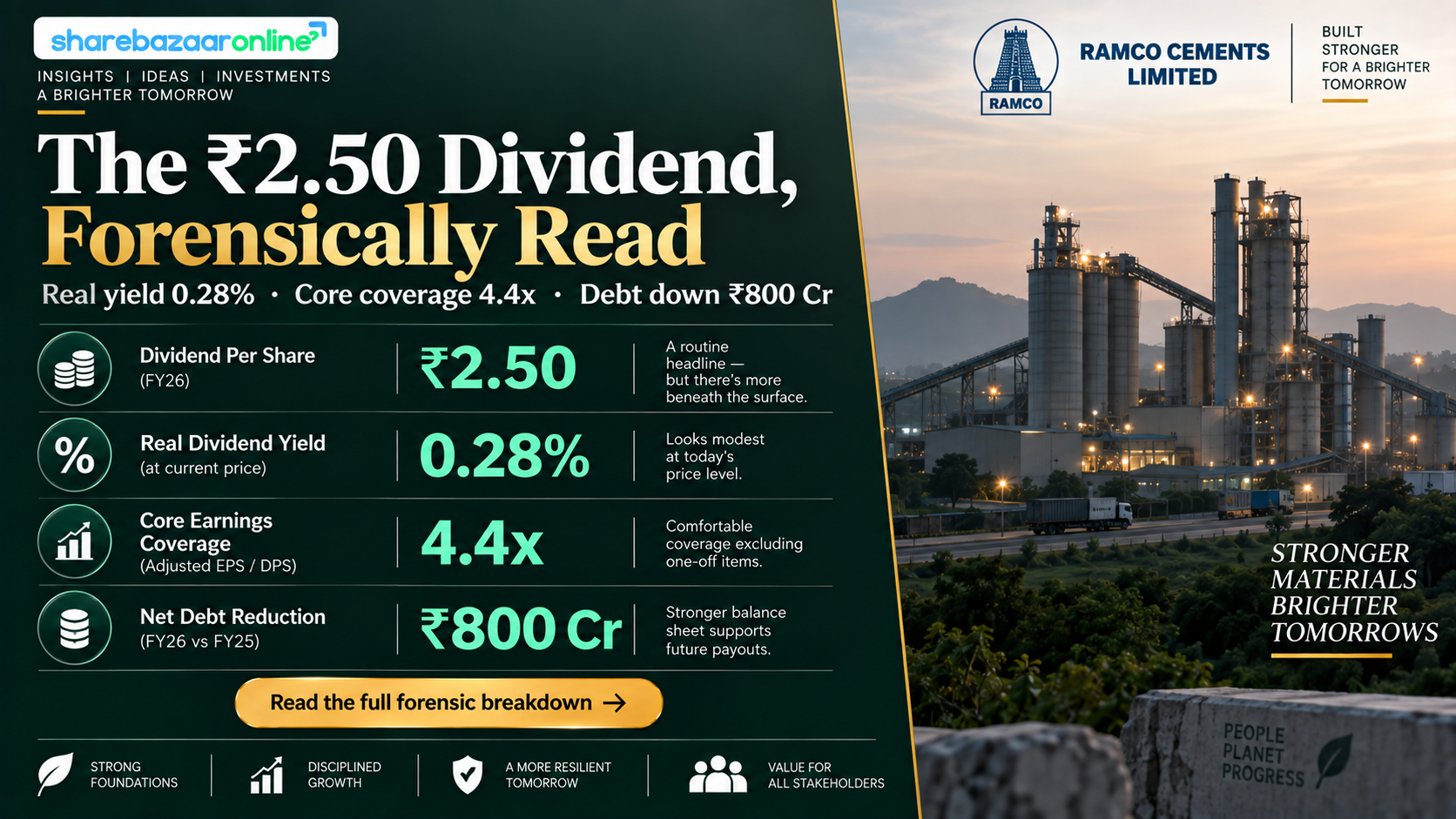
The Ramco Cements Limited (NSE: RAMCOCEM, BSE: 500260) has recommended a final dividend of ₹2.50 per share for the financial year 2025-26 (year ended 31 March 2026). Because the face value is just Re 1, this is quoted by the company as a 250% dividend — a headline that sounds enormous but works out to only ₹2.50 in cash per share. At the recent market price of about ₹879.55, the real dividend yield is a modest 0.28%.
Dividend Per Share
₹2.50
Final dividend, FY2025-26
Real Dividend Yield
0.28%
On CMP ₹879.55 (not the 250% headline)
Dividend Type
Final
Subject to AGM approval
Total Dividend Outflow
~₹59.07 Cr
₹2.50 × ~23.63 crore shares
The one-line story: The dividend is comfortably affordable and the underlying cement business genuinely recovered this year, but investors should note two things — the reported profit was heavily flattered by one-off land-sale gains, and Ramco remains a low-yield, modest-payout name rather than an income stock.
Dividend Announcement Summary
At its board meeting held on 22 May 2026, the Board of Directors of The Ramco Cements Limited recommended a dividend of ₹2.50 per equity share of Re 1 each for the year ended 31 March 2026. As a recommended final dividend, it must be approved by shareholders at the Annual General Meeting before it becomes payable. The company has stated the dividend will be paid within 30 days of declaration at the ensuing AGM.
What the board said
- Dividend recommended: ₹2.50/share (FY2025-26)
- Prior year (FY2024-25): ₹2.00/share — this is a 25% increase
- Payable within 30 days of AGM declaration
- Audit reports carried unmodified opinions (both standalone & consolidated)
Context that matters
- Single business segment: cement & cement products
- FY26 profit included large exceptional gains from surplus land sales
- Board simultaneously kept the payout conservative while cutting debt
- AGM scheduled for 20 August 2026 via video conferencing
Key Dates Timeline
Board / Announcement Date
22 May 2026
Confirmed in exchange filing
Annual General Meeting
20 August 2026
Dividend requires AGM approval
Record Date
Not Disclosed by Company
Not stated in the board outcome filing
Ex-Date
13 August 2026 (external)
Reported by third-party data providers; not confirmed in the primary filing
Payment Date
Within 30 days of AGM
Statutory window; exact date per company records
Financial Year
FY2025-26
Year ended 31 March 2026
Note on eligibility: To receive a dividend you must hold shares before the ex-date. Under the T+1 settlement system, buying on the ex-date itself does not make you eligible. Because the company's filing did not specify a record date or ex-date, the ex-date shown above is drawn from third-party trackers and should be confirmed against the official NSE/BSE corporate-action circular.
Dividend Yield Analysis
The "250%" number is a face-value illusion
When a company declares a "250% dividend," that percentage is calculated on the face value of the share (Re 1), not on the price you actually pay in the market. In cash terms it is just ₹2.50 per share. The number that matters to an investor is the yield against the current market price.
Headline (face value) yield
250%
Cosmetic — ignore for investment decisions
Real yield at CMP ₹879.55
0.28%
₹2.50 ÷ ₹879.55
Yield at announcement price ₹914.55
0.27%
Price on/around 22 May 2026
Sector context
Low
Large-cap peer UltraTech yields ~2.1%; cement is generally a low-yield sector
Reality check: A 0.28% yield means ₹10 lakh invested in Ramco Cements would generate roughly ₹2,840 a year in dividends before tax. Ramco is a capital-appreciation / cyclical-recovery story, not an income stock. The yield is low mainly because the company deliberately keeps its payout ratio small and reinvests cash into capacity and debt reduction.
Dividend History Analysis
| Financial Year | Dividend / Share (₹) | Face Value | Type |
|---|---|---|---|
| FY2025-26 | 2.50 | Re 1 | Final |
| FY2024-25 | 2.00 | Re 1 | Final |
| FY2023-24 | 2.50 | Re 1 | Final |
| FY2022-23 | 2.00 | Re 1 | Final |
| FY2021-22 | 3.00 | Re 1 | Final |
| FY2020-21 | 3.00 | Re 1 | Final |
| FY2019-20 | 2.50 | Re 1 | Interim + Final |
| FY2018-19 | 3.00 | Re 1 | Final |
| FY2017-18 | 3.00 | Re 1 | Final |
| FY2016-17 | 3.00 | Re 1 | Final |
Dividend history compiled from third-party corporate-action records; all figures are on the Re 1 face value, so no Ind AS 33 restatement is required. To be re-verified against company records at the desk.
Pattern classification: cyclical / irregular payer
Ramco has paid a dividend every year for at least a decade, so it is not an irregular payer in the strict sense. But the amount has wobbled between ₹2.00 and ₹3.00 depending on the cement cycle, rather than rising steadily. It is best described as a consistent-but-cyclical payer — a company that pays through the cycle but does not treat dividend growth as a priority.
This year's ₹0.50 increase
The rise from ₹2.00 to ₹2.50 is a 25% increase and takes the payout back to the FY24 level. It signals management confidence in the FY26 earnings recovery, but the absolute amount is still below the ₹3.00 peaks seen in FY18-FY22. There have been no dividend cuts to zero and no suspensions in the period reviewed.
Financial Performance Analysis
Consolidated results (₹ Crore)
| Metric | FY2025-26 | FY2024-25 | Change |
|---|---|---|---|
| Revenue from Operations | 9,028.76 | 8,518.40 | +6.0% |
| Profit Before Tax | 871.10 | 319.31 | +172.8% |
| Exceptional Items (gain) | 553.17 | 199.41 | — |
| Net Profit (to parent) | 698.65 | 272.65 | +156.2% |
| EPS (₹) | 29.56 | 11.53 | +156.4% |
Operating leverage: modest revenue growth, sharp headline profit growth — but read the fine print
Revenue grew only ~6%, yet reported profit more than doubled. That gap is not mainly operating leverage — it is largely a one-off. FY26 profit before tax included ₹553 crore of exceptional gains, principally ₹573.52 crore from the sale of surplus land (partly offset by a ₹20.30 crore charge for the new Labour Codes). Exceptional items accounted for ~63% of standalone pre-tax profit.
The encouraging part: strip out the exceptionals and the core cement business still improved sharply. Standalone profit before exceptional items and tax rose from ₹125.91 crore to ₹326.01 crore — up ~159% — driven by better cement realisations and cost control. Operating margin improved to 16% from 15%. So the recovery is real; it is the magnitude of the headline profit that is flattered.
Standalone vs consolidated: The two are very close for Ramco because the parent cement business dominates the group. Standalone net profit was ₹693.62 crore (EPS ₹29.33) versus consolidated ₹698.65 crore (EPS ₹29.56). We use consolidated figures as the primary lens and standalone for dividend-capacity checks, since the dividend is paid by the parent.
Cash Flow Analysis
Reported profit is an opinion; cash is a fact — and here the cash is strong
The most reassuring finding in this analysis is that Ramco's cash generation is genuinely robust, independent of the accounting gains. Operating cash flow of ₹1,611 crore was 2.32 times the reported net profit — a very healthy conversion ratio, helped by the large depreciation charge typical of a capital-heavy cement maker. Crucially, the exceptional land-sale gain sits in investing cash flows, not operating, so it does not inflate this operating number.
Operating Cash Flow (FY26)
₹1,611 Cr
Up from ₹1,402 Cr in FY25
Free Cash Flow (OCF − Capex)
₹614 Cr
After heavy capex of ₹997 Cr
OCF / Net Profit
2.32x
Strong cash conversion
Dividend as % of FCF
9.6%
Only 3.7% of operating cash flow
How is the dividend funded?
The ₹59 crore dividend is funded comfortably out of current-year free cash flow — it consumes less than a tenth of FCF and under 4% of operating cash. It is not being paid out of borrowings or by drawing down reserves. In fact, the company used its cash to repay debt during the year rather than lift the dividend. Receivables did rise (trade receivables and other assets absorbed ~₹149 crore of working capital), but this was more than offset by higher payables and strong core cash generation.
Balance Sheet Strength
Total Borrowings (Standalone)
₹3,852 Cr
Down ~₹800 Cr from ₹4,652 Cr
Debt-to-Equity
0.47x
Improved from 0.62x a year ago
Net Worth (Standalone)
₹8,142 Cr
Book value ~₹343/share
Cash + Liquid Balances
₹227 Cr
Interest cover 3.05x (per filing)
Ramco carries meaningful debt — net debt of about ₹3,625 crore — which is why it is not a cash-rich, high-payout name. But the direction of travel is positive: the company reduced gross borrowings by roughly ₹800 crore in FY26 and brought debt-to-equity down to 0.47x from 0.62x. Interest cover of 3.05x is adequate. The land-sale proceeds and strong operating cash both helped fund this deleveraging. A leaner balance sheet is arguably more valuable to shareholders than a slightly larger dividend at this stage of the cycle.
Dividend Sustainability Analysis
Four-test coverage scorecard
| Test | Coverage | Verdict |
|---|---|---|
| Earnings coverage (reported EPS ÷ DPS) | 11.7x | Very strong |
| Earnings coverage (core, ex one-offs) | 4.4x | Comfortable |
| Operating cash flow coverage | 27x | Very strong |
| Free cash flow coverage | 10.4x | Very strong |
| Liquidity / cash coverage | 3.8x | Adequate |
Composite verdict: Sustainable
On every test the ₹2.50 dividend is well covered. Even after stripping out the exceptional land-sale gains, core earnings still cover the dividend ~4.4 times, and free cash flow covers it more than 10 times. The payout is so conservative that sustainability is not in question — the risk is the opposite, that the payout stays small.
The honest caveat
Headline coverage of 11.7x overstates the comfort because FY26 profit was inflated by one-offs. The core coverage of 4.4x is the number to anchor on. It is still healthy, but it shows how much of the reported cushion is non-recurring. In a weak cement year, coverage on core earnings could compress toward 2-3x while still remaining safe.
Peer Comparison
| Company | Latest DPS | Approx. Yield | Payout | Note |
|---|---|---|---|---|
| Ramco Cements | ₹2.50 | ~0.28% | ~8.5% | Low-yield, mid-cap, deleveraging |
| UltraTech Cement | ₹240.00 | ~2.1% | ~21-28% | Largest player, steady raiser |
| Shree Cement | — | — | — | High-margin, low-yield growth name |
| Dalmia Bharat | — | — | — | East-India growth focus |
| JK Cement | — | — | — | Mid-cap, capex phase |
Cells shown as — are intentionally left blank rather than filled with unverified figures. Peer yields/payouts to be completed at the desk from each company's latest filing.
The cement sector as a whole is a low-dividend-yield sector — companies reinvest heavily into capacity, so yields are typically well under 2%. Even against that backdrop, Ramco's ~0.28% yield and ~8.5% payout sit at the low end. Market leader UltraTech pays a far larger absolute dividend and a higher payout, reflecting its scale and cash generation. Ramco's lower payout is a deliberate choice tied to its debt-reduction and capex priorities, not an inability to pay.
Promoter Impact Analysis
Promoter Holding
42.56%
Per latest shareholding pattern
Promoter Dividend Income
~₹25.1 Cr
42.56% of the ~₹59 Cr outflow
Of the ~₹59 crore total dividend, roughly ₹25.1 crore flows to the promoter group (the Ramco / P.R. Venketrama Raja family) and about ₹33.9 crore to public and institutional shareholders. Institutional ownership is significant — mutual funds hold ~19%, insurers ~9% and foreign investors ~8%. Because the payout is modest, the promoter is clearly not using dividends as a primary cash-extraction route; the family benefits far more from long-term value creation and the deleveraging of the business than from this small distribution. Minority shareholders receive dividends on identical per-share terms.
Taxation Analysis
How dividends are taxed in India
Since the abolition of Dividend Distribution Tax in FY2020-21, dividends are taxed in the hands of the investor at their applicable income-tax slab rate. The company deducts TDS at 10% under Section 194 only if the total dividend paid to a resident shareholder by that company exceeds ₹10,000 in a financial year (the threshold was raised from ₹5,000 with effect from FY2025-26). For most retail investors receiving a small dividend, no TDS is deducted, but the dividend must still be declared and taxed at slab rate.
Worked example: retail investor holding 1,000 shares (30% slab)
| Shares held | 1,000 |
| Dividend per share | ₹2.50 |
| Gross dividend | ₹2,500 |
| TDS under Section 194 (below ₹10,000 threshold) | ₹0 |
| Tax at 30% slab + 4% cess (31.2%) | ₹780 |
| Net dividend in hand | ₹1,720 |
| Effective post-tax yield (on CMP ₹879.55) | ~0.20% |
Illustrative only; surcharge may apply to high-income investors and figures vary by individual tax situation. This is not tax advice — consult a qualified tax professional.
Key Risks
- Earnings quality risk: ~63% of FY26 pre-tax profit came from one-off land-sale gains. Such gains are not repeatable, so headline profit and EPS could fall sharply next year even if the cement business holds steady.
- Cement cycle & pricing risk: Ramco is a single-segment, South-India-focused cement maker. Regional oversupply and weak pricing directly hit realisations. Sources note pressure from higher mineral-bearing land tax in Tamil Nadu and coking-coal cost volatility.
- Input cost inflation: Power & fuel (~₹2,055 crore consolidated) and freight are the largest cost lines. Any spike in coal, pet-coke or diesel prices compresses margins quickly.
- Debt load: Net debt of ~₹3,625 crore means a portion of cash flow services interest. A downturn plus capex could slow further deleveraging or pressure the payout.
- Contingent liability — CCI penalty: A Competition Commission of India penalty of ₹258.63 crore (for alleged cartelisation) is under appeal at the Supreme Court, with only ₹25.86 crore (10%) re-deposited and no provision made. An adverse ruling would be a one-time hit.
- Low-yield profile: For income-seeking investors, the ~0.28% yield offers little cushion; total return depends almost entirely on share-price movement, which has been weak (the stock is near its 52-week low).
What To Monitor
- Core (ex-exceptional) profit trend: Watch whether the ₹326 crore standalone core PBT keeps growing in FY27 once land-sale gains disappear — this is the true test of the recovery.
- Cement realisations and EBITDA per tonne: Track quarterly price and volume commentary, especially South India pricing discipline post the GST rate cut on cement.
- Debt reduction pace: Whether management continues to bring borrowings and debt-to-equity down from the current 0.47x.
- Capex intensity: FY26 capex was ~₹997 crore. Monitor whether the capex cycle is peaking, which would free up more cash for dividends or faster deleveraging.
- Dividend payout policy: Watch whether the ₹2.00 → ₹2.50 increase marks the start of a rising trend or is simply cycle-linked.
- CCI litigation outcome: Any Supreme Court development on the ₹258.63 crore penalty.
- Ramco Windfarms amalgamation: Progress of the NCLT-approved scheme and its effect on the consolidated structure.
Conclusion
The Ramco Cements ₹2.50 final dividend for FY2025-26 is a small but very safe payout. The "250%" label is a face-value artefact; the real yield is about 0.28%, and the payout ratio is a conservative ~8.5%. Coverage is strong on every measure — free cash flow covers the dividend more than ten times over, and even core earnings (after removing one-off land-sale gains) cover it more than four times.
The two findings that separate this from a wire-service summary: first, ~63% of this year's reported profit was a one-off land-sale gain, so headline EPS growth of ~156% massively overstates the operating improvement; and second, despite that, the underlying cement business genuinely recovered (core profit up ~159%) and the company cut debt by ~₹800 crore while generating ₹614 crore of free cash. Management is clearly prioritising a stronger balance sheet over a bigger cheque to shareholders.
The positives are safety of the dividend, real operational recovery and deleveraging. The negatives are a tiny yield, profit quality distorted by one-offs, a cyclical payout history and an unresolved CCI contingency. We present these facts so you can weigh them yourself — this article does not offer any buy, sell or hold recommendation.
Frequently Asked Questions
What dividend has Ramco Cements announced for FY2025-26?
What is the Ramco Cements dividend yield?
What is the record date for the Ramco Cements dividend?
What is the ex-date for this dividend?
When will the Ramco Cements dividend be paid?
Who is eligible to receive the dividend?
How is the Ramco Cements dividend taxed?
Is the Ramco Cements dividend sustainable?
Why did reported profit jump so much this year?
What is Ramco Cements' dividend history?
How much of the dividend goes to the promoter?
What should investors monitor going forward?
Should I buy Ramco Cements for its dividend?
Disclaimer
This article is for informational and educational purposes only and is based on The Ramco Cements Limited's board-outcome filing dated 22 May 2026 and publicly available market data. It is not investment, financial, legal or tax advice, and does not constitute a recommendation to buy, sell or hold any security. ShareBazaar Online is not a SEBI-registered investment adviser or research analyst. Dividend amounts are subject to shareholder approval at the AGM; record date, ex-date and payment date must be confirmed against official NSE/BSE corporate-action circulars. All market prices and yields are price-dependent and change continuously. Figures marked "Not Disclosed by Company" were not available in the primary filing. Investments in securities are subject to market risks; please read all related documents carefully and consult a SEBI-registered adviser before investing. The Ramco Cements share price referenced is approximately ₹879.55 (NSE) as of 31 August 2026.