
Dividend Snapshot
Uniparts India Limited (NSE: UNIPARTS, BSE: 543689) declared its First Interim Dividend of ₹9 per equity share for FY2026-27, announced after the board meeting on 04 August 2026. On a face value of ₹10, the payout equals a headline 90% — but that percentage is calculated on face value, not on the market price. At the recent market price of about ₹893, the real cash yield on this single dividend works out to just ~1.01%.
Dividend Per Share
₹9.00
First Interim Dividend, FY2026-27
Face Value & "Dividend %"
₹10 | 90%
Percentage is on face value, not market price
Real Yield @ CMP ~₹893
~1.01%
Yield on the ₹9 dividend alone
Record Date
12 Aug 2026
Eligibility already determined
The one-line takeaway: A "90% dividend" sounds enormous, but the number that actually lands in a shareholder's bank account is a little over 1% of the current share price. The bigger story sits behind the headline — this ₹9 payout follows a bumper FY26 in which Uniparts distributed ₹37.75 per share, including a one-time ₹22.50 special dividend.
Dividend Announcement Summary
On 04 August 2026, the Board of Directors of Uniparts India Limited met between 5:00 PM and 5:25 PM IST and declared a First Interim Dividend of ₹9 per equity share (face value ₹10) for the Financial Year 2026-27. The company fixed 12 August 2026 as the record date for determining eligible shareholders and stated that the interim dividend would be paid within 30 days from the date of declaration. The announcement accompanied the company's Q1 FY27 (quarter ended June 2026) results.
What the company disclosed
- Dividend type: First Interim Dividend, FY2026-27
- Amount: ₹9 per equity share of ₹10 face value
- Record date: 12 August 2026
- Payment: within 30 days of declaration
- Board meeting: 5:00 PM – 5:25 PM IST, 04 Aug 2026
Context that adds meaning
- ₹9 is the largest regular interim in the company's listed history (previous highs were ₹8.25 and ₹8.00).
- It follows a heavy FY26 that included a ₹22.50 special dividend.
- Q1 FY27 net profit rose ~64% year-on-year, supporting the payout.
- Being an interim dividend, it does not require separate shareholder approval at the AGM.
Key Dates Timeline
| Event | Date | Notes |
|---|---|---|
| Board Meeting / Declaration | 04 Aug 2026 | Dividend declared post market hours |
| Ex-Date | 12 Aug 2026 | Inferred: under T+1 settlement, ex-date coincides with record date. Confirm against the official NSE/BSE corporate-action circular. |
| Record Date | 12 Aug 2026 | Company-disclosed. Eligibility already determined. |
| Payment Date | On or before 03 Sep 2026 | A specific date was not disclosed; statutory outer limit is 30 days from declaration. |
Because the record date of 12 August 2026 has passed, eligibility for this dividend was based on shareholders on the company's register as of that date. Investors buying the stock now are not eligible for this particular payout; they would be positioned for future declarations.
Dividend Yield Analysis
Yield is the single most misunderstood number in dividend reporting. Uniparts' "90%" figure is the dividend expressed as a percentage of the ₹10 face value. It has nothing to do with what you earn on your investment. The yield that matters is the dividend divided by the price you actually pay for the share.
Yield on the ₹9 dividend
- At recent CMP ~₹893: ~1.01%
- At announcement-day close ~₹733 (04 Aug 2026): ~1.23% (cited: exchange price data)
Trailing 12-month yield
- Including the ₹22.50 special (₹38.50 total): ~4.31%
- Excluding the special (₹16.00 of regular dividends): ~1.79%
Yield Reality Check
Any yield figure near 4% for Uniparts is flattered by a one-time event — the ₹22.50 special dividend paid in October 2025. Strip that out and the sustainable, recurring yield sits closer to 1.0%–1.8%. Investors screening on a high trailing yield should recognise that the special dividend is unlikely to repeat every year. All yield figures are price-dependent and should be re-verified against the live market price.
Dividend History Analysis
| Ex / Record Date | Type | DPS (₹) | Financial Year |
|---|---|---|---|
| 24 Feb 2023 | Interim | 8.25 | FY23 |
| 07 Jun 2023 | Interim | 6.00 | FY24 |
| 24 Nov 2023 | Interim | 8.00 | FY24 |
| 21 Feb 2024 | Interim | 6.00 | FY24 |
| 21 Aug 2024 | Interim | 6.75 | FY25 |
| 12 Feb 2025 | Interim | 7.50 | FY25 |
| 13/14 Aug 2025 | Interim | 8.25 | FY26 |
| 23 Oct 2025 | Special | 22.50 | FY26 |
| 16 Feb 2026 | Interim | 7.00 | FY26 |
| 12 Aug 2026 | 1st Interim | 9.00 | FY27 (current) |
Source: exchange filings and dividend-history aggregators (TipRanks, Trendlyne, Choice, EquityBulls). Uniparts listed in December 2022, so a full listed record begins from FY23.
Classification: Consistent Payer (with a cyclical tilt)
Since listing, Uniparts has paid a dividend in every half-year, typically twice a year. The company has not skipped or suspended a dividend during its listed life. However, the per-share amounts move with earnings, and it layered in a large one-time special dividend in FY26 — so the pattern is best described as a consistent payer whose amounts flex with the auto/off-highway cycle.
The FY26 anomaly worth noticing
FY26 total distribution of ₹37.75 (₹8.25 + ₹22.50 special + ₹7.00) was more than double the ₹14.00–₹14.25 range of the previous two years. The ₹22.50 special dividend, declared October 2025, was the swing factor. The FY27 first interim of ₹9 signals a return to a more normal payout rhythm.
Financial Performance Analysis
Consolidated performance (₹ Crore)
| Metric | FY22 | FY23 | FY24 | FY25 | FY26 | TTM |
|---|---|---|---|---|---|---|
| Revenue | 1,227 | 1,366 | 1,140 | 964 | 1,170 | 1,244 |
| Operating Profit | 268 | 298 | 201 | 145 | 247 | 277 |
| OPM % | 22% | 22% | 18% | 15% | 21% | 22% |
| Net Profit (PAT) | 169 | 205 | 125 | 88 | 158 | 180 |
| EPS (₹) | 37.40 | 45.40 | 27.63 | 19.50 | 35.07 | 39.98 |
Source: Screener.in consolidated financials. TTM = trailing twelve months.
A V-shaped recovery
Uniparts is a cyclical business tied to global off-highway, agriculture and construction equipment demand. Profits fell sharply from a ₹205 Cr peak (FY23) to a ₹88 Cr trough (FY25) as export markets softened, then rebounded to ₹158 Cr (FY26) — a ~79% jump. The recovery has accelerated into FY27.
Q1 FY27 momentum
In Q1 FY27 (June 2026 quarter), revenue rose ~26.9% year-on-year to about ₹347 Cr, and net profit jumped ~64.3% to ₹56.61 Cr (from ₹34.46 Cr). Operating margin expanded to around 24%. This strong quarter is the earnings backdrop for the ₹9 dividend. (cited: exchange results, HDFC Securities data)
Operating leverage: watch the base effect
The headline profit-growth numbers are large partly because they are measured against a weak base. FY25 was a cyclical low, so FY26 and Q1 FY27 growth rates look spectacular. Over five years, consolidated sales growth has been modest at about 5% compounded, which is why Screener flags "poor sales growth" as a con. The recovery is real, but the multi-year trend is cyclical rather than steadily compounding — an important distinction for a dividend investor.
Cash Flow Analysis
Reported profit is an accounting opinion; cash is a fact. For a dividend, the question is whether the business actually generates enough cash to fund the payout without borrowing or selling assets. Here Uniparts scores well.
Consolidated cash flows (₹ Crore)
| Metric | FY22 | FY23 | FY24 | FY25 | FY26 |
|---|---|---|---|---|---|
| Operating Cash Flow | 85 | 253 | 200 | 182 | 174 |
| Free Cash Flow | 50 | 223 | 166 | 152 | 148 |
| Net Profit (PAT) | 169 | 205 | 125 | 88 | 158 |
Source: Screener.in consolidated cash-flow statement.
Cash conversion is healthy
FY26 operating cash flow of ₹174 Cr against PAT of ₹158 Cr shows the business converts profit into cash. Free cash flow of ₹148 Cr comfortably covers this year's ₹9 dividend outflow of roughly ₹40.6 Cr — a coverage of about 3.65x.
The one caution: working capital
Uniparts is inventory-heavy. Inventory days run around 400 and the cash conversion cycle is roughly 320 days, with working-capital days rising to about 168 in FY26. A large chunk of cash is tied up in stock, so a demand slowdown can quickly squeeze cash generation — a structural feature of this off-highway components business.
How was the FY26 special dividend funded?
The FY26 total distribution of ~₹170 Cr (₹37.75 per share) exceeded FY26 profit of ₹158 Cr, implying an effective payout of about 108%. Consolidated reserves dipped from ₹842 Cr to ₹825 Cr over the year despite the ₹158 Cr profit — consistent with the company drawing down accumulated reserves and cash to fund the one-time ₹22.50 special dividend. The current ₹9 dividend, by contrast, is comfortably funded by current-year cash generation.
Balance Sheet Strength
Borrowings (FY26)
₹155 Cr
Low leverage for a manufacturer
Investments (FY26)
₹205 Cr
Exceeds borrowings — near net-cash
Reserves (FY26)
₹825 Cr
Down from ₹842 Cr after heavy FY26 payout
Book Value / Share
~₹193
Equity capital ₹45 Cr; ~4.51 crore shares
With borrowings of about ₹155 Cr set against investments of about ₹205 Cr, Uniparts sits in a roughly net-cash position at the group level. This matters for dividend investors: the company is not paying dividends by taking on debt. Return ratios are solid — ROCE ~21.6% and ROE ~18.3% — indicating the business earns well above its cost of capital even in the current cyclical phase. Precise line-item cash balances beyond the investments figure are Not Disclosed by Company in the summarised data used here.
Dividend Sustainability Analysis
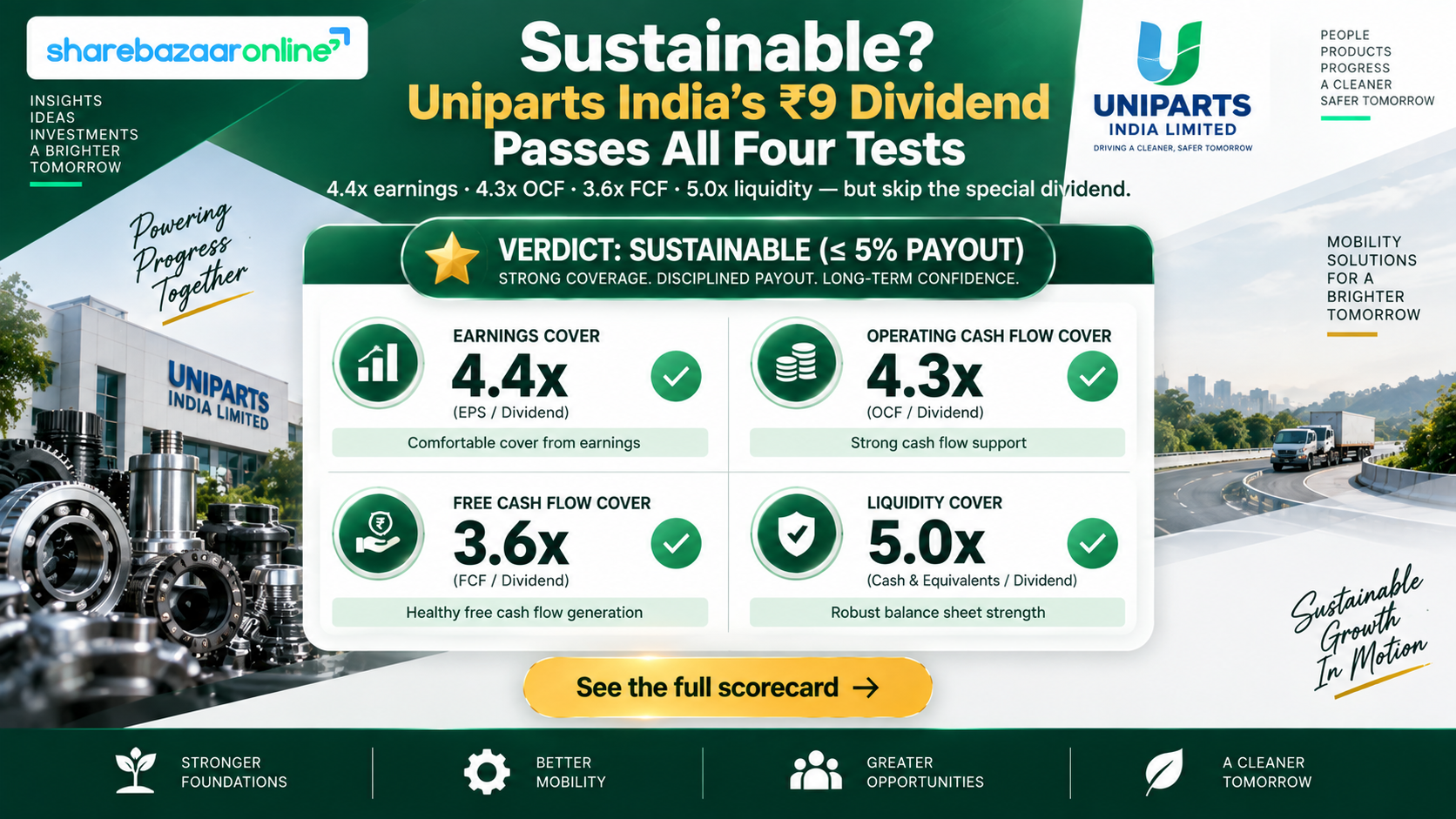
Four-test sustainability scorecard (for the ₹9 first interim)
| Test | Metric | Result |
|---|---|---|
| Earnings coverage | EPS (TTM ₹39.98) ÷ DPS ₹9 | 4.44x — strong |
| Operating cash coverage | OCF ₹174 Cr ÷ outflow ₹40.6 Cr | 4.29x — strong |
| Free cash flow coverage | FCF ₹148 Cr ÷ outflow ₹40.6 Cr | 3.65x — strong |
| Liquidity / cash coverage | Investments ₹205 Cr ÷ outflow ₹40.6 Cr | 5.05x — strong |
Verdict: Sustainable (for the recurring ₹9), but the special dividend is not a baseline
On all four tests, the ₹9 first interim is comfortably sustainable — it consumes barely a quarter of TTM earnings and is covered many times over by cash flow and liquidity. The important nuance is that investors should not annualise FY26's ₹37.75 or the special dividend. Because Uniparts is cyclical, the sustainable question is really about the regular dividend stream, which the business supports well. In a downturn like FY25 (PAT ₹88 Cr), the company still maintained its regular dividend by lifting the payout ratio — a sign of intent, but also a reminder that payout ratios expand when earnings shrink.
Peer Comparison
| Company | Recent Dividend Yield | Payout Ratio | ROE | ROCE |
|---|---|---|---|---|
| Uniparts India | ~1.0% (regular); ~1.8% trailing ex-special | ~23% on TTM EPS (this dividend) | ~18.3% | ~21.6% |
| Balkrishna Industries | ~0.7% | ~22% | — | — |
| Ramkrishna Forgings | ~0.2%–0.3% | ~8% | — | — |
| Auto Components sector (avg.) | ~0.6% | — | — | — |
Peer yields/payout: INDmoney, Simply Wall St, StockAnalysis (approximate, recent). Cells marked “—” were not independently verified and are left blank per house data-integrity policy. Verify all peer figures before publication.
Against auto-component peers, Uniparts' recurring yield of roughly 1.0%–1.8% is at the higher end — above the sector average (~0.6%) and above larger names like Balkrishna Industries and Ramkrishna Forgings. Its return ratios (ROE ~18%, ROCE ~22%) are also competitive. That said, the off-highway components space is capital-intensive and cyclical, so yields across the group are generally modest by design.
Promoter Impact Analysis
Who receives the ₹40.6 Cr?
- Total dividend outflow: ~₹40.6 Cr (₹9 × ~4.51 crore shares)
- Promoter holding: 65.87% (as of June 2026)
- Promoter dividend income: ~₹26.7 Cr
- Public & institutional shareholders: ~₹13.9 Cr
Shareholding pattern (June 2026)
- Promoters: 65.87%
- FIIs: 3.38%
- DIIs: 4.94%
- Public & others: 25.79%
With promoters (the Soni family) owning nearly two-thirds of the company, they are the largest single beneficiary of every dividend — about ₹26.7 Cr of this ₹9 payout flows to them. This is not unusual for a promoter-led Indian company and it aligns promoter and minority interests around cash returns. The flip side, seen in FY26, is that a high-promoter-ownership structure can favour generous special dividends over reinvestment. DII holding has steadily declined (from ~11% in early 2023 to ~5% now) while public shareholding has risen — a shift worth watching, though not directly dividend-related.
Taxation Analysis
Since the abolition of the Dividend Distribution Tax in FY2020-21, dividends in India are taxable in the hands of the shareholder at their applicable income-tax slab rate. There is no separate concessional rate for dividends. In addition, the company deducts TDS at 10% under Section 194 if the total dividend paid to a resident shareholder exceeds ₹5,000 in a financial year (TDS is 20% if PAN is not furnished). The TDS is adjustable against the shareholder's final tax liability.
Worked example — 1,000 shares at ₹9 dividend, 30% slab
| Gross dividend (1,000 × ₹9) | ₹9,000 |
| TDS @10% (deducted at source, as > ₹5,000) | ₹900 |
| Total tax @30% slab (incl. the ₹900 already withheld) | ₹2,700 |
| Net dividend after tax | ₹6,300 |
| Effective post-tax yield @ CMP ~₹893 | ~0.71% |
Illustrative; excludes surcharge and cess, which apply at higher income levels. Not tax advice — consult a qualified professional for your situation.
Why this matters: for a shareholder in the highest slab, roughly one-third of the dividend is lost to tax, taking the ~1.01% pre-tax yield down to about 0.71% post-tax. High-slab investors typically value dividends less than growth or buybacks for this reason.
Key Risks
- Export and cyclical demand: Uniparts sells engineered components into global off-highway, agriculture and construction equipment markets. A slowdown in these end-markets — as seen in the FY24–FY25 profit decline — directly hits earnings and the ability to raise dividends.
- Customer concentration: The company serves large international OEMs; the loss or destocking of a major customer can swing quarterly results sharply.
- Working-capital intensity: Inventory days near 400 and a cash conversion cycle of ~320 days lock up substantial cash; a demand shock can strain liquidity even when the company is profitable.
- Currency and geography: With operations and customers across 25+ countries (US, Europe, India), forex movements and regional trade or tariff shifts affect realisations and margins.
- Special-dividend base effect: Trailing-yield screens currently overstate the recurring payout because of the one-time ₹22.50 FY26 special dividend, which is unlikely to repeat annually.
- Raw-material and commodity inflation: Steel and alloy price swings can compress operating margins, which already dropped to 15% in the weak FY25 year.
What To Monitor
- Sustainability of the earnings recovery: whether the strong Q1 FY27 (PAT +64% YoY) carries through the full year, or whether it partly reflects a low FY25 base.
- Regular vs special dividend cadence: track the FY27 second interim (typically declared around February) to see the normalised annual regular payout — and whether another special dividend follows.
- Free cash flow trend: FCF eased from ₹223 Cr (FY23) to ₹148 Cr (FY26); a rebuild would strengthen future dividend capacity.
- Working-capital and inventory days: any improvement in the ~320-day cash conversion cycle would free up cash for higher distributions.
- Order book and new business awards: forward demand signals from key OEM customers across agriculture and construction equipment.
- Institutional ownership: the multi-quarter decline in DII holding — whether it stabilises or continues.
Conclusion
Uniparts India's ₹9 first interim dividend for FY2026-27 is a well-covered, cash-funded payout that reflects a genuine earnings recovery — Q1 FY27 profit rose about 64% year-on-year, and the dividend is covered roughly 4.4x by trailing earnings and 3.6x by free cash flow. The company is near net-cash, earns strong returns on capital, and has never skipped a dividend since listing.
Positives
- Strong coverage on all four sustainability tests
- Near net-cash balance sheet, low borrowings
- ROE ~18%, ROCE ~22% — quality returns
- Unbroken dividend record since December 2022 listing
Negatives / Cautions
- Real recurring yield is modest (~1.0%–1.8%)
- Highly cyclical, export-dependent earnings
- FY26 special dividend distorts trailing-yield screens
- Heavy working-capital lock-up (~320-day cycle)
In short: a solid, sustainable regular dividend from a quality cyclical business — but one whose true income appeal is around 1% rather than the "90%" or ~4% figures that headlines and trailing screens might suggest. We present the facts; the decision is yours.
Frequently Asked Questions
What dividend has Uniparts India announced?
What is the dividend yield on the ₹9 dividend?
What was the record date for this dividend?
What was the ex-date?
When was the dividend paid?
Who was eligible to receive the dividend?
How is this dividend taxed?
Is the dividend sustainable?
What is Uniparts India's dividend history?
Why did FY26 dividends look so much larger?
Does this interim dividend need AGM approval?
What should investors monitor going forward?
Disclaimer
This article is for informational and educational purposes only and does not constitute investment, financial, legal or tax advice, nor a recommendation to buy, sell or hold any security. ShareBazaar Online is not a SEBI-registered investment adviser or research analyst. Figures are drawn from the company's exchange filing dated 04 August 2026, from Screener.in, and from public dividend-history and market-data sources, and may contain errors or become outdated. Market prices, yields and dates are subject to change; all price-dependent figures must be re-verified against live data and the official NSE/BSE corporate-action circular. Dividend taxation depends on individual circumstances — consult a qualified professional. Investments in securities are subject to market risks; please read all related documents carefully and conduct your own due diligence before investing. Past performance and past dividends are not indicative of future results.