
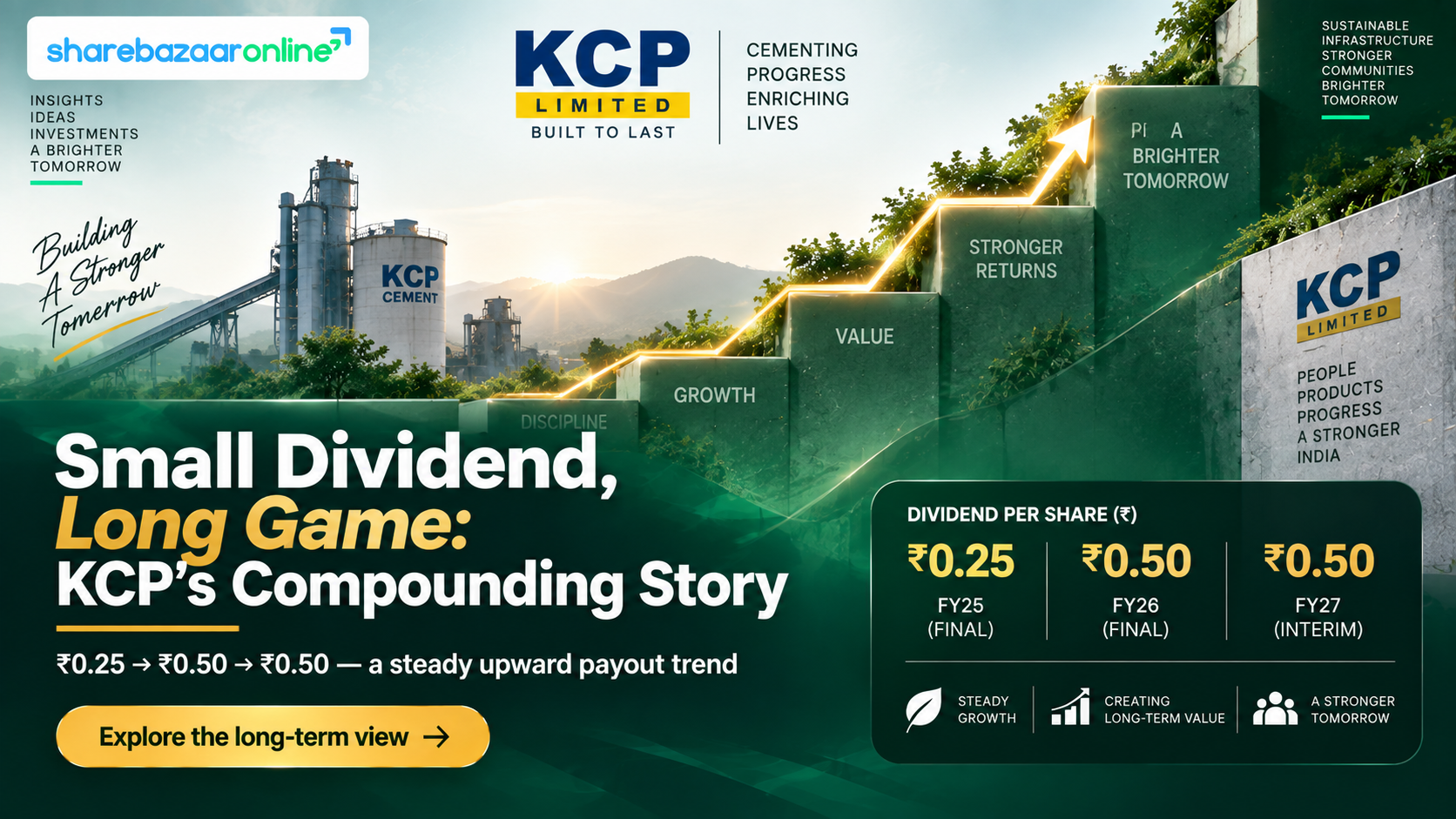
Dividend Snapshot
The KCP Limited (NSE: KCP | BSE: 590066 | ISIN: INE805C01028) has declared an Interim Dividend of ₹0.50 per equity share — that is 50% on a face value of ₹1 — for the financial year 2026-27. The payout was approved at the Board Meeting held on 3 August 2026, alongside the results for the quarter ended June 2026. This KCP dividend 2026 comes with a record date of 12 August 2026 and payment on or after 25 August 2026.
Dividend Per Share
₹0.50
Interim Dividend · 50% of ₹1 face value
Interim Dividend Yield
~0.29%
On CMP of ~₹172.81 (NSE, 9 Jul 2026)
Record Date
12 Aug 2026
Wednesday
Payment Date
On/after 25 Aug 2026
Tuesday
Quick take: The cash reward is small (a ₹0.50 KCP interim dividend), but it is comfortably covered by earnings. The more important signal in the same results is a sharp year-on-year fall in quarterly net profit even as revenue rose — a margin story every KCP shareholder should read below.
Dividend Announcement Summary
The KCP interim dividend was declared under Regulation 42 of SEBI (LODR) Regulations, 2015. The company first intimated the record date on 16 July 2026, stating the dividend would be paid if declared at the board meeting. The board then met on 3 August 2026 and confirmed an interim dividend of ₹0.50 per share for FY2026-27.
Company: The KCP Limited
NSE Symbol: KCP
BSE Code: 590066
ISIN: INE805C01028
CIN: L65991TN1941PLC001128
Dividend Type: Interim Dividend
Dividend Per Share: ₹0.50
Dividend %: 50% (on ₹1 face value)
Financial Year: FY2026-27
AGM/Shareholder approval: Not required (interim dividends are board-declared)
Management context (from public filings): The same board meeting also saw KCP approve exploration of new business lines in paints, building materials and real estate development, and the company recently commissioned a 15.8 MW Waste Heat Recovery System at its Muktyala (Andhra Pradesh) cement unit. Detailed per-line management commentary on the dividend rationale was Not Disclosed by Company in the record-date intimation.
Key Dates Timeline
Record Date Intimation
16 July 2026
Board Meeting / Announcement
3 August 2026
Ex-Date
12 August 2026
Under T+1 settlement, the ex-date and record date fall on the same day.
Record Date
12 August 2026 (Wed)
Payment Date
On or after 25 August 2026 (Tue)
Eligibility rule explained simply: To receive this KCP dividend, you must own the shares before the ex-date. Because India settles trades in T+1, buying KCP on the ex-date (12 August 2026) itself does not make you eligible — the seller keeps the dividend.
Dividend Yield Analysis
Interim Dividend Yield (this event)
~0.29%
₹0.50 ÷ ₹172.81 (NSE close, 9 Jul 2026)
Trailing 12-Month Yield
~0.58%
TTM dividend ₹1.00 (₹0.50 final FY26 + ₹0.50 interim FY27) ÷ ₹172.81
Announcement-date yield: The exact NSE closing price on 3 August 2026 (announcement day) could not be independently verified from primary sources at the time of writing — Not Disclosed by Company. Using the most recent verified price of ₹172.81 (9 July 2026), the single-event yield works out to roughly 0.29%. Readers should check the live NSE/BSE price for a current figure.
Yield reality check: KCP's yield is low not because the share price has crashed to inflate it, but simply because the dividend amount is small relative to the ₹165–₹173 share price. KCP is structurally a capital-appreciation stock, not a high-yield income stock. The stock is down roughly 28% over the past year (52-week range about ₹125–₹230), yet the yield still stays below 0.6% — confirming the low payout is a policy choice, not a distress signal.
Dividend History Analysis
| Financial Year | Type | Per Share | % | Declared |
|---|---|---|---|---|
| FY2026-27 | Interim | ₹0.50 | 50% | 3 Aug 2026 |
| FY2025-26 | Final | ₹0.50 | 50% | 28 May 2026 |
| FY2024-25 | Final | ₹0.25 | 25% | 28 May 2025 |
Trailing 12-month dividend: ₹1.00 per share. Market data providers note KCP has declared 36 dividends since 2003. A full audited year-by-year per-share table for the last 10 years could not be verified from primary filings — Not Disclosed by Company in the current intimation.
Classification: Consistent but modest payer. KCP has a long, uninterrupted history of returning small dividends. The pattern shows growth — from ₹0.25 (FY25) to ₹0.50 final (FY26) to ₹0.50 interim (FY27) — but the company has never been a large-payout name. There is no visible special dividend, suspension, or cut in the recent record; instead the story is a slow, steady rise off a low base.
Financial Performance Analysis
The headline the record-date notice hides: In Q1 FY2026-27 (quarter ended June 2026), KCP's consolidated revenue rose to about ₹779 crore from ₹676 crore a year earlier (up ~15%), but consolidated net profit fell to about ₹36.8 crore from ₹63.5 crore (down ~42%). Standalone revenue for the quarter was about ₹388.67 crore. In plain terms: the company sold more but earned less.
FY2024-25 (Consolidated)
Revenue: ₹2,590 Cr (down ~9% YoY)
Net Profit: ₹147 Cr (down ~22% YoY)
Net Margin: ~5.7% (from ~6.6%)
EPS: ₹11.41 (vs ₹14.63 in FY24)
Growth Trend
5-Year Sales Growth: ~8.1% (described as poor)
EPS trend: Declining (₹14.63 → ₹11.41)
Q1 FY27 PAT: Down ~42% YoY
Other income (standalone): ~₹119 Cr
Operating leverage warning: When revenue climbs but profit drops, the culprit is usually margin compression — costs (raw materials, energy, employee or other expenses) rising faster than selling prices. For a cement-heavy business, weak realisations against firm input costs squeeze the operating margin. The large other income (~₹119 crore) also tells you a meaningful slice of reported profit comes from KCP's treasury/investment book rather than the core manufacturing business — worth keeping in mind when judging "profit quality."
Cash Flow Analysis
Reported profit is an accounting opinion; cash is a fact. Ideally we compare Operating Cash Flow (OCF) with net profit, and check whether the dividend is funded by current earnings, reserves, asset sales or borrowings.
Operating Cash Flow (latest)
Not Disclosed by Company
Not available in the record-date intimation; verify from the latest annual report/cash-flow statement.
Free Cash Flow (latest)
Not Disclosed by Company
Not verifiable from primary sources at time of writing.
What we can say with confidence: The total interim dividend outflow is only about ₹6.4 crore (₹0.50 × ~12.89 crore shares). That is a tiny fraction of FY25 net profit of ₹147 crore and is dwarfed by the company's other income of ~₹119 crore. Even without the exact cash-flow numbers, a ₹6.4 crore payout is almost certainly funded comfortably from current earnings and cash reserves, not from borrowings or asset sales. The risk here is not affordability — it is the falling profit trend behind the payout.
Balance Sheet Strength
Cash & Investments
Not Disclosed by Company
Large other income (~₹119 Cr) implies a sizeable treasury/investment book; exact figure needs the annual report.
Net Debt
Not Disclosed by Company
Verify from latest balance sheet.
ROE (3-yr avg, standalone)
~2.1%
Low; consolidated FY25 return is higher given ₹147 Cr PAT.
ROCE
Not Disclosed by Company
Not reliably verifiable from current sources.
Valuation context: KCP trades at roughly 1.1–1.2x book value and a market cap of about ₹2,000–₹2,230 crore. A low price-to-book plus a low return-on-equity is a classic profile: the market is not paying up for the assets, and the assets are not yet earning strong returns. The presence of a meaningful investment/treasury book is a cushion, but core-business returns need to improve to re-rate the stock.
Dividend Sustainability Analysis
Dividend Payout Ratio
~4.4% (interim) / ~8.8% (TTM)
₹6.4 Cr interim outflow, and ₹12.9 Cr annualised, vs FY25 PAT ₹147 Cr.
Dividend Coverage (EPS ÷ DPS)
~22.8x
EPS ₹11.41 ÷ interim DPS ₹0.50.
Verdict: Sustainable (from an affordability view). With a payout ratio in single digits and earnings covering the dividend more than 22 times over, KCP can pay ₹0.50 many times over even if profits stay soft. The caveat is that sustainability of the amount is different from the direction of earnings — profit is trending down, so the dividend is safe but not a sign of business strength. Classification for this payout: Sustainable.
Peer Comparison
| Metric | KCP Ltd (verified) | Cement / diversified peers (indicative) |
|---|---|---|
| Dividend Yield | ~0.29% (event) / ~0.58% (TTM) | Large-cap cement names typically ~0.3%–0.8% |
| Payout Ratio | ~4–9% | Verify live per peer |
| ROE | Low (~2% 3-yr standalone) | Verify live per peer |
| ROCE | Not Disclosed by Company | Verify live per peer |
| Cash Position | Sizeable treasury (other income ~₹119 Cr) | Verify live per peer |
Peer-specific yield, payout, ROE, ROCE and cash figures could not all be independently verified at the time of writing and are marked for live verification rather than estimated. This avoids presenting unverified numbers as fact.
Takeaway: KCP's yield sits at the lower end of the cement/diversified-industrials pack. Cement is generally a low-yield sector because companies reinvest into capacity; KCP fits that mould, with the added feature of a diversified sugar, engineering and power mix.
Promoter Impact Analysis
Promoter Holding
44.25%
Velagapudi Ramakrishna family group
Promoter Dividend Income (interim)
~₹2.85 Cr
44.25% × ₹6.4 Cr total outflow
Of the roughly ₹6.4 crore total interim dividend, promoters receive about ₹2.85 crore and public/institutional shareholders share the remaining ~₹3.6 crore. Institutional holding is small — FII ~2.64% and DII ~0.56% — so most non-promoter dividend flows to retail/public investors (~52.5%). Because the payout is proportional and modest, there is no disproportionate promoter benefit here.
Taxation Analysis
How dividends are taxed in India (post-2020): Dividends are added to your total income and taxed at your applicable income-tax slab rate under "Income from Other Sources." The company deducts TDS at 10% under Section 194 if your total dividend from that company in a financial year exceeds ₹10,000. For NRIs, TDS is generally 20% (plus surcharge/cess) or the lower DTAA rate.
Worked example (template)
Shares held: 1,000
Dividend: ₹10 / share
Gross dividend: ₹10,000
Tax slab: 30%
TDS @10% (if > ₹10,000): ₹1,000
Tax @30% + 4% cess: ₹3,120
Net dividend after tax: ₹6,880
KCP-specific reality (₹0.50/share)
Shares held: 1,000
Dividend: ₹0.50 / share
Gross dividend: ₹500
Below ₹10,000 threshold → No TDS
Tax @30% slab: ₹150 (+cess)
Net dividend: ~₹344
To cross the ₹10,000 TDS threshold on KCP you would need over ~20,000 shares.
Effective yield after tax: For a 30%-slab investor, an interim gross yield of ~0.29% becomes roughly ~0.20% net of tax. For lower slabs the after-tax yield is higher. Always confirm figures with a tax professional for your situation.
Key Risks
- Margin compression: Q1 FY27 showed revenue rising ~15% while net profit fell ~42% YoY — input costs and weak realisations are squeezing profitability.
- Declining earnings trend: Consolidated EPS slipped from ₹14.63 (FY24) to ₹11.41 (FY25), and FY25 revenue fell ~9% and PAT ~22%.
- Cement cyclicality & regional exposure: KCP's cement business is tied to South India demand, pricing and energy costs, which are volatile.
- Diversification execution risk: New forays into paints, building materials and real estate development are unproven and can dilute focus/returns.
- Low return ratios & reliance on other income: Modest ROE and a meaningful chunk of profit from treasury/other income (~₹119 Cr) reduce core-business quality.
- Low liquidity/float sensitivity: Small institutional holding (FII 2.64%, DII 0.56%) can mean sharper price swings.
What To Monitor
- Operating margin (OPM) trend: Watch whether the Q1 FY27 margin squeeze reverses in coming quarters.
- Cement realisations & volumes: Track South-India cement pricing and dispatch growth, plus energy/fuel costs.
- Cash flow & capex: Follow operating cash flow, free cash flow and how the WHRS/new-business investments are funded.
- Quality of profit: Monitor the share of "other income" in total profit — a lower share signals healthier core earnings.
- Dividend trajectory: See whether KCP builds on the ₹0.25 → ₹0.50 uptrend or holds flat as earnings soften.
- New segment progress: Concrete milestones in paints, building materials and real estate before assigning them value.
Conclusion
The KCP Limited interim dividend of ₹0.50 per share (50%) for FY2026-27 is a small, well-covered and easily affordable payout — earnings cover it more than 22 times over and the total outflow is only about ₹6.4 crore. For income-focused investors, the yield of roughly 0.29% (about 0.58% on a trailing basis) is modest; KCP remains a capital-appreciation stock, not a dividend play.
The more meaningful signal in the same results is operational, not the dividend: revenue up but profit down sharply, a declining EPS trend and reliance on other income. The dividend is a reassurance on balance-sheet health; the margin trend is the variable that will decide the stock's direction. We present the positives, negatives, risks and monitoring points so you can weigh them yourself.
Frequently Asked Questions
What dividend has KCP Limited announced in 2026?
What is the KCP dividend yield?
What is the KCP dividend record date?
What is the KCP ex-dividend date?
When will the KCP dividend be paid?
Who is eligible for the KCP interim dividend?
How is the KCP dividend taxed?
Is the KCP dividend sustainable?
What is KCP's dividend history?
What should investors monitor in KCP?
Does KCP interim dividend need AGM approval?
Why did KCP's profit fall while revenue rose?
What is the total KCP dividend outflow?
Disclaimer
This article is for informational and educational purposes only and does not constitute investment, tax or legal advice, nor any buy/sell/hold recommendation. Dividend figures, record and payment dates are based on KCP Limited's exchange filings; financial and market data are sourced from public providers as of July–August 2026 and may change. Items marked "Not Disclosed by Company" were not available in the source filing at the time of writing. Please verify live prices and figures and consult a SEBI-registered adviser and a tax professional before acting. ShareBazaar Online is not liable for any decisions taken based on this content.