
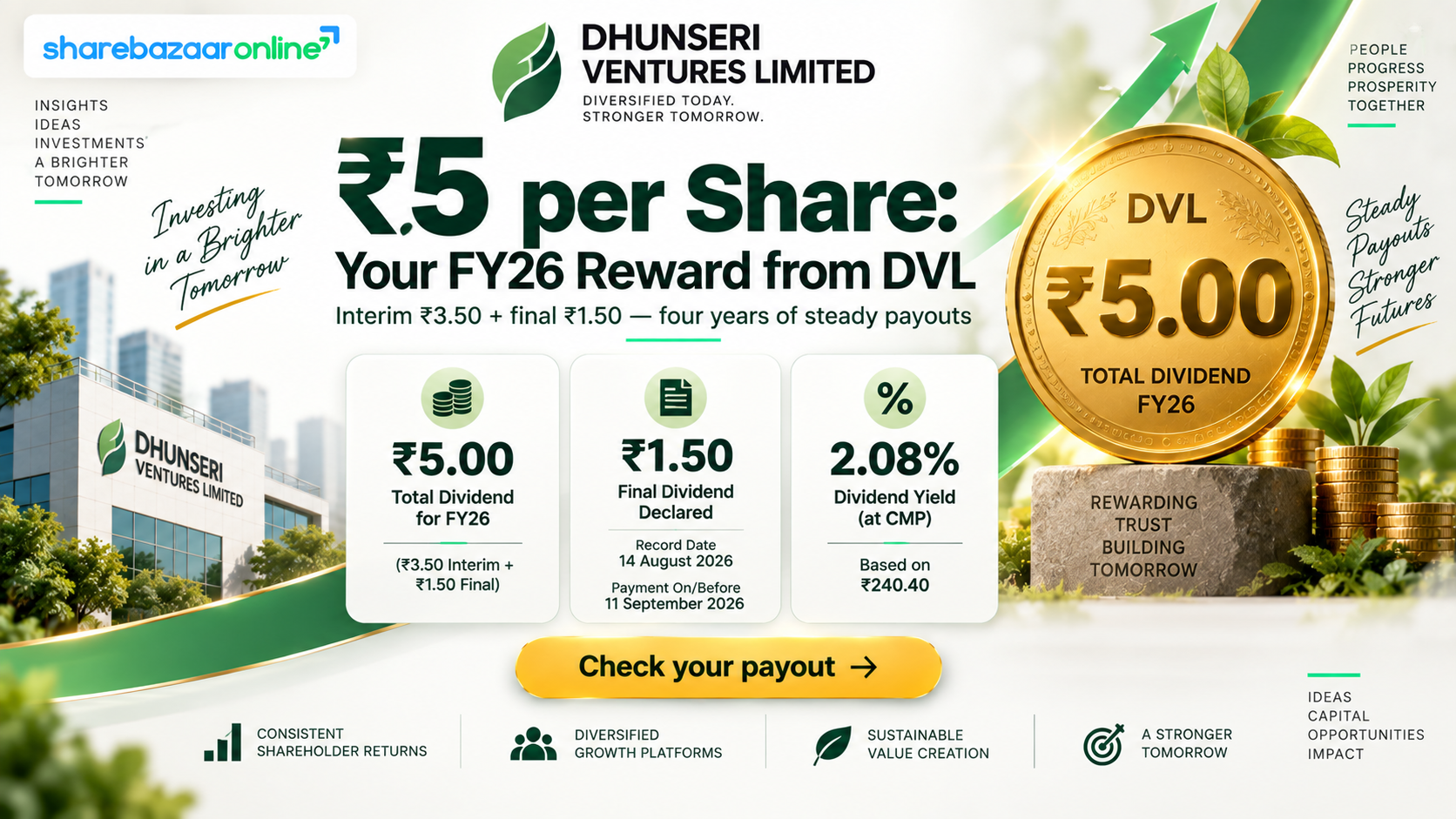
Dividend Snapshot
Final Dividend
₹1.50 / share (15%)
Face value ₹10 each
Total FY2025-26 Dividend
₹5.00 / share (50%)
₹3.50 interim + ₹1.50 final
Dividend Type
Final Dividend
FY 2025-26 (year ended 31 Mar 2026)
Record / Cut-off Date
11 August 2026
Ex-date 11 Aug 2026 (T+1)
Payment Date
On or after 21 Aug 2026
After AGM approval on 18 Aug 2026
Approx. Dividend Yield
~0.6% final · ~2.1% full year
On CMP of ~₹240 (Sep 2026)*
Dividend Announcement Summary
At its meeting held on 26 May 2026, the Board of Dhunseri Ventures Limited recommended a final dividend of ₹1.50 per equity share for FY2025-26. As a "final" dividend, it must be approved by shareholders at the AGM before it can be paid. The company has fixed 11 August 2026 as the cut-off (record) date to identify eligible shareholders and will keep its register of members closed from 12 to 18 August 2026.
Read in isolation, ₹1.50 looks like a small payout. But it is only the final leg of the year. In February 2026 the company had already paid a larger{" "} ₹3.50 interim dividend. So for the full year the shareholder receives{" "} ₹5.00 per share — the same total the company distributed for FY2022-23, FY2023-24 and FY2024-25.
| Company | Dhunseri Ventures Limited |
| NSE Symbol / BSE Code | DVL / 523736 |
| ISIN | INE477B01010 |
| Dividend per share (final) | ₹1.50 (15% on ₹10 face value) |
| Interim already paid (FY26) | ₹3.50 (35%) |
| Total FY2025-26 dividend | ₹5.00 (50%) |
| Shares outstanding | 3,50,32,900 shares |
| Final dividend outflow | ≈ ₹5.25 crore |
| Full-year FY26 outflow | ≈ ₹17.52 crore |
| AGM approval required | Yes — 110th AGM, 18 Aug 2026 |
| Registrar | KFin Technologies Ltd |
Key Dates Timeline
Announcement Date
26 May 2026
Board recommends final dividend
Record Date / Cut-off
11 August 2026
Determines eligible shareholders
Ex-Dividend Date
11 August 2026
Under T+1, ex-date = record date
Book Closure
12 – 18 August 2026
Register of members closed
AGM Date
18 August 2026
110th AGM, 11:30 AM — approval sought
Payment Date
On or after 21 Aug 2026
Credited within statutory timelines
Dividend Yield Analysis
Dividend yield tells you how much cash return a dividend represents against the price you pay for the share. Because DVL split its FY26 payout into an interim and a final dividend, it helps to look at both the final-only yield and the full-year yield.
Formula: Dividend Yield % = (Dividend per share ÷ Current Market Price) × 100.
| Basis | Dividend | Reference Price | Yield |
|---|---|---|---|
| Final dividend only | ₹1.50 | ~₹240 (CMP) | ~0.63% |
| Full-year FY26 | ₹5.00 | ~₹240 (CMP) | ~2.08% |
| Full-year FY26 (at announcement) | ₹5.00 | ~₹250 (26 May 2026)* | ~2.00% |
Yield reality check
A big part of what makes DVL's yield look "reasonable" is not a generous dividend — it is a falling share price. Over the year to September 2026 the stock fell roughly 30%, from a 52-week high near ₹402 to about ₹240. A lower denominator mechanically lifts the yield. The dividend itself (₹5.00) has been flat for four years, so the higher yield reflects price weakness as much as shareholder generosity.
*Share price on the announcement date is an approximate NSE level; verify the exact close on the exchange.
Dividend History Analysis
| Financial Year | Dividend / Share | Rate (on ₹10 FV) |
|---|---|---|
| FY2025-26 (current) | ₹5.00 (₹3.50 interim + ₹1.50 final) | 50% |
| FY2024-25 | ₹5.00 | 50% |
| FY2023-24 | ₹5.00 | 50% |
| FY2022-23 | ₹5.00 | 50% |
| FY2021-22 | ₹4.00 | 40% |
| FY2020-21 | ₹2.50 | 25% |
| FY2019-20 | ₹0.50 | 5% |
History compiled from public dividend records; the current year's split is from the company filing. Figures may be revised by data providers.
Classification: Consistent Payer
Dhunseri Ventures has paid a dividend every year through this window and has held a steady ₹5.00 per share for four consecutive years. The dividend climbed from just ₹0.50 in FY2019-20 to ₹5.00 by FY2022-23, then plateaued. There have been no dividend cuts or suspensions in recent years.
What changed this year
For the first time in recent memory the company front-loaded the payout as an interim dividend (₹3.50 in February 2026) and topped it up with a smaller ₹1.50 final. The total is unchanged at ₹5.00, but the timing shift is worth noting — it delivered cash to shareholders earlier in a year when earnings were under pressure.
Financial Performance Analysis
Dhunseri Ventures is effectively a holding-cum-investment company. Its reported profit is dominated by two things: its share of profit from PET resin associates (the IVL Dhunseri joint ventures in India and Egypt) and{" "} volatile treasury/investment gains. This is why the standalone and consolidated pictures look so different, and why you must read both.
| Metric (FY26 vs FY25) | Standalone | Consolidated |
|---|---|---|
| Revenue from operations | ₹263.70 cr (−10.1%) | ₹371.75 cr (−11.9%) |
| Total income | ₹385.77 cr | ₹454.14 cr |
| Share of associate profit | — (shown as dividend income ₹58.61 cr) | ₹183.78 cr (+22.7%) |
| Exceptional item (impairment) | ₹26.26 cr | — |
| Profit before tax | (₹1.39 cr) | ₹112.72 cr (continuing) |
| Net profit | ₹5.50 cr (−91%) | ₹87.93 cr (−38%) |
| EPS | ₹1.57 | ₹25.97 |
Operating leverage worked against the company
Revenue fell ~12% at the consolidated level, but the damage below the top line was worse. The Treasury Operations segment swung to a loss of about ₹63.7 crore{" "} (from a small ₹1.3 crore profit a year earlier), driven by adverse investment/mark-to-market movements. The Flexible Packaging Films segment profit fell to ₹23.05 crore from ₹35.72 crore. Without the ₹183.78 crore share of associate profit, the group would have been loss-making at the pre-tax level.
The standalone red flag
On a standalone basis the company reported a pre-tax loss of ₹1.39 crore, turned into a slim ₹5.50 crore net profit only by a deferred-tax credit. It also booked a ₹26.26 crore impairment on its Twelve Cupcakes (Singapore) subsidiary, which entered voluntary winding-up. In other words, the standalone entity that actually pays the dividend earned very little this year.
Cash Flow Analysis
Reported profit is an opinion; cash is a fact. And on cash, the FY26 picture carries a clear warning: operating cash flow was negative on both a standalone and a consolidated basis.
| Cash Flow (FY26) | Standalone | Consolidated |
|---|---|---|
| Net cash from operations | (₹69.42 cr) | (₹101.63 cr) |
| Capex (PP&E / intangibles) | ₹0.30 cr | ₹720.76 cr |
| Dividend received from associates | ₹58.61 cr | ₹58.61 cr |
| Dividends paid to shareholders | (₹29.77 cr) | (₹29.77 cr) |
| Free cash flow (OCF − capex) | Negative | Deeply negative |
Where is the dividend money coming from?
Not from operations, and not from free cash flow — both were negative this year. The dividend is effectively funded by cash the company receives from its associates{" "} (₹58.61 crore of dividend income) and by churning its large investment portfolio{" "} (net investment sales generated cash within investing activities). This is normal for a holding company, but it means the payout is not backed by the operating business.
The big capex twist
At the consolidated level the group spent about ₹720.76 crore on capex{" "} (a new Brownfield BOPET film line at Panagarh, West Bengal) and raised roughly{" "} ₹597 crore of fresh long-term borrowings to fund it. So the group is simultaneously paying dividends and borrowing heavily for expansion — a capital-allocation tension worth watching.
Balance Sheet Strength
Standalone: cash-rich, asset-heavy
The standalone balance sheet is very strong. Total equity is about{" "} ₹1,859 crore. It holds roughly ₹1,775 crore of investments{" "} (₹1,186 crore non-current + ₹589 crore current) plus ~₹20 crore of cash. Against this, standalone borrowings are only about ₹31.5 crore — the standalone entity is effectively net cash.
Cash + current investments cover the ₹17.52 crore full-year dividend roughly{" "} 35 times over. Affordability is not the concern here.
Consolidated: debt is rising fast
The consolidated picture is different because of the BOPET expansion. Consolidated borrowings jumped to about ₹951 crore from ₹369 crore a year earlier — roughly a 2.6× increase. Capital work-in-progress rose to{" "} ₹819 crore from ₹74 crore.
Net of ~₹824 crore of cash and investments, consolidated net debt is around{" "} ₹127 crore — still modest, but the trajectory is clearly upward as the project is built out.
Dividend Sustainability Analysis
| Coverage Test | Standalone | Consolidated |
|---|---|---|
| Dividend payout ratio (÷ net profit) | ~319% | ~19% |
| Dividend coverage (EPS ÷ DPS) | 0.31× | 5.19× |
| Cash coverage (cash + current inv ÷ outflow) | ~35× | — |
| Free cash flow coverage | Not covered (FCF negative) | Not covered |
Payout and coverage use the full-year FY26 dividend of ₹5.00 (₹17.52 cr outflow).
Verdict: Moderately Sustainable
The dividend is small in absolute terms (₹17.52 crore) against a company sitting on a ~₹1,775 crore investment book and receiving ~₹58.6 crore of steady dividends from its PET associates every year. On affordability, the payout is comfortable — cash and liquid investments cover it dozens of times over.
But on quality of coverage the score is weak. The dividend was{" "} not covered by standalone earnings (payout above 300%), and{" "} not funded by operating or free cash flow (both negative this year). It is also being paid while the group takes on significant new debt for its BOPET capex. A holding company can sustain such a dividend for years by leaning on its portfolio and associate income — but the buffer, not the business, is doing the work.
Peer Comparison
DVL is best compared with its own group investment-holding companies, which share a similar structure (large securities portfolios, income from investments, deep discount to book). Pure operating peers in BOPET films (e.g. Polyplex, Cosmo First, Jindal Poly Films) are useful as an industry backdrop but are not like-for-like on the treasury side.
| Company | Latest Dividend / Share | Approx. Yield | Approx. P/B |
|---|---|---|---|
| Dhunseri Ventures (DVL) | ₹5.00 (FY26) | ~2.1% | ~0.26 |
| Dhunseri Investments | ₹3.00 | ~0.2–0.3% | ~0.23 |
| Naga Dhunseri Group | ₹2.50 | ~0.07% | Low |
Peer figures are approximate market data and change with price; verify before use.
Within the group, DVL offers the highest dividend yield (~2.1% vs a fraction of a percent at its sister companies), largely because DVL pays the biggest absolute dividend and its price has fallen more. Return on equity across the group is low (DVL's consolidated ROE is only ~2.8% and standalone ROE ~0.3% this year), which is typical of investment-holding companies whose value sits in the portfolio rather than in operating returns.
Promoter Impact Analysis
Promoter Holding
~74.99%
Dhanuka family / group entities
Public / FII / DII
~22.7% / 0.56% / 1.73%
Institutional interest is minimal
| Beneficiary | Final Dividend (₹1.50) | Full-Year FY26 (₹5.00) |
|---|---|---|
| Promoters (~75%) | ≈ ₹3.94 cr | ≈ ₹13.14 cr |
| Public + institutions (~25%) | ≈ ₹1.31 cr | ≈ ₹4.38 cr |
| Total outflow | ≈ ₹5.25 cr | ≈ ₹17.52 cr |
With promoters owning about 75%, roughly three of every four rupees{" "} of dividend flow to the promoter group — about ₹13.1 crore for the full year. Minority shareholders collectively receive about ₹4.4 crore. High promoter ownership is not negative in itself, but it means dividend decisions strongly benefit insiders, and it explains why a cash-rich holding company favours regular payouts.
Taxation Analysis
Since the Dividend Distribution Tax was abolished in 2020, dividends are taxed{" "} in the hands of the shareholder as "Income from Other Sources" at your{" "} applicable income-tax slab rate.
- The company deducts TDS at 10% under Section 194 only if your total dividend from DVL exceeds ₹10,000 in a financial year (this threshold was raised from ₹5,000 to ₹10,000 with effect from FY2025-26).
- If you have not given a valid PAN, TDS is 20%.
- TDS is an advance deduction — you adjust it against your final tax liability when you file your return.
Worked example (30% slab investor)
Assume you hold 1,000 DVL shares and receive the full-year FY26 dividend of ₹5.00 per share:
| Gross dividend (1,000 × ₹5.00) | ₹5,000 |
| TDS (below ₹10,000 threshold) | ₹0 |
| Tax at 30% slab (+4% cess) | ≈ ₹1,560 |
| Net dividend after tax | ≈ ₹3,440 |
| Effective post-tax yield (on ~₹240 cost) | ≈ 1.43% |
If your total DVL dividend crossed ₹10,000 in the year, the company would deduct 10% TDS upfront; your final tax would still be at your slab rate. A 5% or nil-slab investor pays far less, or nothing, after adjustment.
Key Risks
1. Earnings depend on associates
Almost all consolidated profit (~₹184 cr) comes from the IVL Dhunseri PET associates. Any downturn in the global PET resin cycle directly hits DVL's profits and its dividend-paying capacity.
2. Volatile treasury income
The Treasury Operations segment swung to a ~₹63.7 cr loss in FY26 on adverse market movements. A large chunk of DVL's income is inherently market-linked and unpredictable.
3. Rising consolidated debt
Borrowings jumped ~2.6× to ~₹951 cr to fund the ₹720 cr BOPET line. Execution delays or cost overruns would raise leverage and interest costs while the project is not yet earning.
4. Negative operating cash flow
Both standalone and consolidated operating cash flows were negative in FY26. Dividends currently rely on associate payouts and portfolio churn, not core operations.
5. Subsidiary trouble
The Twelve Cupcakes (Singapore) F&B subsidiary went into voluntary winding-up, forcing a ₹26.26 cr impairment. It signals risk in the group's non-core diversification bets.
6. Low liquidity & float
With ~75% promoter holding and negligible institutional presence, trading volumes are thin and the price can be volatile — as the ~30% one-year decline shows.
What To Monitor
- Associate dividend inflow: Whether IVL Dhunseri continues to pay ~₹58 cr+ a year to DVL — this is the real engine of the dividend.
- BOPET project ramp-up: Commissioning timeline, capacity utilisation and margins on the new Panagarh line, and whether it starts generating cash.
- Debt trajectory: Consolidated borrowings and interest cost as the capex completes — is net debt peaking or still climbing?
- Operating cash flow: A return to positive operating cash flow would materially strengthen dividend quality.
- Treasury segment swings: Quarter-to-quarter investment gains/losses, which drive reported profit volatility.
- Dividend policy: Whether the ₹5.00 annual run-rate holds, rises, or is trimmed if earnings stay under pressure.
Conclusion
Dhunseri Ventures' ₹1.50 final dividend takes its FY2025-26 payout to ₹5.00 per share, extending a four-year streak of steady dividends and reinforcing its status as a{" "} consistent payer. For income-focused holders, the full-year yield of roughly 2.1% on a beaten-down price is reasonable for this kind of investment-holding stock.
The honest picture, though, is nuanced. The dividend is very affordable{" "} (covered dozens of times by the company's cash and investment portfolio and by ~₹58.6 crore of annual associate dividends) but of low current-year quality — it was not covered by standalone profit, and operating and free cash flow were both negative. It is being paid while consolidated debt rises sharply to fund a large BOPET expansion.
The positives are a strong balance sheet, a long dividend record, and a huge investment book; the negatives are weak core earnings, market-linked income volatility, rising leverage and a troubled overseas subsidiary. We present these facts so you can weigh them yourself — this article does not make any buy, sell or hold recommendation.